
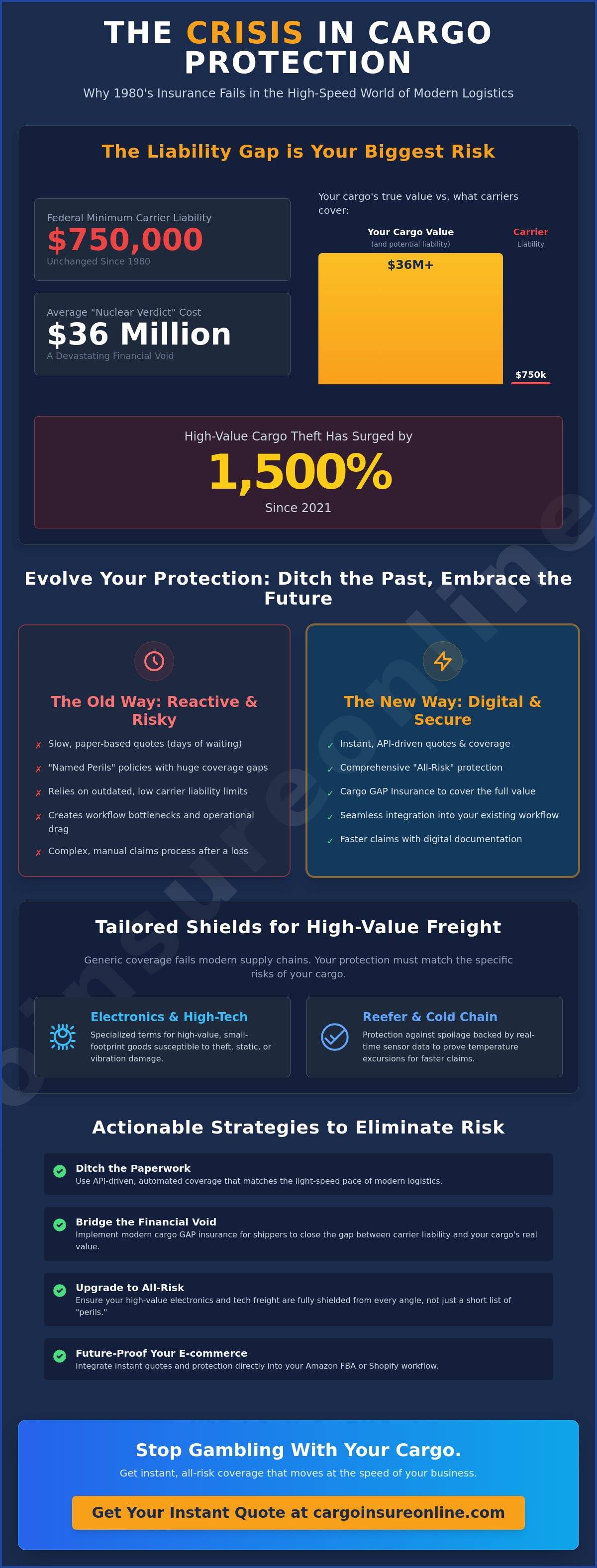
Did you know the federal minimum liability for carriers hasn't moved since 1980? While "nuclear verdicts" now average $36 million, that $750,000 requirement is a dangerous relic. You've likely felt the friction of waiting days for a quote or realized your high-value electronics were under-insured. It's an operational drag. This is why modern cargo GAP insurance for shippers is no longer optional; it's the only way to move at the speed of 2026 trade.
We agree that your protection should move as fast as your freight. This guide will help you master the high-speed world of digital coverage with actionable strategies to eliminate risk. We are ditching the paperwork for digital-first precision. You're about to learn how to secure instant coverage, protect expensive tech, and integrate insurance seamlessly into your workflow.
Key Takeaways
- Ditch the paperwork. Use API-driven, automated coverage that matches the light-speed pace of 2026 logistics.
- Bridge the dangerous financial void between carrier liability and your cargo's real value with modern cargo GAP insurance for shippers.
- Upgrade to All-Risk protection to ensure your high-value electronics and tech freight are fully shielded from every angle.
- Simplify the recovery process with real-time digital inventory transparency and instant documentation management for faster claims.
- Future-proof your e-commerce operations by integrating instant quotes and protection directly into your Amazon FBA or Shopify workflow.
The New Era of Cargo Insurance: Why Traditional Methods Fail in 2026
Cargo theft isn't just a nuisance anymore. It's an epidemic. Since 2021, high-value cargo theft has surged by a staggering 1,500%. Despite this, most shippers are still relying on insurance models built for a different century. Traditional, paper-based processes are slow. They're bureaucratic. In the high-speed world of 2026 logistics, waiting 24 hours for a quote is a liability, not a procedure. If your insurance doesn't move at the speed of your supply chain, it isn't protection. It's a bottleneck.
Modern cargo GAP insurance for shippers bridges the divide between what carriers cover and what your business actually loses. It's about moving from a reactive "wait and see" stance to a proactive, tech-led strategy. While foundational knowledge like understanding marine insurance is helpful for context, the industry has evolved. We aren't just dealing with stormy seas anymore. We're dealing with sophisticated criminal networks and hyper-accelerated supply chains that demand instant responses.
High-Velocity Trade Risks
Air, sea, and land freight are all moving faster than ever. This speed creates vulnerabilities. Traditional "named perils" policies are far too rigid for 2026. They only cover specific, listed events. If your loss doesn't fit into a tidy box defined decades ago, you're left exposed. Modern shippers need specificity. You need cargo GAP insurance for shippers that recognizes the unique risks of high-value electronics and volatile global markets. We've shifted from reactive insurance to proactive risk mitigation. This means using real-time data to identify threats before they result in a claim.
The Digital-First Mandate
Insurance shouldn't be a line item you dread. It should be a competitive advantage. Automation removes the friction that kills profit margins in global logistics. Stop viewing insurance as an administrative chore. Start seeing it as an on-demand tool. When you can secure protection instantly, you can say "yes" to high-value loads that your competitors are too slow to touch. The goal is a seamless transition from booking a shipment to securing its value. It's about empowerment. Digital integration ensures that your workflow remains uninterrupted while your financial exposure disappears. You don't need more paperwork. You need more speed.
Choosing the Right Shield: All-Risk vs. Specialized Cargo Protection
Stop settling for generic coverage. Traditional "named perils" policies are a gamble. They list specific disasters, like fire or sinking, and ignore the rest. If your loss isn't on that list, you're on your own. It's a recipe for financial ruin in a world of unpredictable logistics. You don't need a list of what might go wrong. You need a shield against everything that could.
All-Risk coverage is the modern gold standard. It flips the script by covering every incident unless it's specifically excluded. For shippers moving high-value freight in 2026, this is the only logical choice. When paired with cargo GAP insurance for shippers, you eliminate the "per-kilo" liability limits that leave your balance sheet exposed. It's about total financial recovery, not just a fraction of the cost.
Your mode of transport dictates your risk. A sea freight policy shouldn't look like a trucking policy. Air freight demands speed and specific valuation for rapid transit. Trucking requires protection against transit theft and road accidents. Tailoring your shield to the specific mode ensures you aren't paying for irrelevant clauses while filling the holes you didn't know existed.
Specialized Coverage for Electronics and Drones
High-value tech is a thief's favorite target. Standard freight protection often treats a box of semiconductors like a box of gravel. It doesn't work. Electronics and high-value devices require specialized terms that account for their small size and massive value. Electronics in transit possess a unique risk profile due to their high resale liquidity and susceptibility to microscopic damage from vibration or static. Whether it's mobile phones or advanced drone fleets, you need protection that understands the hardware. Don't let your most expensive assets be under-insured by generic freight rules.
Reefer and Temperature-Sensitive Best Practices
Managing the cold chain is a precision game. Simple spoilage coverage is a relic of the past. Modern reefer insurance relies on real-time sensor data to prove exactly when and where a temperature excursion occurred. This transparency speeds up claims and ensures freshness from the warehouse to the doorstep. It's about total protection, not just a payout for rotten goods. If you're moving perishables, our specialized Reefer Product provides the tech-led security you need to keep your cool while maintaining total supply chain visibility.
Closing the Financial Gaps: Why Carrier Liability is Your Biggest Risk
Carrier liability isn't insurance. It's a legal shield designed to protect the carrier, not your balance sheet. Relying on it is like using a paper umbrella in a hurricane. Many shippers realize this far too late, usually when a claim for $100,000 worth of cargo results in a check for $500. This is the brutal reality of the "Per-Kilo Trap." Carriers typically limit their financial responsibility based on the weight of the freight, not its actual market value. If you ship a lightweight box of high-end microchips and it vanishes, the carrier owes you for the weight of the plastic and silicon. They don't owe you for the technology inside.
Stop viewing liability as a safety net. It's a legal minimum that often fails you when you need it most. True cargo insurance covers the full invoice value of your goods. It ensures that a loss in transit doesn't become a loss on your quarterly earnings report. Furthermore, sea freight introduces the terrifying concept of General Average. Under maritime law, if a vessel is in danger and cargo is sacrificed to save the ship, every shipper on that vessel shares the cost. Even if your specific container is untouched, you could be legally required to pay for everyone else's loss. Modern cargo GAP insurance for shippers is the only way to mitigate this ancient but devastating risk.
The Hidden Costs of Under-Insurance
Calculating your real exposure is a sobering exercise. If you're relying on standard carrier limits for electronics, you're likely under-insured by 90% or more. For a lean e-commerce seller, a single maritime incident or a hijacked truck isn't just a setback. It's a bankruptcy event. Saving a few dollars on premiums creates a massive hole in your financial security. You aren't saving money; you're gambling with your company's future. Devastating bottom-line losses happen when the cost of recovery far exceeds the carrier's legal obligation.
GAP Insurance: The Missing Link in Logistics
Defining cargo GAP insurance for shippers is simple: it's the bridge over the financial void. It covers the difference between a carrier's limited liability payout and the total value of your shipment. It's the missing link in a modern, resilient supply chain. Integrating GAP protection into your standard shipping workflow shouldn't be a chore. It should be a seamless, digital-first step that happens at the moment of booking. By automating this coverage, you ensure that every load is protected from dock to doorstep without slowing down your operations. You get total loss recovery. You get peace of mind. You get back to business.
Documentation and Claims: Best Practices for Frictionless Recovery
Stop thinking of claims as a months-long battle. In 2026, speed is the only metric that matters. Every hour you wait to report damage is an hour your capital stays locked in a dispute. Traditional insurers want a paper trail. We want a digital stream. By utilizing modern cargo GAP insurance for shippers, you're choosing a system designed for rapid resolution, not bureaucratic delay. In this high-velocity market, the 24-hour reporting mindset is non-negotiable. If you don't report it immediately, you're giving the carrier an excuse to deny your recovery.
Documentation is the fuel for your recovery engine. If the fuel is dirty, the engine stalls. Leveraging technology to automate evidence-gathering is how you win. Instead of waiting for a manual inspection, use real-time data to prove your case. This isn't just about getting paid. It's about getting back to operational capacity before your customers even notice a disruption. Efficiency isn't a luxury. It's a survival trait.
Digital Documentation Standards
Paper is dead. It's slow, it gets lost, and it's easily disputed. Modern recovery relies on digital invoices and electronic packing lists that provide instant transparency. Use high-resolution photos and sensor data to bulletproof your claims. If a temperature sensor proves a reefer failure, the debate ends instantly. Also, never underestimate the power of an accurate Declared Value. If you don't declare the full worth of your high-value tech in every shipment, you're leaving your recovery to chance. Precision in your digital records ensures full financial restoration when things go wrong.
Accelerating the Claims Process
Follow a framework built for the digital age. Step 1: Immediate notification. Use mobile platforms to capture damage and notify all parties before the freight even leaves the dock. Step 2: Digital submission. Submit your Statement of Claim through a cloud-based portal. No mail. No fax. No waiting. Step 3: Rapid adjustment. In a digital-first insurance environment, settlements happen in days, not months. This streamlined flow removes the friction from your supply chain and puts your capital back where it belongs. Ready to stop the paperwork and start the protection? Get an instant cargo insurance quote today and experience the speed of modern logistics.
Future-Proofing with Cargo Insure Online: Instant Quotes and API Integration
Traditional insurance is a slow-motion wreck. Waiting 48 hours for a quote in a market that moves in milliseconds is operational suicide. You don't need more emails. You need more speed. Cargo Insure Online is the accelerator your supply chain deserves. We've replaced the bureaucratic friction of the past with a high-octane digital platform. Secure your cargo GAP insurance for shippers instantly and keep your freight moving without a single pause. It's about total control. It's about removing the hurdles that stand between you and a successful delivery.
The API revolution is here. We aren't just an insurance provider; we are a technology partner. By embedding insurance directly into your TMS or ERP system, you eliminate the need for manual data entry. Everything is connected. Everything is automated. For e-commerce giants, this means protecting Amazon FBA and Shopify shipments without lifting a finger. Your protection should be as scalable as your business. We ensure that as your volume grows, your risk mitigation stays perfectly in sync.
From Manual to Instant: The Quote Revolution
The 48-hour wait for air and sea freight quotes is a relic. It belongs in a museum, not your workflow. Cargo Insure Online delivers sophisticated, data-driven rates in seconds. Whether you're moving high-value tech or bulky industrial equipment, our automation engine calculates the risk and provides a price immediately. This allows you to finalize your shipping costs and secure coverage before the carrier even leaves the dock. To see this speed in action, explore our specialized Air Freight Insurance: High-Speed Coverage for Global Trade and see how we handle high-velocity logistics.
Scaling with White-Label and API Solutions
Logistics providers are no longer just moving boxes. They are providing comprehensive financial security. Our white-label solutions allow you to offer our sophisticated insurance products as your own. This drives new revenue streams while providing your clients with the cargo GAP insurance for shippers they desperately need. It's a win-win. Freight forwarders gain a massive technical advantage by offering embedded insurance that is transparent, fast, and reliable. Future-proof your business by leveraging a tech stack that understands the complexities of 2026 trade. Don't just survive the digital shift. Lead it.
Take Command of Your Supply Chain
The days of crossing your fingers and hoping for the best are over. Relying on carrier liability isn't a strategy; it's a gamble your balance sheet can't afford. You've seen the math. You know the per-kilo trap is real. Modern logistics demands cargo GAP insurance for shippers that works as hard as your team does. Ditch the 48-hour wait and the mountain of paperwork. Choose a digital-first approach that prioritizes your time and your profit margins.
For broader business protection beyond logistics, working with an established agency like SI Insurance can help you secure all your commercial assets effectively.
Stop settling for generic protection. Whether you're moving high-value electronics or managing a global e-commerce fleet, your coverage must be as sophisticated as your tech. We've simplified the complex. We've removed the friction. With instant quotes for air, sea, and land freight, plus seamless API and white-label integrations, you can finally focus on scaling your business. The future of trade is fast, transparent, and fully protected. Don't let your insurance be the one thing slowing you down. Get an Instant Cargo Insurance Quote Now and start shipping with total confidence.
Frequently Asked Questions
What are the best practices for cargo insurance in 2026?
Best practices in 2026 center on digital integration and speed. Manual processes are relics that slow down your operations. Use API-driven tools to secure cargo GAP insurance for shippers at the exact point of booking. This removes human error and ensures every load is fully protected before it even leaves the dock, keeping your supply chain moving at light speed.
Is carrier liability enough for shipping high-value electronics?
Carrier liability is a dangerous safety net for high-value electronics. It pays by weight, not actual market value. A box of high-end smartphones weighs very little but costs thousands of dollars. Without specialized tech insurance, a total loss could result in a payout of just a few dollars, leaving your balance sheet exposed to devastating financial hits.
How does all-risk cargo insurance differ from named perils?
Named perils policies only cover specific, listed events like fire or sinking. If the cause of loss isn't on that list, you aren't covered. All-risk insurance covers every incident unless it is specifically excluded. For modern shippers, all-risk is the only way to avoid the fine print traps and list-based gaps inherent in traditional, outdated policies.
What is cargo GAP insurance for shippers and why do I need it?
Cargo GAP insurance for shippers is a specialized policy that bridges the divide between a carrier's legal liability and the actual value of your goods. You need it because standard carrier payouts rarely cover the full replacement cost of high-value tech. It ensures you recover your total invoice value, not just a small fraction based on weight limits.
How can I speed up the cargo insurance claim process?
Stop the paperwork and start the data stream to accelerate your recovery. Report damage within 24 hours using mobile platforms to upload high-resolution photos and real-time sensor logs. Digital submissions bypass the slow mail and put your claim directly in front of an adjuster for rapid settlement and faster capital recovery, minimizing operational downtime.
Can I integrate cargo insurance into my e-commerce platform like Shopify?
You can absolutely automate your protection through digital integration. API solutions allow you to embed insurance directly into Shopify or Amazon FBA workflows. This ensures every order is protected the moment it is placed by the customer. No manual data entry. No missed shipments. Just seamless, high-speed security for your growing e-commerce brand.
What does reefer cargo insurance cover for temperature-sensitive goods?
Reefer insurance protects your temperature-sensitive goods against cold chain failures and equipment malfunctions. It goes beyond simple spoilage coverage by using real-time sensor data to prove temperature integrity throughout the journey. This ensures your perishables are protected from the warehouse to the final doorstep, maintaining freshness and total financial security for your sensitive shipments.
Why should I use a digital-first insurance provider like Cargo Insure Online?
Efficiency is the ultimate competitive advantage in modern logistics. Digital-first providers like Cargo Insure Online eliminate the 48-hour quote wait that kills deals and slows down shipping schedules. You get sophisticated rates in seconds. This allows you to move at the same high speed as global trade while maintaining total transparency and operational relief.


