That $100 "included liability" from your carrier isn't a safety net. It's a trap designed to leave you footing the bill for lost inventory. For high-growth brands, relying on standard carrier payouts instead of dedicated cargo insurance for online sellers is a gamble that costs thousands in rejected claims every year. You're building a business, not a charity for logistics giants. It's time to stop letting "lost in transit" notifications dictate your profit margins.
It's exhausting to battle slow, manual quoting systems and cryptic legal terms like "General Average" while your shipments sit idle. You deserve a shipping strategy that's as fast and digital as your storefront. We're going to master the essentials of e-commerce shipping protection so you can stop losing sleep over stolen freight or damaged electronics. No more bureaucracy. No more guesswork. Just total protection for your bottom line.
This 2026 guide reveals how to bypass carrier excuses and secure frictionless, door-to-door coverage. We'll explore the latest 2026 rate adjustments from UPS and FedEx, the shift in Amazon FBA reimbursement policies, and why third-party digital quotes are the secret to protecting your margins. It's time to turn shipping anxiety into a competitive advantage with shipping that's actually bulletproof.
Key Takeaways
- Stop falling for the carrier liability trap. Learn why weight-based payouts fail and how to secure full-value protection for your balance sheet.
- Choose the right shield. We explain why All-Risk coverage is the 2026 gold standard for modern inventory compared to risky "named perils" policies.
- Master cargo insurance for online sellers. Get the facts on Amazon and Shopify mandates to keep your accounts healthy and your freight safe.
- Protect high-value tech. Discover how to insure "target commodities" like electronics and drones that standard policies often exclude.
- Go digital-first. Say goodbye to manual manifests and hello to instant, AI-driven quotes that move as fast as your business.
The Carrier Liability Myth: Why Your Shipments Are Unprotected
Don't mistake a carrier's "declared value" for actual protection. It's a bureaucratic hurdle, not a safety net. Real cargo insurance for online sellers acts as a direct shield for your balance sheet. It ensures that when a pallet disappears, your cash flow doesn't vanish with it. You aren't just buying a policy; you're securing your ability to restock and stay in the game. Traditional shipping protection is built for the carrier's benefit, while modern insurance is built for your survival.
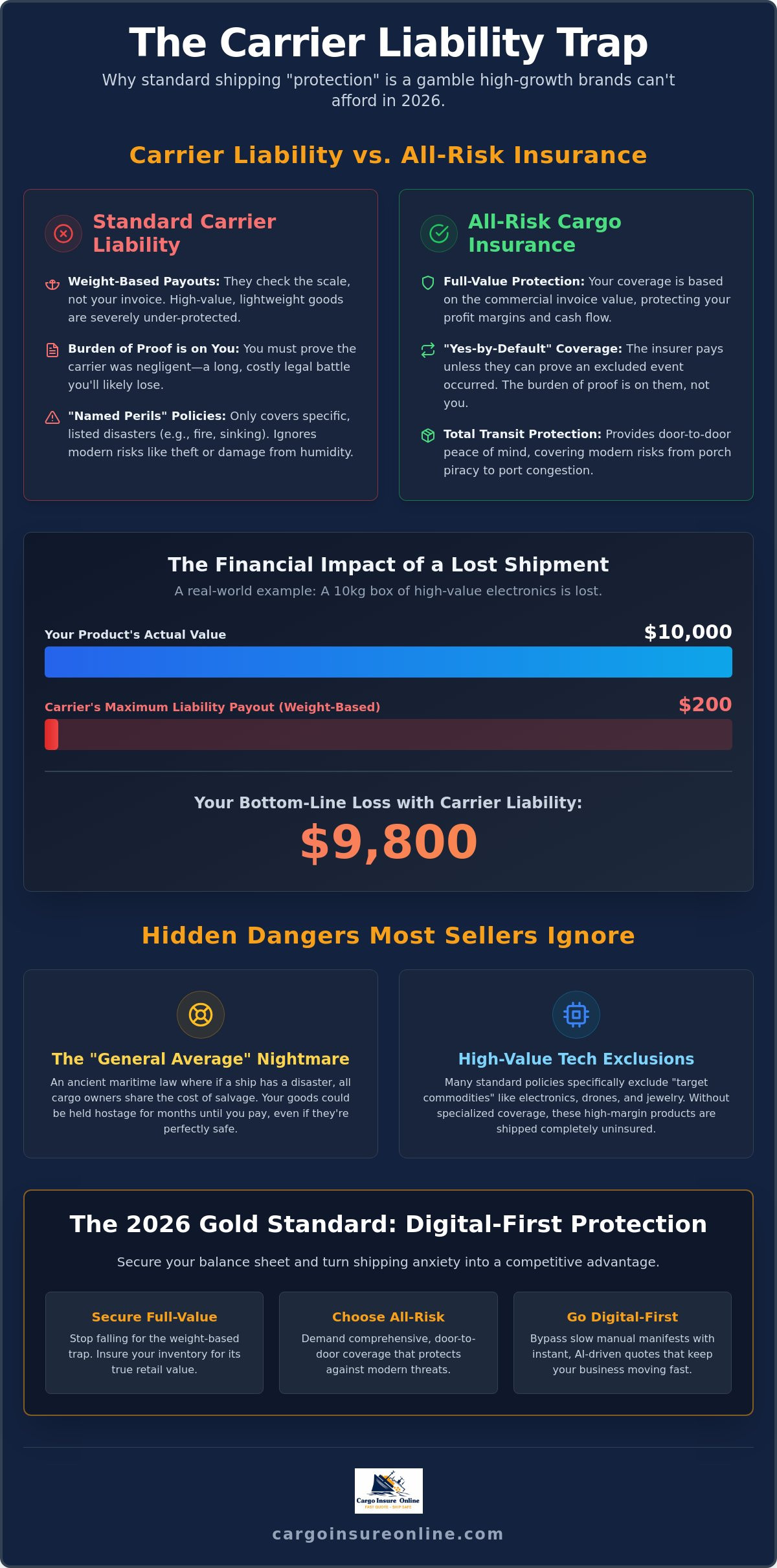
Most sellers fall into the "Limited Liability" trap without realizing it. Carriers don't look at your Shopify invoice when they lose a box. They look at the scale. International maritime and trucking laws often limit payouts to a specific "per-kilo" rate. If you're shipping lightweight, high-value tech, you're essentially uninsured. A 10kg box of smartphones worth $10,000 might only net you a $200 payout based on weight limits. That's not a settlement; it's an insult to your profit margins.
Then there's the "General Average" nightmare, a risk most sellers ignore until it's too late. This ancient maritime law means if a ship catches fire or runs aground, every cargo owner on that vessel shares the cost of the salvage. You didn't lose your goods? It doesn't matter. You still owe money to save the ship. Without proper shipping insurance, your inventory could be held hostage for months until you pay your share of someone else's disaster.
Carrier Liability vs. All-Risk Insurance
To get a cent from a carrier, you usually have to prove they were negligent. Good luck with that. You're fighting a legal team with a limitless budget while your customer demands a refund. All-Risk insurance flips the script. It's the "yes" button for damaged inventory. It doesn't care whose fault it was. If the damage happened during transit, you get paid. All-Risk insurance is the non-negotiable gold standard for 2026 e-commerce because it prioritizes your brand's continuity over carrier excuses.
The Financial Impact of "Standard" Shipping Protection
Let's look at the math. Imagine $5,000 worth of premium electronics crushed in a warehouse. Under standard carrier liability, you might walk away with a measly $40 check based on weight. That's a $4,960 hit to your bottom line. For a scaling store, one lost container isn't just an inconvenience; it's a bankruptcy event. This risk is even higher when you scale globally. You need cross-border e-commerce insurance to ensure that international complexity doesn't become a financial terminal point for your business.
Choosing Your Shield: All-Risk vs. Named Perils Coverage
Choosing the wrong policy is like buying a bulletproof vest that only covers your shoulders. In the world of cargo insurance for online sellers, you typically face two paths: Named Perils or All-Risk. One is a relic of the past; the other is your ticket to scaling without fear. Understanding the difference isn't just about insurance jargon. It's about whether your business survives a rough week at the port or a sudden spike in shipping mishaps.
Named Perils coverage is the budget option that feels like a deal until you try to file a claim. It only covers what is explicitly listed in the policy, such as a ship sinking or a warehouse fire. If your inventory is stolen by a sophisticated theft ring or damaged by extreme humidity, and those aren't "named" in your document, you get nothing. It's cheap, but it's dangerous. You're essentially betting that only a few specific bad things will happen to your freight. In 2026, that's a bet you're likely to lose.
All-Risk is the default choice for modern online sellers. Instead of listing what is covered, it covers everything unless a specific exclusion is mentioned. It shifts the burden of proof from you to the insurer. You don't have to prove how the damage happened; the insurer has to prove why they shouldn't pay. It's a "yes-by-default" model that matches the speed of high-volume e-commerce. It provides the door-to-door peace of mind that allows you to focus on sales rather than logistics disasters.
Why "All-Risk" is Non-Negotiable in 2026
The logistics landscape has shifted. Porch piracy and port congestion are no longer rare events; they're daily operational risks. All-Risk policies cover these modern headaches, including "Acts of God" like freak storms that carriers routinely use to dodge liability. When your high-value inventory is stuck in a container for six weeks, you need a policy that treats delays and damage with urgency. If you're ready to upgrade your protection, you can get a digital-first quote that actually fits your workflow.
The Hidden Gaps in Standard Policies
Even All-Risk has limits. It won't save you from poor packaging or "inherent vice," which refers to goods that deteriorate naturally. However, the biggest gap most sellers miss is Consequential Loss. Standard policies pay for the manufacturing cost of the item, but they won't pay for the lost profit or the marketing dollars you spent to acquire that customer. You also need to verify "Warehouse-to-Warehouse" clauses. You need a policy that follows your goods from the moment they leave the manufacturer until they hit the customer's doorstep. In global trade, the gap between your warehouse and the customer's door is a financial minefield without All-Risk coverage.
Platform Protection: Amazon FBA, Shopify, and Beyond
Selling on a major platform doesn't mean you're safe. Many sellers assume Amazon or Shopify has their back when a shipment vanishes. This is a dangerous misconception. Platforms provide the infrastructure, but the financial risk of transit remains firmly on your shoulders. In 2026, cargo insurance for online sellers is the only way to ensure platform growth doesn't lead to a catastrophic loss of capital. You need protection that integrates with your tech stack, not a bureaucratic reimbursement system that pays pennies on the dollar. For those looking to optimize that stack further, C Me Online provides award-winning e-commerce development and web design services.
Amazon FBA: Requirements and Realities
Amazon isn't just a marketplace; it's a strict regulator. If you're a Professional Seller with sales exceeding $10,000 in any month, Amazon mandates at least $1 million in commercial liability insurance. But don't let this mandate lull you into a false sense of security. Amazon's own reimbursement policy, updated on March 31, 2025, pays out based on manufacturing cost, not your retail price. If your inventory is lost or damaged, Amazon keeps your profit margin while you're left with a 60-day window to file a claim. Real insurance covers the full replacement value, ensuring your cash flow stays positive even when the FBA warehouse loses your pallet.
Shipping to fulfillment centers introduces unique risks. Inbound freight is often handled by multiple carriers, creating "blind spots" where damage can occur without a clear culprit. Industry data shows that 1% to 3% of FBA inventory experiences issues eligible for reimbursement each year. A dedicated policy ensures your goods are covered from the moment they leave the factory until they are checked into Amazon's system. It turns a potential financial disaster into a minor administrative blip.
Global Selling via Shopify and Independent Stores
Shopify sellers face a different challenge: the "Return to Sender" nightmare. International shipping is a minefield of customs delays and local courier handoffs. When a customer rejects a package or it's damaged during an international return, who pays? Without Shopify seller cargo insurance, you're on the hook for the shipping costs and the dead inventory. Insurance isn't just a safety net here; it's a marketing tool. In 2026, 48% of cart abandonment is driven by shipping concerns. Offering "Fully Insured Shipping" at checkout builds immediate trust and boosts conversion rates.
Managing a global store requires a 5-star customer experience. If a high-value item arrives broken, your customer wants an immediate replacement, not a three-month investigation into carrier negligence. Cargo insurance allows you to ship a replacement immediately because you know the claim is already secured. It keeps your brand reputation intact while the insurance handles the financial recovery. It's the difference between a frustrated customer leaving a 1-star review and a loyal fan praising your speed and reliability.
Specialized Coverage for High-Value and Tech Goods
Standard insurance policies are often built for low-risk commodities like gravel or lumber. They aren't designed for the high-stakes reality of shipping $2,000 drones or pallets of smartphones. Most general underwriters classify these as "Target Commodities," which is just industry code for "too risky to cover." If you're selling premium gear, relying on a basic policy is a recipe for a denied claim. You need cargo insurance for online sellers that understands the specific volatility of the tech market. Don't let an outdated exclusion clause turn a theft incident into a total loss.
In 2026, cargo insurers are implementing even stricter underwriting for high-value goods. Theft remains the primary concern for electronics. Small, lightweight packages with massive resale value are magnets for organized cargo crime. If your policy doesn't explicitly account for these risks, you're essentially self-insuring your most expensive inventory. It's time to stop crossing your fingers and start using a shield built for the digital age.
Building a shield for the digital age involves more than just insurance; it requires staying informed on all digital assets, and you can explore Course Enrollment and Subscription Fees at Cryptora Institute to deepen your understanding of the crypto economy.
Electronics and Mobile Device Logistics
Small boxes equal big risks. The high theft rate of wearable tech and mobile devices means standard carrier liability is practically useless. You need electronics shipping insurance that guarantees "Full Value" coverage. For tech resellers, this is the only way to protect your actual replacement costs rather than just the manufacturing price. Whether you're moving laptops or the latest smartwatches, specialized mobile phone shipping insurance ensures that a stolen pallet doesn't cripple your quarterly growth.
High-tech assets like drones and tablets require a policy that follows the goods through every handoff. From the factory floor to the final mile, your protection must be seamless. If you're ready to secure your high-value inventory with a policy that actually pays out, get your instant electronics quote today.
Cold Chain and Reefer Risks for Online Sellers
The e-commerce boom isn't just about gadgets; it's about perishables. Gourmet food, high-end supplements, and temperature-sensitive beauty products are flooding the market. Standard cargo policies often ignore the "Refrigeration Breakdown" risk. If a reefer unit fails at a port or on a truck, your entire shipment could become worthless in hours. This is why a specific reefer endorsement is a critical survival tool for niche sellers. You can find a deep dive into these protections in our guide to reefer cargo insurance. It's the only way to ensure your cold chain stays profitable even when the power fails.
Frictionless Logistics: Getting an Instant Quote in 2026
The old way of securing insurance is dead. Forget the days of faxing manifests or waiting 48 hours for an underwriter to check their inbox. In the high-velocity world of e-commerce, a two-day delay is an eternity. It's the difference between catching a vessel and watching your inventory sit on a hot dock for another week. Modern cargo insurance for online sellers has evolved into a digital-first tool that matches the speed of your Shopify or Amazon store. You don't need more paperwork; you need instant, AI-driven results.
Cargo Insure Online serves as your sophisticated ally in this fast-moving landscape. We've replaced bureaucratic friction with technological sophistication. By leveraging real-time data and intelligent algorithms, we provide quotes in under 60 seconds. This isn't just a convenience. It's a strategic advantage that allows you to move at the speed of global trade. Stop treating insurance as an administrative chore and start using it as a streamlined part of your logistics stack.
The 3-Step Digital Quote Process
Precision matters when you're protecting your profit margins. To get the most accurate quote, have your commercial invoice and shipment details ready. The process is designed to be punchy and efficient:
- Step 1: Enter shipment details. Input your origin, destination, and the total replacement value of your goods. Speed up the process by having your HS codes or product descriptions handy.
- Step 2: Select coverage level. As we've discussed, All-Risk is the gold standard. Choose the protection level that fits your specific commodity, whether it's high-value tech or temperature-sensitive goods.
- Step 3: Instant certificate of insurance (COI). Review your quote and confirm. Your COI is generated immediately for your files or to send to your freight forwarder.
Why Speed is Your Competitive Advantage
In 2026, logistics agility defines the winners. Instant insurance prevents port delays and ensures you never miss a critical sailing window because of a missing document. It allows you to pivot quickly when sourcing from new suppliers or testing new international markets. You can't afford to let a slow insurance broker hold your supply chain hostage. Integrating insurance directly into your workflow removes the final bottleneck in your shipping process.
Ready to ship with total confidence? Get your frictionless cargo quote now and experience protection that moves as fast as you do. Don't let outdated systems compromise your 2026 growth. Secure your inventory, protect your balance sheet, and get back to scaling your brand.
Scale Without Limits: Your Bulletproof Logistics Strategy Starts Now
You've seen the data. Carrier liability is a relic of a slower era. Relying on it is a gamble that puts your inventory and your customer trust at risk. Modern cargo insurance for online sellers isn't just about covering losses; it's about empowering your brand to move faster and bolder in a global market. You've mastered the difference between All-Risk and Named Perils. You know how to navigate platform mandates. Now, it's time to execute.
Our digital-first AI quoting engine eliminates the friction of traditional brokers. We provide global coverage across air, sea, and land; ensuring your high-value electronics and drones are protected from factory to doorstep. Don't let logistics anxiety stall your 2026 growth. Your next shipment deserves better than "good enough." Take control of your supply chain and ship with total confidence. The future of e-commerce belongs to the brands that protect their margins while they scale.
Secure your shipments with an instant, frictionless quote today.
Common Questions About Shipping Protection
Is cargo insurance for online sellers legally required?
No, the government does not legally mandate it, but it's often a contractual requirement for major platforms. For example, Amazon Professional Sellers with high monthly sales must maintain commercial liability. Beyond platform mandates, cargo insurance for online sellers is a financial necessity for anyone moving high-value inventory. It's the only way to protect your capital from the unpredictable risks of global trade.
Doesnt my shipping carrier already provide insurance?
Carriers provide "declared value," which is a limit on their liability, not a true insurance policy. While the first $100 is often free for services like FedEx and UPS, anything above that requires proof of carrier negligence. This is a high bar to clear. True third-party insurance covers you regardless of fault, including "Acts of God" and porch piracy that carriers routinely reject.
What is the "Per-Kilo" rule and how does it affect my claims?
The "Per-Kilo" rule is a maritime and trucking standard that limits carrier payouts based on the weight of the shipment rather than its invoice value. If you're shipping lightweight tech, the carrier might only owe you pennies on the dollar if the box is lost. This creates a massive financial gap for electronics sellers who lose thousands in value but only receive a weight-based pittance from the logistics provider.
Can I get cargo insurance for international e-commerce shipments?
Yes, you can secure comprehensive protection for international freight across air, sea, and land. Modern policies offer door-to-door coverage that follows your goods from an overseas manufacturer to your domestic warehouse or directly to the customer's doorstep. This is essential for managing the risks of port congestion, customs delays, and international handoffs that define global e-commerce in 2026.
What does "All-Risk" cargo insurance actually cover?
All-Risk cargo insurance covers all physical loss or damage from external causes unless a specific exclusion is listed. This includes theft, water damage, and "General Average" incidents at sea. It won't cover losses caused by poor packaging or natural deterioration of the product. It's the most robust shield available, shifting the burden of proof from the seller to the insurer for a faster claims process.
How much does cargo insurance for an online store typically cost?
Third-party insurance is typically 30% to 50% cheaper than the "declared value" fees charged by major carriers like UPS or FedEx. While carrier rates for high-value items escalate quickly, digital-first insurers offer more competitive pricing by using AI to assess risk more accurately. You'll generally save more as your shipment value increases, making it a more efficient choice for scaling brands with high-value inventory.
What happens if my Amazon FBA shipment is damaged before it reaches the warehouse?
Amazon’s reimbursement policy generally only applies once your inventory is fully checked into their fulfillment center. If your goods are damaged during inbound transit, you're responsible for the loss unless you have a separate cargo policy. Since Amazon now reimburses based on manufacturing cost rather than retail price, having your own insurance ensures you recover your full potential profit rather than just your production expenses.
How do I file a cargo insurance claim if my goods are stolen?
Filing a claim involves submitting proof of loss and value through a digital portal. You'll typically need your commercial invoice, the bill of lading, and a police report if the goods were stolen during transit. Modern insurers have replaced slow, manual audits with streamlined digital filing. This allows you to get your payout faster so you can restock and keep your store running without a cash flow crisis.


