What if your current insurance policy is actually a financial landmine? With maritime cyber incidents surging by 103% in 2025 and climate-driven premiums jumping up to 20%, the old rules of logistics no longer apply. If you're still relying on opaque "per-kilo" liability limits, you're leaving massive gaps in your balance sheet. Choosing the right cargo insurance policy isn't just a box to check. It's a strategic move to eliminate those traps. You know the drill. Traditional brokers move slowly. Their contracts are buried in jargon. Claims take forever to settle. It's a bottleneck you don't need.
This guide changes the game. You'll master the art of selecting cargo protection that matches your speed, secures your bottom line, and provides specialized coverage for high-value tech like drones and electronics. We'll show you how to transition from bureaucratic delays to a digital-first claims process that keeps your cash flow moving. From all-risk coverage to smart automation, here is your 2026 roadmap for modern cargo security.
Key Takeaways
- Stop relying on carrier liability. It's a limited legal promise, not a safety net, especially when "per-kilo" caps leave your high-value electronics exposed.
- Simplify choosing the right cargo insurance policy by aligning your protection with your specific logistics volume and digital tech requirements.
- Unlock coverage for the "untouchables." Get specialized protection for high-value tech, mobile phones, and drone cargo that standard policies often ignore.
- Demand a 60-second standard. If your insurance partner can't provide instant quotes and photo-driven digital claims, they're slowing down your business.
- Scale with confidence. Compare single shipment options for pilot projects against annual open policies designed for high-volume global traders.
Don’t Fall for the Liability Trap: All-Risk vs. Carrier Limits
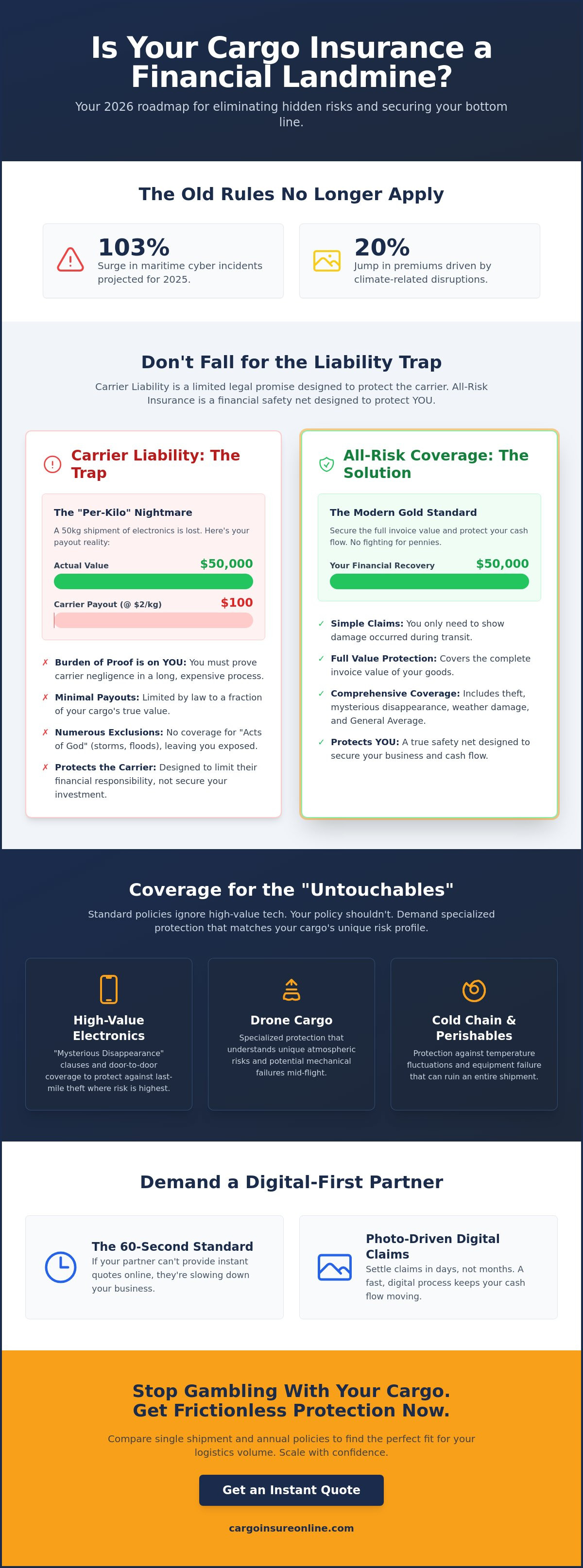
Carrier liability is a mirage. It looks like protection. It feels like a safety net. In reality, it is just a limited legal promise designed to protect the carrier, not your business. Most shippers assume their freight forwarder or trucker has them covered. They don't. They have "liability," which is a completely different animal than a dedicated policy. Choosing the right cargo insurance policy requires a shift in mindset. You aren't just buying a document; you're securing your cash flow against a system designed to pay you as little as possible.
The "Per-Kilo" nightmare is the ultimate proof of this trap. Imagine a pallet of high-value electronics. It weighs 50 kilograms but carries an invoice value of $50,000. Under standard carrier liability, you might only recover $2 per kilo. That is a $100 payout for a $50,000 loss. It is a financial disaster waiting to happen. All-risk coverage is the modern gold standard. It doesn't care about weight. It cares about value. Forget fighting for pennies. Secure the full invoice value and move on with your day.
Decoding Carrier Liability vs. All-Risk
The real difference lies in the "burden of proof." With carrier liability, you have to prove the carrier was negligent. That is a long, expensive legal battle. You lose time. You lose money. With All-Risk, you only need to show that the damage occurred during transit. It's a faster, cleaner process. In the broader context of Marine insurance, this distinction is vital. Consider "General Average" at sea. If a vessel faces a crisis and cargo is sacrificed to save the ship, every cargo owner on board shares the cost. Without All-Risk protection, a single maritime incident could hit you with a bill that bankrupts your operation before your goods even reach the dock. All-Risk is the ultimate shield against the unpredictable.
The Hidden Costs of "Free" Coverage
Standard carriers hide exclusions in their terms of service like landmines. The "Acts of God" clause is the biggest loophole in traditional freight. If a storm damages your shipment, the carrier simply points to the weather and walks away. You're left holding the bag. Choosing the right cargo insurance policy means looking past these "standard" terms. Specialized goods need more than just a basic promise. Whether it's theft, mysterious disappearance, or damage from extreme weather, you need a policy that anticipates the risks of 2026. Don't settle for the bare minimum. You deserve a digital-first partner that eliminates these gaps and provides total peace of mind.
Assessing Your Cargo DNA: Specialized Coverage for High-Value Goods
Every shipment has a unique risk profile. A pallet of raw timber doesn't face the same threats as a crate of 5G smartphones. Choosing the right cargo insurance policy starts with identifying these specific vulnerabilities. If you're moving high-value tech, you aren't just worried about a ship sinking. You're worried about theft, "mysterious disappearance," and handling damage. Standard policies often fail here because they don't account for carrier liability limitations which can leave you exposed for thousands. You need a policy that's as sophisticated as the hardware you're shipping.
High-Value Electronics and Mobile Tech
When shipping tech, "door-to-door" coverage is non-negotiable. Port-to-port leaves too many gaps during the "last mile" where theft is most common. Look for policies with zero-deductible options for high-theft items. "Mysterious disappearance" clauses are vital here. If a box goes missing and there's no sign of a break-in, a standard policy might deny the claim. A modern, all-risk policy won't. If you're moving goods at the speed of light, check out Air Freight Insurance: High-Speed Coverage for Global Trade for a deeper dive into rapid logistics protection.
Drones represent the next generation of logistics. They're expensive, fragile, and face unique atmospheric risks. Most traditional insurers won't touch drone cargo because they don't understand the technology. You need a partner that understands high-flying protection and the specific mechanical failures that can occur mid-flight. It is about protecting the future of your fleet, not just the current shipment.
The Cold Chain and Perishables
A single degree of temperature fluctuation can ruin an entire shipment of pharmaceuticals or fresh produce. Evaluating reefer breakdown clauses in your policy is essential. Don't just look for physical damage. Look for "consequential loss" coverage. If a reefer fails, you don't just lose the product; you lose the market opportunity and potential future contracts. Specialized reefer products require real-time risk mitigation to avoid a cold chain catastrophe. You need to know that if the power goes out, your bottom line is still glowing.
Amazon FBA has strict insurance requirements. If your policy doesn't match their fulfillment center standards, your goods won't even make it through the door. Choosing the right cargo insurance policy means ensuring your coverage is Amazon-compliant from day one. It's about removing friction before your cargo even hits the road. You can explore specialized Electronics & High-Value Devices Insurance to see how modern tech protection works for e-commerce leaders.
Open Policy vs. Single Shipment: Scaling Your Protection
Choosing the right cargo insurance policy isn't a one-size-fits-all decision. It is a choice between tactical agility and operational scale. If you're just starting out or exploring a new market, you might think a single shipment policy is enough. For some, it is. But as your volume grows, the administrative burden of quoting every box becomes a bottleneck. Stop quoting every journey. Start covering them automatically. Your insurance should be an accelerator, not a brake pedal on your growth.
The transition from one-off shipments to a comprehensive annual strategy is a milestone for any scaling business. It reflects a shift from reactive risk management to proactive protection. Whether you are testing a new supplier or dominating a global niche, your policy structure determines how fast you can move.
When to Stick with Single Shipment
Single shipment coverage is your tactical testing ground. It's perfect for the occasional high-value move or a pilot project on an irregular route. If you're shipping a niche product once a quarter, don't tie yourself to an annual contract. You need speed, not a long-term commitment. If your current broker makes you wait 48 hours for a quote, they are failing you. Modern platforms deliver an instant quote in seconds. Use single shipment policies to "stress test" new logistics routes or handle unique, one-time high-value tech transfers without the overhead of a full annual policy.
The Efficiency of Open Policies
As your e-commerce storefront scales, manual reporting becomes a nightmare. Open policies are the frictionless choice for high-volume global traders. They eliminate the administrative chore of reporting every individual shipment. Instead, you're covered for every journey within a set period. This isn't just about saving time; it's about the bottom line. You gain access to lower premiums through volume-based risk assessment. It is a sophisticated way to manage risk at scale. For those moving massive volumes across the ocean, integrating Sea Freight Insurance: Total Protection for the High Seas in 2026 into an open policy provides the ultimate blanket of security.
Your insurance must grow alongside your brand. A small e-commerce shop might start with single shipments, but as sales explode, the transition to an annual open policy is a sign of operational maturity. It signals to your partners that you've mastered the complexities of global trade. You move from being a reactive shipper to a proactive leader. By choosing the right cargo insurance policy structure early, you build a foundation that supports rapid, frictionless expansion.
The Tech Stack Test: Speed, Claims, and Integration
Financial stability is a baseline requirement, but it's useless if the claims process is stuck in 1995. If your insurer asks you to "send a fax" or wait three days for a quote, they are a bottleneck, not a partner. Choosing the right cargo insurance policy in 2026 means auditing their tech stack before you sign. Speed is the only metric that matters in a global market. If an instant quote takes more than 60 seconds, it's already too slow. Your business moves at the speed of the internet. Your protection must keep pace.
Transparency should be a feature, not a request. You deserve a dashboard that provides real-time tracking of policy status and claim progress. No more digging through email threads. No more chasing brokers on the phone. Modern logistics requires a digital-first approach where every active risk is visible at a glance. It's about moving from administrative chaos to streamlined control.
Evaluating the Digital Claims Experience
The moment of truth for any policy is the claim. A "modern" strategy is worthless if the payout takes months to arrive. When evaluating a provider, follow these three steps to ensure they can handle the pressure:
- Step 1: Check for a mobile-first claims portal. You should be able to upload photos of damaged goods directly from the warehouse floor. If it isn't mobile-friendly, it isn't modern.
- Step 2: Verify the average settlement speed. Aim for a partner that settles in days, not months. Slow settlements disrupt your cash flow and stall your operations.
- Step 3: Look for automated status updates. You should receive triggers via email or API the moment a claim moves from "pending" to "approved."
Embedded Insurance and APIs
The most efficient way to secure your goods is to never leave your existing platform. APIs allow modern logistics providers to embed insurance directly at the point of sale. This means freight forwarders can offer instant coverage during the booking process. White-label solutions are transforming how businesses view protection, turning a separate administrative chore into a seamless part of the shipping workflow. Embedded insurance is the future of frictionless trade. It eliminates manual data entry and ensures that no shipment ever leaves the dock unprotected. It's not just about choosing the right cargo insurance policy; it's about choosing the right integration that automates your peace of mind.
Ready to see how fast your protection can move? Get an instant quote in under 60 seconds and experience a digital-first approach to global trade.
Cargo Insure Online: Frictionless Protection for Global Logistics
Traditional insurance is a relic. It is slow, opaque, and buried in paperwork. Cargo Insure Online (CIO) is the modern alternative. We've replaced dry bureaucracy with high-speed, confident shipping. Choosing the right cargo insurance policy shouldn't feel like a chore. It should feel like a competitive advantage. We’ve built a platform where sophisticated technology meets global authority. We don't just provide a policy. We provide a frictionless journey for your most valuable assets. It's about moving from a state of administrative dread to one of confident optimism.
The logistics world moves fast. Your protection needs to move faster. We’ve stripped away the layers of middle-men and manual reporting that plague the industry. What remains is a lean, digital-first experience that empowers you to ship anything, anywhere, without hesitation. We are the ally you need to navigate the complexities of 2026 trade routes.
Why We Are Different
Most insurers run away from high-value tech. We run toward it. We specialize in the goods others are afraid to touch. Whether you are shipping advanced drones, high-end electronics, or temperature-sensitive reefer products, we have the specialized expertise to protect them. Our scope is worldwide. Our reach is global. We understand that your supply chain doesn't stop at the border. You need a partner that moves as fast as your data. We bring a sense of relief and excitement to an industry that has been stagnant for decades. We've removed the friction so you can focus on your next big move.
Our focus on high-value assets means we've built specific clauses for theft and mysterious disappearance that standard policies ignore. We've optimized our risk assessment for the modern world. This isn't just about covering a box. It's about protecting the future of your brand. When you choose us, you aren't just getting an insurance provider. You are getting a tech-savvy ally that values your time and your peace of mind. We transform insurance from a necessary evil into a seamless part of your success story.
Get Started in Minutes
Onboarding should be instantaneous. We've eliminated the 48-hour wait. With CIO, you move from quote to coverage in just a few clicks. Our instant quote tool is designed for the modern logistics professional who doesn't have time to waste. For our logistics partners, our API integration is a game-changer. You can embed our sophisticated protection directly into your own platform. It’s white-label insurance made simple. No more manual data entry. No more administrative bottlenecks. Just pure, automated efficiency.
The transition to a digital-first insurance strategy is the last piece of your modern logistics puzzle. You've optimized your shipping. You've streamlined your fulfillment. Now, it is time to automate your protection. Don't let an outdated insurance broker slow you down. Join the innovators who are already securing their bottom line with CIO. Protect your high-value cargo with an instant quote today and see how effortless global trade can be.
Secure Your Future in Global Trade
The logistics landscape of 2026 demands more than just standard promises. You've seen how carrier liability is a trap for high-value goods and how a digital tech stack is the only way to keep your cash flow moving. Choosing the right cargo insurance policy isn't just about managing risk; it is about choosing a partner that operates at your speed. Stop settling for outdated systems. Start leveraging a strategy that eliminates liability gaps and automates your peace of mind.
By shifting to all-risk protection, you secure the full invoice value of your goods. You move from administrative friction to instant results. Whether you need specialized drone and electronics coverage or global all-risk protection, the solution is at your fingertips. Experience the relief of a modern, frictionless strategy that puts you back in control of your journey.
Don't let dry bureaucracy slow your growth. Get instant digital quotes and protect your assets with the authority your business deserves. Stop waiting and start shipping with a modern cargo insurance quote. Your cargo is the lifeblood of your brand. Treat it with the sophistication it deserves.
Frequently Asked Questions
Is carrier liability enough for high-value electronics?
No, carrier liability is a financial trap for high-tech shippers. It's typically limited by weight, meaning a lightweight box of smartphones might only be covered for a few dollars per kilogram. This leaves a massive gap in your balance sheet. Choosing the right cargo insurance policy means moving beyond these "per-kilo" limits to all-risk coverage that protects the full invoice value of your hardware. Don't risk a total loss on a technicality.
What is the difference between All-Risk and Named Perils coverage?
All-Risk is a proactive shield that covers every possible threat unless it's specifically excluded in the fine print. Named Perils is a reactive, limited list that only pays out for specific events like fire or sinking. If a risk isn't on that list, you're on your own. Modern logistics requires the comprehensive safety of All-Risk to handle the unpredictable nature of global trade in 2026. It's the only way to ensure total peace of mind.
How much does cargo insurance usually cost as a percentage of value?
Industry rates for individual shipments are commonly priced at 0.1% to 2% of the declared value of the cargo. These rates vary based on your risk profile, destination, and the nature of the goods. While premiums for some have increased due to climate events, businesses with strong data and tracking often see more competitive pricing. It’s a small investment to protect your entire bottom line from a catastrophic supply chain disruption.
Can I get cargo insurance for drone shipments?
Yes, you can secure specialized protection for drone cargo and high-tech fleet movements. Traditional insurers often avoid these "risky" assets because they don't understand the technology. Modern policies now include specific clauses for atmospheric risks and mechanical failures unique to drone logistics. It's about protecting the next generation of transport with the same speed and clarity as traditional freight. Your innovation deserves an insurance partner that understands the future.
What happens if my cargo is lost at sea due to General Average?
Without insurance, you are legally required to contribute to the losses of others, even if your own cargo is safe. General Average is a maritime law where all stakeholders share the cost of saving a vessel. This can lead to a massive bill that arrives months after the incident. All-Risk insurance covers these contributions automatically. It transforms a potential bankruptcy event into a simple, covered claim. Don't let ancient laws sink your modern business.
How fast can I get a cargo insurance quote online?
You can get a quote in under 60 seconds. The days of waiting 48 hours for a broker to call you back are over. Modern digital platforms use real-time data and automation to provide instant pricing. This allows you to secure coverage and generate your certificate of insurance the moment you book your freight. It's frictionless, fast, and designed to match the high-speed rhythm of global e-commerce and trade.
Does cargo insurance cover temperature-sensitive reefer goods?
Yes, but you need a specific Reefer Product to handle the unique risks of the cold chain. Standard policies often exclude losses caused by mechanical breakdown or temperature fluctuations. A specialized reefer policy covers these gaps, ensuring your perishables or pharmaceuticals remain protected from port to door. Real-time risk mitigation is essential here. It's the difference between a successful delivery and a total loss due to a single degree of change.
What is an open cargo policy and do I need one?
An open cargo policy is an annual agreement that automatically covers every shipment you make during the year. If you move high volumes, you need this to eliminate the administrative chore of reporting every individual journey. It simplifies choosing the right cargo insurance policy by providing a blanket of security that scales with your growth. You get lower premiums through volume-based assessment and the freedom to ship without manual paperwork. It’s the ultimate frictionless solution.


