What if your "payload" insurance is actually just an empty shell that leaves your high-value cargo unprotected the moment it leaves the ground? You've built a cutting-edge UAV operation, yet you're likely still stuck waiting days for legacy brokers to assess your risk. It’s a common trap. Many operators assume their standard hull policy covers the commercial value of what they're carrying, only to face massive losses when a delivery goes sideways. Securing the right drone cargo insurance shouldn't feel like a drag on your momentum. Stop settling for "maybe" coverage; start operating with absolute certainty.
You're already dealing with the pressure of Remote ID enforcement and the 2026 rollout of FAA Part 108. You don't need the added stress of slow, non-compliant insurance. We understand that in the world of autonomous logistics, speed is your greatest asset. This guide is your roadmap to shielding autonomous deliveries and scaling your fleet with confidence. We'll break down the critical differences between Cargo Liability and All-Risk coverage, decode the new BVLOS standards, and show you how to secure instant digital protection that matches the pace of your technology.
Key Takeaways
- Spot the hidden gaps in standard hull policies and learn how to protect the actual commercial value of your high-flying payloads.
- Choose with confidence between Cargo Liability and All-Risk drone cargo insurance based on your specific operational risks and delivery models.
- Explore specialized protection strategies for high-stakes logistics, from sensitive bio-medical supplies to premium consumer electronics.
- Build a 2026-ready compliance framework that keeps your entire UAV fleet aligned with the latest global regulatory standards.
- Replace slow, legacy insurance hurdles with instant, digital-first coverage designed to match the high-speed nature of drone logistics.
Why Standard Drone Insurance Fails Your Cargo Logistics
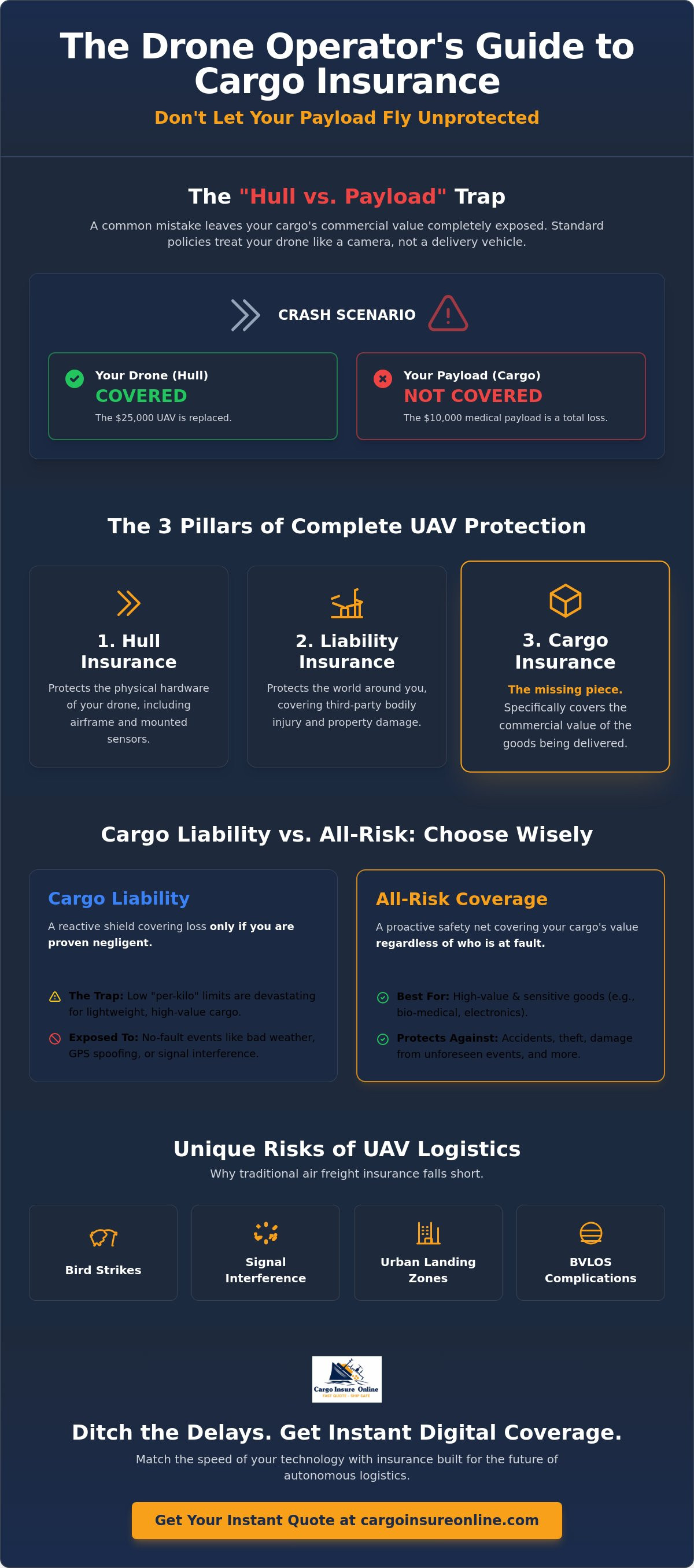
You spent $25,000 on a high-spec UAV. You bought hull coverage. Then a motor fails over a suburban street. The drone is replaced, but the $10,000 medical payload is a total loss. Your insurer says "sorry, we only cover the equipment." This is the "Hull vs. Payload" trap. It’s the single biggest risk facing operators in 2026. Standard policies treat the drone like a flying camera, not a delivery vehicle. They protect the hardware, but they ignore the very reason you're in the air: the cargo.
With the FAA’s Part 108 and Part 146 finally enabling scalable BVLOS operations, the logistics landscape has shifted. We aren't just testing anymore. We're delivering. But as drone delivery applications expand into critical sectors, the insurance gap widens. Traditional carrier liability limits are notoriously low. While a trucking company might offer basic protection based on weight, UAV liability is often even more restrictive. In many cases, standard carrier terms offer zero protection for autonomous flight risks. If you're carrying high-value items, those pennies-per-pound limits won't save your balance sheet when a $10,000 payload is damaged or destroyed.
The Difference Between Hull, Liability, and Cargo
- Hull insurance: Handles the physical UAV. It covers the airframe and those expensive mounted sensors if the drone crashes.
- Liability insurance: Focuses on the world around you. It covers third-party bodily injury if a prop hits a person or property damage if you clip a roof.
- Cargo insurance: The missing piece. It specifically covers the commercial value of the goods from the moment they're loaded until the final drop-off.
Neither hull nor liability protects the box attached to your gimbal. Drone cargo insurance is the essential third pillar. It ensures that if the goods are lost, stolen, or damaged, your business isn't left holding the bill. It's about protecting your reputation as much as your revenue.
Why Traditional Air Freight Rules Don't Always Apply
You might think air freight insurance has this covered. It doesn't. Traditional air cargo rules are built for 30,000 feet and massive cargo holds. Low-altitude UAV operations face unique risks like bird strikes, signal interference, and urban landing zones. BVLOS operations increase these risks because the pilot isn't physically there to intervene. Drone cargo insurance exists as the nexus of aviation and freight protection, bridging the gap between flight safety and logistical liability. It’s a specialized field for a specialized industry. Stop relying on outdated rules for a high-tech future.
Cargo Liability vs. All-Risk: Choosing the Right Protection
Choosing the wrong policy is a silent profit killer. Most operators default to basic liability because it's familiar. It's what they know from trucking or standard aviation. But drone cargo insurance isn't one-size-fits-all. You need to understand the fundamental split between Cargo Liability and All-Risk coverage before you book your next flight. One protects your legal defense; the other protects your actual assets. The difference could be the survival of your logistics business.
Cargo Liability is built on negligence. It triggers only if you, the operator, are legally at fault for the damage. If a pilot error leads to a crash, you're likely covered. But autonomous flight introduces a gray area. What happens when a sudden microburst or unforeseen signal interference drops your payload? In these no-fault scenarios, Cargo Liability often leaves you stranded. It’s a reactive shield, not a proactive safety net. For those pursuing FAA Part 135 certification, understanding these nuances is mandatory for long-term compliance and risk management.
When to Choose Cargo Liability
Liability-only coverage works best for high-volume, low-value deliveries. Think of it as a baseline. It satisfies many basic contractual requirements without the premium of full protection. However, the "Per-Kilo" rule is a massive trap here. Traditional air freight liability is often capped at a specific dollar amount per kilogram of weight. On a heavy cargo plane, that's fine. On a drone carrying a 2kg medical kit worth $5,000, that weight-based limit is devastating. You might receive a payout of $50 for a $5,000 loss. Don't let legacy math ruin your modern margins.
The Power of All-Risk UAV Coverage
All-Risk is the gold standard. It flips the script. Instead of proving negligence, it covers every risk unless it's specifically excluded in the policy. Theft, mysterious disappearance, signal loss, and mechanical failure are all on the table. It’s the "first-dollar" coverage your autonomous fleet needs. This means you aren't fighting over who's at fault while your customer waits for a refund. You get paid, you replace the goods, and you keep flying. It's the same level of comprehensive security seen in sea freight insurance, scaled down for the high-speed UAV world. If you're transporting temperature-sensitive meds or premium electronics, All-Risk isn't an option. It's a requirement. Ready to see how easy this can be? You can explore tailored UAV protection in just a few clicks.
Industry-Specific UAV Cargo Risks: From Bio-Meds to Electronics
Every payload presents a unique financial puzzle. A drone carrying a pair of sneakers faces a completely different risk profile than one transporting a human heart for transplant. In 2026, the complexity of what we fly has outpaced standard "one-size-fits-all" policies. You need drone cargo insurance that understands the specific DNA of your industry. Stop treating your high-value cargo like a generic box. Start protecting it based on its actual mission requirements.
Industrial logistics for remote mining and offshore energy sites have become a major driver for UAV adoption. When a critical component fails on an oil rig, every hour of downtime costs thousands. Delivering that 2kg specialized valve via drone is efficient, but it’s a high-stakes flight. If the part is lost at sea, the claim isn't just about the hardware. It's about the "just-in-time" necessity of the cargo itself. Your insurance needs to reflect the urgency and the specific industrial environment of the route.
Cold Chain and Bio-Medical UAV Logistics
Medical logistics is perhaps the most demanding sector for drone delivery. We aren't just talking about crashes; we're talking about temperature excursions. If a batch of vaccines or blood samples deviates from its required thermal range, the cargo is effectively destroyed. This isn't a hull risk. It's a cargo risk. To secure a valid claim in 2026, operators must leverage Reefer Product standards, using onboard sensor data to prove the environment was maintained from takeoff to touchdown. Transporting biological or hazardous materials also requires specialized liability extensions that standard aviation policies simply don't offer.
High-Value Electronics and Micro-Fulfillment
The retail sector faces the twin threats of theft and "porch piracy" at the point of delivery. As micro-fulfillment centers move toward autonomous last-mile solutions, the risk shifts from the warehouse to the air. Insuring multiple high-value drops in a single flight cycle is the new challenge. If your drone carries four smartphones for four different customers, your policy must track the shifting value of the remaining payload after every drop. 2026 UAV tech requires real-time cargo monitoring for insurance validity. This digital-first approach ensures that if a package is snatched from a landing pad, your coverage triggers instantly. Don't let your e-commerce margins vanish into thin air. Choose drone cargo insurance that’s as smart as your delivery network.
The Drone Fleet Manager’s Checklist for Insurance Compliance
Managing a drone fleet isn't just about pilot skills anymore. It's about data integrity. In 2026, a single administrative oversight can ground your entire operation. Compliance is no longer a "nice-to-have" feature; it's the baseline for every commercial contract you sign. If your weight and balance logs don't match the flight profile during a loss, your drone cargo insurance claim is dead on arrival. Stop treating documentation as a chore. Start seeing it as your ultimate financial safety net.
- Pilot Credentials: Real-time tracking of certifications and flight hours.
- Payload Precision: Weight and balance logs for every commercial lift to prove the drone was within operational limits.
- Technical Redundancy: Documentation of secondary command links and fail-safe protocols.
- Cyber Defense: Protection against GPS spoofing and control-link hijacking.
- Bid-Ready Proof: Instant access to digital insurance certificates for regulatory audits and client proposals.
Managing Fleet-Wide Cargo Risk
The days of insuring drones one by one are over. Modern fleet managers are switching to per-operation or "usage-based" insurance models. This allows you to scale your costs directly with your flight volume. You also need to account for intermodal risks. When a drone drops a package onto a delivery truck or a cargo ship, the liability handoff must be seamless. Black-box data is your best friend here. In the event of a cargo claim, your flight telemetry provides the objective truth that legacy insurers can't ignore. It turns a "he-said-she-said" dispute into a data-driven settlement.
Regulatory Compliance in 2026
The regulatory landscape is moving fast. Staying ahead of FAA and EASA mandates for Remote ID and flight over people is the only way to keep your commercial operator's license. Non-compliant insurance is the fastest way to lose your authority to fly. Authorities are now cross-referencing Remote ID broadcasts with insurance registries in real-time. If the data doesn't match, the fines are just the beginning; you could be grounded indefinitely. Don't risk your license on a technicality. You can get your fleet compliant today with a digital-first policy built for the 2026 regulatory environment.
Cargo Insure Online: High-Flying Protection for UAVs
Traditional insurance is a relic. It’s slow. It’s manual. It’s built for a world that moves at the speed of paper. Your UAV logistics business moves at the speed of sound. You need drone cargo insurance that can keep up. At Cargo Insure Online, we've stripped away the bureaucratic red tape to provide a frictionless experience. Get a quote in minutes, not days. Secure your payload before your props even start spinning. We aren't just an insurance provider. We're your digital flight partner.
Our platform is built for the 2026 tech landscape. We offer deep API integration for seamless fleet management. This means your insurance platform talks directly to your flight operations software. Coverage triggers automatically when a mission begins. It scales as your fleet grows. Whether you're managing three drones or three hundred, our digital-first approach removes the administrative burden. Global reach is standard. Our protection follows your drones across borders, ensuring that international delivery routes remain secure and compliant without extra paperwork.
Claims shouldn't be a battle. In a high-speed industry, waiting weeks for a settlement is a death sentence for your cash flow. We use data-driven settlements to move at the speed of your business. By leveraging your UAV’s flight telemetry and sensor data, we verify claims instantly. It’s transparent. It’s objective. It’s fast. We value your time as much as your cargo.
The Future of UAV Logistics Insurance
We use automation to reward safe flying. By analyzing fleet performance data, CIO lowers premiums for operators with proven safety records. We also offer white-label solutions for drone manufacturers and delivery platforms. This allows you to embed world-class cargo protection directly into your own customer experience. We are more than a service; we are a "Digital Ally" committed to empowering the next generation of global trade. We dismiss the old obstacles and replace them with streamlined, intelligent alternatives.
Ready to Launch Your Fleet?
Starting your first policy is simple. There are no long forms or endless phone calls. You can integrate our cargo protection into your existing logistics stack in three easy steps. First, enter your fleet and payload details into our digital portal. Second, select the coverage level that fits your specific industry risks. Third, receive your digital certificate of insurance instantly. Your fleet is now ready for the 2026 skies. Don't let legacy insurance hold you back from the future of logistics. Secure your drone cargo today with Cargo Insure Online and take your autonomous operations to the next level.
Future-Proof Your UAV Logistics Today
The era of trial flights and experimental waivers is over. 2026 is about scale, speed, and sophisticated risk management. You've seen why standard hull policies leave your revenue vulnerable and how the right All-Risk coverage protects your most sensitive payloads. From bio-medical cold chains to high-value retail drops, your reputation depends on the certainty of your protection. Staying compliant isn't just about following rules; it's about securing the future of your fleet.
Don't let the slow pace of legacy insurance ground your ambitions. You need drone cargo insurance that matches the velocity of your technology. With our 2026 Tech-Ready Policies and global coverage for autonomous fleets, you can expand across borders without friction. Experience the relief of digital-first claims processing that turns data into immediate settlements. It’s time to move beyond the bureaucratic drag of the past. Why settle for yesterday's coverage for tomorrow's delivery network?
Stop waiting and start flying; get your instant drone cargo insurance quote now. The sky is open. We're here to help you own it with absolute confidence.
Frequently Asked Questions
Does standard drone hull insurance cover the goods I am carrying?
No, hull insurance is strictly for your hardware. It protects the physical airframe, motors, and expensive mounted sensors if your drone crashes. It does not cover the commercial value of the payload. To protect the goods you are actually delivering, you must secure a dedicated drone cargo insurance policy. Don't assume your equipment coverage extends to your customer's assets.
What is the difference between drone liability and drone cargo insurance?
Liability insurance covers the world around you, while cargo insurance covers the box you're carrying. If your drone hits a car, liability handles the repair costs. If the package inside the drone is smashed, only cargo insurance compensates you for that loss. One shields you from third-party lawsuits; the other shields your revenue and your client's inventory.
Is drone cargo insurance mandatory for commercial delivery in 2026?
It is often a contractual requirement rather than a universal federal mandate. However, as the FAA finalizes Part 108 and Part 146 regulations in 2026, most commercial clients and high-stakes logistics partners now require proof of cargo coverage before signing a contract. Operating without it is a massive financial risk that could cost you your commercial license if a major loss occurs.
How much does drone cargo insurance typically cost for a small fleet?
Premiums are highly specific to your flight volume and the value of the goods you transport. While liability-only drone insurance for $1 million in coverage often ranges between $500 and $1,000 per year, cargo-specific costs depend on your risk profile. High-risk operations or those carrying sensitive medical supplies will see different rates than those delivering low-value retail items. We offer tailored quotes that match your fleet's unique mission.
Does insurance cover drone cargo if the signal is lost during flight?
Yes, if you have an All-Risk policy. Basic liability policies often require proof of operator negligence to trigger a payout. All-Risk drone cargo insurance is much broader. it covers "mysterious disappearance," signal loss, and mechanical failures. If your drone vanishes or loses its link and the cargo is destroyed, an All-Risk policy is your primary safety net.
What happens if a drone delivery causes property damage AND loses its cargo?
This scenario triggers two separate parts of your insurance portfolio. Your liability coverage handles the damage to the third-party property, like a roof or a vehicle. Simultaneously, your cargo policy handles the financial loss of the goods. Using a digital-first provider ensures these claims are processed together, preventing the administrative nightmare of dealing with multiple disconnected insurers.
Can I get on-demand drone cargo insurance for a single flight?
Yes, on-demand coverage is a core feature of the modern UAV logistics market. You don't have to pay for an annual policy if you only fly occasionally. Digital platforms allow you to secure coverage for a single operation or a specific flight window. This flexibility allows you to scale your insurance costs directly with your delivery revenue, removing the burden of fixed annual overhead.
Are medical supplies and hazardous materials covered under standard UAV cargo policies?
They usually require specialized endorsements. Standard policies often exclude perishables, biologics, and hazardous chemicals. As of early 2026, new Chemical and Cargo Liability options have emerged to specifically address risks like temperature excursion for vaccines or damage from agricultural chemicals. Always verify that your policy includes "Reefer Product" or hazardous material extensions before taking off with sensitive medical cargo.


