What if the most important "marine" insurance you ever buy never touches a drop of salt water? It sounds like a relic from the age of sail, but inland marine cargo insurance is actually the high-speed digital safety net for the modern world. You're moving high-value tech and specialized equipment across highways and rails, not just shipping containers across the Atlantic. Traditional policies often leave massive gaps in carrier liability that could cost you everything. Stop worrying about the name. Start focusing on the protection. This is about your assets in motion.
We know the drill. You're tired of wading through confusing jargon and waiting days for a quote while your high-value gear sits at risk. It's frustrating to realize your carrier's standard coverage barely covers a fraction of your specialized tech if things go sideways. You need speed, clarity, and zero friction. In this guide, you'll master the essentials of inland marine coverage and discover how to shield your assets across every land-based supply chain link. We'll break down the coverage scope, show you how to get instant protection for high-value assets, and reveal the secrets to a frictionless claims process.
Key Takeaways
- Decode the "Marine" paradox. See why this land-based protection is essential for every mobile asset in your supply chain.
- Bridge the gap. Discover how inland marine cargo insurance protects you when standard carrier liability limits fall short.
- Audit your risk. Ensure your high-value tech and specialized tools are shielded from theft, collision, and natural disasters.
- Demand speed. Learn to evaluate modern providers by their ability to deliver instant "All-Risk" quotes without bureaucratic delay.
- Transform an administrative chore into a competitive advantage with frictionless, digital-first logistics protection.
Inland Marine Cargo Insurance: Why the Name is Weird but the Protection is Vital
The name is a total misnomer. It sounds like something for a 19th-century steamship, yet it’s the most critical tool for a 2026 digital supply chain. If you’re moving goods by truck, rail, or even drone, you’re using inland marine cargo insurance. The "marine" part is just a historical hangover from when most cargo moved by sea. As commerce moved inland, the insurance industry simply dragged the terminology along. It’s a modern shield for assets that never touch the ocean.
To understand why we still use this name, look at the historical origins of inland marine insurance. It started as an extension of ocean marine policies. When goods left the ship and hopped onto a train, they needed protection that followed them. Today, that same logic applies to your high-value electronics, medical equipment, and e-commerce inventory. It’s insurance for property that doesn't stay in one place. It’s built for the road, not the waves.
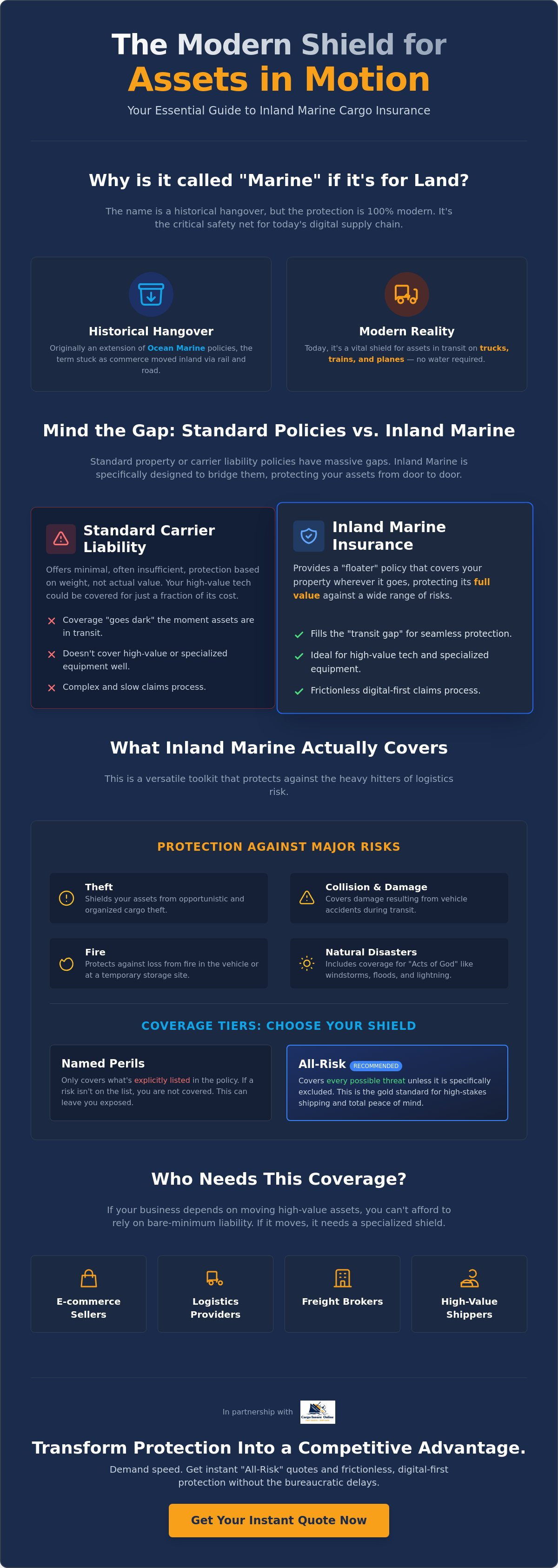
This isn't a niche product anymore. The global inland marine insurance market is projected to reach USD 48.48 billion in 2026. It’s a powerhouse sector because it fills the "transit gap" that standard property policies leave wide open. Most standard policies are built for static locations. They protect your office, your warehouse, and your furniture. But the moment your assets hit the road, those policies often go dark. Inland marine is designed to cover property in transit, regardless of where it is on the map.
The Evolution of Land-Based Protection
The industry has moved far beyond steam engines. We’ve traded ledger books for AI-powered risk assessment. The "floater" concept is the secret here. In insurance speak, a floater covers property that moves from place to place. It’s the ultimate safety net for mobile assets. Modern supply chains are fast and fragmented. You can't rely on "warehouse-only" coverage when your inventory is spread across multiple states and fulfillment centers. The U.S. inland marine insurance industry has seen 20 consecutive years of underwriting profitability, proving that specialized protection is more reliable than generic plans.
Who Actually Needs This Coverage?
It isn't just for massive trucking fleets. If you're an e-commerce seller, you're likely moving inventory to fulfillment centers daily. You need inland marine cargo insurance to protect those margins. Logistics providers handling high-value devices or drones need it to stay competitive. Even freight brokers use it to shield their clients from sudden transit losses. If your business depends on moving high-value assets, you can't afford to rely on the bare minimum liability offered by carriers. If it moves, it needs a specialized shield.
Beyond the Truck: What Inland Marine Actually Covers
Inland marine isn't a one-size-fits-all box. It’s a versatile toolkit designed for a world where property refuses to sit still. While the name suggests a narrow focus, the reality is expansive. It covers your cargo, your specialized equipment, and even the "instrumentalities of transport" like bridges or radio towers. To truly grasp what inland marine insurance covers, you have to look past the physical trailer. It’s about protecting the value of your assets from the moment they leave your hands until they reach their final destination.
The protection goes deep. We're talking about a shield against the heavy hitters: theft, fire, collision, and "acts of God" like lightning or windstorms. But not all policies are created equal. You’ll often choose between "Named Perils" and "All-Risk" coverage. Named Perils only cover what’s explicitly listed in the fine print. If it’s not there, you’re on your own. Modern logistics demand more. All-Risk is the gold standard; it covers every possible threat unless it’s specifically excluded. For high-stakes shipping, inland marine cargo insurance with an All-Risk status is the only way to move with total confidence.
High-Value Tech and Specialized Cargo
Standard policies often choke when they see a manifest full of drones or high-end mobile devices. These aren't just "goods"; they are high-risk, high-reward assets. Specialized riders are essential here. If you're moving temperature-sensitive inventory, our reefer product ensures a hardware failure doesn't melt your profits. We also see a massive shift toward White Label solutions. Tech platforms are now integrating insurance directly into their user journeys, removing the friction of third-party applications. It’s about making protection as invisible and efficient as the software you use to run your business.
Property in the Care of Others
You don't have to own the goods to be responsible for them. This is the "Care, Custody, and Control" reality of logistics. If you’re a carrier or a broker, you have a legal liability for cargo in your possession. Inland marine follows the cargo, not the building. Whether your goods are sitting in a third-party warehouse, a cross-docking hub, or a fulfillment center, the protection stays attached. It bridges the gap where a warehouse’s standard property policy ends. It’s the ultimate "floater" that ensures your financial interest is protected regardless of whose roof is currently over your inventory.
The Gap in Your Policy: Inland Marine vs. Standard Insurance
Most business owners think they’re covered. They aren’t. General Liability is fantastic for slip-and-fall accidents in your lobby, but it’s completely useless for a jackknifed trailer on the I-95. There’s a massive misconception that "business insurance" is a universal shield. In reality, standard Business Owners Policies (BOP) are built for the warehouse, not the highway. They protect your static assets, but the moment your inventory hits the road, that protection often evaporates. You need inland marine cargo insurance to bridge the gap between your four walls and your customer’s doorstep.
The "100-foot rule" is a silent business killer. Most standard property policies only cover assets while they are on your premises or within a tiny radius of your building. Move your goods across the street, and your policy goes silent. This is a nightmare for anyone moving high-value tech or specialized equipment. Because inland marine insurance covers products, materials and equipment regardless of location, it acts as the ultimate "floater" for your mobile assets. It’s the difference between a minor setback and a total financial collapse after a single collision.
Carrier Liability: The "Per-Kilo" Trap
Carriers aren't your insurance partners. They are logistics providers with strictly limited liability. If a carrier loses or damages a shipment of high-end laptops, they won't pay you the retail value. They often pay based on weight. The industry standard is frequently as low as $0.50 per pound. Imagine shipping a $50,000 electronics crate that weighs 1,000 pounds. If it’s destroyed, the carrier might only owe you $500. That’s a $49,500 hole in your balance sheet. All-Risk inland marine cargo insurance is the only real safety net that covers the actual value of your goods, not just their weight.
Standard Property Insurance Limitations
Standard policies are designed for stability, not motion. They lack the flexibility to handle the complexities of modern transit. If your specialized diagnostic tools or drones are damaged in the field, your warehouse policy will likely deny the claim. You shouldn't have to choose between moving your gear and keeping it protected. Specialized floaters ensure your equipment is shielded while it’s being used, stored at a third-party hub, or sitting in a truck bed. Don't wait for an "uncovered transit" claim to realize your BOP has limits. Shield your assets where they actually live: in the supply chain.
Selecting Your Shield: Modern Criteria for Inland Marine Coverage
Stop settling for "good enough" coverage. In 2026, waiting three days for an insurance quote is an operational failure. It’s a bottleneck your business can’t afford. You need protection that operates at the speed of your digital manifest. When you evaluate inland marine cargo insurance, prioritize providers that eliminate friction. If they can't offer an instant quote, they can't keep up with your logistics. Modern insurance shouldn't be a hurdle; it should be a catalyst for your growth.
Focus on "All-Risk" status. Named perils are a trap for the unwary. They only cover what’s explicitly listed, leaving you exposed to the unexpected. All-Risk coverage flips the script. It protects against every threat unless it is specifically excluded. It’s the ultimate safety net for high-value cargo. Whether you’re moving specialized medical devices, drones, or high-end electronics, anything less than All-Risk is a gamble with your bottom line. Don't leave your assets to chance when you can have comprehensive certainty.
Digital claims aren't a luxury. They're a baseline requirement. Paper forms and manual signatures belong in a museum. Modern logistics demand a data-driven approach where you can file a claim and track its progress from your smartphone. Speed in filing leads to speed in settlement. That’s how you maintain cash flow after a loss. If your provider isn't using AI and automation to accelerate your claims, they're wasting your time and your money.
The Tech-First Checklist
Your insurance should live where your data lives. Look for providers offering API integration so your coverage triggers automatically the moment a shipment is booked. You should manage everything through a mobile dashboard, from viewing policies to generating certificates of insurance in seconds. Transparency is key. You deserve a data-backed view of your risk profile that helps you make smarter shipping decisions. It’s about moving from reactive protection to proactive intelligence.
Customizing Your Limits
One size never fits all in land logistics. You must calculate your Total Insurable Value accurately, including the cost of goods plus shipping and replacement expenses. Balance your deductibles to match your risk appetite; a higher deductible lowers your premium but requires more cash on hand for small losses. Don't forget the importance of GAP insurance. If your high-value assets are financed, GAP insurance ensures you aren't left paying off a loan for equipment that was destroyed in transit. It’s the final piece of a truly modern shield.
Stop letting legacy bureaucracy slow your operations down. Get an instant quote for inland marine cargo insurance and start shipping with total digital-first confidence.
Cargo Insure Online: Frictionless Protection for the Digital Supply Chain
Bureaucracy is a drag on your growth. Traditional insurance companies love their paper trails and manual reviews, but your supply chain doesn't have a "pause" button. Cargo Insure Online (CIO) is the disruptive alternative. We’ve replaced the dry, slow-moving processes of the past with a high-energy digital platform. It’s built for the speed of 2026 logistics. We don't just sell policies; we provide a competitive advantage through automation and clarity. You get the protection you need without the administrative headache you hate.
Our "Instant Quote" engine is the heart of this transformation. You shouldn't have to wait days to secure inland marine cargo insurance for a high-value shipment. With CIO, you get answers in seconds. This allows you to book loads, confirm contracts, and move inventory without the administrative friction that used to define the industry. We specialize in the cargo that others find "difficult," like high-value electronics and drones. If it’s high-tech and high-value, we’ve already built the shield for it. It’s insurance that moves at the speed of trade.
Built for Modern Logistics
Our platform is a powerhouse for e-commerce sellers and global freight movers. We understand that your risk doesn't stop at the shoreline. That’s why we offer seamless ways to link your land logistics to our Sea Freight Insurance for total end-to-end protection. For our logistics partners, we offer white-label solutions. This lets you integrate our high-speed insurance directly into your own customer experience. It’s about empowering your clients while we handle the heavy lifting of risk management. You provide the logistics; we provide the peace of mind.
Your High-Speed Partner
The logistics landscape of 2026 demands a digital-first partner. You're using AI for routing and drones for delivery, so why are you still using 20th-century insurance? CIO bridges that gap with technology that moves as fast as you do. Whether you're moving goods by truck, rail, or air, we have the expertise to keep you covered. Check out our Air Freight Insurance guide for more multi-modal tips. Don't let slow insurance be the weak link in your supply chain. It's time to experience protection that actually helps you scale.
Get your instant inland marine quote now and see the difference that frictionless insurance makes for your bottom line.
Secure Your Supply Chain at Digital Speed
Legacy insurance is a bottleneck. It’s slow, confusing, and riddled with gaps that leave your specialized electronics at risk. But your business doesn't operate in the past. You've learned that standard carrier liability is a trap and that your warehouse policy stops at the door. You need a modern shield that stays attached to your assets throughout the entire land-based journey. Inland marine cargo insurance is that shield. It provides the financial certainty you need to scale without fear.
Choosing the right protection means demanding more from your provider. No more waiting days for a quote. No more wading through legalistic jargon. You need all-risk protection for 2026 logistics that triggers at the speed of a digital booking. By focusing on specialized high-value tech coverage and instant digital quotes, you transform insurance from an administrative chore into a strategic advantage. Your supply chain is fast. Your insurance should be faster.
Stop waiting and get your instant cargo insurance quote today.
The road ahead is clear. Let’s get your cargo protected and your business moving with total confidence.
Frequently Asked Questions
What is the difference between cargo insurance and inland marine insurance?
Inland marine insurance is property coverage for the owner of the goods, while cargo insurance is typically liability coverage for the transporter. If you own the inventory, you need inland marine to protect your assets directly. If you're the carrier, cargo insurance protects you if you're held responsible for a loss. Inland marine is often broader, covering specialized equipment and "floaters" that standard liability won't touch.
Does inland marine insurance cover theft from a locked vehicle?
Yes, theft from a locked vehicle is standard under an "All-Risk" inland marine policy. You shouldn't have to worry about your inventory while it's in transit. However, always check the "Named Perils" list if you've chosen a more restrictive plan. Modern inland marine cargo insurance focuses on these real-world risks to ensure your high-value gear stays protected from the warehouse to the final mile.
How much inland marine coverage do I need for a small e-commerce business?
Your coverage limit should match the maximum value of goods you have in transit at any single moment. Don't just look at your average shipment. If you occasionally send a $50,000 crate of electronics, your policy must reflect that peak value. Under-insuring is a gamble that leaves your small business vulnerable to a total loss. We help you calculate your Total Insurable Value to ensure every route is shielded.
Can inland marine insurance cover international shipments?
Inland marine specifically covers land-based transport, typically within a defined geographic area like North America. While it handles the "land legs" of an international journey, you'll need Sea Freight Insurance or Air Freight Insurance for the overseas portions. CIO makes it easy to link these policies together. This creates a seamless safety net that protects your assets from the factory floor to the international hub.
Is inland marine insurance required by law for trucking companies?
No, inland marine isn't a federal legal requirement like auto liability insurance. However, it's a commercial necessity. Most freight brokers and shippers will refuse to work with a trucking company that doesn't carry adequate cargo protection. It’s the industry standard for trust and professional credibility. Without it, you’re locked out of the highest-paying contracts and the most valuable supply chain links.
What is a "floater" in inland marine insurance?
A "floater" is a policy that follows your property wherever it moves. It doesn't care about a specific address or warehouse. If your specialized tech is in a truck, at a job site, or in a temporary hub, the floater stays attached. It’s the perfect solution for mobile assets that don't have a permanent home. It provides the flexibility that modern, high-speed logistics demand.
Does inland marine insurance cover specialized equipment like drones?
Yes, specialized equipment like drones and high-value electronics are the core of modern inland marine cargo insurance. Standard policies often exclude these items because they’re seen as high-risk. We embrace that risk with specialized riders. Whether you're moving a fleet of drones or temperature-sensitive medical devices, our "All-Risk" approach ensures your tech is protected against collisions, theft, and natural disasters.
How do I file a claim for damaged cargo under an inland marine policy?
Filing a claim with CIO is a frictionless, digital experience. Skip the paper forms and the endless phone tag. Just log into your dashboard, upload your manifest and photos of the damage, and submit. Our data-driven process starts immediately. We prioritize speed and transparency because we know that a fast settlement is the only way to keep your supply chain moving without a hitch.


