What if a single blown fuse or a two-hour power lag didn't mean a $250,000 write-off for your business? You're already managing the most volatile segment of global trade. You know that a slight temperature deviation can turn a premium shipment into a total loss in minutes. Traditional insurance often makes this worse. It buries you in confusing exclusion clauses and slow, manual quoting processes that can't keep up with the speed of modern logistics. It's frustrating, outdated, and unnecessary.
We're changing the game. This guide shows you how to secure your shipments with modern reefer cargo insurance that offers instant, all-risk protection. You don't have to settle for "per-kilo" liability myths that leave you exposed. Instead, you can eliminate the fear of spoilage with coverage that's as fast and precise as your own cold chain technology.
We'll walk you through getting instant proof of coverage, staying compliant with 2026 FDA and international standards, and mastering a zero-friction claims process. It's time to move past the paperwork and protect your bottom line with digital-first confidence.
Key Takeaways
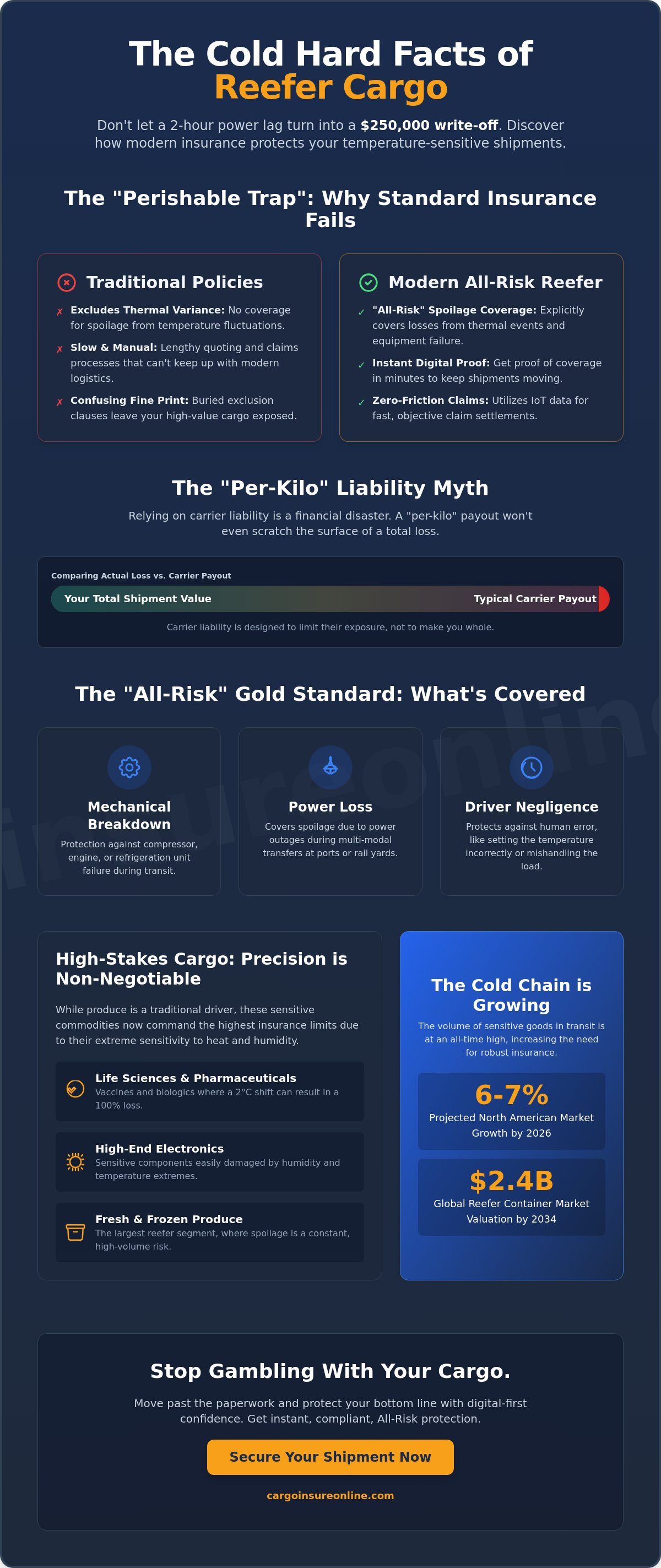
- Identify the "Perishable Trap" and why standard cargo policies frequently fail to cover thermal variance or spoilage.
- Decode the "All-Risk" gold standard to ensure your protection includes mechanical failure, power loss, and driver negligence.
- Debunk the carrier liability myth to see why a "per-kilo" payout won't even scratch the surface of a total loss.
- Learn how to optimize your reefer cargo insurance premiums by understanding the impact of commodity types and route complexity.
- Transition to a frictionless, digital-first insurance model that provides instant proof of coverage and zero-friction claims.
The Cold Chain Reality: Why Reefer Cargo Insurance is Non-Negotiable
Logistics is a game of variables, but temperature shouldn't be one of them. To understand the stakes, you first need to understand what is the cold chain. It's a complex, interconnected system where a single minute of mechanical failure can erase years of manufacturing effort. Reefer cargo insurance acts as your financial fail-safe. It isn't just about covering "broken stuff." It's specialized protection against thermal variance, refrigeration unit breakdown, and the catastrophic mechanical failures that dry freight policies simply ignore.
Many shippers fall into the "Perishable Trap." They assume their standard cargo policy has their back. It doesn't. Most general policies explicitly exclude damage caused by temperature fluctuations or atmospheric conditions. If your cooling unit cuts out on a 100-degree day, a standard policy sees a functioning trailer and a spoiled load, then denies the claim. Specialized insurance removes this friction. It provides a literal reset button for your balance sheet when the hardware fails.
The scale is massive and growing. By 2026, the North American reefer market alone is projected to grow by 6-7%. With the global reefer container market heading toward a $2.4 billion valuation by 2034, the volume of sensitive goods in transit is at an all-time high. In this high-speed environment, insurance isn't a bureaucratic hurdle. It's a strategic asset that keeps your supply chain resilient.
The High Stakes of Temperature Sensitivity
Precision is everything. In the worlds of pharmaceuticals, fresh produce, and high-end electronics, "close enough" is a recipe for disaster. Consider these realities:
- The 2-Degree Disaster: For many biologics and vaccines, a mere 2-degree shift outside the validated range results in a 100% loss of cargo value. There is no "discounted" version of a spoiled vaccine.
- The IoT Revolution: Modern reefer cargo insurance leverages real-time data. IoT sensors now track internal temperatures every second, providing the objective proof needed to settle claims instantly.
- The Three Pillars: While produce is the traditional driver, high-end electronics and life sciences now command the highest insurance limits due to their extreme sensitivity to humidity and heat.
Air, Sea, or Land: Multi-Modal Protection
Your risks change with your zip code and your altitude. True protection must be multi-modal to be effective. Trucking remains the front line of risk, where long-haul mechanical breakdowns or driver error can jeopardize a load in hours. On the high seas, the challenges shift to "Acts of God" and power outages. With 40ft high cube reefers now costing up to $48,000 each, the equipment risk is as high as the cargo risk.
Air freight offers the fastest transit but introduces the most transitions. Moving ultra-sensitive biologicals from a tarmac to a cold storage facility is a high-friction moment. Whether your cargo is on a deck, in a trailer, or in a fuselage, your insurance must follow the goods, not just the vehicle. It's about seamless, end-to-end security that doesn't stop when the mode of transport changes.
Decoding the Policy: What Does Reefer Insurance Actually Cover?
Traditional insurance policies are a maze of "what-ifs." Modern coverage is a clear "yes." When you're moving high-value perishables, you don't have time to wonder if a specific type of failure is covered. You need to know that your reefer cargo insurance is built for the actual risks of 2026. This means moving beyond basic theft and collision to cover the technical heartbeat of your shipment: the refrigeration unit itself.
A comprehensive policy should address three main failure points. First is mechanical breakdown, where the compressor or engine simply stops. Second is power loss, which is a constant threat during multi-modal transfers at ports or rail yards. Finally, there's driver negligence. If a driver sets the temperature to 35 degrees instead of -5, the cargo is lost just as surely as if the truck flipped. An "All-Risk" policy is the gold standard here. Unlike "Named Perils" coverage, which only protects you against a specific list of disasters, All-Risk covers every eventuality unless it's explicitly excluded. It's the difference between hoping you're covered and knowing you are.
Compliance isn't optional in this industry. Following federal regulations for the sanitary transportation of food is your baseline. However, even the most compliant operation faces loading and unloading risks. If a product isn't pre-cooled correctly before it hits the trailer, the reefer unit might never catch up. Modern policies can include coverage for these pre-cooling errors and even "Consequential Loss." This protects you when a refrigeration failure triggers a chain reaction, such as disposal fees or contractual penalties for late, spoiled delivery. You can start protecting your cold chain today with a policy that understands these nuances.
Mechanical Breakdown vs. Spoilage
A reefer unit is a machine. Machines fail. But sometimes, the machine stays perfect while the cargo rots. This is why you need coverage for both mechanical breakdown and spoilage. In 2026, policy language is becoming more precise. You'll often find that "Reefer Breakdown" is defined by a specific duration of temperature variance. To win a claim, maintenance records are your best friend. If you can't prove the unit was serviced according to manufacturer specs, the insurer might argue the failure was preventable. Keep your logs digital and your records tight.
Common Exclusions to Watch For
No policy covers everything. You need to be aware of the "Inherent Vice" exclusion. This is insurance-speak for cargo that was doomed before it was ever loaded. If your strawberries were already moldy at the farm, no amount of refrigeration will save them, and no policy will pay for them. Pre-existing damage is another hurdle. If the Bill of Lading shows the cargo was warm at pickup, the transit claim is dead on arrival. Finally, watch out for delay exclusions. If a truck is stuck in traffic for two days and the produce wilts, a standard policy might deny the claim unless you've added a specific rider for time-sensitive spoilage.
Shipper vs. Carrier: The "Per-Kilo" Liability Myth
Carriers aren't your insurance company. They're your transport partners. It's a critical distinction that many shippers learn too late. When a load spoils, the carrier’s goal is to limit their financial exposure, not to make you whole. Relying on carrier liability is like using a paper shield in a thunderstorm. It won't keep you dry when the real pressure hits. You need a dedicated solution that prioritizes your balance sheet over the carrier's legal defenses.
Let's look at the math. Standard carrier liability for motor truck cargo is often capped at a mere $2.00 per pound. Imagine you're shipping a high-value pharmaceutical load worth $50,000. If that shipment weighs 50 pounds, the carrier's legal obligation is only $100. You're left with a $49,900 hole in your budget. This is why reefer cargo insurance is essential. It covers the actual value of your goods, not just a fraction of their weight. It transforms a potential bankruptcy into a minor operational hiccup.
The "Burden of Proof" is another massive obstacle. To get a carrier to pay, you must prove they were 100% negligent. If a compressor fails due to an "Act of God" or an unforeseen power surge at a port, the carrier can walk away. Proving fault is a slow, legal nightmare that can drag on for months. Direct cargo insurance flips the script. You file a claim with your insurer, get paid, and let the insurance professionals handle the subrogation against the carrier later. Your business keeps moving while the lawyers sort out the details.
The Financial Gap in Logistics
Standard reefer limits often fall short of modern shipment values. This is where GAP Insurance becomes a lifesaver. It bridges the distance between what a carrier covers and what you actually stand to lose. E-commerce sellers are particularly vulnerable here. They often move small, high-value parcels that have almost zero protection under traditional weight-based liability. An "All-Risk" trigger ensures you get paid for events totally outside the carrier’s control, from sudden power grid failures to extreme weather events that compromise the cold chain.
Compliance and Contractual Requirements
Major retailers don't play games with temperature safety. Giants like Amazon and Walmart require specific reefer limits before you can even bid on a contract. They understand that Cold chain custody accountability is the only way to protect their brand reputation. By carrying robust reefer cargo insurance, you aren't just protecting yourself; you're proving your reliability. Meeting FDA and international food safety standards through verified insurance helps you win higher-paying contracts and build long-term trust with global partners who demand perfection.
Calculating the Premium: What Drives Reefer Insurance Costs?
Traditional insurance pricing feels like a black box. It shouldn't. Your premium for reefer cargo insurance is a direct reflection of your specific risk profile, not a generic industry average. Understanding these drivers allows you to optimize your coverage without overpaying for protection you don't need. It's about data, precision, and operational transparency.
The commodity is your primary cost driver. Not all cold is equal. Frozen beef is resilient; live vaccines are delicate. If power fails on a load of frozen meat, you have a small window to save the cargo. If it fails on biologicals, the loss is instantaneous and total. Route complexity adds the next layer. Domestic trucking is predictable. Cross-border maritime routes involve port congestion and customs delays that increase the time-at-risk. Finally, your deductible strategy matters. Balancing a higher deductible with a lower upfront premium is a smart way to manage your risk appetite if you have high-frequency, low-margin shipments.
Technology is the ultimate discount lever. Insurers in 2026 prioritize "smart" shipments. If you use GPS tracking and real-time IoT temperature monitoring, you're a lower risk. This transparency allows for faster claims and prevents spoilage before it happens. You can get an instant quote today to see how your tech-stack can lower your rates.
The Commodity Risk Profile
High-value electronics are the hidden giants of the reefer world. While people think of food first, mobile phones and drones often require temperature-controlled environments to protect sensitive batteries and circuits from overheating or moisture. These tech goods carry a high theft risk alongside their thermal sensitivity, which impacts the premium. Perishable goods also face seasonal fluctuations. During peak harvest seasons, the demand for reefer capacity spikes, and insurance rates often follow the market's volatility. Protecting these diverse assets requires a policy that adapts to what's inside the container, not just the container itself.
Volume and Frequency Discounts
Stop buying insurance one shipment at a time if you're a high-volume player. Annual open policies provide continuous coverage and significant cost savings over single-shipment quotes. For those in the digital space, E-Commerce Cargo Insurance streamlines the process by automating coverage for high-volume sales. This is the "CIO Advantage." Instead of manual paperwork for every load, you get instant quotes for recurring shipments. It's a digital-first approach that respects your time and rewards your consistency with better rates and zero friction.
Cargo Insure Online: Instant Reefer Protection for the Digital Age
Stop the paperwork. Start the shipping. The era of waiting three days for a broker to call you back is officially over. You're running a high-speed, high-stakes cold chain operation. You don't have time for faxes, manual forms, or the "we'll get back to you" culture of the past. We've built a digital-first platform that treats reefer cargo insurance as the software-driven asset it should be. It's about momentum. It's about clarity. It's about getting your shipments moving without the administrative drag that kills your margins.
Tech-savvy innovators choose Cargo Insure Online because we operate at the speed of 2026. We don't hide behind legalistic jargon or bury you in fine print. We provide instant proof of coverage so you can secure high-value pharmaceutical or electronics loads in real-time. Our claim process is just as aggressive. You shouldn't have to mail physical packets to get paid for a spoilage event. Our digital claims portal is designed for immediate action, allowing you to upload sensor data and photos instantly. We turn a potential financial disaster into a managed, professional event.
White-label solutions are the next frontier for our logistics partners. We don't just sell insurance; we empower you to offer it. If you're a freight forwarder or a platform provider, you can integrate our robust protection directly into your user experience. This builds trust with your shippers and ensures that every load you move is protected by the highest standards of the industry. It's about creating a seamless ecosystem where protection is a feature, not a hurdle.
Seamless API Integration
The future of logistics is embedded. Our API allows freight brokers to offer reefer cargo insurance directly within their own booking platforms. This isn't just a convenience. It's a strategic competitive advantage. By integrating insurance into the digital booking flow, you ensure automated compliance across your entire fleet. You'll never ship a sensitive load without the right reefer rider again because the system handles the heavy lifting. It's frictionless cold chain logistics made simple.
Disrupting the Bureaucracy
We're here to kill the bureaucracy. The traditional insurance industry is dry, slow, and disconnected from the reality of global trade. We're vibrant, high-energy, and focused on your results. We empower you through speed. Get quotes in seconds, not days. No more "checking with the underwriter" or waiting for a manual review. Our intelligent platform understands your risk and delivers a solution instantly. Ready to experience the modern way? Get your instant reefer cargo insurance quote now and see how easy protection can be.
Take Command of Your Cold Chain Security
The days of crossing your fingers and hoping the cooling unit holds are over. You've seen how the "per-kilo" liability trap leaves your business exposed. You know that standard policies aren't enough for the precision required in 2026. Protecting your high-value perishables isn't just a compliance box to tick; it's a strategic move to ensure your business stays resilient in a volatile global market.
By choosing modern reefer cargo insurance, you gain more than just a policy. You gain All-Risk coverage that removes the fear of spoilage and global logistics expertise that understands your actual risks. No more waiting days for a quote. No more confusion over exclusion clauses. Just clear, instant digital protection that respects your time and your bottom line.
It's time to stop reacting to failures and start preventing financial loss with zero-friction technology. Secure Your Cold Chain with an Instant Quote and experience the relief of shipping with total confidence. Your logistics journey just got a whole lot smoother.
Frequently Asked Questions
What is the difference between reefer breakdown and spoilage coverage?
Breakdown coverage protects you when the refrigeration unit mechanically fails, while spoilage coverage protects the cargo itself. It's possible for a unit to run perfectly but for the cargo to spoil due to poor airflow or incorrect loading. You need both to ensure you're covered for every thermal eventuality.
Does reefer insurance cover "Acts of God" like power outages at sea?
Yes, provided you've secured an "All-Risk" policy. While standard carrier liability often excludes "Acts of God," modern all-risk reefer cargo insurance is designed to handle the unpredictable. This includes sudden power failures on vessels or extreme weather events that compromise the ship's electrical grid.
How much reefer cargo insurance do I need for international shipping?
You should cover the 110% of the commercial value of your goods plus the cost of freight. In 2026, the standard $100,000 limit is often insufficient for high-value seafood or pharmaceuticals. Many international shippers now carry limits between $250,000 and $500,000 to avoid significant out-of-pocket losses.
Can I get a reefer insurance quote for a single shipment of electronics?
Absolutely. You don't need a high-volume contract to get protected. You can secure instant, per-load coverage for one-off shipments of sensitive electronics like mobile phones or drones. This ensures your high-value tech stays climate-controlled and fully insured without any long-term commitment.
What documents are required to file a reefer cargo insurance claim?
You'll need the Bill of Lading, the commercial invoice, and the packing list. Most importantly, you need the temperature logs. Digital-first insurers prioritize IoT sensor data because it provides an objective, unalterable timeline of the thermal variance, which speeds up the payout process significantly.
Does reefer insurance cover driver error, such as setting the wrong temperature?
Yes, if your policy includes a negligence clause. Human error is a leading cause of cold chain failure. Whether a driver enters the wrong set-point or fails to monitor the fuel levels for the cooling engine, a comprehensive policy will protect your financial interest from these mistakes.
Is reefer insurance mandatory for Amazon FBA food sellers?
Amazon requires all professional sellers to carry commercial general liability insurance once they hit specific sales thresholds. While they don't explicitly name "reefer" coverage, food sellers are effectively required to have it. Without it, a single rejected shipment at an FBA warehouse could result in a total loss of inventory.
How does temperature monitoring technology affect my insurance premium?
Real-time monitoring technology acts as a massive discount lever for your reefer cargo insurance. Insurers value the transparency of IoT data. When you can prove your cargo is monitored 24/7, you're a lower risk. This transparency prevents spoilage before it happens and leads to lower premiums and faster claims processing.


