
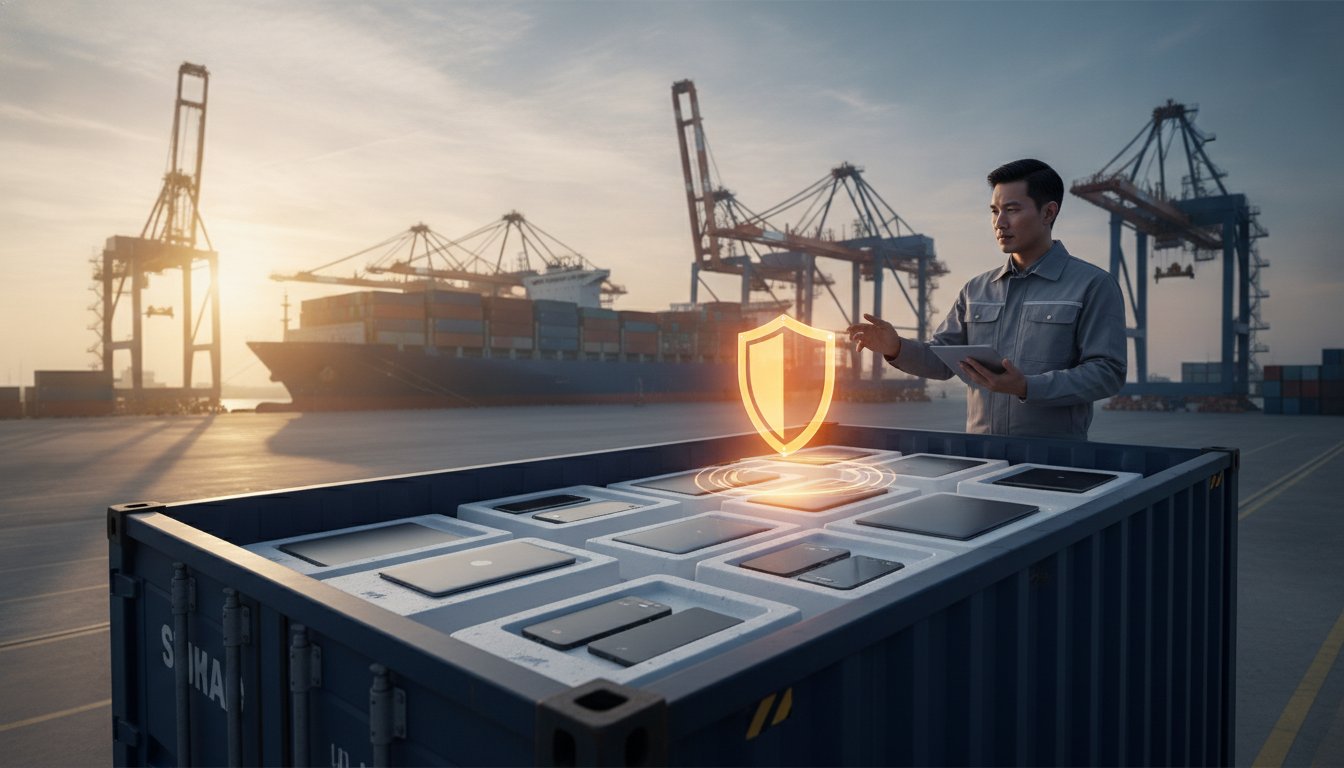
Why did your carrier just offer a tiny $20 payout for a $2,000 laptop destroyed in transit? It is the classic carrier liability trap. You check the box, pay the fee, and assume your electronics shipping insurance is handled. Then a claim gets denied on a technicality. You are left with a hole in your budget and a slow, paper-heavy reimbursement process that drags on for weeks. It is time to stop gambling with your high-value inventory.
We know you are tired of technicalities and high theft rates for "street-desirable" tech like smartphones. You need coverage that provides instant, digital-first protection without the bureaucratic headache. This guide shows you how to ditch standard liability for frictionless, all-risk protection that covers your full invoice value. We will explore the 2026 shipping landscape, including the new July CPSC electronic submission mandates and how to maintain global protection across air, sea, and land. Discover how to transform insurance from a chore into a seamless competitive advantage.
Key Takeaways
- Ditch the "per-kilo" trap. Learn why carrier liability leaves you exposed and how to protect the full invoice value of your tech.
- Upgrade to all-risk electronics shipping insurance. Stop guessing which perils are covered and get comprehensive protection against theft and transit damage.
- Master multi-modal logistics. Secure high-speed air launches and long-haul sea freight with strategies tailored for sensitive hardware.
- Build a bulletproof shipping workflow. Use our 2026 checklist to verify packaging standards and create digital manifests that speed up claims.
- Go digital-first. Discover how to bypass bureaucratic delays with instant quotes and automated coverage for global shipments.
Why Carrier Liability is a Death Trap for Electronics Shipping
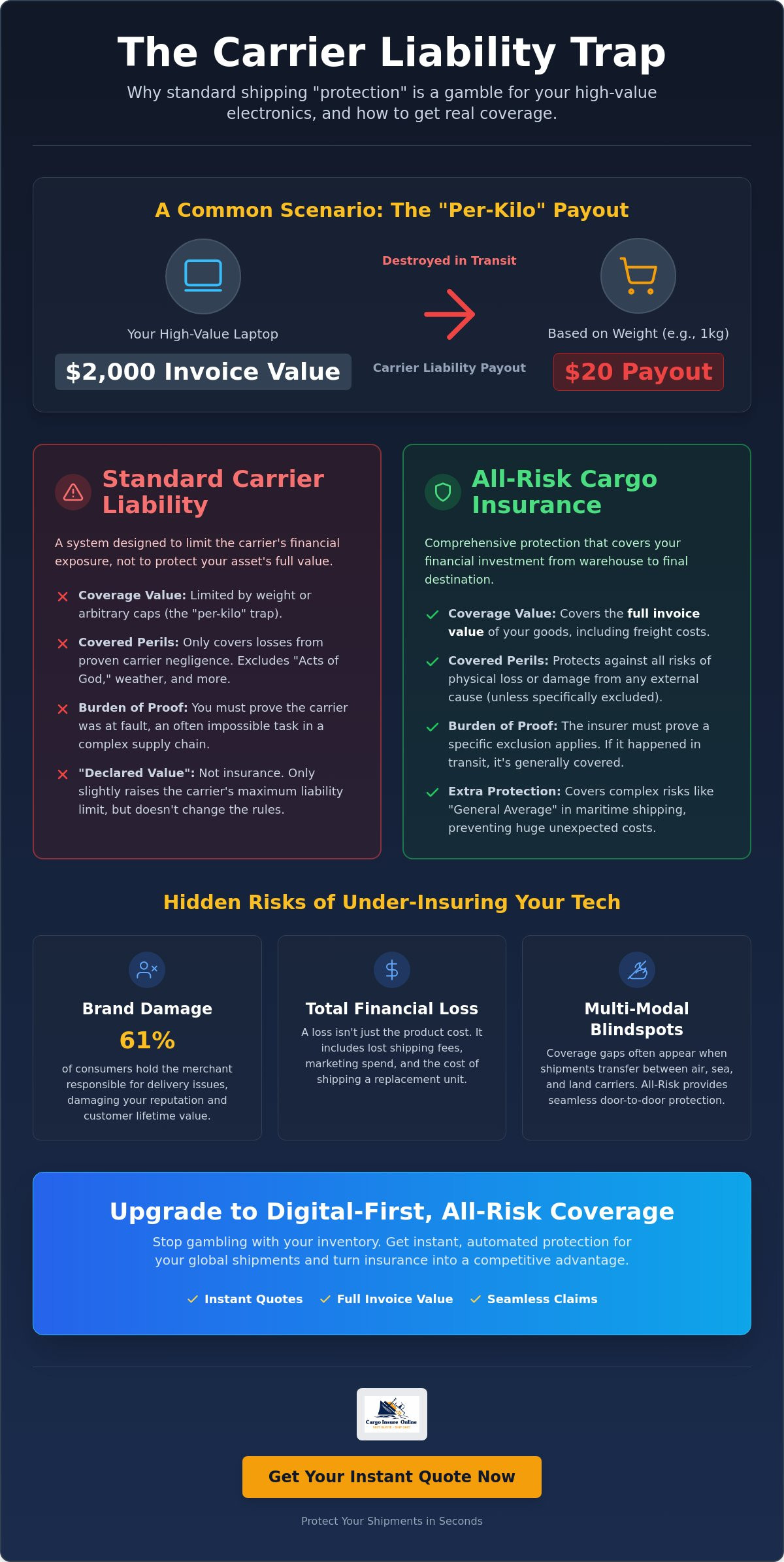
You probably think checking the "declared value" box on your shipping label means you're safe. It doesn't. Most carriers operate under a system designed to protect their bottom line, not yours. When you ship high-value tech, you aren't just moving boxes; you're moving concentrated capital. Standard carrier liability is a relic that treats a high-end laptop the same as a box of gravel.
The "Per-Kilo" Nightmare is the most common trap. Carriers often limit their payout based on the weight of the package. If a 1kg MacBook Pro disappears, a carrier might only offer you $20 based on standard weight limits. That is a catastrophic loss for a $2,000 asset. You're left with a massive budget hole while the carrier points to the fine print. It's a losing game for anyone shipping miniaturized, high-value hardware.
Relying on standard liability leaves you exposed to several critical risks:
- Limited Perils: Carriers won't pay for "Acts of God," weather-related damage, or theft after a package is marked as delivered.
- The Burden of Proof: You must prove the carrier was negligent. Proving exactly where a shipment was mishandled in a global supply chain is an uphill battle you will lose.
- Brand Damage: Industry data shows that 61% of consumers hold the merchant accountable for delivery issues. A single lost shipment can destroy your customer lifetime value (CLV) and send buyers to your competitors.
The Trap of Declared Value
Don't confuse "Declaring Value" with having a real Shipping insurance policy. Declaring value simply raises the carrier's maximum liability limit. It does not change the underlying rules; you still have to prove they were at fault. Hidden caps and exclusions are baked into standard terms and conditions. The myth of "Standard Protection" in global logistics is a dangerous assumption that costs businesses millions every year. It's a contractual ceiling, not a safety net for your inventory.
Financial Impact of Unprotected Tech
Calculating the real cost of a loss goes far beyond the retail price. You lose the cost of goods sold (COGS), the initial shipping fees, and the marketing dollars spent to acquire that customer. Then you have to pay for a replacement unit and expedited shipping all over again. Limited Liability is a structural risk to e-commerce margins. It is time to stop viewing protection as a bureaucratic chore. High-performance electronics shipping insurance turns a vulnerability into a shield. Liability is a gamble; All-Risk is a strategic advantage for your tech brand.
Decoding Electronics Shipping Insurance: All-Risk vs. Named Perils
Choosing the right protection is more than a checkbox. It's a strategic decision. Most shippers get stuck between two worlds: All-Risk and Named Perils. One offers a shield. The other offers a sieve. Forget the fine print and focus on the philosophy of your coverage.
All-Risk coverage is the gold standard for high-value tech. Its philosophy is simple: if it happened during transit, it's covered. You don't need to prove the carrier dropped the pallet or the truck crashed. Unless the cause is specifically excluded, you get paid. Named Perils, on the other hand, is a gamble. It only covers a specific list of disasters like fire or sinking. If your smartphones disappear from a warehouse or suffer "mysterious disappearance," a Named Perils policy often stays silent. It's a cheaper price tag for a much higher risk.
Then there's the "General Average" nightmare. This ancient maritime law means if a ship catches fire and some cargo is sacrificed to save the rest, every shipper on that boat shares the cost. Your pristine electronics could be held hostage for payment even if they weren't touched by flames. All-risk electronics shipping insurance typically covers these contributions, saving you from a massive, unexpected bill.
Standard carrier payouts often ignore the money you spent on shipping. High-performance protection covers the full invoice value. This includes the cost of the goods plus the freight charges. If a shipment is lost, you aren't just getting the product cost back; you're getting the total investment returned. This ensures your margins remain protected even when logistics fail.
Standard Exclusions You Must Know
Even the best policies have boundaries. The "Poor Packaging" clause is the most common claim killer. If you aren't safely shipping lithium batteries according to PHMSA standards, your claim is dead on arrival. Inherent vice is another hurdle; insurance covers transit damage, not a faulty circuit board that failed on its own. Finally, customs rejection isn't a transit risk. It's a compliance issue. Get your paperwork right to keep your coverage intact.
The ROI of Comprehensive Protection
Predictability is the ultimate goal. When you use a platform like Cargo Insure Online, you remove the administrative burden of policy management and turn risks into a fixed cost. This allows for aggressive global expansion. You can ship to new markets with confidence, knowing your full invoice value and freight costs are secured. Stop managing paperwork. Start managing growth. If you want to scale without the stress, explore all-risk coverage for your next shipment.
Multi-Modal Tech Protection: Air, Sea, and Land Logistics
Your tech inventory doesn't stay still. It moves through a complex web of planes, ships, and delivery vans. Each transition is a potential point of failure. Modern electronics shipping insurance must be as agile as your supply chain. It shouldn't matter if your goods are at 30,000 feet or in the back of a local courier truck. You need a single policy that follows the asset, not the vehicle.
Air freight is the lifeblood of product launches. It is fast. It is efficient. But it is also rough. Ground crews move quickly, and sensitive motherboards don't handle sudden impacts well. If you are rushing a new SKU to market, you cannot afford a weight-based payout for a pallet of high-end GPUs. You need protection that recognizes the technological value of the cargo, not just its mass.
Sea freight offers scale but introduces environmental enemies. Salt air and moisture can corrode delicate connectors over a 40-day voyage. While we discussed General Average earlier, the physical risk of long-duration transit is just as dangerous. Your protection must cover the entire journey, including the weeks spent sitting in a humid shipping container at the port. It is about total lifecycle protection for the shipment.
When exporting, remember that U.S. Census Bureau regulations require the declared value to include insurance charges. This isn't just a best practice; it's a regulatory framework for global trade. Proper documentation ensures that your electronics shipping insurance remains compliant and valid during customs inspections.
Drone and UAV Logistics
Unmanned aerial vehicles (UAVs) are a logistics nightmare. They are packed with high-value sensors, LIDAR, and precision optics. These components are incredibly fragile. Standard cargo policies often fail to account for the unique vibration risks and sensor sensitivity inherent in drone transport. Check our Drone Cargo Insurance guide to see how specialized logic protects these technical marvels from factory to flight line.
Mobile Phones and Consumer Tech
Smartphones are "street-desirable." They are the primary target for theft. If you ship consumer tech, port-to-port coverage is a trap. Most theft happens during the last mile or at the regional distribution center. You need door-to-door protection that addresses concealed damage. This is when the box looks perfect, but the screen inside is shattered. Proving that damage happened during transit is nearly impossible without comprehensive protection that covers the entire chain of custody.
The 2026 Checklist for High-Value Tech Shipments
High-value tech demands more than a "fragile" sticker. It requires a tactical workflow. If your preparation is sloppy, your electronics shipping insurance claim will be too. Carriers look for any excuse to deny a payout. Don't give them one. Follow this 2026 protocol to ensure your assets are protected before they even leave the dock.
Start with packaging standards. Use ISTA 3A or similar certified methods. This isn't just about bubble wrap; it's about structural integrity. If you ignore these benchmarks, you're handing the carrier a "get out of jail free" card during a damage dispute. Digital evidence is the only language adjusters speak now. Create a detailed manifest and take high-resolution, timestamped photos of every item before the box is taped shut. If it isn't documented, it didn't happen.
Choose your Incoterms wisely. These terms define the exact micro-second risk shifts from you to the buyer. If you don't know when your liability ends, you don't know if you're actually protected. Once the goods arrive, implement an immediate inspection protocol. Tech often looks pristine on the outside while the internal circuitry is shattered. Catching concealed damage within the first hour of delivery is the difference between a full reimbursement and a total loss.
How to File a Tech Claim in Minutes
Filing a claim shouldn't feel like a root canal. You need three things: clear photos, the Bill of Lading (BOL), and the commercial invoice. Report damage instantly. Waiting even 24 hours to report a hardware issue can kill your claim's credibility. Cargo Insure Online eliminates the friction with a zero-paperwork, high-speed digital claims process. We settle at the speed of your business, not the speed of an insurance adjuster's desk.
Risk Mitigation Beyond Insurance
Think beyond the policy. Use GPS trackers and shock sensors for sensitive electronic components. These IoT devices provide real-time data that proves exactly when and where a "shock event" occurred. Pair this hardware with Air Freight Insurance to minimize the time your goods spend in high-risk transit zones. Use tamper-evident seals on every crate. If a seal is broken, do not sign for the delivery. Secure your next shipment with confidence and get an instant quote from Cargo Insure Online today.
Cargo Insure Online: Instant Electronics Coverage Without the Bureaucracy
Traditional insurance is a bottleneck. It is slow. It is paper-heavy. It is a relic of a pre-digital era that doesn't understand the urgency of a 2026 tech launch. You shouldn't have to wait 48 hours for a quote while your high-value inventory sits vulnerable on a loading dock. Cargo Insure Online is the antidote to this friction. We provide instant, digital-first electronics shipping insurance that moves at the speed of your business.
Stop waiting for manual approvals. Our platform delivers real-time rates for global tech shipping across every mode of transport. Whether you are managing high-speed air freight for a flagship smartphone release or long-haul sea freight for industrial components, we provide a single, unified interface. We have mastered the complexities of multi-modal logistics so you don't have to. From the back of a delivery van to the hold of a cargo plane, your protection remains seamless and constant.
We aren't generalists. We are specialists. Cargo Insure Online understands the specific risks associated with "street-desirable" tech like mobile phones and the extreme fragility of industrial drones. We offer white-label and API solutions designed for modern logistics partners who need to embed protection directly into their own platforms. This isn't just about a policy; it is about building a tech-forward infrastructure that scales with your growth.
The Future of Freight Protection
The era of manual policy management is over. We specialize in embedded insurance, integrating directly with your existing supply chain workflow. This means coverage is triggered automatically, removing the risk of human error or forgotten checkboxes. As your e-commerce tech brand expands into new global markets, our scalable coverage adapts to your volume and value. Our mission is simple: we are transforming insurance from a hurdle into a high-speed launchpad. We empower you to take bigger risks and reach further markets without the administrative weight of old-school brokerage.
Get Protected Today
Delayed coverage is a gamble you cannot afford in 2026. With the suspension of de minimis rules and increased customs scrutiny, your logistics chain is already under pressure. Don't add "uninsured loss" to your list of worries. The Cargo Insure Online onboarding process is built for speed and clarity. You can go from a blank screen to a fully protected shipment in under two minutes. Experience the relief of frictionless protection. Secure your electronics shipment now with a Cargo Insure Online quote and stop risking your bottom line on carrier liability.
Future-Proof Your Global Tech Logistics
Standard carrier liability is a gamble your margins can't afford. You've seen the "per-kilo" trap and the administrative friction of old-school claims. In 2026, staying competitive means securing your inventory with electronics shipping insurance that understands the value of a microchip, not just the weight of the pallet. By choosing all-risk protection, you safeguard your full invoice value and freight costs across every mode of transport.
The transition to a digital-first workflow removes the bureaucracy and replaces it with speed. Whether you're launching a new drone fleet or shipping thousands of smartphones, you need a partner that moves as fast as you do. We provide global coverage for air, sea, and land with specialized drone and mobile phone protection. Our digital-first claims process ensures you aren't stuck with paperwork while your competitors are scaling.
Don't leave your next shipment to chance. Get an Instant Electronics Shipping Insurance Quote today and experience the relief of frictionless, all-risk protection. Your high-value assets deserve a high-speed launchpad. Let's get your tech moving with confidence.
Frequently Asked Questions
Is electronics shipping insurance worth the extra cost?
Yes. The small premium is a tiny fraction of the replacement cost for a $3,000 server or a pallet of smartphones. It transforms a potential catastrophic loss into a predictable, manageable business expense. Without it, a single lost shipment can wipe out your entire quarterly margin. It is the difference between a minor setback and a financial disaster.
Does standard carrier liability cover the full value of electronics?
Rarely. Carrier liability is almost always tied to weight rather than actual market value. A lightweight laptop might only fetch a $20 payout under standard "per-kilo" terms. True electronics shipping insurance covers the full invoice value and freight costs. It ensures you get back exactly what you lost, not just a symbolic pittance based on mass.
What is the difference between freight insurance and shipping insurance for tech?
Scope and scale define the difference. Freight insurance typically protects large-scale cargo moved via sea or air on pallets or in containers. Shipping insurance often focuses on individual parcels and the specific risks of e-commerce delivery. High-growth tech brands usually need both to protect their products from the factory floor to the customer's doorstep.
How much does electronics shipping insurance typically cost?
Rates depend on the total invoice value and the destination risk profile. Third-party providers generally offer rates that are 30% to 50% lower than carrier-provided declared value fees. You get broader, all-risk coverage for a much smaller investment. It is a smarter way to protect your capital without overpaying for basic carrier services.
Can I insure second-hand or refurbished electronics for shipping?
Yes. You can protect refurbished tech as long as you have a clear commercial invoice or a recent appraisal to prove its current market value. This is vital for businesses participating in the circular economy or high-end resale markets. Just ensure your documentation is precise to avoid valuation disputes during the claims process.
What should I do if my electronics shipment arrives damaged?
Act fast. Document the damage with high-resolution, timestamped photos before you even move the item from the delivery area. Keep all original packaging as evidence for the adjuster. File your digital claim immediately through your insurance portal to ensure you stay within the strict reporting windows required for high-value hardware.
Does electronics shipping insurance cover theft or "porch piracy"?
It depends on your policy type. All-risk coverage typically includes theft and "mysterious disappearance" during the entire transit journey. Standard carrier liability often ends the moment a package is marked as "delivered." If you want protection against porch piracy or warehouse theft, you need a dedicated all-risk policy that covers the last mile.
What are the most common reasons electronics shipping claims are denied?
Negligence and delays are the primary claim killers. Using sub-standard packaging that doesn't meet ISTA benchmarks is a frequent reason for denial. Many shippers also lose their right to a payout by failing to report damage within the first 24 to 48 hours. Follow the checklist, document everything, and report issues instantly to keep your coverage valid.


