What if your carrier’s "industry-standard" protection is actually a trap? You’ve been told your freight is covered, but the reality is often a $0.50 per pound payout for a shipment worth thousands. It’s frustrating to realize that the carrier’s contract protects their profit, not your inventory. Understanding the nuances of cargo insurance vs carrier liability is no longer just a logistics chore; it's a survival tactic for your bottom line. You deserve better than waiting months for a claim that barely covers the shipping costs.
Relying on carrier liability is a gamble you don't have to take. We’re here to show you how modern cargo insurance transforms a bureaucratic nightmare into total financial peace of mind. In this guide, we’ll dive into the 2026 landscape of shipping law, from the Montreal Convention's 26 SDR per kilogram air freight limits to the hidden gaps in LTL contracts. You'll discover how to bypass complex legal jargon, secure faster payouts, and get coverage that actually matches your invoice value. Let's ditch the friction and start protecting your growth.
Stop crossing your fingers. Learn the truth about cargo insurance vs carrier liability and why standard carrier protection is designed to save them, not you.
Avoid the negligence trap. Carriers use "Acts of God" and packaging rules to deny claims; learn how to stay protected regardless of the cause.
Master the math of per-kilo caps. Understand why a destroyed smartphone might only net you pennies under carrier liability rules.
Upgrade to All-Risk security. Get door-to-door coverage that actually matches your invoice value and covers the high-risk final mile.
Shift to digital-first logistics. Leverage AI-driven tools to get instant quotes and eliminate the bureaucratic nightmare of traditional insurance.
Cargo Insurance vs. Carrier Liability: Defining the Gap
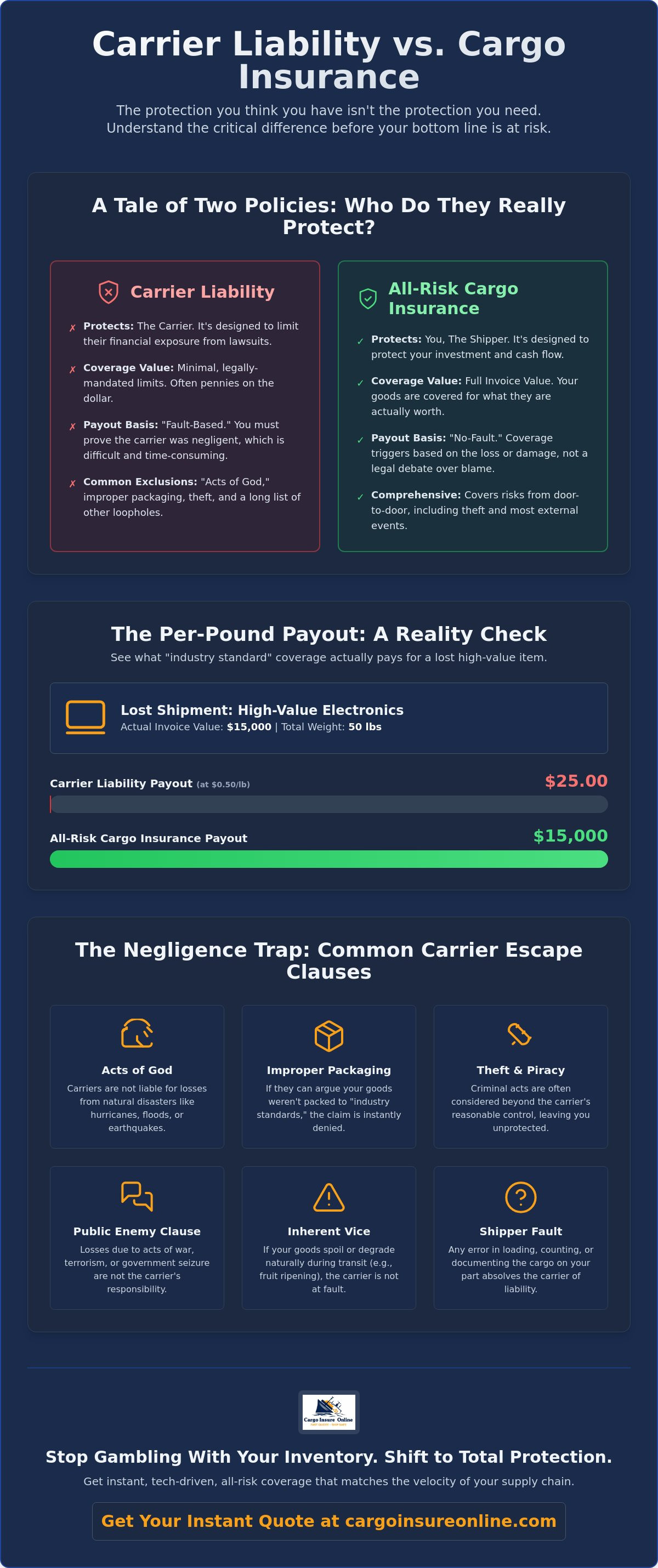
Carrier liability isn't a safety net for your business. It's a shield for the carrier. Most shippers assume that because a carrier is "insured," their goods are safe. That's a dangerous myth. Carrier liability is simply the minimum legal baseline required for transporters to cover losses caused by their own errors. It exists to protect the carrier's assets, not your inventory. When you compare cargo insurance vs carrier liability, you're looking at two entirely different worlds of risk management.
Cargo insurance is a first-party policy you purchase to protect the full commercial value of your freight. It represents a fundamental shift in strategy. Instead of hoping a carrier admits fault, you move the risk off your balance sheet and onto a dedicated insurer. This isn't just a paperwork change. It's a financial upgrade that turns a potential total loss into a manageable line item. In 2026, logistics are too complex for "hope" to be a strategy. The evolution of Marine Insurance has led us to a point where digital-first protection is the only way to keep up with global demand. You need a solution that matches the velocity of your supply chain.
Who is Protected by Which Policy?
It's simple. Carrier liability protects the freight forwarder or the trucker from lawsuits. It limits their exposure so one mistake doesn't bankrupt them. Cargo insurance, however, protects your investment. It ensures your customer relationships stay intact even when things go wrong. The "negligence" hurdle is the biggest trap here. Under carrier liability, you must prove the carrier was directly at fault. If you can't prove their mistake caused the damage, you get nothing. Cargo insurance removes that burden of proof entirely.
Fault vs. No-Fault Coverage
Stop fighting with carriers over who dropped the ball. Cargo insurance bypasses the "at fault" requirement. Whether it's a shipping error or an external event, your coverage triggers based on the damage to the goods, not a legal debate. This means immediate financial recovery instead of months or years of legal battling. You get the funds to replace your stock and keep your business moving. For more on how this applies to high-speed logistics, read What is Cargo Insurance? The Modern Guide to Shipping. You'll see why 2026 demands a faster, smarter approach to cargo insurance vs carrier liability.
The Negligence Trap: When Carrier Liability Fails
Carrier liability is a legal maze designed to keep money in the carrier's pocket. It's built on the idea that they only pay if they were uniquely at fault. But what happens when nature strikes? If a hurricane sinks a ship or lightning strikes a warehouse, carriers invoke "Acts of God." Under these circumstances, you're left holding the bill for destroyed inventory. Even as advancements from Seacoat SCT, LLC work to protect vessel hulls from extreme conditions, nature remains unpredictable. It's a brutal wake-up call for anyone debating cargo insurance vs carrier liability. Nature doesn't care about your balance sheet, and neither does a carrier's legal team.
Packaging is another common landmine. It's the number one reason carriers deny liability claims instantly. If they can argue your box wasn't "industry standard," they're off the hook. The same applies to sophisticated criminal intercepts. High-tech theft and piracy are often considered beyond a carrier's reasonable control. This leaves your high-value electronics or reefer products vulnerable without a first-party policy. Carriers aren't security guards; they're transporters. When a shipment vanishes due to a coordinated hack or a "mysterious disappearance," the carrier simply points to their contract and walks away.
The "Exclusion" List That Costs Shippers Millions
Legal frameworks like COGSA for ocean freight and the Carmack Amendment for trucking provide carriers with a long list of "outs." You can find the deep technical roots of these protections in the Federal Motor Carrier Safety Administration rules. These regulations often prioritize carrier stability over shipper recovery. Force Majeure clauses are essentially a "get out of jail free" card for transporters during major disruptions. Even "latent defects" in electronics, where a component fails due to transit vibration rather than a specific crash, are routinely excluded from liability payouts. You're left with broken tech and zero compensation.
Proving Negligence: A High Bar for Shippers
The burden of proof sits squarely on your shoulders. You don't just have to show the goods are broken. You must prove the carrier was uniquely careless. This is incredibly difficult when the damage happens inside a sealed container or a locked trailer. If you can't point to a specific moment of failure, you're out of luck. General Average is a risk where cargo owners share the cost of a vessel’s loss. This means you could actually owe money to cover a disaster that didn't even destroy your specific goods. It's a chaotic, archaic system. To avoid these legal traps, smart shippers secure comprehensive protection before the first mile begins. Don't let a misunderstanding of cargo insurance vs carrier liability sink your quarterly margins.
The Per-Kilo Nightmare: Calculating Your Real Payout
Stop counting your inventory by its value. When you rely on carrier liability, the industry only counts its weight. This is the most painful lesson in the cargo insurance vs carrier liability debate. Carriers don't care if a box contains high-end semiconductors or scrap metal. They pay by the kilo. If your freight is light and expensive, you're walking a financial tightrope without a net. It’s a system designed for bulk commodities, not the high-value speed of 2026 commerce.
The numbers are staggering. Under the Montreal Convention for air freight, the liability limit is 26 Special Drawing Rights (SDR) per kilogram. For ocean freight, the Hague-Visby rules are even more restrictive, often capping at just 2 SDR per kilo or $500 per package under COGSA. Carriers rely on these strict weight-based limits and numerous exceptions to carrier liability to minimize their risk. Cargo insurance flips the script. It covers the full invoice value plus freight costs and taxes. You get paid for what the goods are actually worth, not what they weigh on a scale.
The Math of a Denied Claim
Let's look at the reality of a 1,840-pound shipment of electronics. If this shipment is lost in a domestic LTL (Less-Than-Truckload) incident, the carrier’s "released rate" might limit their liability to just $0.50 per pound. That’s a payout of only $920 for a shipment that could easily be worth $50,000. You’re left with a $49,080 hole in your balance sheet. With cargo insurance, you’d receive the full $50,000. For a deeper dive into tech-specific risks, check out our Electronics Shipping Insurance: The 2026 Guide. Don't let a heavy loss happen because of light freight.
SDRs and International Treaties
What are Special Drawing Rights? Think of them as a "global currency" used by the International Monetary Fund. They fluctuate daily, making it impossible to know your exact coverage limit until the moment of the loss. Navigating this complexity requires a law degree you shouldn't have to earn. E-commerce sellers are at the highest risk here. Small, high-value items like smartphones or drones are the perfect targets for weight-based payout caps. Understanding the financial disparity in cargo insurance vs carrier liability starts with the scale. If you're shipping anything more valuable than a box of bricks, the weight-based model is a losing game.
All-Risk Cargo Insurance: The Modern Shipper’s Shield
The "per-kilo" nightmare ends here. If you’re tired of the weight-based gamble, All-Risk cargo insurance is your definitive solution. It’s the ultimate upgrade for any business that values its inventory over industry excuses. Unlike the restrictive caps of carrier liability, this coverage is built for the modern economy. It doesn’t matter if you’re shipping microchips or high-end drones; your protection is based on the actual value of your invoice. This is the core difference in cargo insurance vs carrier liability. One protects the transporter’s wallet, while the other secures your entire supply chain.
Why settle for "Named Perils" when you can have it all? Traditional policies only cover specific disasters listed in the contract. If it’s not on the list, you aren’t covered. All-Risk insurance covers everything not specifically excluded in the policy. This proactive approach is essential for brand protection. When a shipment goes missing, your customer doesn’t care about the Montreal Convention or carrier negligence. They want their product or their money back. High-speed claims mean you can refund or replace items in days, keeping your reputation spotless while your competitors are still filing paperwork.
Comprehensive Coverage for Every Mode
Your business doesn't stop at the port, and neither should your insurance. Modern trade requires unified protection that follows your freight from the factory floor to the customer's doorstep. This includes specialized riders for Drones Insurance, Mobile Phone Insurance, and Electronics & High-Value Devices Insurance. Whether it's Air Freight Insurance or Trucking Insurance, you need a single, seamless shield. For founders looking to scale without the stress, check out Cargo Insurance for Small Business. It’s the blueprint for building a resilient 2026 brand.
The Claims Advantage
Speed is the new currency in global logistics. While carrier liability claims often drag on for six months or more, digital-first insurance moves at the speed of light. You avoid the adversarial relationship that usually happens when you try to prove a carrier was at fault. Instead of fighting with a trucking company, you work with a partner dedicated to your recovery. It’s about removing friction and keeping your cash flow healthy. Ready to ditch the bureaucratic delays? You can get an instant quote today and see how easy cargo insurance vs carrier liability can be when you have the right technology on your side.
CIO: Instant, Tech-Driven Protection for Global Logistics
Traditional insurance is broken. It is slow, manual, and buried in fine print. Cargo Insure Online (CIO) fixes this. We have replaced the dusty filing cabinet with high-speed automation. Our AI-driven platform generates instant quotes, moving at the same velocity as your business. When you weigh cargo insurance vs carrier liability, the choice becomes clear. One is a relic of the past. The other is a digital-first ally for the future. We don't just provide a policy. We provide a competitive edge for your entire supply chain.
Our focus is specialized because your freight is unique. We have deep expertise in Electronics & High-Value Devices Insurance and Reefer Product. We understand the specific risks of shipping high-tech assets across borders. For those who need to bake protection directly into their logistics stack, we offer White Label Solutions and API integrations. Whether you are a freight broker or a scaling e-commerce brand, our technology scales with you. Our global reach covers shipments from Asia to the Americas. We provide local support that actually understands your market. No more waiting for time zones to align. Just fast, transparent protection.
Why Modern Founders Choose Cargo Insure Online
Founders don't have time for friction. They need results. We have eliminated the administrative burden of calculating freight insurance premiums. Our platform is built for growth. It handles everything from Drones Insurance to Mobile Phone Insurance with surgical precision. There is a profound sense of relief in knowing your most valuable assets are fully covered. You focus on building your brand. We handle the risk. It is the smart way to navigate cargo insurance vs carrier liability in 2026. We turn a complex legal headache into a simple, positive business decision.
Get Protected in Seconds
Insurance shouldn't be a chore. It should be a seamless part of your digital workflow. Stop crossing your fingers every time a truck leaves the dock. Ditch the gamble of carrier liability and embrace the certainty of modern protection. Your bottom line is too important to leave to chance. Are you ready to transform your logistics strategy? Get your instant cargo insurance quote now and experience the future of shipping safety. It is time to stop waiting and start winning.
Secure Your Future in Seconds
The weight-based math of the past is a liability your brand can't afford. You've seen how standard carrier contracts prioritize the transporter, leaving you with pennies for high-value losses. Transitioning to an all-risk model isn't just about protection; it's about speed and customer trust. When you compare cargo insurance vs carrier liability, the winner is always the business that controls its own risk. We've replaced the old-school bureaucracy with a digital-first shield that moves as fast as you do.
Cargo Insure Online makes this transition effortless. We offer instant AI-driven quoting and global coverage for high-value electronics and drones. If you're a logistics partner, our white-label solutions integrate directly into your workflow. No more administrative chores. No more legal jargon. Just total financial peace of mind and faster payouts. It's time to treat your freight with the respect it deserves.
Stop the gamble—get an instant All-Risk quote today
Your supply chain is the heartbeat of your business. Keep it strong, stay protected, and keep moving forward with confidence. The future of logistics is frictionless, and we're ready to help you lead the way.
Frequently Asked Questions
Is carrier liability enough for international shipping?
No, carrier liability is a legal baseline designed to protect the transporter, not your inventory. International treaties like the Montreal Convention use weight-based caps that often pay out only a tiny fraction of what high-value cargo is actually worth. Choosing cargo insurance vs carrier liability ensures you are covered for the full commercial value. You get protection that ignores the carrier's legal "outs" and focuses on your bottom line.
How much does cargo insurance usually cost compared to liability?
Carrier liability is often "included" in your shipping rate, but it offers almost zero real protection for expensive goods. Cargo insurance premiums are typically calculated as a small percentage of your shipment's total declared value. This investment is marginal compared to the risk of a total loss. It transforms an unpredictable financial threat into a fixed, manageable cost. You get comprehensive protection that covers the massive gaps where standard liability fails.
Does cargo insurance cover "Acts of God" like hurricanes?
Yes, an All-Risk cargo insurance policy covers natural disasters including hurricanes, earthquakes, and lightning. Carriers are legally exempt from liability during these events because they are considered beyond their control. Without your own policy, a storm at sea could result in a total financial loss for your business. All-Risk coverage ensures you stay protected even when nature is at its worst. It removes the "negligence" requirement that makes carrier claims so difficult.
Can I buy cargo insurance if I am using a freight forwarder?
You can and should buy your own cargo insurance even when working with a freight forwarder. While many forwarders offer their own basic coverage, it may not match the specific needs of high-value tech or e-commerce inventory. Securing your own policy through a digital-first provider gives you direct control over the claims process. It eliminates the middleman. It ensures your interests are the top priority if something goes wrong during transit.
What is the "per package" limit for ocean freight in 2026?
The "per package" limit for ocean freight remains capped at $500 under the Carriage of Goods by Sea Act (COGSA) for shipments to or from the United States. This archaic limit means a container filled with expensive drones is treated the same as a box of low-value scrap. Relying on this cap is one of the biggest risks in the cargo insurance vs carrier liability debate. All-Risk insurance bypasses these limits entirely and covers your full invoice value.
How long does it take to get a claim paid with all-risk insurance?
All-risk insurance claims are typically resolved in a matter of days or weeks when using a digital-first provider. In contrast, carrier liability claims often drag on for six months or longer as the carrier investigates their own negligence. Fast payouts are essential for maintaining your cash flow and replacing inventory quickly. We prioritize speed and clarity to ensure your business doesn't skip a beat after a transit incident.
Do I need specialized insurance for shipping electronics or drones?
Specialized insurance is critical for electronics and drones because they are prime targets for theft and transit damage. Standard carrier liability is notoriously inadequate for lightweight, expensive tech due to weight-based payout caps. You need a policy that understands the unique risks of the electronics sector. This includes coverage for "latent defects" caused by transit vibration and protection against sophisticated criminal intercepts that carriers routinely exclude from their contracts.
What happens if my carrier goes bankrupt during a claim?
If a carrier goes bankrupt during a liability claim, you become an unsecured creditor in a long legal line and will likely receive nothing. However, when you have your own cargo insurance, your claim is with the insurance company, not the carrier. Your payout remains secure regardless of the carrier's financial health. This provides a vital layer of insulation against the volatility often seen in the global trucking and shipping industries.


