
Stop treating your high-value electronics like a coin toss. You think checking the "Declared Value" box on your shipping form means your inventory is safe. It's a lie. That box is a legal ceiling for the carrier, not a safety net for your business. When you weigh the merits of declared value vs cargo insurance, you're choosing between a bureaucratic nightmare and actual financial recovery. Most shippers realize this too late, usually after a pallet of premium tech vanishes and the carrier points to the fine print.
We understand the anxiety of global logistics. The fine print is dense; the fear of a rejected claim is constant. You want the relief of knowing a lost shipment won't wreck your quarterly margins. This article reveals why "Declared Value" is a legal technicality and how to secure real protection that pays out fast without the "burden of proof" struggle. We'll break down carrier liability limits, the hidden traps in shipping forms, and the streamlined path to total peace of mind.
Key Takeaways
- Stop mistaking a liability cap for a safety net. Learn why checking the "Declared Value" box often leaves your high-value inventory exposed.
- Navigate the debate of declared value vs cargo insurance with a clear focus on financial recovery rather than legal technicalities.
- Protect your electronics from "Acts of God" and concealed damage that traditional carrier liability simply won't cover.
- Shift the burden of proof. Discover how cargo insurance pays out for loss or damage regardless of whether the carrier was at fault.
- Transform an administrative chore into a competitive edge with instant, frictionless digital solutions that eliminate the paperwork nightmare.
The Declared Value Trap: Why That Little Box Isn't Enough
Checking that box on your shipping form feels like buying peace of mind. It isn't. You're simply paying to raise a legal ceiling. Most shippers assume they've bought coverage. They haven't. They've just negotiated a higher limit on how much the carrier is allowed to lose before they stop paying. When evaluating declared value vs cargo insurance, many businesses realize the truth too late, usually after a high-value shipment disappears into a logistics black hole. It's a subtle distinction with massive consequences for your bottom line.
Carriers love exemptions. If a hurricane hits the port or a labor strike halts the rails, the carrier isn't liable. These are "Acts of God" or "Force Majeure" events. Under declared value rules, you're left holding the bill for the total loss. The carrier walks away legally unscathed. This is the fundamental flaw in the declared value vs cargo insurance debate; one is a shield, the other is just a bigger bucket for the carrier's excuses. You aren't buying safety. You're buying a more expensive way to get told "no."
What is Declared Value exactly?
Declared Value is a contractual limit on carrier liability that defines the maximum dollar amount a carrier is responsible for if they lose or damage your freight. On a Bill of Lading, you'll see "Released Value." This is the base rate, often a measly amount like $0.50 per pound. Checking "Declared Value" raises that number. But don't be fooled by the "valuation fee" they charge. It looks like an insurance premium. It feels like an insurance premium. It isn't. That fee doesn't buy you a policy; it just funds the carrier's increased risk of being sued for their own mistakes.
The 'Negligence' Hurdle
This is where things get messy. Under the Carmack Amendment for domestic trucking and COGSA for international sea freight, carriers are only liable if you can prove they were negligent. You are the detective. You must provide evidence that the carrier's specific actions caused the damage. The paperwork alone is a full-time job. You'll spend weeks chasing drivers and warehouse managers for statements that never come. It's a friction-heavy process designed to wear you down until you abandon the claim.
Think about high-value electronics. If a server arrives with internal components rattled loose but the box looks pristine, how do you prove "negligent handling"? You can't. The carrier will claim the packaging was insufficient or the damage was pre-existing. Without a "smoking gun," your claim dies on the vine. You're paying for the right to fight a legal battle you'll likely lose. It's an illusion of protection that evaporates the moment you actually need it.
Cargo Insurance: The 'All-Risk' Shield for Modern Logistics
Carrier liability is a shield for the carrier. Cargo insurance is a shield for you. When you evaluate declared value vs cargo insurance, the most critical shift is who the policy actually serves. Insurance protects the physical integrity of your goods, not the carrier's legal standing. It's the difference between hoping a carrier admits a mistake and knowing your financial interest is secured by a binding contract. You aren't just paying for a promise; you're buying a financial floor for your business operations.
All-Risk coverage is the gold standard for a reason. It doesn't wait for a courtroom to decide who was at fault. It triggers the moment your inventory leaves the warehouse and stays active until the final mile is completed. Traditional carrier valuation leaves you exposed to the "General Average" nightmare. If a ship captain jettisons cargo to save a vessel during a storm, every shipper on that boat is legally required to pay for the lost goods. Without a dedicated policy, you're on the hook for a share of someone else's disaster. With insurance, your provider covers the bond and the payout instantly.
Shipper's Interest: Protecting Your Bottom Line
A direct contract with an insurer changes the entire claims dynamic. Securing international cargo insurance means you don't have to navigate the carrier's internal bureaucracy to get paid. All-Risk policies cover external causes that carriers routinely dodge, including theft, fire, and catastrophic loss during transit. You get a clear, transparent framework for recovery. It's a proactive strategy that replaces the anxiety of "maybe" with the certainty of "covered."
Specialized Protection for High-Value Tech
Modern supply chains run on high-value hardware. For businesses moving drones or mobile devices, electronics shipping insurance is a non-negotiable requirement. These items are prime targets for theft and are notoriously fragile. A carrier's declared value limit won't account for the full market price or the business disruption caused by a lost shipment. We also recommend integrating GAP insurance into your risk management plan to cover the difference between carrier limits and the actual replacement cost of your tech.
Speed is a feature, not an afterthought. Third-party claims are processed through digital platforms designed for efficiency, often paying out in days rather than months. You can get an instant quote and secure your next shipment in seconds. Stop wasting time on paperwork and start focusing on growth. The modern logistics landscape moves too fast for slow, bureaucratic carrier claims. Choose the digital-first path to total peace of mind.
The Showdown: Declared Value vs. Cargo Insurance
It's time to put them in the ring. When you analyze declared value vs cargo insurance, the winner depends on whether you want a legal argument or a check in the bank. Most shippers focus on the upfront cost, but the real price tag is hidden in the payout structure. Carriers typically pay out based on the depreciated market value of your goods. If your tech is six months old, you aren't getting the replacement cost. Cargo insurance flips the script. It covers the full invoice value plus freight costs, often adding an extra 10% to cover your administrative headaches. This "CIF + 10%" standard ensures your business doesn't just survive a loss; it recovers completely.
The "General Average" risk is the ultimate tie-breaker for ocean shippers. If a vessel experiences a mid-sea emergency, the maritime law of General Average can be declared. You become legally responsible for a portion of the costs to save the ship, even if your specific cargo is fine. Declared value offers zero protection here. You'll be forced to post a cash bond just to get your goods released from the port. Insurance providers handle this bond and the subsequent payout automatically. You stay focused on your customers while the experts handle the maritime mess.
Liability Limits vs. Full Valuation
Carrier liability is often a race to the bottom. They use "per pound" limits that make sense for scrap metal but are insulting for high-value electronics. If you ship a five-pound box of premium smartphones worth $5,000, a standard carrier might cap their liability at $100. That's a catastrophic gap for your balance sheet. Our sea freight insurance solutions replace these arbitrary caps with full valuation. We also cover the "Exclusions" list that carriers won't touch, such as strikes, riots, or civil commotion. You get total protection, not a list of excuses.
The Claims Experience: Bureaucracy vs. Digital Speed
The carrier isn't your friend. They're your adversary. Carrier claims departments are notorious for a "denial by default" strategy. They'll drag out the process for 90 days or more, buried in a mountain of physical paperwork and requests for "additional proof." It's a friction-heavy nightmare designed to make you give up. Modern digital insurance is different. We act as your advocate, not your opponent. By using automated workflows and digital documentation, we slash claim times from months to days. You get a transparent, high-speed experience that respects your time and your cash flow. Stop playing defense with carriers and start playing offense with a partner that values your success.
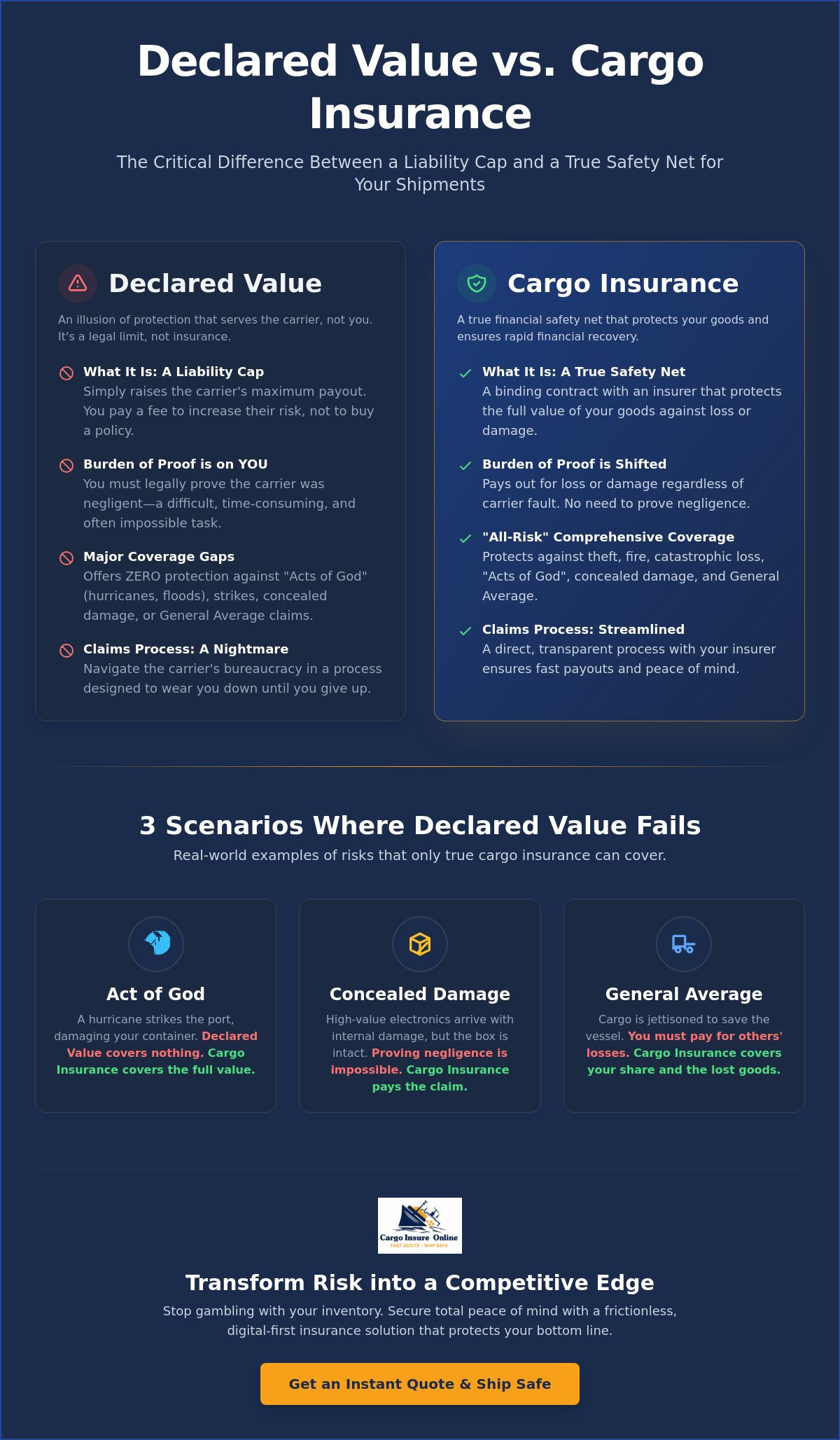
3 Scenarios Where Declared Value Will Fail You
Carrier contracts are built to protect the carrier, not your inventory. If you're still debating declared value vs cargo insurance, consider these common logistics traps where your perceived protection vanishes instantly. Carrier liability is a fragile agreement. It breaks the moment a situation becomes complicated, expensive, or inconvenient for the freight company. You think you're covered until the first real crisis hits. Then, the fine print becomes a wall between you and your money.
Theft without force is a frequent nightmare for electronics shippers. If a single high-end smartphone disappears from a pallet but the shrink-wrap looks intact, carriers label it a "mysterious disappearance." They won't pay. They'll claim the item was never there or was lost during your own internal handling. Without proof of a physical break-in or carrier negligence, your declared value is worthless. You're left with a hole in your inventory and a hit to your quarterly margins. This is the brutal reality of the declared value vs cargo insurance divide; one requires a smoking gun, the other just requires proof of loss.
The 'Act of God' Loophole
Force Majeure is a legal clause that frees carriers from liability for extraordinary events beyond their control, such as natural disasters, strikes, or political unrest. If a freak storm floods a terminal or a hurricane sinks a container, the carrier isn't paying a dime. They'll point to the weather report and close your claim file before the clouds even clear. Our air freight insurance eliminates this excuse. We cover your goods regardless of the weather forecast or the carrier's inability to control the elements. You get paid even when nature strikes.
Concealed Damage in Electronics
High-end tech is incredibly sensitive to vibration and temperature. If a cooling unit fails or a pallet is rattled too hard, the damage is often internal. The box arrives looking perfect. Your warehouse team signs the delivery receipt. Only later do you discover the internal circuits are fried. The carrier will deny the claim instantly because you "accepted" the goods in good condition. This is why reefer cargo insurance is vital for maintaining cold chain and tech integrity. You need coverage that accounts for the reality of modern logistics, not just the visible exterior of a cardboard box.
Stop leaving your revenue to chance and secure your freight now with a policy that actually pays. Don't let a legal loophole turn your high-value shipment into a total loss.
Ship Smarter: The CIO Frictionless Insurance Advantage
Stop playing "Liability Roulette" with your freight carriers. Every time you rely on carrier valuation, you're gambling your inventory on a system designed to deny you. The declared value vs cargo insurance debate isn't just about cost; it's about control. Carriers want you stuck in a cycle of paperwork and delays. We offer a modern, disruptive alternative. It's time to move past the bureaucratic hurdles of the 20th century and embrace a digital-first shield that actually works.
Digital-first claims are our secret weapon. While carriers use "denial by default" to protect their margins, we use automation to protect yours. Speed is a feature of our platform. We've eliminated the 90-day waiting game. Our claims process is transparent, logical, and incredibly fast. You get paid, you restock, and you keep moving. No friction. No excuses. Just the high-speed results your business deserves in a global market that never sleeps.
Integration and Automation
We've removed the friction from the booking process entirely. Our sophisticated API and white-label solutions allow you to integrate protection directly into your existing workflow. There's no manual entry and no room for human error. Whether you're moving massive shipments or individual high-value items, our system scales with you. We provide tailored coverage for high-value assets like drones and mobile phones, ensuring every device is secured from warehouse to doorstep. It's the relief of knowing your most fragile tech is backed by an "All-Risk" guarantee, not a carrier's legal loophole.
Your Next Move: Real Protection
Don't just check a box on a shipping form. Secure your business's future with a partner that values your time. The ROI of choosing dedicated insurance over carrier valuation fees is clear; you save money on premiums and avoid the catastrophic costs of unrecovered losses. You've seen how declared value vs cargo insurance plays out in the real world. One leaves you exposed to "Acts of God" and "General Average" bonds. The other provides a financial floor that lets you scale with confidence. It's time to stop worrying about the "what ifs" and start focusing on your growth.
The choice is simple. You can stay trapped in the carrier's liability maze, or you can switch to a frictionless, automated solution. Get an instant cargo insurance quote and stop worrying about your next shipment. Join the ranks of tech-savvy shippers who have traded liability roulette for total peace of mind.
Take Control of Your Supply Chain Risk
You've seen the reality of the declared value vs cargo insurance showdown. One is a legal maze designed to protect the carrier; the other is a financial shield built for your bottom line. Stop letting "Acts of God" or "mysterious disappearances" dictate your quarterly margins. Real protection means having a contract that pays out when tech fails or ships stall, regardless of carrier negligence. You deserve a partner that prioritizes your recovery over their legal fine print.
We've simplified the complex. Our platform delivers global coverage for air, sea, and land with specialized tech and reefer protection that carriers simply won't touch. You get a fast digital claims process that respects your time and keeps your operations moving. No more friction. No more "denial by default." Just the relief of knowing your inventory is secured by experts who act as your advocate. It's time to trade bureaucratic nightmares for digital-first certainty.
Ready to ditch the liability trap? Secure your freight with an instant CIO quote today and experience the difference. Your business moves fast; your insurance should too.
Frequently Asked Questions
Is declared value the same as shipping insurance?
No. Declared value is merely a request to increase the carrier's maximum financial liability for your shipment. It isn't a policy. It doesn't guarantee a payout. True cargo insurance is a separate contract that protects the physical value of your goods regardless of the carrier's legal standing or internal rules.
What does 'All-Risk' cargo insurance actually cover?
All-Risk covers any physical loss or damage from external causes during transit. This includes theft, fire, and catastrophic weather events that carriers routinely exclude. It protects your inventory from the moment it leaves the warehouse until it reaches the final destination. It's the gold standard for anyone moving high-value electronics or fragile freight.
Do I have to prove the carrier was negligent to get paid?
With declared value, yes. You must provide evidence that the carrier's specific actions caused the damage. It's a friction-heavy nightmare. Cargo insurance removes this burden of proof entirely. You only need to prove that the loss or damage occurred during the covered transit period. We handle the recovery while you focus on your business.
How much does cargo insurance cost compared to declared value?
Dedicated insurance is often more cost-effective than carrier valuation fees. Carriers charge high fees to pad their own risk management budgets. Third-party providers offer competitive rates based on actual risk factors and your specific cargo type. When comparing declared value vs cargo insurance, you'll find that insurance offers broader protection for a much smarter investment.
What is General Average and does declared value cover it?
General Average is a maritime law requiring all shippers on a vessel to share the costs if cargo is sacrificed to save the ship. Declared value offers zero protection for these shared costs. You'd be forced to post a cash bond just to get your goods released. Only cargo insurance covers these bonds and the subsequent payouts automatically.
Can I buy cargo insurance for just one shipment?
Yes. You can secure "spot" coverage for a single high-value shipment or set up an open policy for recurring freight. Our digital platform makes the process near-instantaneous. You get the same All-Risk protection without being forced into a long-term contract. It's about giving you the flexibility to protect your bottom line on your own terms.
What if my high-value electronics are damaged but the box looks fine?
Carriers will likely deny this as "concealed damage" because the exterior packaging is pristine. They'll claim the damage was pre-existing or caused by poor internal packing. Cargo insurance accounts for the reality of modern logistics. It covers internal failures caused by transit vibrations or temperature shifts that don't leave a mark on the cardboard box.
Why do carriers have liability limits at all?
Carriers use liability limits to cap their financial exposure to a small fraction of your goods' actual value. It's a self-preservation tactic. These limits are often based on weight rather than worth, which is catastrophic for electronics shippers. Dedicated insurance replaces these arbitrary caps with a financial floor based on the actual invoice value of your inventory.


