Your carrier’s liability isn't a safety net. It's a financial trap. When a shipment of high-value drones or sensitive reefer goods hits a snag, relying on standard limits often means recovering just $500 per ocean package or $20 per kilogram for air freight. That isn't protection. It's a rounding error that stalls your momentum and leaves your balance sheet vulnerable. Securing robust international cargo insurance shouldn't feel like a bureaucratic chore defined by opaque terms and endless paperwork.
We know the frustration of slow claim processes that halt your operations and complex forms that fail to account for specialized tech. You deserve a digital-first solution that moves as fast as your supply chain. This guide empowers you to master the complexities of global logistics and discover how to protect your assets with zero-friction digital insurance. We will explore how to secure instant quotes, bypass the limitations of traditional carriers, and ensure full financial protection for the entire door-to-door journey. It is time to transform your risk management into a seamless competitive advantage.
Key Takeaways
- Ditch the carrier liability trap. Learn why "per-kilo" limits are a financial disaster for your high-value shipments.
- Tailor your protection. Discover how to bridge coverage gaps for air, sea, and land freight with mode-specific clauses.
- Master international cargo insurance. Secure full financial protection for the entire door-to-door journey without the bureaucratic lag.
- Guard your sensitive assets. Get the blueprint for protecting high-tech devices and specialized reefer goods in a volatile market.
- Move at digital speed. Find out how to get a world-class insurance quote in minutes so you don't waste time on brokers.
What is International Cargo Insurance and Why Does it Matter in 2026?
International cargo insurance is your end-to-end financial shield. It ensures that goods moving across borders don't just travel; they arrive with your balance sheet intact. In 2026, the logistics world has shifted into a higher gear. Speed is the new baseline, but faster transit times have ushered in more complex risks. Geopolitical tensions, climate-driven delays, and sophisticated theft rings mean your cargo is more exposed than ever before. Standard protection is no longer a viable strategy for high-speed logistics. It's too slow, too thin, and too fragile for the modern era.
We've moved past the age of dusty folders and bureaucratic delays. Traditional insurance was an administrative chore that felt like an anchor on your operations. Today, the industry has pivoted toward automated digital coverage. Modern protection is an instant, intelligent layer that integrates directly into your digital workflow. It's about removing friction and replacing uncertainty with a seamless, positive experience that respects your time and your growth targets.
The Core Difference: Carrier Liability vs. All-Risk
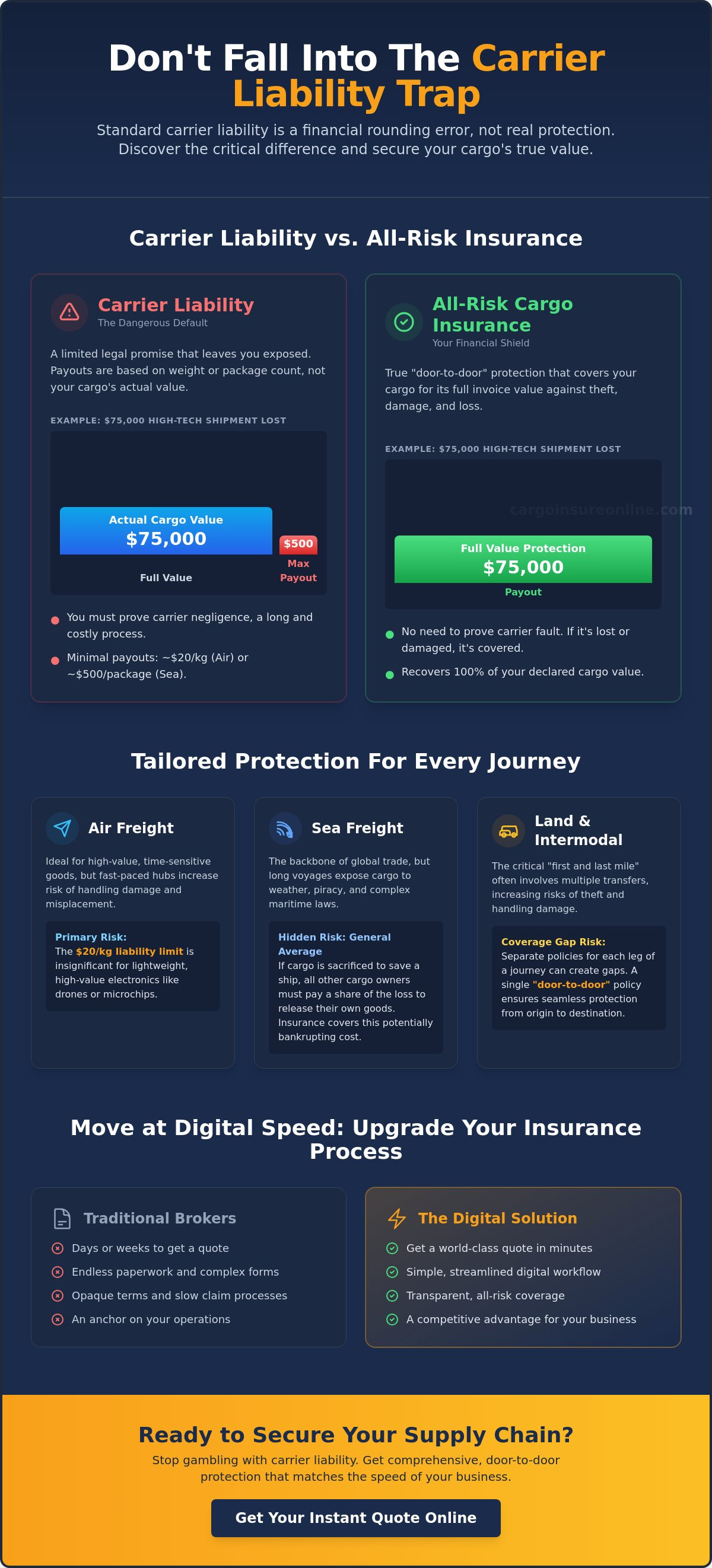
Many shippers fall into the trap of confusing carrier liability with actual insurance. It isn't the same thing. Carrier liability is a limited legal promise, not a comprehensive safety net. If your goods are damaged, the "per-kilo" rule kicks in. This often results in payouts of just $20 per kilogram for air freight, even if the electronics inside are worth thousands. That's a massive financial gap that can derail your entire quarter.
Cargo protection is a specialized branch of Marine insurance, and it has evolved to meet the demands of 2026. While carrier liability requires you to prove the carrier was negligent, all-risk coverage flips the script. It's the only way to ensure 100% value protection against theft, damage, and loss. You don't waste months in legal battles. You get your payout, protect your margins, and keep your business moving forward.
The Financial Impact of Uninsured Freight
The true cost of a lost shipment goes far beyond the invoice value. You have to account for lost opportunities, derailed production schedules, and the damage to your brand's reputation. One of the most dangerous risks is "General Average." This maritime law requires all cargo owners to share the cost if a ship's loss is prevented by intentional sacrifice. If a vessel runs aground, you could be forced to pay for the salvage of everyone else's goods just to release your own.
For an unshielded business, a single General Average event can lead to bankruptcy. Protecting your cash flow in a volatile market is non-negotiable. Real-time digital insurance turns a potential catastrophe into a manageable line item. It's about being a sophisticated ally to your own business, ensuring that your capital stays where it belongs: in your pocket.
Tailoring Coverage to Your Freight Mode: Air, Sea, and Land
Global trade in 2026 is an intermodal sprint. Your goods might start on a ship, jump to a truck, and end on a plane. Each leg of that journey presents a different set of hazards. A single, static policy won't cut it. You need a dynamic approach to international cargo insurance that adapts to the specific risks of each transit mode. Understanding What Is Cargo Insurance means recognizing that a container on the high seas faces different threats than a pallet in a high-velocity air hub. Traditional insurance models treat every shipment the same. We don't.
Air Freight: Speed Meets Security
Speed is the primary goal, but it comes with a premium risk profile. Air cargo often involves high-value electronics or time-sensitive pharmaceuticals where the "per-kilo" liability limit of $20 is practically insulting. Integrating specialized air freight insurance is non-negotiable for these shipments. High-velocity hubs like Memphis or Hong Kong move fast. This speed increases the chance of rough handling or "misplacement" during airport-to-door transitions. You need limits that reflect the tech-heavy reality of 2026, where a single lost drone shipment can cost more than a standard carrier's annual liability cap. Typical air freight insurance rates hover between 0.2% and 0.5% of cargo value, a small investment to secure such high-speed assets.
Sea Freight: Navigating the High Seas
Ocean transit is the backbone of global trade, but it's also where the most dramatic losses occur. From containers being swept overboard in heavy weather to the ancient, yet very real, threat of General Average, the risks are massive. With standard sea freight insurance, you aren't just protecting your own goods; you're shielding your business from being forced to pay for everyone else's losses. Most ocean shipments in 2026 are insured at 0.3% to 0.8% of their value. This provides "Warehouse to Warehouse" protection that ensures your coverage doesn't vanish the moment the ship docks. It's about closing the gap between the port and your customer's hands.
Trucking: The Vital Inland Link
The "final mile" is often the most dangerous part of the journey. Hijacking and theft remain significant risks in global trucking corridors, especially for electronics and mobile devices. If your international policy stops at the port, you're flying blind during the most vulnerable stage of delivery. Inland marine coverage ensures your protection extends through the loading and unloading process. Don't let a forklift accident at the destination warehouse wipe out your profits. It's easy to view your coverage options and ensure every mile of the journey is accounted for. We prioritize clarity over complexity, making it simple to secure your entire supply chain in one digital move.
The 'Per-Kilo' Trap: Why Carrier Liability Isn’t Enough
Carriers aren't insurance providers. They're logistics companies protected by a web of international treaties designed to limit their financial exposure. If your cargo is crushed, stolen, or lost at sea, the carrier doesn't owe you the replacement value of your goods. They owe you a predetermined amount based on weight or package count. This is the "Per-Kilo" trap, and it's a primary reason why international cargo insurance is a non-negotiable requirement for modern trade. Relying on a carrier's limited legal promise is a gamble where the house always wins.
The burden of proof is the second hurdle. Under standard liability rules, you must prove the carrier was negligent to even see a cent. If a storm damages your container or a strike halts the port, the carrier can simply point to an "Act of God" or "Force Majeure" clause to walk away. You're left with a total loss while they move on to the next shipment. Before you book your next freight move, you must Know Your Incoterms to understand exactly when your financial responsibility begins. If the risk is on you, the protection must be on you too.
Decoding the SDR and Per-Kilo Limits
Carrier liability is often calculated using Special Drawing Rights (SDR), a basket of international currencies. In practical terms, this translates to roughly $20 per kilogram for air freight and $500 per package for ocean freight. Imagine you're shipping a 25kg crate of high-end electronics worth $50,000. If that crate disappears in an air hub, the carrier’s maximum liability is just $500. That is a 99% financial hit to your business. Declaring a higher value with the carrier is rarely the answer; it's often more expensive and comes with the same bureaucratic red tape when you try to collect.
The Benefit of First-Party Insurance
First-party international cargo insurance flips the script by removing the carrier from the middle of your claim. You don't have to prove they were at fault. You don't have to wait for their legal team to finish an internal investigation. If the damage is covered by your all-risk policy, you get paid. It's that simple.
- Direct Control: Manage your claims through a digital platform instead of chasing a freight forwarder’s agent.
- Speed: Faster settlements mean your cash flow isn't tied up in legal disputes for six months.
- Total Protection: Cover the full invoice value plus freight costs and a 10% margin for lost profit.
Stop treating your cargo's safety as a secondary thought. Modern logistics requires a digital-first approach that prioritizes your bottom line over a carrier's fine print. Transitioning to all-risk coverage is the only way to ensure a loss doesn't become a business-ending event.
Specialized Protection for High-Value and Sensitive Cargo
Global trade has evolved. We aren't just moving grain and steel anymore. The 2026 market is driven by high-velocity consumer tech and delicate pharmaceuticals. Standard international cargo insurance often fails in these sectors. It doesn't account for the unique vulnerabilities of a drone or a temperature-controlled container. You need a partner that understands the difference between a crate of bricks and a pallet of high-end mobile phones. Sophisticated trade requires sophisticated protection that moves beyond the basics.
Electronics and High-Value Devices
Tech shipping faces the "Concealed Damage" nightmare. The box looks perfect, but the internals are shattered from vibration or drops during transit. Traditional policies often fight you on this, demanding proof of exactly when the damage occurred. We don't. Our Electronics & High-Value Devices Insurance is built to handle these precise risks. Whether it's Mobile Phone Insurance for a bulk shipment or specialized Drones Insurance for UAV equipment, we provide the specific clauses needed for theft prevention and high-tech transit. We focus on specialized packaging requirements and theft-heavy corridors to ensure your high-margin goods are truly safe. If your devices don't power on at the destination, your insurance should kick in immediately without a three-month investigation.
To further reduce the risk of receiving faulty or incorrectly packaged goods from overseas suppliers, many businesses partner with The Inspection Company to conduct thorough quality control and factory audits in Asia before the shipment begins its journey.
Temperature-Sensitive and Perishable Goods
A two-degree shift can destroy an entire shipment of medicine or gourmet food. Protecting the "Cold Chain" requires more than just a standard policy. You need reefer cargo insurance that specifically covers equipment failure and power outages. In 2026, real-time monitoring is the gold standard. If a reefer unit fails mid-Pacific, your insurance should trigger based on sensor data, not just manual logs. This level of Reefer Product coverage is what keeps your supply chain resilient. We prioritize "Equipment Failure" clauses that shield you when the hardware lets you down. It's about turning a potential total loss into a manageable, insured event.
E-Commerce and FBA Shipments
Amazon FBA and Shopify sellers operate on a different timeline. You need to scale fast and meet strict platform requirements that often mandate specific liability thresholds. Our E-Commerce Cargo Insurance is designed for the modern digital entrepreneur. It protects your goods from the factory in Shenzhen all the way to the fulfillment center in Ohio. Don't let a single lost container or a warehouse mishap stall your store's growth. We handle the complex paperwork so you can stay focused on your customers. You can secure your specialized cargo quote in minutes and get back to scaling your brand with total peace of mind.
How to Secure an International Cargo Insurance Quote in Minutes
The legacy insurance model is a relic. Waiting days for a broker to return an email isn't just annoying; it's a risk to your supply chain. High-speed trade demands high-speed protection. Securing international cargo insurance should be as fast as booking a flight. We've stripped away the bureaucracy to give you a 3-step digital process that puts you in control. No more phone tag. No more opaque fee structures. Just instant, all-risk coverage that moves at the speed of your business.
Moving from a "per-shipment" headache to an "open policy" breeze is the ultimate efficiency hack. While single-shipment quotes are great for one-off moves, an annual open cover automates your protection. It covers every shipment you make within a year. You don't have to think about it. You just ship. This is how modern logistics partners stay ahead. We even offer API and white-label solutions for logistics providers who want to embed world-class insurance directly into their own platforms. It is about empowering your team through speed and clarity.
The Digital Quote Checklist
Getting a quote shouldn't feel like an interrogation. You only need a few key data points to start. Having this information ready ensures your journey is frictionless. Most digital platforms in 2026 require just three main categories of data to generate a binding quote.
- Route Details: Know your exact origin and destination.
- Commodity Type: Be specific about whether you're shipping raw materials, electronics, or drones.
- Insured Value: Calculate your total value, typically using the CIF + 10% formula.
Estimating your annual shipping volume can unlock even better rates. If you ship frequently, an annual policy is almost always the smarter financial move. It simplifies your accounting and ensures nothing ever leaves the warehouse uninsured. You get one policy, one point of contact, and total peace of mind.
Why Cargo Insure Online is the Modern Choice
We built this platform for the 2026 trade reality. That means zero paperwork and zero stress. You get instant digital certificates that you can fire off to your banks or partners immediately. Our claims process is equally fast. We don't hide behind legal jargon. We use technology to verify data and settle claims so you can keep your operations running. Transparency isn't just a buzzword for us; it's our operating system. We act as a sophisticated ally that values your time.
Ready to Ship Without the Scare?
Cargo Insure Online eliminates the administrative drag of global trade by replacing slow human brokers with instant, intelligent digital protection. Don't let a "per-kilo" liability trap or a slow claim process hold you back. It's time to trade with confidence. Stop waiting and get your instant cargo insurance quote now!
Secure Your Global Future with Frictionless Protection
The "per-kilo" trap is a relic that belongs in the past. You've seen how carrier liability leaves your balance sheet exposed; especially when you're shipping high-value electronics or temperature-sensitive reefers. Modern trade doesn't wait for manual brokers or dusty paperwork. It demands a digital-first partner that understands the intermodal reality of 2026. Securing international cargo insurance is no longer an administrative chore. It's a strategic move that empowers your bottom line and protects your growth.
Our platform eliminates the friction of global trade through automation and total transparency. Whether you're moving drones by air or bulk containers by sea, you deserve a solution that matches your speed. We provide global protection with zero paperwork and specialized clauses built for the most sensitive cargo. It's time to stop gambling with your freight and start shipping with confidence. Get Your Instant International Cargo Insurance Quote today and experience the relief of total asset protection. Your supply chain is ready to scale. We're here to make sure nothing stops that momentum.
Frequently Asked Questions
Is international cargo insurance mandatory for all shipments?
International cargo insurance isn't a legal requirement like vehicle insurance. However, just as you might check out In The Garage for premium physical protection for your car or motorcycle, cargo insurance is a business necessity. Many banks and global buyers won't sign a contract without it. If you're shipping under CIF or CIP terms, you're contractually bound to provide coverage. Don't let a lack of mandatory status fool you into a total loss. It is about protecting your capital, not just following rules.
What does "All-Risk" cargo insurance actually cover?
All-Risk is the gold standard for protection. It covers any physical loss or damage from external causes. This includes theft, water damage, and rough handling during transit. It doesn't cover inherent vice or poor packaging. It's the only way to ensure your assets are protected from the unpredictable nature of global logistics. You get a safety net that catches almost everything.
How much does international cargo insurance cost in 2026?
Your premium depends on your cargo's value, the shipping route, and the mode of transport. Fragile electronics or high-risk routes naturally influence the final cost. We've replaced the slow broker model with instant international cargo insurance quotes. You get a transparent price in minutes based on your specific risk profile. No hidden fees. Just clear, high-velocity protection for your goods.
What is the difference between cargo insurance and marine insurance?
Marine insurance is the broad umbrella for the entire industry. It covers ships, terminals, and the goods themselves. Cargo insurance is a specialized branch focused exclusively on the items being moved. While protecting your inventory is essential, ensuring that the vessels and transport fleets have a reliable energy source is also a key part of operational resilience; learn more about maritime bunkering and bulk fuel services. Think of marine as the category and cargo as the specific shield for your inventory. It's about protecting what you sell, not just the vessel that carries it across the ocean.
How do I file a claim for damaged international cargo?
Filing a claim is simple and digital. Start by notifying your insurer the moment you spot damage. Take high-resolution photos of the packaging and the goods before moving them. Keep all shipping documents like the bill of lading and commercial invoice. Our platform lets you upload everything in minutes to trigger a fast investigation. Speed is everything when your cash flow is on the line.
Does my insurance cover the "General Average" in sea freight?
Yes, our all-risk policies cover General Average. This ancient maritime law forces all cargo owners to share the cost if a ship's loss is prevented by an intentional sacrifice. Without coverage, you could be on the hook for thousands of dollars to help pay for someone else's salvaged goods. We ensure you aren't paying for other people's mistakes or maritime emergencies.
Can I get insurance for high-value electronics and drones?
We specialize in protecting high-value assets. Standard policies often shy away from drones or mobile phones because the risk is too high. We don't. We offer dedicated Electronics & High-Value Devices Insurance and Drones Insurance. These include specific clauses for concealed damage and theft. Your tech is covered from the moment it leaves the warehouse until it reaches the customer's hands.
What are the Incoterms 2020/2026 and how do they affect insurance?
Incoterms are the international rules that define who pays for what. They dictate exactly when the risk of loss transfers from the seller to the buyer. Terms like CIF (Cost, Insurance, and Freight) require the seller to provide international cargo insurance. Understanding these rules is vital to ensure your goods aren't left in a coverage vacuum. We help you align your protection with your specific contractual obligations.


