In the first quarter of 2026, supply chain crimes drained $131.58 million from businesses across North America. If you're still relying on basic carrier liability to protect your bottom line, you're essentially flying without a parachute. Understanding exactly what is cargo insurance has become the difference between a minor logistics hiccup and total financial ruin. It isn't just about paperwork; it's about survival in a high-speed global market.
You've worked hard to build a seamless supply chain. It's frustrating when complex maritime laws and slow, bureaucratic claims processes make you feel like you've lost control. We get it. You want to move goods, not manage disasters. This guide is your shortcut to total peace of mind during transit. We'll show you how to shield your shipments from modern risks like strategic fraud, cyber-attacks, and climate disruptions. You'll learn why carrier limits are dangerously low and how to leverage smart insurance for near-instant recovery. Let's turn your biggest vulnerability into your strongest competitive advantage.
Key Takeaways
- Master the basics of what is cargo insurance to build a high-speed shield that protects your goods from origin to destination.
- Stop relying on carrier liability; discover why weight-based payouts lead to massive financial gaps and how to avoid the "$50,000 mistake."
- Navigate the "All-Risk" landscape to find broad protection that covers theft, heavy weather, and collisions across air, sea, and land.
- Tailor your coverage to your specific needs, from high-value electronics and reefer products to specialized drone transit.
- Move from administrative friction to instant protection by using modern digital platforms for quotes in minutes, not days.
Defining Cargo Insurance: Your Shield Against Supply Chain Chaos
Logistics used to be predictable. You shipped a container; it arrived. Today, the global supply chain is a high-speed obstacle course. Cargo insurance is the financial safeguard for owners of freight that ensures a lost shipment doesn't mean a lost business. It's a specialized branch of Marine insurance designed to protect the actual value of your goods against physical loss or damage. Whether your inventory is moving by sea, air, or land, this protection covers the entire journey from your origin to the final destination.
When you ask what is cargo insurance in the 2026 market, you aren't just looking for a dictionary definition. You're looking for a digital-first solution. Old-school policies were slow, bureaucratic, and buried in paperwork. Modern coverage is different. It's powered by automation and intelligence. It moves at the same breakneck speed as global trade itself. It replaces the friction of traditional brokerage with instant, transparent protection that actually makes sense for your workflow.
The Core Purpose of Freight Protection
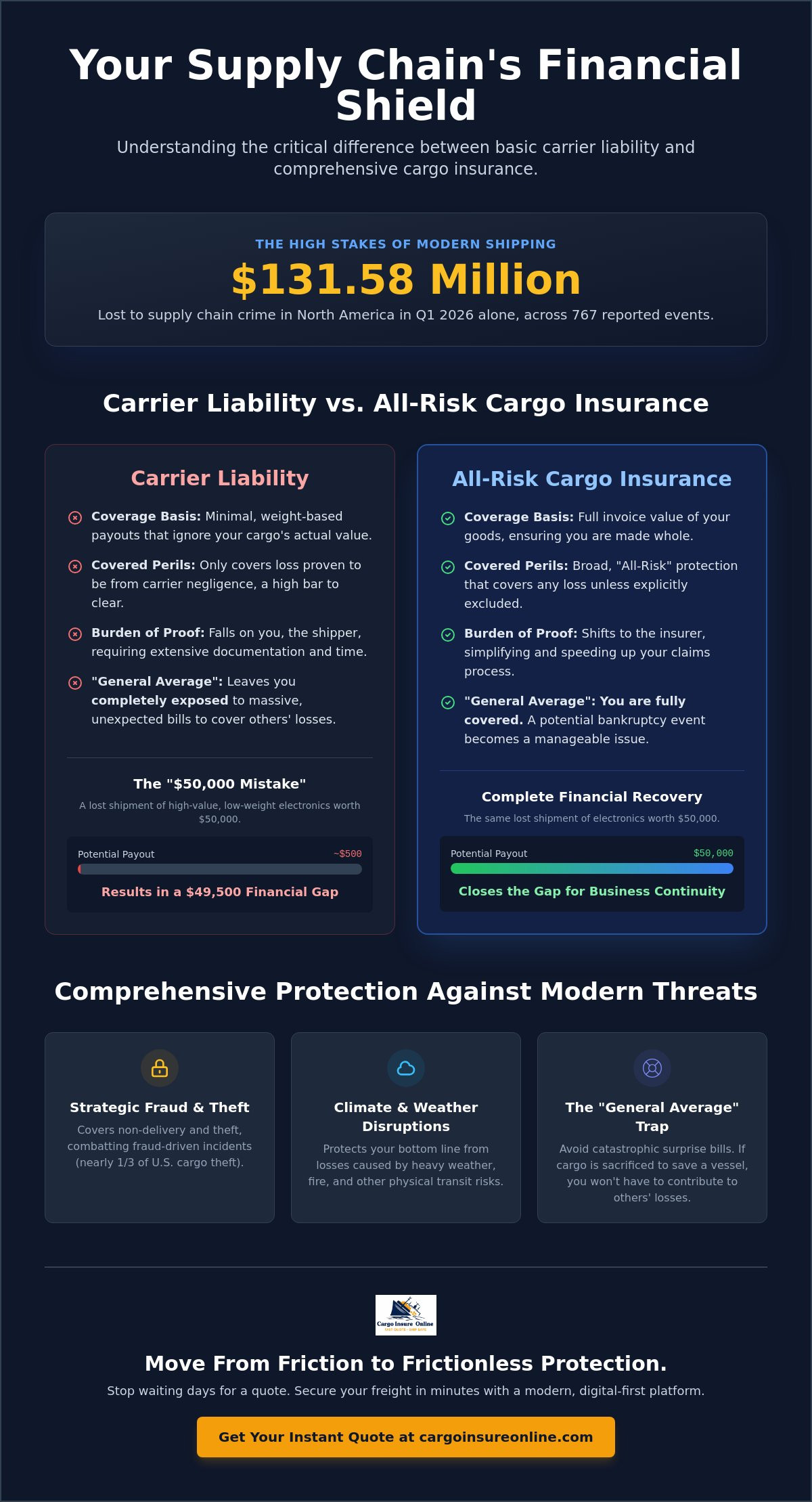
Hope isn't a strategy. In an unpredictable global economy, you can't afford to leave your bottom line to chance. During the first quarter of 2026, North America saw 767 supply chain crime events, resulting in over $131 million in losses. Cargo insurance mitigates this financial risk. It provides the liquid capital you need to keep operating after a major shipping disaster. It's not just about replacing a box. It's about business continuity. It's about moving from anxiety to confident optimism every time a truck leaves the dock.
Who Actually Needs Cargo Insurance?
Ownership equals risk. If you have a financial interest in the goods, you need a shield. Exporters and importers use it to manage the complexities of international trade. E-commerce founders rely on it when moving stock to fulfillment centers. Even freight brokers use it to protect their professional reputations. With strategic fraud now accounting for nearly a third of all U.S. cargo theft incidents, and insider involvement affecting 22% of global cases, the "safe" shipment is a myth. You don't just need a policy; you need a sophisticated ally like Customs and Trade Logistics that understands modern threats and offers a frictionless way to neutralize them.
What Does It Actually Cover? Navigating the All-Risk Landscape
Forget the dusty insurance folders from thirty years ago. Modern shipping requires modern armor. When you're trying to figure out what is cargo insurance in a practical sense, you need to look for "All-Risk" terms. This isn't just a marketing phrase. It's the gold standard for shippers who want to move fast without looking back. While traditional policies only cover specific "named perils," an All-Risk policy flips the script. It covers every possible cause of loss unless it's explicitly excluded. It's the ultimate negation of uncertainty.
Standard inclusions in these modern policies protect you from the heavy hitters: theft, extreme weather, fire, and collisions. But you have to be smart about the fine print. No policy covers "inherent vice," which is insurance-speak for goods that destroy themselves, like fruit that rots because it was already too ripe. Improper packaging is another common pitfall. If your team doesn't secure the load correctly, the insurer won't pay for the resulting damage. You can easily check your specific coverage needs to ensure your packing standards meet the policy requirements.
Then there's the "General Average" trap. This ancient maritime law is a shock to many modern founders. If a vessel faces a life-threatening emergency and the captain sacrifices part of the ship or cargo to save the rest, every cargo owner on board shares the cost. Even if your specific container is untouched, you could be hit with a massive bill to help cover the loss of others. All-Risk coverage absorbs this blow, turning a potential bankruptcy event into a managed line item.
The Anatomy of an All-Risk Policy
Protection goes beyond just major shipwrecks. It covers physical damage from rough handling or shifting cargo during a bumpy flight or a sharp turn on the highway. It also handles total loss scenarios where a vessel or aircraft simply doesn't arrive. With strategic theft and fraud-driven incidents rising, your policy also covers "non-delivery" scenarios where your goods disappear into the digital void of a fraudulent carrier's network.
Specialized Protection for Modern Goods
Generic coverage doesn't work for specialized inventory. If you're moving perishables, you need temperature-sensitive protection for reefer products to guard against cooling unit failures. For those shipping high-value tech, electronics shipping insurance is essential to cover the full market value of mobile devices and hardware. With personal care and beauty product thefts jumping 178% in early 2026, many brands are also adding GAP insurance to cover the "hidden" costs of a loss, like freight charges and anticipated profits, ensuring a claim doesn't just break even, but keeps the business growing.
Cargo Insurance vs. Carrier Liability: The $50,000 Mistake
Don't assume your carrier has your back. They don't. One of the most dangerous misconceptions in logistics is the belief that carrier liability is a substitute for a real policy. It isn't. When you're clarifying what is cargo insurance for your team, start with this: carrier liability is a legal minimum, not a protection plan. It's designed to protect the carrier's bottom line, not yours. If your freight is lost or damaged, the carrier's first priority is to find a loophole that limits their payout to pennies on the dollar.
The "Acts of God" loophole is a classic example. If a violent storm or an "unavoidable" accident damages your goods, the carrier usually isn't legally responsible. They simply point to the weather report and walk away. You're left with a destroyed shipment and zero compensation. Understanding the deep divide between Cargo Insurance vs. Carrier Liability is the only way to avoid a catastrophic financial hit. Real insurance covers you regardless of whether the carrier was at fault. It's the difference between a total loss and a minor delay.
Weight-Based Limits vs. Replacement Value
Carriers don't care about the market value of your inventory. They pay by the pound or the kilo. This "per-kilo" rule is a nightmare for anyone shipping high-value, low-weight items. If you're moving a pallet of high-end mobile phones or electronics, the carrier's liability might only cover 1% of the actual replacement cost. You get a tiny check that doesn't even cover your shipping fees. To make matters worse, the burden of proof is on you. You have to prove the carrier was negligent, which can take months of legal friction and administrative headaches.
The Advantage of First-Party Insurance
Stop fighting with carriers and start winning with first-party protection. When you have your own cargo policy, you bypass the blame game entirely. Your insurer pays you directly for the loss, and then they handle the battle with the carrier behind the scenes. It's frictionless. Payouts are based on the full invoice value of the goods, often including freight costs and an additional 10% to cover lost profit. You get the capital you need to reorder stock and keep your customers happy. There's no need to prove negligence. If the damage happened during transit, you're covered. It's total peace of mind for a digital-first supply chain.
From Drones to Sea Freight: Tailoring Coverage to Your Mode
One size fits all is a relic of the past. In 2026, your protection must be as agile as your logistics strategy. If you're still using a generic policy for every shipment, you're leaving money on the table. Understanding what is cargo insurance means recognizing that a drone delivery in a smart city has different risks than a massive container ship crossing the Pacific. You need a modular approach. You need speed. You need precision. Knowing what is cargo insurance in a multi-modal world is about understanding these nuances before you hit "ship."
Air cargo is all about velocity. It's high-speed coverage for high-speed transit. Because air freight is usually more expensive and time-sensitive, the valuation rules differ significantly from ocean transit. Air Freight Insurance focuses on rapid claims and high-value protection for electronics and pharmaceuticals. On the flip side, Sea Freight Insurance manages the brutal realities of the high seas and the ongoing port congestion that can stall your supply chain for weeks. It's about bulk, endurance, and deep-sea risk management. You aren't just insuring a box; you're insuring a complex journey through international waters.
Air vs. Sea: Different Risks, Different Rules
The choice between air and sea isn't just about cost. It's about the nature of the risk. Air shipments face higher handling frequency but shorter exposure times. Sea shipments deal with moisture, shifting loads, and the ancient legal complexities of General Average. Tailoring your coverage means matching the policy to the transit time and the environmental stressors of the route. It's about ensuring your financial shield is as robust as the vessel carrying it.
E-Commerce and FBA Requirements
Modern founders aren't just shipping boxes; they're scaling brands. If you're a Shopify seller or an Amazon FBA expert, you have specific compliance needs. Amazon's requirements are strict. Shopify's pace is relentless. A tailored Cargo Insurance for Small Business policy ensures you stay compliant without the administrative bloat. For logistics platforms, White Label solutions allow you to offer these protections directly to your users, creating a frictionless ecosystem. Ready to secure your next shipment? Get an instant quote for your specific mode here.
Trucking insurance shields your inland logistics from road accidents and the sharp rise in strategic theft. It’s the backbone of the "last mile." With California remaining a hotspot for cargo theft in 2026, inland transit requires constant vigilance. But the real disruption is happening in the sky. Drone cargo insurance is the new frontier. As autonomous delivery scales, you need protection against GPS spoofing, signal interference, and mid-air collisions. It’s high-tech armor for the future of delivery. This isn't science fiction; it's a necessary layer of security for the next generation of logistics.
Frictionless Protection: How to Secure Your Freight in Minutes
Stop playing phone tag with analog brokers. The days of waiting 48 hours for a quote are over. In a market where supply chain crimes cost millions every month, speed is your best defense. When you understand what is cargo insurance in the modern sense, you realize it’s a software-driven solution. It’s about getting protected before the truck even pulls up to the dock. Old-school bureaucracy makes you wait. Modern technology gives you results. It's that simple.
Securing your freight should be as easy as ordering a coffee. We’ve distilled the process into three effortless steps that respect your time and your bottom line:
- Step 1: Define your cargo. Whether you’re shipping high-value electronics, reefer products, or drones, tell us what’s in the box and what it’s worth.
- Step 2: Set the route. Choose your origin and destination. Our system handles the complexities of global geography and local risk zones automatically.
- Step 3: Bind the coverage. Review your instant rate and secure your certificate immediately. No delays. No friction.
This isn’t just a convenience. It’s a competitive edge. Digital-first insurance removes the administrative friction that slows down global trade. It empowers you to move fast and stay protected.
The Power of Digital-First Insurance
Automation means zero paperwork. It means near-instant certificate issuance. You don't have time for manual entries or "broker surprises" that change the price at the last second. Transparency is the new standard. Whether you need a one-off policy for a single shipment of mobile phones or a high-volume annual policy for a global e-commerce brand, the system scales with you. It’s efficient. It’s logical. It’s built for the speed of 2026. You get the protection you need without the headache you don't.
The Cargo Insure Online Advantage
We aren't just a platform; we're specialists. We understand the specific risks associated with electronics and high-value devices insurance. We know how to protect reefer products from temperature fluctuations. Our global reach ensures you have local support for claims, no matter where the disruption occurs. For logistics platforms and freight forwarders, our white-label and API solutions integrate protection directly into your workflow. You can offer air freight insurance, sea freight insurance, or trucking insurance to your clients with zero extra effort. Understanding what is cargo insurance isn't just about knowing the definition. It's about knowing how to get it done fast. Don't let analog processes put your freight at risk. Move at the speed of the digital-first supply chain and secure your peace of mind today.
Future-Proof Your Freight Today
The global logistics landscape moves too fast for analog solutions and limited carrier liability. You've seen the risks. You know that relying on "standard" protection is a gamble your business can't afford to take. Understanding what is cargo insurance in 2026 means embracing a digital-first strategy that prioritizes speed, clarity, and total financial recovery. It's about replacing uncertainty with a high-speed shield that covers your goods from the moment they leave the warehouse until they reach the customer's hands.
We've streamlined the entire process to match your workflow. No more waiting days for a broker's response. No more confusing maritime jargon. We are specialists in electronics and high-value tech, offering global coverage for air, sea, and land transit. You get instant digital certificates with no waiting and no friction. It's the sophisticated ally your supply chain deserves.
Don't leave your bottom line to chance. Get an Instant Cargo Insurance Quote Now and experience the relief of effortless protection. Let's keep your business moving forward with confidence.
Frequently Asked Questions
Is cargo insurance legally required for international shipping?
No, cargo insurance isn't a legal requirement for most international shipments. However, it's often a contractual requirement under specific Incoterms like CIF or CIP. Skipping it doesn't break the law; it just leaves your balance sheet exposed to total loss. Smart shippers view it as a mandatory financial shield rather than an optional line item. It's about protecting your capital, not just checking a box.
How much does cargo insurance typically cost?
Costs vary based on the value of your goods, the shipping route, and the mode of transport. High-risk commodities or unstable routes naturally attract different rates than standard dry freight. Because every shipment is unique, digital platforms now offer real-time pricing that reflects current market conditions. You get a transparent rate based on your specific risk profile without the hidden fees of traditional brokerage. It's efficient, fair, and fast.
What is the difference between "All-Risk" and "Named Perils" coverage?
All-Risk coverage is the gold standard for modern logistics. It protects against all physical loss or damage unless the cause is specifically excluded in the policy. Named Perils coverage is the opposite; it only covers the specific disasters listed, such as fire or sinking. When you're researching what is cargo insurance in a digital-first world, All-Risk is the answer that provides the most comprehensive peace of mind for your inventory.
How do I file a cargo insurance claim if my goods are damaged?
Filing a claim is a streamlined, digital process. You should notify your insurer immediately, take clear photos of the damage, and keep all packaging for inspection. You'll need to provide the bill of lading and a commercial invoice to verify the value. Modern platforms allow you to upload these documents instantly. This replaces weeks of mailing paper forms with a fast, transparent recovery process that gets your business back on track.
Does cargo insurance cover shipping delays or lost profits?
Standard cargo insurance focuses on physical loss or damage. It doesn't typically cover financial losses caused by simple shipping delays, such as missing a seasonal sales window. However, many policies include a valuation clause that covers the invoice value plus 10% to account for anticipated profit. If you need deeper protection against market fluctuations, you should discuss specialized add-ons with your provider to ensure your business continuity is fully shielded.
What is "General Average" and how does it affect my shipment?
General Average is an ancient maritime principle that still applies today. If a ship's captain sacrifices cargo or equipment to save the vessel during an emergency, all cargo owners share the financial loss. Even if your goods arrive perfectly safe, you could be legally required to pay a percentage of the total rescue costs. A robust policy covers these contributions, saving you from a surprise bill that could reach tens of thousands of dollars.
Can I buy cargo insurance for a single shipment?
Yes, you can secure protection for a single shipment. This is often called transactional or spot coverage. It's the perfect solution for e-commerce brands or small businesses that don't move enough volume for an annual policy. You get the same high-level protection as the giants of industry without committing to long-term contracts. It's flexible, fast, and scales exactly when you need it. You only pay for the protection you use.
Does my business insurance already cover my freight?
Most standard business insurance policies don't cover your freight once it leaves your premises. Commercial general liability or property insurance often has strict transit exclusions or very low limits that won't cover a total loss at sea or in the air. Dedicated cargo insurance is a separate, specialized product designed to bridge this gap. It ensures your inventory is protected throughout the entire global supply chain, not just while it's sitting in your warehouse.


