

What if protection for a device’s outbound trip doesn’t clearly cover its journey back? A returned phone, laptop, or camera is a new shipment leg. E-commerce return transit insurance for high value consumer tech needs to account for that reverse journey. If the parcel is lost or damaged before it reaches your warehouse, carrier liability may not match the device’s declared value.
That gap is easy to overlook. Returns can involve a different route, carrier, or handoff. Incomplete shipment records or condition evidence can also make a claim harder to support. Treat each return as a shipment with its own value, route, and policy terms to make better-informed decisions.
This 2026 guide explains what return transit insurance should address and how to compare cover with your shipment value, transport mode, and returns workflow. You’ll also learn what records to keep and how Cargo Insure Online’s cargo insurance platform supports digital quoting, policy issuance, and downloadable certificates. Use these steps to assess cover for the journey home.
Key Takeaways
- Treat each customer return as a separate shipment leg, with its own route, mode, declared value, and policy terms.
- Compare cargo insurance with carrier liability and retail return policies to identify where the device’s value may exceed available protection.
- When evaluating e-commerce return transit insurance for high value consumer tech, review covered events, exclusions, claims evidence, and who is insured.
- Build a return-shipment record with item identifiers, value details, packaging information, and carrier records from dispatch through receipt.
- Cargo Insure Online supports cargo shipments by air, sea, truck, or courier, with digital quotes, online policy issuance, and downloadable certificates.
Why E-Commerce Return Transit Insurance Matters for High-Value Tech
A return label gets a device moving. It doesn’t, by itself, protect the device in transit. A phone or laptop can be lost, stolen, or damaged while traveling from the customer back to the seller, just as it can on the outbound journey. The return route may involve several handoffs, and the parcel may pass through different parts of the shipping network before reaching your returns team.
Return transit insurance is cover evaluated for the shipment carrying returned goods from the customer back to the seller; a return policy sets the merchant’s terms for accepting or refunding the item. These serve different purposes. A retailer’s return policy might explain who can return an item and how the refund works. It doesn’t necessarily address physical loss or damage while the item is moving. For a general overview of the concept, see Shipping Insurance.
What makes a high-value tech return different?
Phones, laptops, cameras, and other consumer devices are compact, but their shipment value can be substantial. If a small parcel disappears or arrives damaged, its size offers little protection from the financial impact. Records also matter when a device is returned in a different condition than expected: they help establish what was sent and what arrived.
Keep the item’s identifier and value information with the return record. Note its condition before dispatch, and retain relevant packaging and shipment details. These records connect the returned device to its parcel and help document its journey if a loss or damage claim arises.
Does outbound shipping protection cover the return leg?
Assess outbound and return movements as separate shipment legs. Don’t assume that arrangements for the original delivery also extend to a customer-initiated return. Review the actual policy wording for the return route, transport mode, insured value, and the party whose financial interest is protected. The key question is whether the policy applies to the goods while they travel back to the seller.
Carrier liability and cargo insurance are also different. A carrier’s terms may limit its responsibility, while cargo insurance is assessed against the shipment value and policy terms. That distinction matters for lightweight tech: carrier liability may not reflect the device’s full value. A policy’s covered events, exclusions, and claim requirements determine how it responds to a specific loss, so review those details rather than relying on a label alone.
For e-commerce return transit insurance for high value consumer tech, focus on the reverse journey itself. Cargo insurance can address eligible transit risks such as physical damage, theft, or total loss under applicable policy terms. Pair that cover with accurate value records, item-condition evidence, and shipment documentation. This gives your team a more informed returns workflow without assuming a refund promise or outbound protection covers every step home.
Compare Return Transit Insurance, Carrier Liability, and Retail Return Policies
Three things can shape the outcome of a returned device shipment, but they do different jobs. A store’s return policy sets customer-facing terms. Carrier liability addresses the carrier’s responsibility under its conditions of carriage. Cargo insurance can cover eligible physical loss or damage under the policy terms. Keeping these roles distinct helps reveal gaps before a phone, laptop, or camera starts its trip back.
Retail return policy: Sets eligibility, refund, exchange, and return-process rules. It doesn’t itself insure the device during transit.
Carrier liability: Sets the carrier’s responsibility for a shipment under applicable terms. Compensation may be limited and may not match the item’s full declared value.
Cargo insurance: Addresses eligible shipment loss or damage under the policy terms and insured value. It can help bridge the difference between carrier liability and the cargo’s value.
A return policy tells the customer what the retailer promises; transit insurance addresses eligible physical loss or damage to goods while they’re being shipped. A refund or exchange may resolve the customer’s purchase experience, but it doesn’t automatically reimburse the seller for a device lost or damaged on its way back. Retailer obligations and insurance terms are separate, even when both apply to the same return.
Return policy versus insurance for the shipment
Think of the return policy as the rules of the transaction: whether the item qualifies, how the return is authorized, and what remedy the customer receives. Insurance focuses on goods in transit. For a return, the policyholder’s financial interest, shipment route, and terms governing that leg matter. A smooth refund process can coexist with an uninsured shipment, so don’t treat customer service promises as physical transit protection.
Carrier liability versus full-value cargo coverage
Carrier liability isn’t the same as insurance based on cargo value. A carrier may have limited responsibility under its terms, while the value of a compact device can be far higher than the amount those terms make available. The precise result depends on the shipment and applicable conditions. For a deeper breakdown of the distinction, see carrier liability versus cargo insurance.
Cargo Insure Online Cargo Insurance provides full-value cargo cover and addresses carrier-liability gaps, subject to policy terms. For an e-commerce return, assess the return shipment itself: its declared value, route, mode, insured party, and applicable cover. Don’t rely on an outbound policy or a carrier’s liability terms as a substitute for reviewing protection on the reverse journey.
That’s the practical lens for e-commerce return transit insurance for high value consumer tech: match the cover to the return shipment, not just the original sale. Cargo Insure Online supports shipments by air, sea, truck, or courier, from any origin to any destination. Its digital platform provides real-time quotes, online policy issuance, and downloadable certificates, helping you document cover within a returns workflow. Explore Cargo Insure Online cargo coverage as you compare the shipment’s value with its policy protection.
How to Evaluate Return Transit Insurance for Consumer Electronics
Evaluate the trip the device is actually taking, not the one it took when first sold. A customer return may have a different origin, destination, carrier, or transport mode. For e-commerce return transit insurance for high value consumer tech, align the policy with that reverse route and the goods’ declared value. Then check how its terms fit your returns operation.
Match declared value and route to the shipment
Start with an accurate value for the item being returned and a clear record linking that value to the shipment. Capture the return origin and destination and transport mode. If one return moves by courier and another by truck, don’t assume their route details are the same. Electronics shipping insurance guidance can also help frame considerations for device shipments beyond the returns leg.
Next, identify who has the financial interest in the device while it travels and who the policy names as insured. A return label identifies a shipping arrangement; it doesn’t, by itself, establish that the policy applies to the shipment or that the right party is insured. Compare the policy wording with your actual handoffs, including when the customer gives the parcel to the carrier and when your team records receipt.
Read coverage, exclusions, and claims requirements
Cargo insurance may address events such as physical damage, total loss, theft, vandalism, fire, explosion, or transit accidents, subject to the issued policy’s terms. These examples don’t mean every loss or circumstance qualifies for compensation. Review the wording and exclusions, and identify what evidence the claims process requires. Standard cargo policies exclude delay-related losses, so distinguish a late arrival from physical loss or damage.
Make the review practical. Check that your returns workflow can preserve the records the policy may call for: return authorization, item identifier and condition, declared value, packaging details, carrier records, and receipt documentation. The aim is to connect the device, its value, and its return journey clearly.
Use this checklist to separate policy wording from assumptions:
- Confirmed in the issued policy: The covered shipment route, transport mode, insured party, declared value basis, transit period, covered events, exclusions, and claims evidence requirements.
- Don’t assume: An outbound policy automatically covers returns, a customer-issued label means the seller is insured, or carrier records alone satisfy claim requirements.
- Workflow fit: Confirm your process captures handoffs and retains shipment and item records through receipt.
Cargo Insure Online provides Cargo Insurance for shipments by air, sea, truck, or courier, with standard all-risks coverage subject to policy terms. Its online platform offers real-time quotes, policy issuance, and downloadable certificates to support a digital shipping workflow. For returns, use those tools alongside a careful review of the shipment details and issued wording.
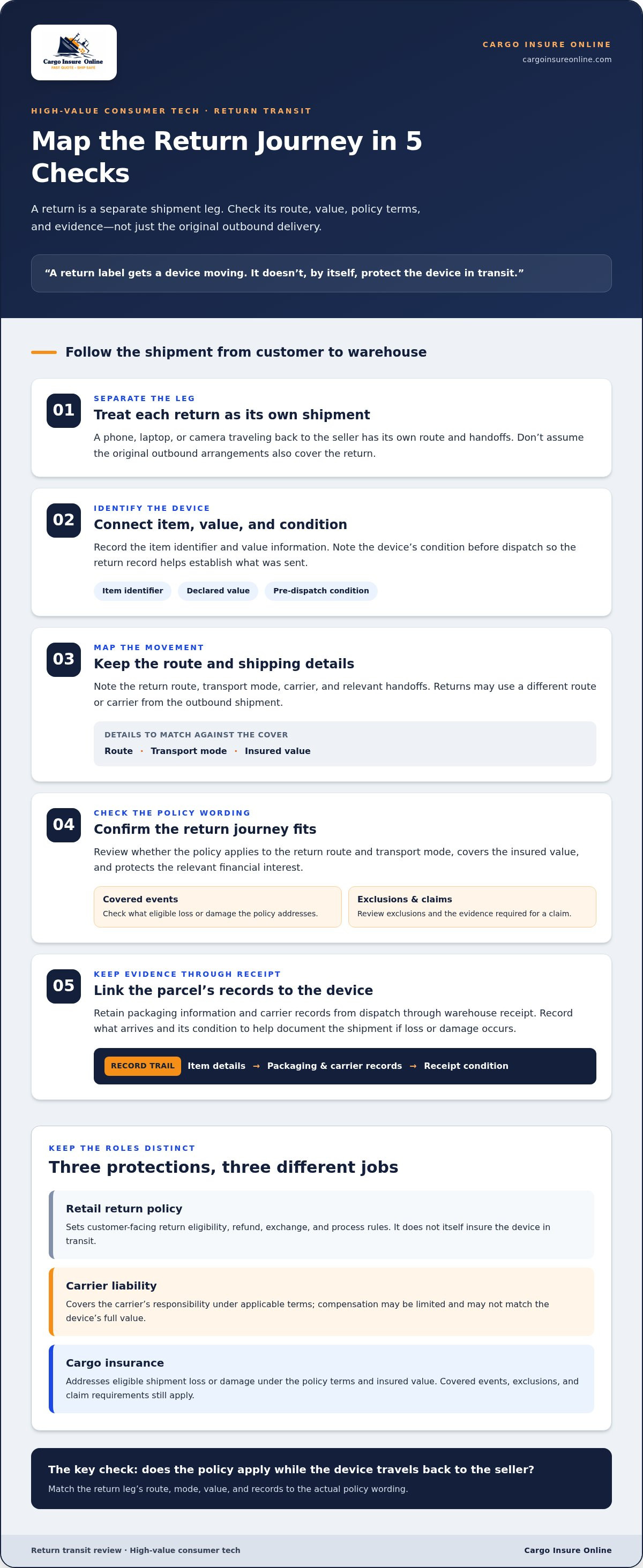
Build a Return-Shipment Checklist That Supports a Clear Claim
A useful return record tells one connected story: which device was authorized for return, what condition it was in, how it was sent, and what arrived back. Build that record into your returns workflow instead of trying to reconstruct events after a problem. It supports day-to-day tracking and gives your team organized information to review against the issued policy if a claim is needed.
Before the customer sends the device
Start with the return authorization. Link it to the item’s identifier, such as its serial number or another unique product record, and retain the value information used for the shipment. Include clear packing and carrier handoff instructions in your process. These are operational guidelines, not a statement of insurance conditions. Capture available evidence of the device’s condition before dispatch, with a date and a connection to the return record.
- Authorize and identify. Create a return reference and connect it to the order, device identifier, customer return, and reason for return. This makes it easier to distinguish a specific device from similar products.
- Record value and condition. Save the value record associated with the shipment and document the device’s visible condition before it leaves the customer. Keep notes factual and tied to the item record.
- Prepare the dispatch record. Retain the return label or shipment details, carrier name, shipment reference, dispatch date, and recorded origin and destination. Keep available packaging details with the same return file.
- Capture the handoff. Record when the parcel is handed to the carrier and preserve the associated carrier acceptance or collection record. This helps establish the transition from customer custody to transit.
- Document receipt and retain the file. At delivery, record the receipt date and parcel condition. Then inspect and record the device condition, noting any visible difference from the pre-dispatch record. Store the return authorization, value record, condition evidence, packaging details, and carrier records together.
At handoff, in transit, and on receipt
A dated sequence can help clarify what happened and when. For example, a record of the parcel’s appearance at handoff, followed by a separate record of its condition on receipt, gives your team a clearer basis for reviewing a reported issue. Keep images or notes linked to the return reference, and retain carrier updates and shipment documentation in the same file.
Make the process consistent across customer-initiated returns, including those using different carriers or routes. A complete file doesn’t guarantee a claim outcome, and it doesn’t replace the policy. Evidence requirements, covered events, exclusions, and claim handling remain subject to the issued policy wording. For e-commerce return transit insurance for high value consumer tech, good records connect the insured shipment details to the device and its actual return journey.
Once your workflow captures the shipment details, get an instant cargo insurance quote for a return shipment.
Protect E-Commerce Returns with Cargo Insure Online
Once you’ve mapped the return route, shipment value, transport mode, and records your workflow can retain, match those details to cargo cover. Cargo Insure Online provides Cargo Insurance for eligible shipments, subject to the issued policy’s terms. It supports movement by air, sea, truck, or courier, from any origin to any destination, so sellers can assess cover for reverse journeys as well as other cargo movements.
Standard all-risks cargo insurance can address events such as physical damage, total loss, theft, vandalism, fire, explosion, and transit accidents, subject to policy wording and exclusions. The policy details matter: enter accurate shipment information, review the quote and terms, and make sure the insured shipment reflects the return journey you need to protect. A digital certificate gives your team a document to retain with the return record.
What the CIO digital workflow looks like
The process is online. Create an account, enter the shipment details, and receive a real-time quote. Review the quoted cover and policy terms before purchase. Once issued, download the policy certificate and store it alongside the return authorization, value record, and carrier reference. Online access and downloadable documentation help keep insurance records connected to the shipment file.
There are no upfront fees. The model is “No Upfront Fees - Pay Only When You Insure.” After obtaining a quote, payment can be made by credit card or e-wallet. Policy issuance is immediate, and the certificate is available to download for your shipment documentation. The certificate records policy details, while coverage remains governed by the policy wording.
When to explore CIO Cargo Insurance
Sellers handling high-value consumer technology can use this workflow to evaluate cargo protection against a return shipment’s declared value, route, mode, and policy terms. It’s especially useful when the reverse leg differs from the original delivery or involves a customer handoff. Cargo Insure Online works with A-rated underwriters, including CHUBB, TSM Assurances, Probitas 1492, and a Lloyd’s Syndicate.
For e-commerce return transit insurance for high value consumer tech, bring the policy process into the returns workflow. Prepare the shipment information, compare it with the quote and issued terms, then retain the certificate with the device’s return records. This creates a clearer connection between the cargo you’re sending back and the cover selected for its transit.
Ready to put those shipment details into action? Create an account and get an instant quote for your cargo shipment.
Make Return Protection Part of Your Workflow
A returned device shouldn’t become an afterthought once a label is created. Make protection review a regular step in your returns process, especially when routes, carriers, or handoff arrangements change. Assign someone to keep shipment details, policy records, and return documentation aligned. This operational habit can help your team make clearer decisions before a device is on its way back.
The right e-commerce return transit insurance for high value consumer tech starts with the shipment in front of you. Use its route, mode, value, and insured interest to guide your review, then keep the issued policy with the return file. Cargo Insure Online’s digital platform brings quoting and policy documentation into one online process, supported by underwriters including CHUBB and AIG.
Ready to put a clearer process in motion? Create a free account and get an instant cargo insurance quote. Start by entering the return shipment details and reviewing the quote and policy terms.
Frequently Asked Questions
Is e-commerce return transit insurance different from a standard return policy?
Yes. A return policy sets the seller’s rules for refunds, exchanges, and return eligibility; transit insurance addresses specified physical loss or damage during shipment, subject to policy wording. A customer promise doesn’t insure a parcel. For e-commerce return transit insurance for high value consumer tech, assess the reverse shipment as its own movement, including its insured value, route, and applicable terms. This keeps the refund decision separate from how transit loss or damage is handled.
Can cargo insurance cover a customer-returned phone or laptop?
It can be considered for a returned device, subject to the issued policy and shipment details. Cargo Insure Online provides Cargo Insurance for air, sea, truck, and courier shipments, with coverage from any origin to any destination. Stated covered risks include damage, total loss, and theft, among others. For example, a seller handling a returned laptop should enter the actual route and shipment information, then review the resulting policy terms.
Does carrier liability cover the full value of a returned electronic device?
Not necessarily. Carrier liability and cargo insurance work differently, and carrier compensation may fall short of a device’s declared value. Don’t assume reimbursement will equal the item’s replacement or resale value. Compare the carrier’s applicable terms with the insured value and the cargo policy wording for the return shipment. Cargo Insure Online Cargo Insurance is designed to fill carrier-liability gaps, subject to policy terms and shipment details.
What information should I keep when a customer returns expensive tech?
Keep records that connect the specific device to its return journey: item identifier, return authorization, shipment value, carrier reference, and handoff information. Retain condition evidence available before dispatch and after receipt, along with relevant parcel or packaging details. For example, link the carrier’s acceptance record to the same return reference used for the device’s condition notes. Follow the issued policy’s documentation and claims requirements, since requested evidence depends on the policy and circumstances.
How much does e-commerce return transit insurance cost?
The premium depends on the shipment information and the quote for the relevant cover, so use the online quote process to see the offer for your return shipment. Enter accurate details, including the route and declared value, and review the quote alongside the policy terms before purchasing. Cargo Insure Online has no upfront fees: payment is made only when you insure. The displayed quote, rather than a general estimate, is the useful basis for your decision.
What happens if a returned device arrives damaged or goes missing?
Preserve the return authorization, carrier records, and available evidence of the parcel and device condition. Then follow the claims instructions in the issued policy and provide the requested supporting documents. For instance, note whether the parcel itself appears damaged and keep that record with the device inspection details. The applicable cover and claim outcome depend on the documented circumstances and policy terms. A store refund or exchange decision is separate from reporting a transit insurance claim.
Can return transit insurance cover courier shipments across borders?
Cargo Insure Online supports courier shipments from any origin to any destination, subject to the issued policy terms. For a cross-border return, enter the actual origin, destination, route, and shipment value when obtaining a quote. Then review the resulting policy for applicable cover and exclusions. A customer returning a phone internationally may follow a different route from the original delivery, so assess the return movement itself rather than assuming identical terms across shipments.


