
A payment demand after a container vessel fire doesn’t automatically tell you who will ultimately bear the cost. Is it a salvage reward, a general average contribution, or another expense? Must you pay or provide security before your cargo is released? The container vessel fire cargo salvage charges reimbursement process can feel urgent and opaque, especially when your shipment is damaged or delayed.
These charges have different foundations, and an immediate demand isn’t the same as a final insurance decision. Responsibility and reimbursement depend on the demand, policy terms, evidence, applicable contracts, and governing rules.
This guide explains the difference between salvage and general average, who may be asked to contribute, and what to do when a notice or security demand arrives. You’ll learn how to preserve key documents, prepare a reimbursement claim, and consider sea freight insurance when planning shipment protection, without assuming every charge or expense will be covered.
Key Takeaways
- Learn how to distinguish salvage remuneration, general average contributions, and ordinary cargo-damage claims.
- Understand why the party asked to provide payment or security may not be the party that ultimately bears the loss.
- Follow a practical claim-preparation sequence, from preserving notices and evidence to submitting and tracking your claim.
- Use this guide to make sense of the container vessel fire cargo salvage charges reimbursement process, while keeping policy terms and applicable contracts in view.
- Reduce avoidable uncertainty by aligning cargo values, goods descriptions, routes, and shipment documents with insurance records.
Container Vessel Fire: What Cargo Owners May Face First
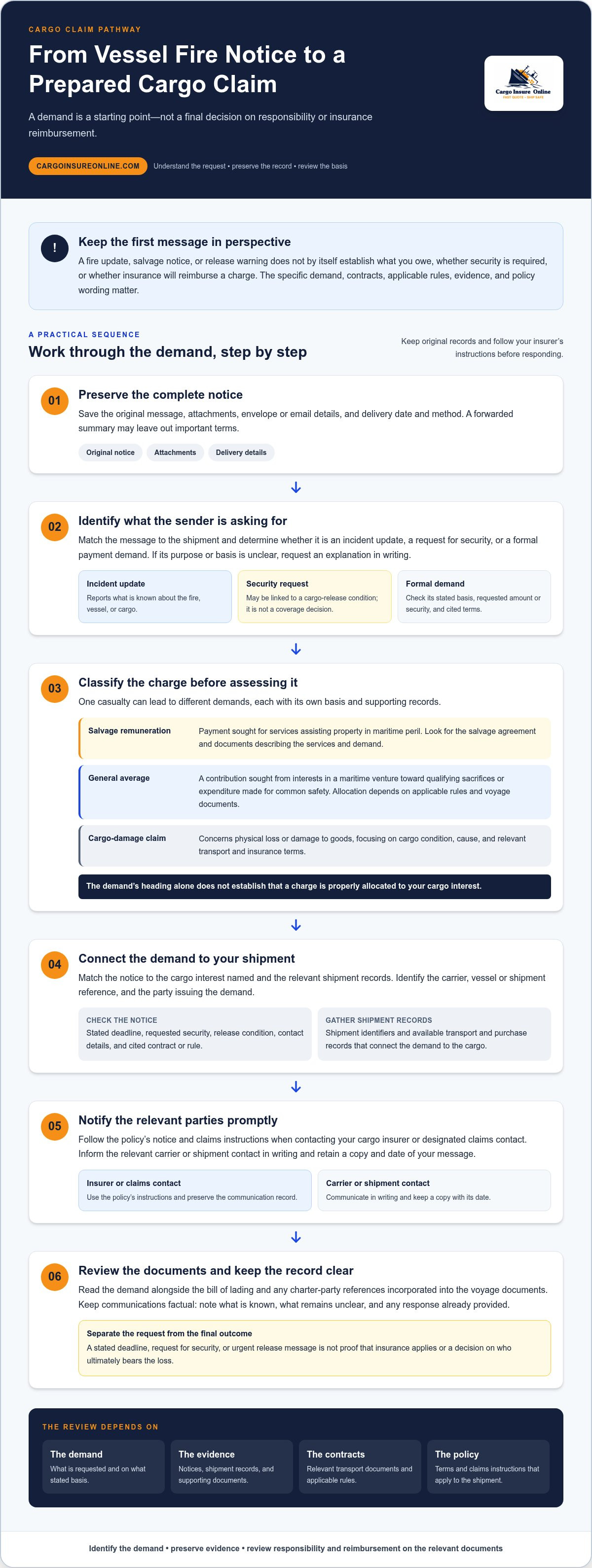
A fire update, salvage notice, or warning that cargo can’t yet be released may arrive with little time to respond. The first message doesn’t settle who owes what. A vessel casualty alone doesn’t establish whether a cargo owner must provide security, contribute to a shared loss, or can seek reimbursement. Those questions depend on the specific demand, contractual roles, applicable rules, and policy wording.
Start by identifying what the sender is asking you to do. Preserve the original notice, notify the relevant parties promptly, and follow your insurance instructions before responding. The container vessel fire cargo salvage charges reimbursement process begins with understanding the demand, not assuming that every amount requested is covered or finally payable.
What a fire-related notice does, and doesn’t, tell you
An incident update reports what is known about the fire, vessel, or cargo. A formal salvage demand or general average notice is different: it may set out a specific request for payment or security. General average involves sharing certain sacrifices or expenses made to preserve a maritime venture. The General Average overview provides useful background, but the relevant contract and governing rules determine how the principle applies in a particular case.
Cargo condition, vessel status, and your role in the shipment can affect what happens next. Keep the original notice, attachments, envelope or email details, and the date and method of delivery. A forwarded summary may omit important terms, so retain the complete message.
The first questions to resolve
Before deciding how to respond, match the notice to your shipment records. Identify the cargo interest named, carrier, vessel or shipment reference, and party issuing the demand. Check whether the message is an incident update, a request for security, or a formal claim. If its purpose or basis is unclear, request an explanation in writing.
Record any stated deadline, requested security, release condition, and contact details. A deadline or demand is not proof that insurance applies, nor does it determine who ultimately bears the loss.
Move quickly on the information you can control:
- Save the notice and related messages in their original format, including attachments and delivery timestamps.
- Notify your cargo insurer or designated claims contact promptly, following the policy’s notice and claims instructions.
- Inform the relevant carrier or shipment contact in writing, and keep a copy of your message and its date.
- Gather shipment identifiers and available transport and purchase records to connect the demand to the cargo.
Keep communications factual. Note what you know, what remains unclear, and any response already provided. Don’t treat an urgent cargo-release message as a coverage decision, or assume that a request for security is the final amount you may owe. Organized records give you a clearer starting point for reviewing responsibility and possible reimbursement.
Salvage Charges vs. General Average: Identify the Demand Correctly
A fire at sea can lead to more than one kind of financial demand. The label matters: salvage remuneration, a general average contribution, and a claim for damaged cargo arise in different circumstances and may require different supporting records. One casualty can give rise to several demands, each with its own basis and evidence.
Use this comparison to sort the notice before assessing responsibility. It’s a starting point, not a legal determination.
Salvage remuneration: Payment sought for services assisting property in maritime peril. The salvage agreement and applicable law can shape how remuneration is assessed. Look for a salvage contract or documents describing the services and the demand.
General average contribution: A contribution sought from interests in a maritime venture toward qualifying sacrifices or expenditure made for the common safety. The adjustment and allocation depend on applicable rules and voyage documents.
Ordinary cargo-damage claim: A claim concerning physical loss or damage to the goods. It focuses on cargo condition, the cause of damage, and relevant transport and insurance terms, rather than payment for salvage services or sharing a qualifying common loss.
How salvage remuneration differs from a general average contribution
Salvage concerns assistance to a vessel, cargo, or other property facing maritime peril. Remuneration may be shaped by the agreement used for the operation, the services performed, and relevant law. Lloyd’s Open Form is a recognized example of a salvage contract, but it isn’t the universal arrangement. Check the paperwork to identify the terms governing the specific operation.
General average is a separate shared-loss principle. It may involve an adjustment of qualifying sacrifices or expenditure made to preserve the common maritime venture. The Comité Maritime International’s overview of General Average explains the principle and the role of adjustment. A general average demand isn’t interchangeable with a salvor’s remuneration demand, even if salvage expenditure later appears in an adjustment.
Why the demand label and governing documents matter
Read the demand alongside the bill of lading and any charter-party references incorporated into the voyage documents. Note who issued it, the amount or security requested, the stated basis, and the contract or rule it cites. A heading alone doesn’t establish that a charge is properly allocated to your cargo interest.
York-Antwerp Rules may apply when incorporated into relevant contracts, but the applicable edition and terms must be verified. Don’t assume a universal allocation formula or automatic cargo-owner liability. The container vessel fire cargo salvage charges reimbursement process depends on identifying the actual demand, its contractual foundation, and the records supporting it.
Keep separate files for salvage documents, any general average notice or adjustment, and evidence of cargo damage. This helps you explain each amount and assess it against policy wording and shipment records. For future shipments, sea freight insurance planning can help align cargo values, descriptions, and documents with your coverage arrangements. Coverage depends on policy terms and the circumstances of the loss.
Who Pays First and When Can Cargo Insurance Reimburse You?
A request for payment or security can arrive before anyone has finished assessing the casualty. That timing may make it seem as if the cargo owner has already been assigned the final bill. Not necessarily. The party asked to provide security or make an initial payment may not be the party that ultimately bears the loss. Responsibility depends on the demand, shipment contracts, and circumstances. Insurance reimbursement is a separate question, assessed under the policy and the evidence.
Think in stages: identify who is making the request and why, understand what action is being sought, then assess any potential insurance response. An uninsured cargo interest may face direct financial exposure under applicable arrangements. An insured interest can submit a claim, but insurance doesn’t automatically cover every salvage charge, general average contribution, or related expense.
- Start with the demand: Identify its stated basis, recipient, deadline, and whether it requests payment, security, or both.
- Check the policy: Match the shipment and cargo interest to the policy records, then review the terms relevant to the event.
- Keep the questions separate: Potential responsibility under applicable contracts is not the same as whether a policy responds.
What may affect a reimbursement decision
Review the policy schedule and wording for the insured interest, insured value, transit scope, conditions, exclusions, deductibles, and any applicable endorsements. Compare those terms with the demand and supporting records. Salvage and general average may be treated differently, and the result can vary with policy wording and the circumstances. Don’t assume that cover for cargo damage also means every associated charge is covered.
Liability and insurance response are separate analyses. A demand may raise questions about contractual responsibility, while a claim review considers policy terms, evidence, and required claim duties. Keep both sets of documents together, but don’t treat one conclusion as proof of the other.
Security, payment, and recovery are different stages
A cargo interest may be asked to provide security while a matter is unresolved, including when cargo release is at issue. Security isn’t necessarily the final amount payable. Paying or providing security also doesn’t by itself establish that an insurer will reimburse it. Read the request carefully and send it, with available supporting records, to the insurer or claims contact promptly.
Follow the policy’s notice and claims instructions, and seek guidance on the specific demand before making assumptions about coverage or payment. Keep written records of instructions, decisions, and any security provided. The container vessel fire cargo salvage charges reimbursement process is easier to assess when the demand, contractual basis, and policy response are clearly documented.
For future shipment planning, explore sea freight insurance as one part of managing cargo risk. Start with the shipment details and policy terms, rather than assuming every charge will be reimbursed.
How to Prepare a Cargo Salvage Reimbursement Claim
A clear claim file connects the amount you’re claiming to the shipment, the demand, and the policy. The container vessel fire cargo salvage charges reimbursement process isn’t just about sending a payment receipt. You need to show what was requested, how it relates to your cargo, what you paid or secured, and how the loss connects to the insured shipment. Follow your insurer’s policy-specific notice and claims instructions, including any required forms or submission channels.
Use this sequence to keep the paperwork organized and easy to review:
- Preserve the notices. Save the original casualty update, salvage or general average demand, security request, attachments, and related messages. Keep delivery details and note when each arrived.
- Notify relevant parties. Give prompt notice to your insurer or claims contact and follow the policy’s instructions. Notify the carrier or other relevant shipment contact as appropriate, and keep copies of your messages.
- Gather shipment and loss evidence. Collect the policy and certificate, commercial invoice, packing list, bill of lading, cargo description, and available records of cargo condition or inspection.
- Submit a matched claim. Use the required claim form and connect each amount claimed to the demand, any adjustment documents, and evidence of payment or security.
- Track the file. Record submission dates, responses, deadlines, and requests for more information. Retain proof of delivery for notices and claim materials.
Build a clear evidence file
Keep related records together, but separate different types of demand so the claim reviewer can follow them. Include casualty notices, salvage documents, any general average adjustment, security demands, payment receipts, cargo inspection findings, and photographs where available. Save correspondence with the carrier, salvor, adjuster, and insurer. If cargo is inspected, retain the findings and note when and by whom the inspection took place.
Core claim records include the policy, transport documents, demand, cargo details, and related correspondence. Add a dated log showing when you submitted each item, who received it, what response came back, and what supplementary material was requested. This creates a useful record if the claim develops over time.
Submit, respond, and track without losing the thread
Make each amount easy to verify. Identify the related demand or adjustment, explain how it concerns your shipment, and attach payment or security evidence if available. Don’t combine separate salvage, general average, and cargo-damage amounts into one unexplained figure. Use the insurer’s stated channel for submissions and replies, and answer requests with the records requested or a clear note about what’s unavailable.
Keep copies of every submission and confirmation. A broader sea freight insurance guide can help put claim preparation in the context of shipment protection. To plan cover for future sea shipments, explore sea freight insurance. Reimbursement depends on policy terms, evidence, applicable contracts, and governing rules.
Reduce Future Fire-Related Exposure with Better Cargo Insurance Planning
Preparation won’t prevent every casualty or guarantee that a future claim will be reimbursed. It can reduce avoidable uncertainty about the cargo, its value, and the protection arranged for its journey. Start before the goods are in transit, making sure shipment information matches across insurance records, commercial documents, and transport paperwork.
That alignment matters after a fire. If an invoice describes goods differently from the insurance schedule, or the insured value doesn’t match the shipment records, it may take more work to establish what was insured and what the demand concerns. Treat the container vessel fire cargo salvage charges reimbursement process as a reason to make shipment records clear before a problem arises.
Prepare before the next ocean shipment
Check that the cargo description, value, packing details, route, and shipment documents are accurate and consistent. Review the relevant policy wording, including the insured transit and notice duties, before the cargo moves. Keep the policy, certificate, shipping records, and insurer and shipment contacts accessible. A simple document routine makes it easier to find the right information if a casualty occurs.
- Match the insured cargo description to the commercial invoice and packing list.
- Use shipment values and route details that align with the insurance records.
- Keep transport documents and packing information with the relevant policy records.
- Make sure the people responsible for the shipment know where to find insurer and carrier contacts.
Choose protection around the shipment’s real exposure
Review protection in light of the shipment’s route, cargo type, value, and contractual responsibilities. A change in goods or routing can affect what needs to be reflected in the insurance records. Read the policy terms rather than assuming one shipment’s arrangements apply to another. Sea freight insurance can form part of a broader risk plan for global cargo movements, but coverage depends on the policy and circumstances.
Insurance and carrier-contract analysis answer different questions. Contract documents help establish the parties’ rights and obligations; the policy sets out the terms on which an insurance claim may be considered. Keeping both in view helps avoid treating insurance as a substitute for understanding the shipment arrangements, or assuming a demand will be reimbursed simply because cover was arranged.
Build a repeatable pre-shipment check: confirm the goods and value, compare the route and documents with insurance records, review relevant policy wording, and save key contacts. These steps won’t eliminate uncertainty, but they can make the information needed to assess a casualty easier to find. Explore cargo insurance solutions as part of planning protection for your sea freight shipments.
Make Your Next Shipment Plan More Resilient
Turn what you’ve learned into a repeatable pre-shipment routine. A clearer container vessel fire cargo salvage charges reimbursement process starts before a vessel sails, with insurance records and shipment details prepared to work together. That preparation won’t remove every uncertainty, but it gives your team a more organized foundation if questions arise.
Consider how your cargo moves across the logistics chain. Cargo Insure Online provides insurance solutions for global logistics operations, with coverage offerings across sea, air, and trucking freight. Reviewing protection across the modes you use can connect cargo planning with the realities of each shipment, while policy terms determine how a particular claim is assessed.
Review your upcoming shipments, the records behind them, and the protection arranged for their journey. Explore sea freight insurance for your cargo and build a more confident starting point for the next voyage.
Frequently Asked Questions
Can cargo owners be asked to provide security before a salvage claim is settled?
Yes, a cargo interest may receive a request for security while salvage remuneration or another maritime claim is still being assessed. The recipient, basis, terms, and connection to your shipment matter. Forward the request promptly to your insurer or claims contact, and keep a copy of any response. Don’t assume that providing security settles the final amount or means an insurer has agreed to reimburse it.
Does a vessel fire automatically trigger general average?
No. A fire alone doesn’t establish that general average applies. The question is whether the facts involve a qualifying sacrifice or expenditure made for the common safety, and whether the relevant voyage documents and governing rules support an adjustment. Fire damage to goods, for example, doesn’t by itself prove that a shared-loss contribution is due. Review any notice and its stated basis against the applicable documents.
Can cargo be released if salvage or general average security is outstanding?
Possibly, but release arrangements depend on the circumstances, demand, and applicable contracts or rules. A carrier or other party may make release conditional on security, but there’s no single answer for every casualty. Request the condition in writing and identify what form of security is sought and which claim it concerns. Share those details with your insurer or claims contact before treating the request as a final payment obligation.
What if the cargo is damaged by fire but no salvage demand arrives?
You can still report and document physical damage; a salvage demand isn’t required to raise a cargo-damage claim. Photograph the goods and packaging before moving or disposing of them, and note visible damage on delivery paperwork where possible. Notify the carrier and insurer using the applicable instructions, and keep inspection findings and repair, disposal, or mitigation records. The cause, policy terms, evidence, and relevant transport documents will inform the assessment.
Does carrier liability cover all cargo losses and salvage charges after a vessel fire?
No, don’t assume carrier liability covers every loss or charge. The outcome can depend on the transport contract, applicable law, the cause of loss, and the evidence. A carrier’s position on damaged cargo also doesn’t automatically determine responsibility for salvage or general average demands. Preserve the carrier’s terms and written response, then consider them separately from any cargo insurance claim.
What records should I keep if a container vessel fire affects my shipment?
Keep records that identify the exact goods and connect them to the incident. Alongside your policy and shipping paperwork, retain container and seal numbers, cargo descriptions, delivery records, and original photo files with their dates. Save inspection reports and copies of messages sent or received. If multiple containers or purchase orders are involved, organize evidence by shipment reference so details don’t get mixed across claims.
Will cargo insurance reimburse every salvage charge or general average contribution?
No policy should be assumed to reimburse every amount automatically. For the container vessel fire cargo salvage charges reimbursement process, the insurer will assess the policy wording, insured interest, evidence, applicable contracts, and governing rules. A charge may need to be distinguished from cargo damage or another expense, and deductibles or exclusions may affect the result. Submit the underlying demand and supporting records, then rely on the policy-specific assessment.


