

What if your lithium battery shipment clears the airline’s checks, yet a loss still leaves a major hole in your balance sheet? Planning dangerous goods Class 9 lithium batteries air shipment insurance takes more than a label and a booking. Configuration matters: batteries shipped alone, packed with equipment, or contained in equipment can have different classification and handling requirements.
If you’re unsure where compliance ends and financial protection begins, you’re asking the right question. Meeting dangerous-goods rules helps a shipment qualify for air transport; it doesn’t automatically insure its value. Carrier liability is separate and may not match the financial exposure of a damaged, lost, or mishandled load.
This guide explains how Class 9 classification, 2026 air-shipping requirements, carrier liability, and cargo insurance fit together. You’ll see which shipment details matter when assessing risk, what to understand before arranging cover, and how to reduce avoidable acceptance delays without treating insurance as a substitute for compliance.
With a clearer picture of the shipment and the risks you need to transfer, you can make a more informed decision about tailored air freight insurance for lithium battery cargo.
Key Takeaways
- Class 9 identifies a dangerous-goods category, but battery chemistry and configuration shape the shipment details that matter.
- Use current air-transport instructions to guide checks on packaging, marks, labels, documents, and training.
- Separate airline acceptance and carrier liability from cargo insurance. Each serves a different purpose and depends on its applicable terms.
- Prepare chemistry, configuration, battery quantity, declared value, route, and shipment dates before assessing dangerous goods Class 9 lithium batteries air shipment insurance.
- Follow a clear sequence: classify accurately, document the shipment, then consider tailored air freight or high-value electronics insurance for its financial risks.
Class 9 lithium battery air shipment insurance: what the label means
Correct dangerous-goods classification is essential, but it doesn’t eliminate a shipment’s financial exposure. The label and transport documents communicate hazards and support safe handling. They don’t determine whether cargo insurance applies or which losses a policy may cover. That distinction is central to dangerous goods Class 9 lithium batteries air shipment insurance.
Class 9 covers substances and articles that present a hazard during transport but aren’t covered by other classes. When lithium batteries are regulated as dangerous goods for air transport, they fall under Class 9. The relevant UN entry and handling instructions depend on battery chemistry and how the batteries are shipped. For 2026 shipments, use the current 67th edition of the IATA Dangerous Goods Regulations and applicable ICAO Technical Instructions, rather than relying on an older guide or a label alone.
Lithium-ion and lithium-metal batteries are distinct types with different hazards and transport entries. For an accessible overview of their differences, see Lithium Battery Types and Hazards. Use the applicable transport regulations to determine the shipment’s classification and requirements.
Which lithium battery shipment configurations matter?
Start by identifying whether batteries are shipped alone, packed with equipment in the same package, or installed in equipment. That configuration affects the applicable UN entry and packing instructions. Lithium-ion batteries shipped alone use UN 3480; UN 3481 applies to lithium-ion batteries packed with or contained in equipment. For lithium-metal batteries, UN 3090 is the entry for batteries shipped alone, while UN 3091 covers batteries packed with or contained in equipment.
These identifiers aren’t interchangeable. Record the battery chemistry and how each battery is presented before preparing documents or arranging insurance. A package of spare batteries alongside a device, for example, may need a different regulatory assessment from a device with its batteries installed. Confirm the entry and wording against the current rules for the route and shipment.
Why Class 9 status is not an insurance decision
Dangerous-goods classification supports transport safety and compliance. Underwriting assesses financial risk, while the policy wording sets the terms that apply to a covered loss. A Class 9 designation doesn’t establish insurance eligibility, scope, limits, or exclusions. Those are separate questions tied to the shipment details and applicable policy terms.
Accurate paperwork matters, but it doesn’t guarantee airline acceptance. Acceptance also doesn’t guarantee insurance recovery after a loss. The carrier makes transport decisions under applicable requirements; an insurer assesses a claim under the policy. Keep the shipment description, declared value, route, and supporting records consistent so the information used for a policy assessment matches the cargo being shipped.
Compliance governs how dangerous goods may be transported; cargo insurance addresses financial loss only as defined by the policy. Treat them as coordinated steps, not substitutes. Classify and document the batteries accurately, then assess financial protection against the shipment’s value and circumstances.
How lithium battery air-shipping rules shape shipment risk
Air-shipping requirements aren’t determined by the Class 9 label alone. Battery chemistry, configuration, quantity, and applicable transport instructions all shape the compliance pathway. A shipment of cells on their own can have different packing and documentation requirements from batteries installed in equipment. An incorrect detail can lead to additional review, delay, or refusal.
For 2026 planning, use the current edition of the IATA Dangerous Goods Regulations and applicable ICAO Technical Instructions. IATA’s IATA Dangerous Goods Regulations for Lithium Batteries resource is a useful starting point, but check shipment-specific requirements against the applicable current instructions. Verify packaging, marks, labels, documentation, and training requirements, including any applicable exceptions. Don’t rely on an old checklist or copy details from a shipment that only looks similar.
What shipment details affect the applicable requirements?
Build a precise shipment profile before selecting packaging or preparing documents. Record the battery chemistry, watt-hour rating where applicable, number of cells or batteries, and whether the batteries are shipped alone, packed with equipment, or contained in equipment. Also note the route and any other details required by current transport instructions. Compare those facts with the current IATA and ICAO requirements, since they can affect the applicable packing and documentation pathway.
For example, a package containing spare lithium-ion batteries with a device may not follow the same pathway as a package containing that device with its batteries installed. The distinction can affect which instructions, marks, and documents apply. Don’t assume a familiar UN number settles every packing question. Classification is the starting point, not the complete shipment review.
What role do UN 38.3 and shipment documents play?
UN 38.3 refers to a series of tests used to assess whether a lithium battery design can withstand conditions associated with transport. A UN 38.3 Test Summary provides information about the battery type and its testing. Keep the relevant summary available and make sure the battery information in shipment records matches the product offered for transport.
A Shipper’s Declaration for Dangerous Goods is required for many lithium battery shipments, subject to exceptions in the applicable rules. Requirements depend on the shipment and its packing instruction, so don’t treat one document set as universal. Confirm which records are required for the specific configuration, and ensure package labels and marks align with the shipment description.
Accurate battery data helps handlers identify the shipment and gives reviewers a clearer basis for assessing its transport documents. That supports safer handling, but doesn’t guarantee airline acceptance. Airlines may apply operational acceptance checks, and a compliant shipment can still be held or rejected if its packaging, condition, or paperwork doesn’t meet applicable requirements.
Clear shipment facts also make it easier to assess dangerous goods Class 9 lithium batteries air shipment insurance without confusing compliance with financial protection. Once you’ve assembled the shipment profile, explore air freight insurance options as part of your separate financial-risk review.
Insurance vs. carrier liability: what protects a Class 9 shipment?
An airline’s acceptance of a lithium battery shipment isn’t a promise to reimburse its full value if something goes wrong. Acceptance means the shipment has passed the carrier’s operational checks for transport at that point. Dangerous-goods compliance addresses transport requirements. Carrier liability and cargo insurance are separate financial questions, each governed by different terms.
Keep the distinction clear:
- Compliance concerns whether the shipment meets applicable dangerous-goods requirements.
- Airline acceptance is the carrier’s decision to handle the shipment under its operating procedures.
- Carrier liability concerns whether the carrier may be legally or contractually responsible for a loss, and how that responsibility is assessed.
- Cargo insurance is a separate policy arrangement, with its own insured transit, covered causes of loss, conditions, and exclusions.
Compliance or acceptance alone doesn’t establish that the cargo’s value is insured. For dangerous goods Class 9 lithium batteries air shipment insurance, review the policy terms alongside the shipment details rather than treating a successful booking as proof of financial protection.
What does air cargo insurance evaluate?
Shipment value is only part of the picture. Assessment may also consider route, transport mode, packaging, handling information, and the scope of transit being insured. Provide an accurate cargo description and declared value, then compare them with the policy’s valuation basis and insured amount. A mismatch can create uncertainty about the protection being sought.
Read the wording closely. Covered causes of loss, exclusions, conditions, and insured transit are policy-specific. Don’t assume a policy covers fire, leakage, delay, or loss connected with regulatory non-compliance. Coverage depends on the applicable wording and circumstances, not simply on a Class 9 label or the fact that insurance was arranged.
Why carrier liability is not the same as cargo insurance
Carrier liability operates under a separate legal or contractual framework. Whether a carrier is responsible, and the extent of any recovery, can depend on governing agreements, applicable law, transport documents, and the facts of the loss. Avoid assuming a universal liability limit. The route and circumstances matter, so any specific limit must be verified against the applicable framework.
Cargo insurance, by contrast, is assessed under its policy terms. A claim may involve the insured cargo, declared value, transit scope, cause of loss, and relevant exclusions. Neither route guarantees full recovery. Keep shipping records and policy information together so they can be reviewed against the circumstances of a loss.
For a closer look at the role of protection in air freight, explore this air freight insurance guidance. Compare the shipment’s value and route with the policy wording, while treating dangerous-goods compliance, airline acceptance, liability, and insurance as connected but distinct checks.
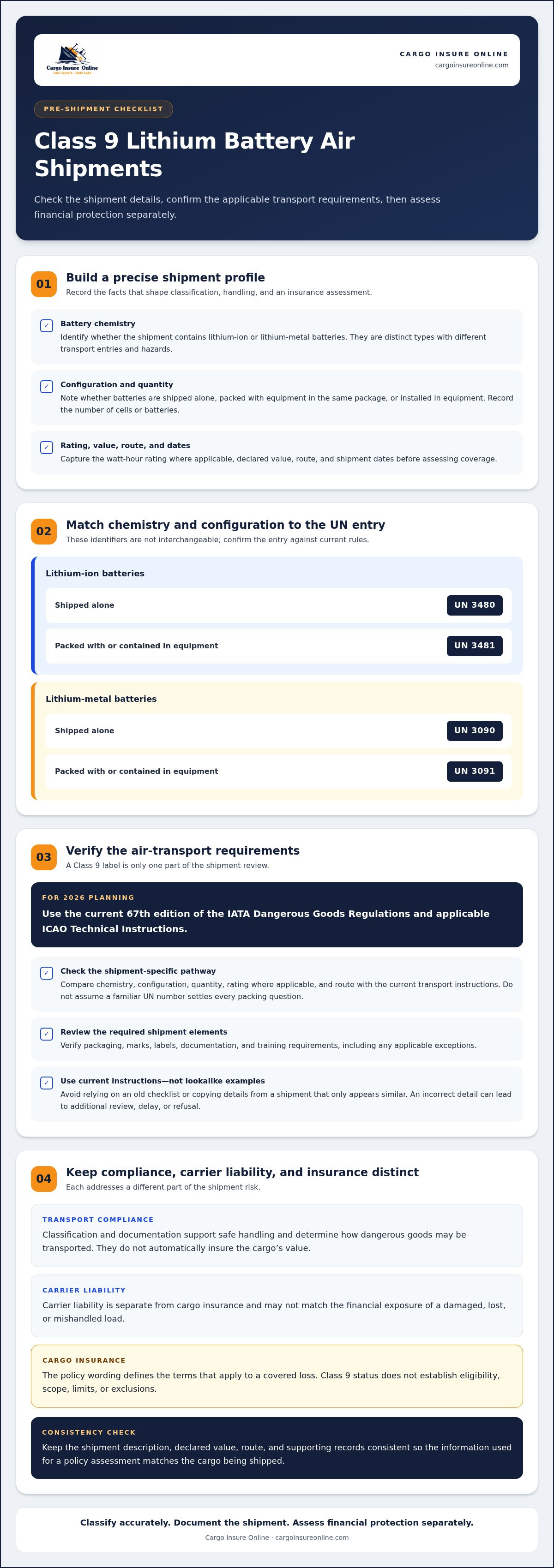
Use this pre-shipment checklist before insuring lithium batteries by air
Build one accurate shipment profile, then use it for compliance checks, carrier paperwork, and your insurance review. Consistent details make it easier to spot gaps before cargo moves. They don’t guarantee airline acceptance or insurance recovery, but they give each review a reliable starting point.
Prepare accurate shipment and value information
Work through the checklist in order. Verify regulatory details against the current IATA Dangerous Goods Regulations and applicable ICAO Technical Instructions. Requirements can vary by shipment.
- Identify the batteries. Record chemistry, watt-hour rating where applicable, and the number of cells or batteries.
- Describe the configuration. Note whether batteries are shipped alone, packed with equipment, or contained in equipment. Record the packaging used.
- Set the shipment value. Document the cargo description and declared value consistently across shipment and insurance information.
- Map the journey. Record origin, destination, route, transport mode, shipment dates, and any planned transshipment or storage.
- Assemble compliance records. Gather the applicable test summary and transport documents, including a Shipper’s Declaration when required for the specific shipment.
- Check handling and acceptance details. Confirm current requirements for packaging, marks, labels, documentation, and trained personnel, then account for the airline’s operational acceptance process.
Small inconsistencies matter. If the transport documents describe spare batteries but the insurance information describes equipment with batteries installed, the records may not describe the same shipment. Reconcile differences before dispatch so reviewers can assess the cargo and its declared value accurately.
| Information set | What it supports | Examples to organize |
|---|---|---|
| Compliance records | Dangerous-goods assessment and handling | Battery details, test summary, applicable packing and marking records |
| Carrier documents | Booking and operational review | Shipment description, route, dates, required declaration |
| Insurance information | Review of the requested financial protection | Insured goods, declared value, transit scope, policy terms |
Review coverage terms before the cargo moves
Compare the policy’s description of insured goods with the actual batteries and equipment. Check the insured transit, covered events, exclusions, conditions, and claim-documentation requirements. Don’t assume an unlisted risk is covered. Review special handling, storage, or transshipment details against the policy wording. For related considerations, read this electronics shipping insurance guidance.
Once the shipment facts and terms are aligned, explore air freight insurance for your shipment as part of your financial-risk review. That step complements compliance; it doesn’t replace it.
Arrange Class 9 lithium battery air shipment insurance with confidence
Turn the shipment assessment into a clear sequence: classify the batteries using applicable transport rules, prepare accurate and consistent documents, then review financial protection separately. Compliance supports safe transport and airline review. It doesn’t establish whether cargo insurance applies or what a policy may cover.
For shippers considering dangerous goods Class 9 lithium batteries air shipment insurance, the next step is a tailored review of the actual cargo and journey. Cargo Insure Online offers air freight insurance and insurance for high-value electronics as relevant options. The right solution depends on shipment details and applicable policy wording, not the Class 9 label alone.
What to have ready when exploring insurance
Bring a concise, accurate picture of the shipment. Include the information that identifies the goods, establishes their value, and describes the transit being considered. Complete details make an insurance discussion more useful and help reveal differences between shipping records and the protection you’re assessing.
- Commodity details: battery chemistry, product description, and watt-hour rating where applicable.
- Configuration and quantity: whether batteries are shipped alone, packed with equipment, or contained in equipment, plus the battery or cell count.
- Value: the shipment’s declared value and the basis for that amount.
- Route and planned transit: origin, destination, planned route, transport mode, and shipment dates.
- Supporting records: applicable test summaries and transport documents for the shipment.
Use the same shipment description and value across relevant records. If one document describes batteries packed with devices while another refers only to electronics, reviewers may need to clarify what cargo and transit are being assessed. Consistency helps keep the discussion focused on the shipment you intend to send.
Choose a digital-first next step
With the shipment facts organized, review the insurance wording against the goods and planned transit. Pay attention to insured items, transit scope, covered events, exclusions, conditions, and claim-documentation requirements. Include special handling, storage, or transshipment details in that review. Don’t assume an unlisted risk is covered, and don’t treat airline acceptance as confirmation of insurance protection.
A digital insurance intermediary can make exploring freight insurance a straightforward next step once compliance work is underway. Cargo Insure Online’s air freight and high-value electronics insurance offerings give shippers relevant options to consider, without replacing dangerous-goods compliance or the airline’s acceptance process.
Have your shipment details ready? Explore air freight insurance options and assess financial protection in light of your cargo, route, and applicable policy terms.
Build a clearer path for your next shipment
Make the insurance review part of shipment planning, not a last-minute add-on. A repeatable process helps your team bring the right cargo information to each decision and identify questions before dispatch. That gives you a stronger starting point for evaluating dangerous goods Class 9 lithium batteries air shipment insurance against the shipment’s route, value, and circumstances.
Cargo Insure Online offers air freight insurance for global logistics operations, alongside specialized insurance for high-value electronics. These are relevant options as you assess financial protection. The fit depends on shipment details and applicable policy wording, so focus on the terms that apply to your cargo rather than assumptions based on its classification.
Ready to consider the next step? Explore air freight insurance options and move forward with a more informed view of your shipment’s needs. Clear information and thoughtful review can make a complex decision more manageable.
Frequently Asked Questions
Is a lithium battery always classified as Class 9 dangerous goods for air shipment?
No, the applicable classification and handling depend on battery type and shipment details. Lithium-ion and lithium-metal batteries have different UN entries, and configuration, quantity, and applicable exceptions can affect the requirements. Some shipments may use provisions for excepted batteries rather than the Class 9 hazard label. Check the current IATA Dangerous Goods Regulations and applicable ICAO Technical Instructions for the specific shipment before preparing it.
Can lithium batteries be shipped by air?
Yes, some lithium battery shipments can travel by air, but the permitted pathway depends on current regulations, battery condition, configuration, and airline acceptance. A shipment of batteries alone may face different requirements from batteries installed in equipment. Damaged or defective batteries require particular caution. Before booking, identify the battery type and condition, then verify the applicable instructions and the operating carrier’s acceptance process. A booking request alone doesn’t establish approval.
What is the difference between UN 3480 and UN 3481?
UN 3480 identifies lithium-ion batteries shipped on their own. UN 3481 applies to lithium-ion batteries packed with equipment or contained in equipment. For example, a package of spare batteries accompanying a device differs from a device with batteries installed. That distinction can affect packing and documentation requirements. Confirm the applicable entry against current air-transport rules, since classification alone doesn’t determine every shipment instruction.
Does UN 38.3 testing mean a lithium battery shipment is automatically compliant?
No. UN 38.3 testing assesses whether a battery design type has passed specified tests related to transport safety. A test summary provides information about that testing, but it doesn’t replace shipment-specific requirements. The shipper still needs to determine the correct classification, packaging, marks, labels, and documents under current rules. A tested battery can still be presented with incorrect packaging or incomplete shipment paperwork.
Can damaged or defective lithium batteries be shipped by air?
Don’t assume a damaged or defective battery can use an ordinary air-shipping pathway. Such batteries face strict restrictions because damage may increase safety risks, and applicable rules may prohibit some shipments or require special approvals. The answer depends on the battery’s condition, proposed transport, and current requirements. Treat this separately from routine booking and consult the applicable current dangerous-goods instructions before attempting air transport.
Does air cargo insurance automatically cover lithium battery fire damage?
No. Fire damage isn’t automatically covered just because air cargo insurance was arranged. For dangerous goods Class 9 lithium batteries air shipment insurance, the policy wording, exclusions, insured transit, shipment description, and declared value all matter. A claim is reviewed under the applicable terms and circumstances. Read the policy’s covered causes of loss and conditions before dispatch, and don’t treat airline acceptance as confirmation of insurance protection.
How does battery watt-hour rating affect air shipment requirements?
For lithium-ion batteries, the watt-hour rating can affect applicable air-transport instructions, so record it accurately and verify the current requirements for the shipment’s configuration and quantity. Lithium-metal batteries are assessed using different specifications, including lithium content, rather than the same watt-hour measure. Don’t apply a lithium-ion threshold to lithium-metal batteries. Use current IATA and ICAO materials to determine the relevant packing, marking, and documentation pathway.
To assess financial protection for your shipment, explore Cargo Insure Online’s air freight insurance options.


