
What if your freight is protected on one leg of its journey, but a handoff leaves a gap on the next? Cross border trucking cargo insurance can help protect a shipment’s value as it moves between carriers and across borders, where responsibility and policy terms may change.
It’s easy to assume a carrier’s liability will cover the full cost of damaged or stolen goods. But liability can be limited and may depend on the carrier being responsible for the loss. Cargo insurance is different: it’s designed to protect the shipment itself, not the truck, and can help address gaps between the cargo’s value and the carrier’s liability.
Before freight rolls, review the full route, shipment value and details, and every carrier handoff. Distinguish cargo insurance from carrier liability, identify where theft, damage, or transit incidents could create uncertainty, and arrange protection for the shipment’s value. Once you’ve mapped the journey, Cargo Insure Online’s digital platform lets you get a real-time quote, purchase Cargo Insurance, and download a certificate online.
Key Takeaways
- Map the full journey, including carrier changes, border transitions, and any shift in transport mode, to spot possible coverage gaps.
- Use cross border trucking cargo insurance to focus protection on the shipment’s value, while treating carrier liability as cover for a carrier’s legal responsibility.
- Compare each policy by what it protects and where it applies, rather than assuming separate arrangements connect across the entire route.
- Prepare accurate cargo descriptions, packaging details, shipment value, origin, destination, and carrier information before requesting cover.
- Cargo Insure Online provides a digital path to request a quote, purchase Cargo Insurance, and download a certificate.
Why cross-border trucking cargo insurance needs a shipment-first view
A cross-border shipment can follow one plan while passing through several hands. A truck may carry freight to a border transfer point, where another carrier takes over. Each party may have different insurance arrangements and responsibilities. That’s why cross border trucking cargo insurance should be reviewed from the shipment’s perspective: what goods are moving, what they’re worth, and how protection applies throughout the journey.
Cargo insurance protects insured goods during transit, while commercial auto insurance covers vehicle-related risks. They address different financial interests. Cargo insurance is also distinct from carrier liability, which concerns a carrier’s legal responsibility for loss or damage under applicable terms and rules. For background on cargo cover’s general principles, see What is Cargo Insurance?
What does cross-border trucking cargo insurance protect?
Cargo insurance can protect insured goods against covered loss or damage while they’re in transit. Cargo Insure Online’s Cargo Insurance addresses risks such as damage or total loss, theft, vandalism, fire, explosion, transit accidents, and natural disasters. The policy wording sets out what applies to a particular shipment, so review its covered causes, exclusions, and conditions against the cargo and route you’re insuring.
Why can a carrier policy leave a cargo-value gap?
A carrier’s liability isn’t automatically the same as insurance for the shipment’s full value. Whether a carrier is responsible, how responsibility is assessed, and how a claim is handled can depend on the circumstances, contract terms, and applicable rules. If more than one carrier handles the freight, questions can arise about which party had custody when the loss occurred. Shipment-level cover is designed to protect the cargo itself, subject to its terms.
Consider a U.S.-Mexico freight movement. One carrier might take a shipment to a border transfer point, then another might continue the journey. That handoff is a practical review point: record where responsibility changes and check whether cargo protection applies across each leg. This is an example, not a template for every international route. Routes, participating carriers, and policy terms vary, so don’t assume one carrier’s arrangement automatically follows the goods across a border.
Start with the cargo, then trace the journey:
- Identify the insured interest: Focus on the goods and their shipment value, not the truck carrying them.
- Map each transition: Note carrier changes, border transfers, and any change in transport mode.
- Review the terms: Compare shipment cover with the carrier’s liability terms, including applicable limits, conditions, and exclusions.
This shipment-first view makes the central question clearer: does the cargo’s protection match its value and the journey it will actually take? Answering that before freight moves helps reveal potential gaps.
Cargo insurance vs. carrier liability on an international truck route
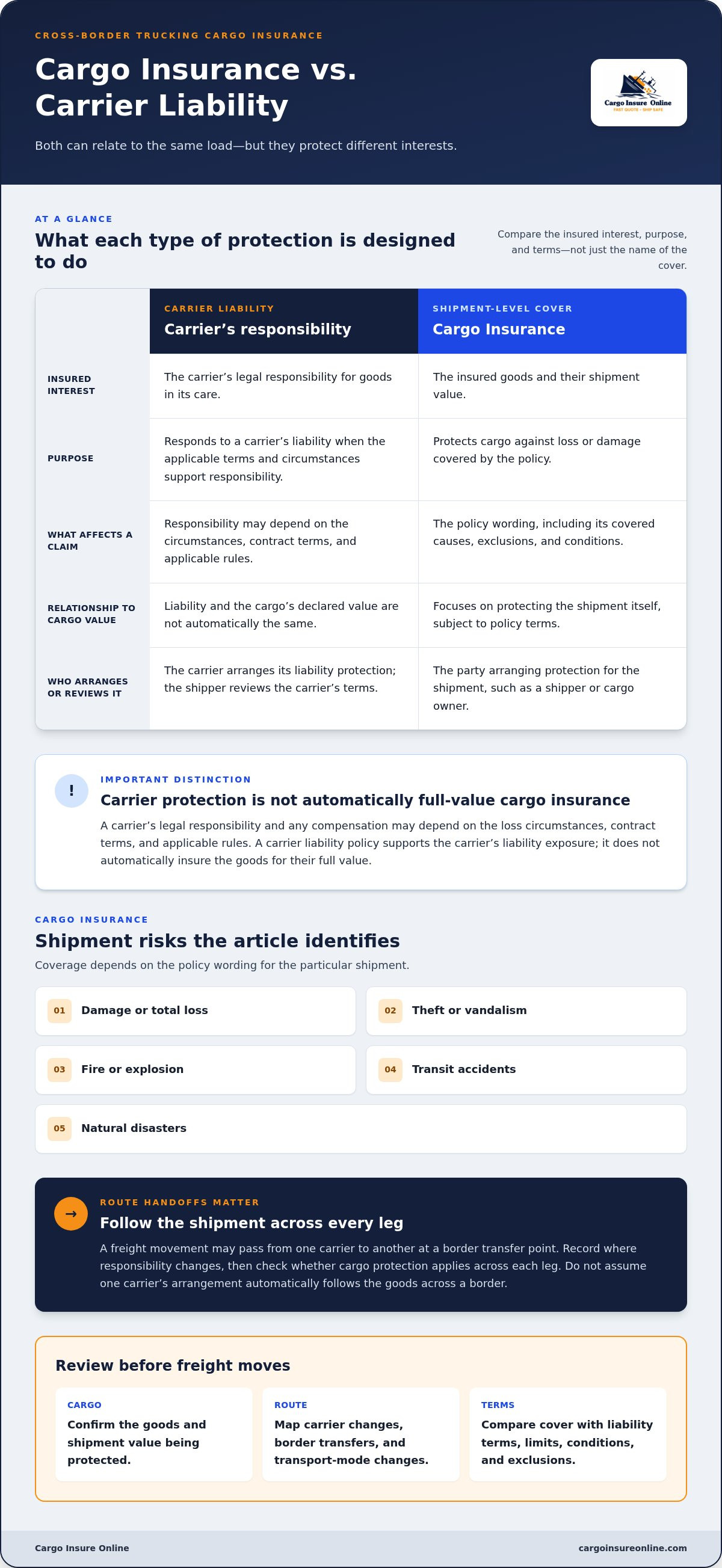
These two forms of protection can relate to the same load, but they focus on different interests. Carrier liability concerns whether a carrier is legally responsible for a loss. Cargo Insurance is designed to protect the insured shipment, subject to policy terms. Keeping that distinction clear helps shippers assess whether the cargo’s value has protection beyond what a carrier may owe.
| Cover type | Insured interest | Purpose | Typical decision-maker |
|---|---|---|---|
| Carrier liability | The carrier’s legal responsibility for goods in its care | Responds to a carrier’s liability when applicable terms and circumstances support responsibility | The carrier arranges its liability protection; the shipper reviews the carrier’s terms |
| Shipment-level cargo insurance | The insured goods and their shipment value | Protects cargo against loss or damage covered by the policy | The party arranging protection for the shipment, such as a shipper or cargo owner |
What carrier liability does, and doesn’t, tell the shipper
A carrier’s legal responsibility can depend on applicable law, contract terms, and the circumstances of the loss. It isn’t safe to assume one country’s rules or liability limits apply across an entire international route. Before relying on a jurisdiction-specific limit or legal rule, verify it against current, authoritative sources for the relevant route and parties.
Even where a carrier is responsible, liability and the cargo’s declared value aren’t automatically the same. The carrier’s terms may define how responsibility is assessed and what compensation may apply. If a shipment passes between carriers, the responsible party and claims process may also depend on where and how the loss occurred. A carrier liability policy supports the carrier’s liability exposure; it doesn’t automatically function as full-value insurance for the goods.
How shipment-level cover complements carrier protection
Cargo Insurance shifts the focus to the freight itself. Cargo Insure Online provides full-value cargo protection designed to address gaps in carrier liability, subject to the policy wording. Covered categories include damage or total loss, theft, vandalism, fire, explosion, transit accidents, and natural disasters. Check the terms for the insured shipment rather than assuming every cause of loss is included.
For example, imagine a shipment changes carriers at a border and is later found damaged. The carrier’s liability review would consider responsibility under the applicable terms and circumstances. Separately, the shipper could look to the cargo policy for protection under its wording. This doesn’t promise a particular claim outcome, but it shows why the two covers serve different roles.
Neither is vehicle hull or commercial auto insurance. Those address the vehicle, while cargo protection addresses the goods. To explore cargo insurance for shipments, start with the cargo’s value and the protection needed for its journey.
How to compare cross-border trucking cargo insurance arrangements
Compare cover by what it protects and how it applies to the shipment, not simply by the country named on a policy. Set shipment-specific cargo cover beside carrier liability and any separate regional policies. Each may serve a different purpose. The goal is to check whether the cargo’s insured value, route, and planned handling align with the documents in place.
When a route includes transfer carriers or multiple countries
Trace the shipment from origin to destination. Record each carrier, border transition, custody handoff, and change in transport mode. A transfer may change who is transporting the goods or which arrangement applies to that leg. Don’t assume a carrier’s policy follows the shipment through every handoff. Compare the route details with the policy’s stated transit scope and conditions.
| Arrangement | Purpose | What to verify in the policy |
|---|---|---|
| Shipment-specific cargo cover | Protects the insured goods against covered loss or damage | Insured value, cargo description, covered causes, exclusions, route scope, and claim documentation |
| Carrier liability | Addresses the carrier’s legal responsibility under applicable terms and rules | Which carrier and leg are involved, applicable contract terms, limits, and claims process |
| Separate regional policy | May address a particular carrier, operating area, or part of the journey | Geographic and transit scope, covered parties, effective period, and how it coordinates with other cover |
Which coverage details matter in a side-by-side review?
Start with the insured cargo value. Compare it with the shipment’s declared value and the policy’s stated basis for cover. Then check whether the goods and route are described accurately. A broad description that doesn’t match the actual freight can make it harder to establish what was insured.
- Route continuity: Check that the origin, destination, border transfers, carrier changes, and any mode changes match the planned journey.
- Covered causes and exclusions: Identify which loss or damage categories the wording addresses, and note exclusions or conditions that could affect the shipment.
- Claims requirements: Review the records and documentation the policy requires if goods are lost or damaged, and note how reporting and submission work.
- Policy relationship: See whether separate arrangements address different parties or legs, rather than assuming they automatically connect.
Policy jurisdiction and underwriting location can be relevant details, but neither alone makes a policy universally superior. Their significance depends on the wording, parties, and route involved. For cross border trucking cargo insurance, a useful comparison connects the documents to the shipment’s actual path, declared value, and handling. If a route-specific legal or liability rule affects your review, verify it against current authoritative sources for the relevant jurisdiction.
A practical checklist before insuring cross-border truck freight
A clear coverage review starts with accurate shipment data. Gather the details before requesting cover, then compare them with the route and transport documents. Consistent information helps connect the goods being insured to the journey they’ll actually take.
What shipment and route information should be ready?
Build the record from the cargo outward: describe the goods and packaging, establish the shipment value, then map the route. Include the origin, destination, planned transport mode, known carriers, and transfer points. If the freight changes carriers or modes, note where that happens. Keep invoices and transport documents consistent with those details.
Use this ordered checklist to prepare for cross border trucking cargo insurance:
- Cargo details: Describe the goods specifically and accurately. Include packaging information that helps identify how the shipment is prepared for transit.
- Shipment value: Gather the value information used for the shipment and check that it aligns with invoices and other records.
- Route: List the origin, destination, planned transit path, and any known border transitions.
- Carriers: Record each known carrier and the portion of the journey it handles.
- Handoffs and mode changes: Note transfer points, custody changes, and any shift between transport modes.
- Requested coverage: Identify the cargo protection needed and review the policy wording for covered causes, exclusions, and applicable route conditions.
How can teams prepare for a potential cargo claim?
Keep shipment records together and retain evidence of cargo condition before and after transit. Relevant materials may include invoices, transport documents, delivery records, and dated photographs of packaging or visible damage. These records can help document what was shipped and its condition at different stages.
Claims documentation, reporting steps, and deadlines depend on the applicable policy terms. Review those requirements before transit so the team knows what information to preserve and how the policy says to report a loss. Documentation supports a claim review, but it doesn’t determine the decision or timeline.
Country-specific insurance and customs requirements can vary. Verify applicable requirements against current official sources for the countries and route involved. Keep that regulatory check separate from the policy review: one concerns applicable requirements, while the other concerns the shipment’s insured value, route, and coverage terms.
Once the details are aligned, use them to get a Cargo Insurance quote through Cargo Insure Online’s digital platform.
Arrange cross-border trucking cargo insurance through Cargo Insure Online
Once your route and shipment details are organized, you can arrange cover online. Cargo Insure Online provides Cargo Insurance designed to protect the shipment’s full value and address gaps in carrier liability, subject to policy terms. Cover is available for truck shipments and other transport modes, keeping the focus on the cargo rather than the vehicle carrying it.
Create a free account, enter your shipment details to get a real-time quote, review the terms, then purchase with a credit card or e-wallet. Cargo Insure Online provides instant policy issuance and downloadable certificates online. There are no upfront fees; you pay only when you insure. Keep the certificate with the shipment’s transport records so relevant parties can refer to the policy documentation during the journey.
What the digital cargo insurance workflow looks like
Start with the information gathered for your coverage review: cargo description, shipment value, origin, destination, and planned route. Include carrier and handoff details where known. Enter accurate information, then review the quote and policy wording to understand the cover before purchase. Cargo Insure Online provides real-time quotes around the clock, immediate policy issuance, and downloadable certificates, making the process digital from quote through documentation.
Cargo Insurance policies are underwritten by A-rated insurers, including CHUBB, TSM Assurances, Probitas 1492, and Lloyd’s Syndicate. Underwriting strength does not remove the need to review the actual policy. Check that the shipment details are correct and understand the applicable terms, covered causes of loss, and exclusions. A certificate records policy information and should be considered alongside the policy wording.
When cargo protection needs more than one transport mode
Some shipments combine road transport with another mode. Cargo Insure Online supports cargo moving by truck, air, sea, and courier, giving shippers a way to arrange protection across different transport arrangements. The shipment’s actual route and policy terms still matter. If freight changes mode during transit, include that transition in the details used for the coverage review rather than treating the trucking leg as the whole journey.
For broader road-freight context, use the earlier sections of this guide to compare cargo protection with carrier liability and map route handoffs. This section focuses on moving from that review to policy documentation, not on repeating a full guide to each transport mode.
For cross border trucking cargo insurance, a clear digital process starts with accurate shipment information and ends with policy documents you can keep alongside the freight records. Cargo Insure Online’s platform supports quotes, policy issuance, and certificates for shipments from any origin to any destination, subject to policy terms.
Get a Cargo Insurance quote through Cargo Insure Online and review the policy details for your shipment.
Put your shipment details into motion
Your route can change after planning, and a carrier handoff can reshape who handles the freight. Make shipment protection part of the process, not a last-minute document task. Keep route and cargo records current, and revisit them whenever the planned journey changes. That gives your team a stronger starting point for reviewing cross border trucking cargo insurance against the shipment’s actual movement.
With the route mapped and shipment details ready, take the next step digitally. Cargo Insure Online provides cargo protection for truck and other transport modes, for shipments from any origin to any destination, subject to policy terms. Policies are underwritten by A-rated insurers, including CHUBB, AIG, TSM Assurances, Probitas 1492, and Lloyd’s Syndicate. Review the quote and policy details so the protection you arrange fits the shipment and its planned transit.
Get an instant cargo insurance quote and move forward with greater clarity. A well-prepared shipment deserves a well-planned next step.
Frequently Asked Questions
Does cross-border trucking cargo insurance cover the full value of a shipment?
It can be arranged to protect the shipment’s full value, subject to the insured amount and policy terms. For cross border trucking cargo insurance, make sure the cargo description and value you provide match the commercial documents. If one shipment contains several types of goods, itemized records can help show what the declared value represents. Review the policy wording to understand how the insured value and any applicable conditions affect cover.
Is carrier liability the same as cargo insurance for international trucking?
No. Carrier liability concerns a carrier’s legal responsibility for goods, while cargo insurance protects the insured shipment against loss or damage covered by its policy. If goods are damaged during a journey, a liability review may consider which carrier handled them and the circumstances of the loss. Cargo cover offers a separate route to assess the shipment’s protection under its own terms. Neither type of cover should be assumed to replace the other.
Can one cargo insurance policy cover a shipment moving through multiple countries?
It may, depending on the policy’s transit scope and terms. Cargo Insure Online supports shipments from any origin to any destination, subject to policy terms. Include the planned countries, border crossings, and transfer points in the shipment information so the route can be considered accurately. If the itinerary changes after arranging cover, compare the revised route with the policy wording rather than assuming the original terms automatically apply to the change.
Does cross-border cargo insurance cover theft during transit?
Cargo Insure Online Cargo Insurance includes theft among the stated covered loss categories, subject to policy wording and applicable conditions. If a shipment is stolen, retain available records that establish what was shipped, its condition before dispatch, and the movement details. Report the incident through the process and within the timeframes specified in the policy. Theft cover doesn’t mean every circumstance is covered, so exclusions and claim requirements matter.
Who should arrange cargo insurance when freight crosses an international border?
The party with a financial interest in the goods often arranges shipment protection, but the seller’s and buyer’s agreement may shape who takes responsibility for arranging it. Identify who bears the potential loss during each stage and check whether that party has arranged cargo cover. If responsibilities are shared or change during the journey, document the arrangement clearly before the shipment moves.
Can cargo insurance cover a shipment that changes carriers or transport modes?
It can be considered for shipments involving truck, air, sea, or courier transport, subject to policy terms. A load might travel by truck to a transfer point and continue by another mode. Provide the planned route and mode changes when arranging cover, then review the issued policy for its transit scope. If carriers or transport plans change, compare the updated details with the policy rather than assuming every new leg is included.
Does standard cargo insurance cover losses caused by transit delays?
Standard Cargo Insurance excludes delay-related losses. Cargo Insure Online offers separate Cargo Delay Insurance, with a stated trigger threshold of 8-14 days, subject to its terms. This distinction matters if a late arrival could create costs beyond physical cargo damage, such as demurrage or production downtime. Review the delay policy’s trigger and covered loss categories against the shipment’s needs; don’t assume standard cargo cover responds to delay alone.


