
What if cargo insurance could be offered before a shipment leaves the booking screen, without adding another manual task? For freight forwarders, automated cargo insurance for freight forwarders connects the insurance offer to the shipment workflow. Instead of switching between systems to request quotes and documents, teams can make coverage part of the booking process.
Carrier liability is not the same as insurance for the full value of a shipment. Shippers may not understand the difference until a loss leads to a dispute. At the same time, teams handling quotes, bookings, and documents can miss the chance to offer cargo coverage. A clear, timely offer can help shippers consider their options and create a potential ancillary revenue stream for the forwarder.
This guide explains how to connect insurance with existing booking workflows, identify potential coverage gaps, and assess whether a digital offer fits your operations. It covers integration requirements, multimodal options, and white-label solutions. Cargo Insure Online provides cargo insurance for air, sea, and trucking, along with white-label solutions for partners exploring branded coverage.
Key Takeaways
- Automated cargo insurance for freight forwarders can connect shipment data to digital quoting and policy workflows, reducing duplicate data entry.
- Check TMS compatibility, API documentation, required data fields, and exception handling before choosing a platform.
- Explain the difference between carrier liability and cargo insurance, and help shippers understand where coverage gaps may remain.
- Confirm that the available coverage fits your transport modes and cargo types, including high-value goods that may require specialized protection.
- White-label insurance can provide a branded way to offer coverage and create a potential ancillary revenue opportunity.
What Is Automated Cargo Insurance for Freight Forwarders?
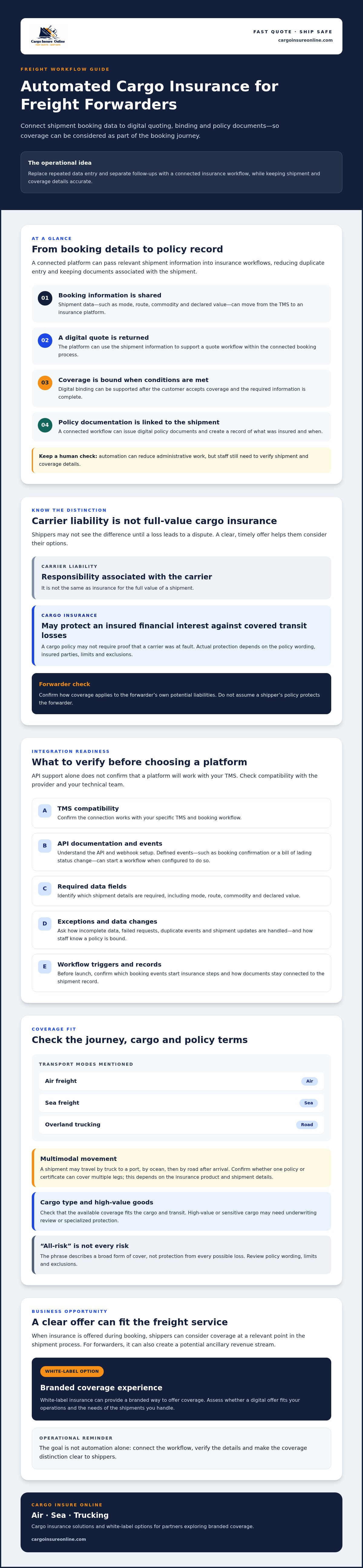
Automated cargo insurance for freight forwarders uses digital data exchange to support quoting, binding, and issuing coverage for individual shipments. Rather than re-entering shipment details in a separate portal or arranging documents through calls and emails, a connected workflow can pass relevant booking information to an insurance platform. After the information is checked and coverage is bound, the platform can issue digital policy documentation for the shipment.
This can be useful for forwarders coordinating transport across multiple parties and offering insurance alongside freight services. A freight forwarder can connect a shipper’s needs with transport options, but carrier liability and cargo insurance serve different purposes. A cargo policy may protect the insured’s financial interest against covered transit losses without requiring proof that a carrier was at fault. The policy wording, insured parties, limits, and exclusions determine the actual protection. Forwarders should also confirm how coverage applies to their own potential liabilities rather than assume a shipper’s policy protects them.
The Shift from Legacy Portals to Embedded Logistics Insurance
Manual insurance workflows can add friction at booking. Staff may have to copy shipment details, request documents, and follow up to confirm whether a certificate has been issued. Embedded insurance brings those steps into the digital booking journey. Shipment data can populate quote fields, reducing duplicate entry and the chance of mismatched information. Depending on the integration and approval process, a booking may trigger a quote or policy workflow without staff leaving the system. Automation can reduce administrative work, but staff still need to check that shipment and coverage details are accurate.
Digital quoting and binding can help a team keep insurance steps connected to dispatch, while creating a record of what was insured and when. Before launch, confirm which booking events start the workflow, what information is required, and how the system handles incomplete data, changes, or exceptions.
Key Modalities Covered Under Digital Marine Architecture
Digital cargo insurance may support air freight, sea freight, and overland trucking. That matters when a shipment travels by truck to a port, by ocean, then by road after arrival. A suitable platform may help coordinate coverage across the journey instead of treating every leg as a separate booking. Confirm whether a single policy or certificate can cover multiple legs. That depends on the insurance product and the shipment details.
Air, ocean, and trucking shipments involve different routes, handoffs, and transit conditions. A digital booking process can help capture the relevant transport mode and route information before presenting coverage. Cargo Insure Online provides insurance solutions for air, sea, and trucking. Before offering a policy, check that its terms match the shipment’s transit and cargo. “All-risk” describes a broad form of cover, not protection from every possible loss.
How Digital Cargo Insurance Integration Operates Inside Your TMS
A TMS integration can make insurance part of the freight booking workflow instead of a separate administrative task. An API connection can send shipment details, such as mode, route, commodity, and declared value, to an insurance platform. The platform can return a quote and, when the customer accepts coverage and required information is complete, support digital binding.
The aim is to reduce duplicate entry and keep insurance documentation linked to the shipment record. Integration details differ, so check which fields are required, how errors or incomplete data are flagged, and what confirms that a policy is bound. Automated cargo insurance for freight forwarders is most useful when it reduces friction without sacrificing accurate coverage records.
The Core Technical Architecture: APIs and Webhooks
REST APIs allow systems to exchange structured information. Webhooks can notify connected platforms when a defined event occurs. For example, a booking confirmation or bill of lading status change could start an insurance workflow if the TMS and insurance platform are configured to use that event. Ask vendors how they manage authentication, failed requests, duplicate events, and updates to shipment data. Do not assume a platform works with your TMS because it supports APIs. Confirm compatibility with the provider and your own technical team.
Underwriting for High-Value and Sensitive Cargo
Underwriting may consider details such as the commodity, transport mode, route, and declared value. Standard freight may be assessed under the insurer’s usual rules, while sensitive goods could require additional information or review. Electronics, drones, mobile devices, and temperature-sensitive cargo can have distinct underwriting needs. Ask which shipments can be quoted and bound through the automated workflow, which require manual assessment, and how a referral or declined risk is communicated. A useful system makes these decisions visible rather than hiding them.
Certificate Issuance and Billing Workflows
After coverage is bound, a platform may generate digital proof of insurance and associate it with the relevant shipment record. Confirm how certificates are delivered, whether amendments are tracked, and how staff can retrieve documents later. Billing is a separate integration question. A forwarder may want insurance charges included in its invoicing process, but what is possible depends on the platform and accounting setup. Ask for a clear record of quotes, approvals, policy changes, and certificate issuance rather than assuming every system stores the same information.
Map the workflow from start to finish: booking data, underwriting response, customer acceptance, binding confirmation, and document and billing updates. Cargo Insure Online offers white-label solutions for forwarders exploring branded digital coverage. Review its white-label cargo insurance solutions as one option when evaluating how insurance could fit your TMS journey.
Carrier Liability vs. All-Risk Cargo Insurance: The Forwarder Exposure Gap
Carrier liability and cargo insurance are not interchangeable. Liability rules generally limit what a carrier may owe, often using weight or package-based formulas rather than the shipment’s full commercial value. Cargo insurance, by contrast, can protect the insured’s interest against covered transit losses without requiring proof that a carrier was at fault. The policy wording controls what is covered. “All-risk” does not mean every cause of loss is included.
This difference matters to forwarders. If a shipper expects full-value protection but later discovers a carrier’s liability cap applies, the dispute can strain the customer relationship, even if the forwarder did not cause the loss. Presenting coverage options clearly and recording the customer’s decision can help set expectations before the cargo moves.
Liability Limits Depend on the Mode and Rules
Limits vary by transport mode, governing rules, and shipment details. Under COGSA, ocean carrier liability is generally limited to $500 per package. Air carrier liability under the Montreal Convention is capped by a limit expressed in Special Drawing Rights, while trucking liability can also be restricted by applicable rules and contract terms. Some standard less-than-truckload liability can be as low as $0.50 per pound. These amounts may fall well short of the goods’ value. Claims can also turn on the facts, applicable terms, and available defenses, so forwarders should not present carrier liability as a full-value insurance substitute.
General Average Can Add Another Costly Complication
In a maritime emergency, a vessel owner may declare general average, requiring cargo interests to contribute to certain extraordinary measures that protect the shared voyage. Cargo release can depend on providing security or a bond while the contribution is assessed. A cargo policy may respond to general average contributions if its terms include that protection, but coverage is not automatic. Check the policy wording and exclusions. Do not promise that insurance will guarantee release or pay every contribution.
Protect the Relationship with Clear Choices
Automated cargo insurance for freight forwarders can put a clear coverage offer into the booking flow, giving shippers a timely opportunity to consider primary cargo protection. Configure the process to explain the option, capture acceptance or declination, and retain a record. An opt-in prompt helps document the decision. It does not replace clear terms or ensure the customer understands every exclusion.
For a mode-specific overview, read our air freight insurance guide. Clear choices, accurate records, and careful policy review can help reduce avoidable misunderstandings if a shipment is damaged or delayed.
Key Criteria for Selecting an Automated Cargo Insurance Platform
The right platform should fit your freight workflows and the risks your customers want to insure. A polished demo is not enough. Assess integration requirements, underwriting scope, insurer financial strength, and what happens when a shipment has a claim. Automated cargo insurance for freight forwarders should reduce friction while keeping coverage terms and claims steps understandable.
Test the Integration, Not Just the Sales Demo
Review developer documentation, API endpoints, and any available sandbox before committing. Test how the system responds to quote requests, whether webhooks report status changes reliably, and how it handles missing or corrected shipment data. Confirm compatibility with your TMS and other logistics software directly with the provider. Ask what implementation work your team must do, what support is available, and whether any uptime commitments are documented in a service-level agreement. Validate any proposed implementation timeline rather than assuming it.
Match Underwriting to Your Cargo Mix
Check the insurer behind the platform, including its financial strength and claims-paying capacity. Then compare the actual policy wording, limits, exclusions, and eligible modes with the shipments your customers move. Ask how the platform handles goods that may need specialized underwriting, such as temperature-controlled products, electronics, drones, and mobile devices. Can it return a decision digitally, or does the shipment need manual review? Understand the difference before building a workflow around automated issuance.
For cold-chain considerations, explore our reefer cargo insurance analysis. Use it alongside policy documents to check whether the cover fits the cargo and transit conditions you handle.
Make Claims Steps Visible and Practical
A fast quote is only one part of the experience. Ask how a shipper reports a loss, uploads photographs and supporting documents, and receives status updates. Look for a clear digital first notice of loss process, defined evidence requirements, and a way for authorized parties to follow progress. A dashboard does not guarantee faster settlement. Ask which milestones it displays, who manages the claim, and how complex cases or requests for additional evidence are handled.
- Integration: Test data mapping, response behavior, webhooks, and error handling.
- Coverage: Verify modes, commodities, exclusions, limits, and referral rules.
- Claims: Review submission steps, evidence requirements, and status visibility.
- Insurer: Assess financial strength and understand who underwrites the policy.
Compare these criteria with your shipment mix and customer experience goals. To explore digital coverage across air, sea, and trucking, review Cargo Insure Online’s cargo insurance solutions.
Transforming Cargo Insurance into an Ancillary Profit Center
Cargo insurance can be part of the freight experience rather than a separate task for your team. When it is offered in a booking workflow, shippers have a convenient opportunity to consider coverage, and the forwarder may gain an ancillary revenue stream. The commercial model depends on the provider agreement, so confirm how compensation works before forecasting revenue.
Automated cargo insurance for freight forwarders can connect the offer to shipments already moving through your systems. That can reduce manual administration and make it easier to present coverage consistently across air, sea, and trucking bookings. It also gives forwarders another service to include in the customer experience instead of treating insurance solely as a back-office requirement.
White-Label Insurance Engines: Your Brand, Modern Underwriting
White-label infrastructure can let forwarders offer a branded digital insurance experience without building an underwriting engine themselves. The insurer or underwriting partner remains responsible for setting terms and assessing risk, while the forwarder provides customers with a route to access coverage. A well-integrated experience can reinforce your brand while making the insurer’s role and policy terms clear. Explore best practices for launching a branded cargo insurance platform before planning your rollout.
Make Checkout Clear, Not Pushy
Insurance is easier to consider when it appears alongside shipment details customers are already reviewing. Show the quote as a distinct line item, explain what the coverage is intended to protect, and make the policy wording accessible before purchase. A clear opt-in lets shippers choose coverage without confusion. Do not assume a preselected box will suit every customer or increase uptake. Test the checkout journey and monitor customer questions, completion, and opt-in behavior.
Grow Without Adding the Same Admin for Every Policy
Automation can reduce repetitive data entry and certificate handling, giving staff more time for freight operations and customer needs. It does not eliminate operating costs or oversight. Teams still need to manage exceptions, answer questions, reconcile billing, and check shipment details. Model the opportunity using your actual volumes, provider terms, service costs, and customer uptake rather than assuming every booking converts.
To assess whether an embedded offer fits your workflow, map the customer journey from quote to policy documentation and identify where staff intervention remains necessary. Road transport teams can also review this trucking cargo insurance guide. For branded coverage across freight movements, explore Cargo Insure Online’s white-label solutions.
Make Insurance a Smarter Part of Every Shipment
Manual insurance steps do not have to slow freight operations. Automated cargo insurance for freight forwarders can connect coverage to the booking journey, reduce repetitive administration, and give shippers a clear opportunity to consider protecting their cargo.
Choose a platform that fits your TMS, supports the modes and goods your customers move, and makes policy terms and claims steps easy to understand. API-driven quotes and digital certificate generation can simplify shipment workflows, while multimodal options across ocean, air, and road can address different transit needs. For forwarders looking to strengthen their branded service, white-label solutions may also create an ancillary revenue opportunity, depending on the provider’s commercial terms.
Cargo Insure Online offers cargo insurance for air, sea, and trucking, along with coverage options for high-value electronics and white-label solutions. Explore Cargo Insure Online’s cargo insurance and white-label solutions to see how coverage could fit your workflow. Start by reviewing your booking process, shipment mix, and integration requirements, then contact Cargo Insure Online to discuss your options.
Frequently Asked Questions
What is the difference between freight forwarder legal liability and cargo insurance?
Freight forwarder legal liability addresses the forwarder’s own legal responsibility for a loss, subject to policy terms and circumstances. Cargo insurance protects the insured’s financial interest in goods against losses covered by that policy. Carrier liability is different again: it may limit a carrier’s responsibility and is not full-value cargo insurance. Review who is insured, covered causes of loss, limits, and exclusions to understand which protection applies to each shipment.
How does an automated cargo insurance API integrate with our existing TMS software?
An API can send shipment details from a TMS, such as mode, route, commodity, and declared value, to an insurance platform for a quote. Depending on the integration, the platform can return a decision and support digital binding and certificate generation. Compatibility and workflow vary by provider and TMS, so confirm required fields, error handling, security, and implementation support before selecting a platform. Automated cargo insurance for freight forwarders should fit the booking flow rather than create another disconnected task.
Can automated cargo insurance handle high-value electronics and temperature-sensitive reefer shipments?
It can if the platform’s underwriting appetite and the specific policy terms include those goods. Cargo Insure Online offers insurance options for electronics and high-value devices, as well as reefer products. Before offering coverage, check commodity eligibility, limits, exclusions, temperature-related conditions, and whether a shipment needs manual underwriting review. Automation can streamline quoting, but it does not mean every shipment is eligible or every cause of loss is covered.
Does automated cargo insurance protect against General Average claims on ocean shipments?
A cargo policy may cover a shipper’s General Average contribution, but protection depends on the policy wording, limits, and exclusions. Automation itself does not add this coverage. Before binding, verify that the policy specifically addresses General Average and any security or contribution requirements that may apply to cargo release. Forwarders should not promise that a policy will pay every charge or ensure cargo release without checking the terms and the insurer’s claims process.
How quickly are claims processed and settled under a digital cargo insurance model?
Digital claims tools can make it easier to submit a notice of loss, photos, and supporting documents, then track updates. They do not guarantee a specific settlement time. Timing depends on the insurer, the type and complexity of the loss, the evidence provided, and any investigation required. Before selecting a platform, ask which claim milestones are visible, what documents are needed, who handles the assessment, and how customers receive updates.
Can our freight forwarding business white-label the cargo insurance platform under our own brand?
Yes. Cargo Insure Online offers white-label solutions that allow logistics partners to present a branded insurance experience. Insurance terms and underwriting remain subject to the provider and relevant policy documentation, so make the insurer’s role and coverage details clear to customers. Before launch, confirm branding options, integration requirements, customer support responsibilities, data flows, and commercial terms. A white-label setup can connect insurance to your service experience without requiring you to build an underwriting platform.
Is automated per-shipment cargo insurance cost-effective for small to mid-sized freight forwarders?
It can be, but the answer depends on shipment volume, integration and operating costs, customer uptake, and the provider’s commercial terms. Compare those costs with the time your team currently spends obtaining quotes, issuing documents, and managing exceptions. Consider whether offering coverage supports customer retention or creates ancillary revenue, without assuming every shipper will opt in. Request clear terms and model the economics using your own shipment data before deciding.


