
Could recurring freight be insured under one standing arrangement instead of a fresh placement for every shipment? Open cover cargo insurance for freight forwarders can simplify the process for eligible shipments, but it is not a blanket promise. Protection depends on the policy wording and whether each shipment is declared as required.
That distinction matters when insurance tasks repeat across routes, customers, and transport modes. It is easy to assume someone else is arranging cover or reporting a shipment. A missed declaration, an excluded cargo type, or a route outside the agreed scope could leave a gap. Carrier liability is not a substitute for cargo insurance, particularly when it may not cover the goods’ full value.
This guide explains how open cover works, who may arrange and declare shipments, and which wording and workflow questions to resolve before comparing providers. You’ll also learn what to check for eligible cargo and routes, exclusions, declaration timing, and record-keeping. The goal is a clear, scalable approach to recurring freight, with responsibilities understood before a shipment moves.
Key Takeaways
- See how open cover cargo insurance for freight forwarders can support recurring shipments, and why its scope depends on the policy wording.
- Map the declaration workflow before shipments move, including who submits details, when they’re due, and how records are kept.
- Compare open cover with single-transit arrangements by looking at reporting requirements and how each fits your shipment patterns.
- Use a checklist to review cargo, routes, transport modes, valuation, claims procedures, and customer responsibilities with a qualified insurance professional.
- Prepare to compare potential partners by mapping your freight flows and confirming product availability, the insurer, and the applicable terms.
Open Cover Cargo Insurance for Freight Forwarders: What It Means
Arranging a separate placement for every consignment can create repetitive work when freight moves regularly. An open cover arrangement is designed for that pattern by setting policy terms for multiple shipments over an agreed period. The precise scope, reporting duties, and timing of cover still depend on the contract.
Quotable definition: An open cover is a policy arrangement intended to insure multiple eligible shipments during an agreed period, subject to the policy’s terms and any required shipment declarations. Unlike a single-shipment policy, it provides a framework for recurring consignments rather than a separate placement for each one.
That framework is not automatically all-risk, unlimited, or suitable for every shipment. Cargo type, route, transport mode, valuation, exclusions, and limits can all affect whether a consignment falls within the wording. The term “open cover” alone does not confirm what is insured or when protection attaches. Read the contract and confirm how it applies to your operation. For wider context, Marine insurance covers different interests, including cargo and vessels, rather than describing one universal type of protection.
How does open cover differ from single-shipment insurance?
With single-shipment insurance, cover is arranged for an individual consignment. Open cover instead sets a recurring structure for shipments that meet agreed criteria. That can make administration more consistent, but it does not remove the need to check eligibility or follow reporting instructions. Confirm in the policy wording whether declarations are required, how often they must be submitted, and when cover attaches. Do not assume a shipment is covered simply because it resembles earlier freight.
Why do freight forwarders consider open cover?
For forwarders coordinating repeat shipments, a defined insurance workflow can make it easier to see which loads may qualify, who reports them, and what records to retain. It can replace ad hoc decisions with a process that teams can follow. But arranging insurance for a customer is not the same as insuring the forwarder’s own property. Before setting up open cover cargo insurance for freight forwarders, clarify customer authority, contractual responsibilities, who has an insurable interest, and who is named or otherwise recognized under the policy.
Start with roles, not assumptions. A forwarder may coordinate a customer’s insurance request without owning the goods or automatically becoming the insured party. Review the relevant parties and interests with a qualified insurance professional, alongside the actual wording. This helps establish whether an open-cover structure fits the shipment flow or whether another arrangement should be considered.
How Open Cover Works: Declarations, Shipments, and Responsibilities
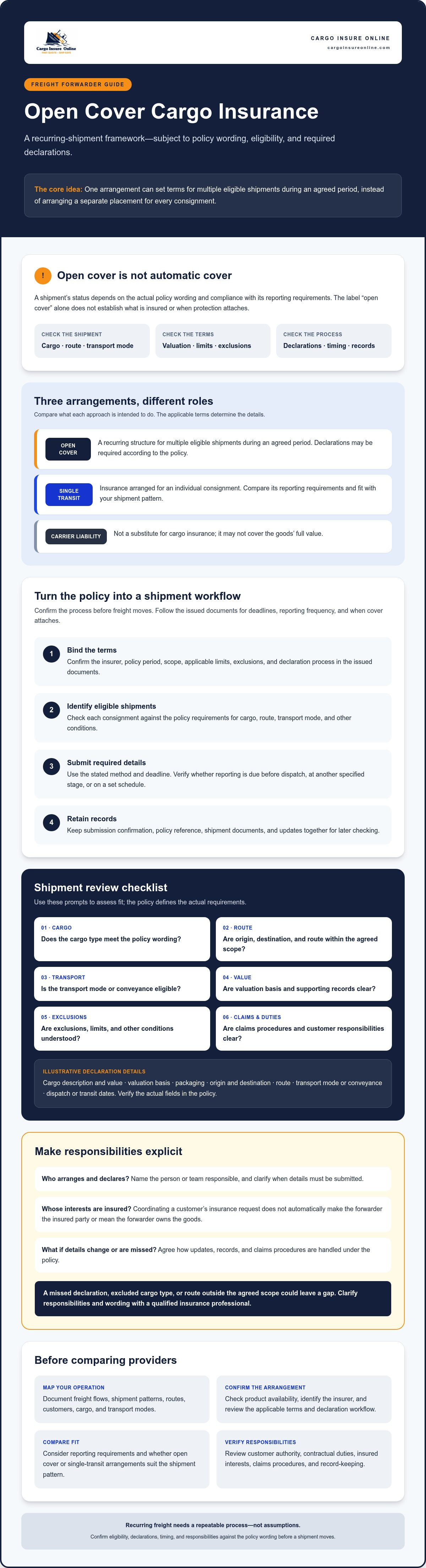
An open cover arrangement needs a clear operating process. Confirm the agreed terms, determine which shipments fit, identify who must report them, and decide what evidence to keep. The policy controls the details, including reporting frequency, deadlines, and when cover attaches. Do not assume a shipment is covered simply because it follows your usual shipping pattern.
A shipment’s insurance status depends on the policy wording and compliance with its reporting requirements. Turn the agreed terms into a practical workflow before freight moves.
- Bind the terms. Confirm the insurer, policy period, scope, applicable limits, exclusions, and declaration process in the issued documents.
- Identify eligible shipments. Compare each consignment with the policy’s requirements for cargo, route, transport mode, and other conditions.
- Submit required details. Follow the stated method and deadline. Check whether reporting is required before dispatch, at another specified stage, or on a set schedule.
- Retain records. Keep the submission confirmation, policy reference, shipment documents, and any updates together so the details can be checked later.
What shipment details may need to be declared?
Use this as an illustrative checklist, not a standard declaration form. Verify the actual fields in the policy. They may include cargo description and value, valuation basis, packaging, origin and destination, route, transport mode or conveyance, and dispatch or transit dates. Accurate descriptions help the insurer assess what is being shipped. Consistent valuations and supporting records can also matter during a claim review. Ask how to report changes, such as a revised route or shipment details, rather than relying on assumptions.
Who reports shipments and keeps the records?
There is no universal reporting model. Depending on the contract and customer arrangement, the cargo owner, shipper, freight forwarder, or an insurance intermediary may have a role. The International Trade Administration describes how freight forwarders are agents for exporters and includes cargo insurance among services they may arrange. That does not establish who must declare a particular shipment or who is insured under a specific policy. Confirm authority and responsibilities in writing.
Record who approved the insurance request, who submitted each declaration, when it was sent, and which policy it relates to. Keep shipment evidence and submission confirmations in an accessible system. Ask the insurance provider how late, incomplete, or inaccurate reports are handled, and what corrections are possible. Understand these procedures before the first declaration is due.
Forwarders reviewing air, sea, or trucking cargo insurance can also discuss recurring freight insurance needs with Cargo Insure Online and confirm whether an open-cover arrangement is available and what terms apply.
Open Cover vs. Single-Transit Cover and Carrier Liability
Choosing an insurance setup starts with your shipment pattern. Open cover is structured for multiple eligible consignments over an agreed period. Single-transit cover is arranged for an individual shipment. Neither label settles what a policy covers. Check the terms, reporting rules, and eligibility against the actual wording.
| Factor | Open cover | Single-transit cover |
|---|---|---|
| Workflow | Set terms for eligible shipments across an agreed period, then follow the policy’s process for each consignment. | Arrange cover for a specific shipment, subject to the individual placement’s terms. |
| Reporting | Declarations may be required. Frequency, deadline, and required details depend on the policy. | Shipment information is provided for that placement. Confirm when it must be submitted and when cover attaches. |
| Potential fit | Worth assessing for recurring freight if the risks are eligible and the operation can meet reporting requirements. | May suit an occasional or distinct shipment, depending on its needs and available terms. |
These are structural differences, not promises of lower cost or easier administration. Open cover cargo insurance for freight forwarders still depends on underwriting acceptance, eligible risks, and a declaration process your operation can follow.
When might recurring open cover be worth evaluating?
Consider shipment frequency, transport modes, route patterns, and your team’s capacity to report shipments accurately. Also consider how customers authorize insurance and who supplies the required information. A forwarder handling regular air, sea, and trucking movements may have different needs from one coordinating occasional, specialized consignments. Suitability depends on the insurer accepting the risks and the policy’s scope, not simply on shipment volume.
What does open cover not automatically protect?
Cargo insurance addresses insured cargo interests under its wording. It does not automatically cover a forwarder’s separate professional or contractual liabilities. Carrier liability is also distinct from cargo insurance and may be limited, so it should not be treated as a guarantee of recovering the goods’ full value. For more detail, see this guide to carrier liability versus cargo insurance.
Check the actual wording for exclusions, limits, deductibles, conveyance conditions, and territorial scope. Confirm the valuation basis and claims requirements too. A policy label, including “all risk” if used, does not by itself confirm protection for a particular loss. Match the loss scenario to the relevant terms and ask a qualified insurance professional about anything unclear before binding cover.
How Freight Forwarders Can Evaluate an Open Cover Arrangement
A useful review starts with your actual shipment profile, not the policy label. Open cover cargo insurance for freight forwarders should fit the cargo and routes you handle, the transport modes involved, and your team’s ability to meet declaration requirements. Review the issued wording with a qualified insurance professional before binding cover.
Questions to ask before binding cover
- Eligible shipments: Which cargo types, commodities, routes, and transport modes can be considered? Are any shipments outside the proposed scope?
- Valuation and limits: What valuation basis applies, and how do policy limits work for individual shipments or other relevant exposures?
- Declarations: Who can declare shipments, what information is required, and what are the submission method and deadline?
- Claims and exclusions: What exclusions, deductibles, and claims notification requirements apply? Which evidence may be needed to support a claim?
- People and authority: Who is insured, and what customer authorization is needed for the forwarder to arrange or report cover?
Check that the answers match how freight moves in practice. If your operation uses several modes, review the relevant details for each one. These guides provide mode-specific background on air freight insurance, sea freight insurance, and trucking cargo insurance. They do not replace checking the wording for the specific arrangement you’re considering.
Build a reliable shipment declaration process
Clear ownership prevents declarations from falling between teams or customers. Assign responsibility for collecting shipment details, submitting them, checking confirmations, and retaining records. Document who can request cover on a customer’s behalf and how that authority is recorded.
Then test the process against your shipment data. A system check or regular reconciliation can help flag a dispatch with no matching declaration, missing information, or inconsistent cargo values. Keep customer instructions, shipment documents, submission timestamps, and policy references accessible for questions or a potential claim. Confirm with the insurance provider how corrections, late reports, and incomplete declarations are handled under the actual terms.
Cargo Insure Online provides air, sea, and trucking cargo insurance and can be a discussion point for recurring freight needs. Discuss your freight insurance requirements and verify whether open cover is available, who the insurer is, and which policy terms would apply.
Next Steps: Match Your Freight Operation to the Right Insurance Partner
You’ve reviewed the structure, declaration workflow, and key policy questions. Now turn that into a clear brief. Open cover cargo insurance for freight forwarders may suit some recurring freight operations, but availability and fit must be confirmed against the risks and terms being considered.
Prepare an accurate freight insurance brief
Give a potential provider a practical view of your operation. Gather:
- Shipment patterns and volumes, including cargo categories and typical values
- Routes, destinations, and transport modes, such as air, sea, or trucking
- Current insurance arrangements and any known coverage gaps
- Your declaration process, including the systems and team capacity used to report shipments
- Customer relationships, authorization to arrange cover, and your role in each placement
Clear information helps a provider assess whether an arrangement may fit. It does not guarantee acceptance or coverage. Ask who the insurer would be, which cargo and routes may be eligible, how declarations would work, and which policy wording and jurisdictions would apply. Review the actual terms with a qualified insurance professional before binding cover.
Discuss freight insurance options with Cargo Insure Online
Cargo Insure Online provides cargo insurance for air, sea, and trucking freight, and operates as a digital insurance intermediary and technology provider for logistics. These categories may be a starting point for a conversation about your transport mix and recurring shipment needs. Do not assume an open cover option is available. Ask directly whether a suitable arrangement can be considered and verify the insurer, eligible risks, declaration requirements, and applicable terms.
Arrive with your shipment brief and the questions your team needs answered. That makes the discussion focused and keeps the decision grounded in your actual freight flows and policy wording.
Explore cargo insurance options and ask whether a recurring-shipment arrangement may be available for your operation.
Build a Clearer Freight Insurance Workflow
Open cover cargo insurance for freight forwarders can create a repeatable framework for recurring shipments, but the policy wording and declaration process determine how it works. Before choosing an arrangement, map your freight flows, confirm who can arrange and report cover, and review eligible cargo, routes, limits, exclusions, and claims requirements.
Keep the key distinction in view: cargo insurance and carrier liability serve different purposes. Neither a policy label nor a familiar shipment pattern confirms protection on its own. Check the actual terms with a qualified insurance professional before binding cover.
Cargo Insure Online provides cargo insurance for air, sea, and trucking freight. As a digital insurance intermediary and technology provider for logistics, it may be a useful discussion point for your operation. Ask whether a recurring-shipment arrangement is available and verify the insurer, eligible risks, and applicable terms.
To discuss your freight operation and whether a recurring-shipment arrangement may be available, explore cargo insurance options.
Frequently Asked Questions
What is open cover cargo insurance for freight forwarders?
It’s a policy arrangement intended to cover multiple eligible shipments over an agreed period, rather than arranging a separate policy for each consignment. The actual wording determines who is insured, which cargo and routes may qualify, and what declarations are required. Freight forwarders may help arrange cover for customers, but they don’t automatically own the goods or become the insured party. Confirm roles and authority before relying on an arrangement.
How does open cover cargo insurance work?
The parties agree policy terms, identify shipments that may fit, submit required details, and retain records. A declaration might include cargo, value, route, transport mode, and dispatch information, but required fields vary. The policy also determines how and when reports must be made, and when cover attaches. Check these points in the actual wording. Do not assume a shipment is covered simply because it resembles earlier consignments.
Is open cover cargo insurance the same as all-risk insurance?
No. “Open cover” describes an arrangement intended for multiple shipments, while “all-risk” refers to a type of coverage wording. Neither label means every shipment or loss is automatically covered. Exclusions, limits, deductibles, conditions, and eligible risks depend on the specific policy. Review the wording for the goods, route, and loss scenario in question, and ask a qualified insurance professional to clarify terms that aren’t clear.
Does open cover replace a freight forwarder’s carrier liability?
No. Cargo insurance and carrier liability are different. Cargo insurance responds to covered losses affecting the insured cargo interest, subject to the policy terms. Carrier liability concerns a carrier’s responsibility under applicable agreements and rules, and it may be limited. Neither guarantees recovery of the cargo’s full value. A forwarder should also distinguish cargo protection from its own professional or contractual liabilities, which aren’t automatically covered by cargo insurance.
What information does a freight forwarder need to declare?
Follow the policy’s declaration requirements. Information to confirm may include an accurate cargo description, value and valuation basis, packaging, origin and destination, route, transport mode or conveyance, and dispatch or transit dates. This is an illustrative list, not a universal form. Accurate details help the insurer assess the shipment and can support later review. Ask how to report changes, omissions, or corrections, and keep the submission confirmation with shipment records.
Can a freight forwarder insure cargo on a customer’s behalf?
A freight forwarder may be able to arrange or report insurance for a customer, but the authority, insured party, and insurable interest must be clear. The customer’s instructions and the policy wording determine the arrangement. Do not assume the forwarder is insured simply because it submitted a declaration or coordinated a placement. Document who authorized the request, who is insured, who reports shipments, and what responsibilities each party accepts.
When might single-shipment insurance be a better fit than open cover?
Single-shipment insurance may be worth considering for an occasional consignment, a one-off route, or freight that doesn’t appear to fit an open cover’s eligible risks. It can also be relevant if the operation can’t meet recurring declaration requirements. The right choice depends on the shipment and the available policy terms, not a general rule. Compare reporting steps, eligibility, exclusions, and timing before arranging cover.


