
What if shipment protection felt like part of the booking flow, not another task for your team? A freight forwarder cargo insurance program can give customers an option beyond carrier liability, which may be limited and may not cover the cargo’s full value. Shippers want reassurance. The challenge is offering it without adding confusing steps or making coverage harder to explain.
This guide shows how to build insurance into the way your operation already works. You’ll learn how to present a clear path to shipment protection, fit insurance into booking and shipping workflows, and communicate coverage and exclusions consistently. We’ll also look at how to evaluate program models and partners for air, sea, and trucking shipments, including white-label solutions. The aim is to make coverage easier for customers to understand and easier for your team to offer, while checking that the program terms and setup match your cargo, transport modes, and operating needs.
Key Takeaways
- Build a freight forwarder cargo insurance program around how shipments are booked, documented, and supported, rather than treating it as a disconnected add-on.
- Map the shipment journey from presenting coverage to recording details and directing follow-up questions.
- Compare program options by cargo eligibility, transport modes, exclusions, documentation, customer communication, and operational fit.
- Prepare your team before launch by assigning owners for presenting options, capturing shipment information, and escalating claims questions.
- Shortlist partners by policy fit and responsibilities, then confirm setup, eligible jurisdictions, claims routing, and technology needs.
What Is a Freight Forwarder Cargo Insurance Program: What Does It Solve?
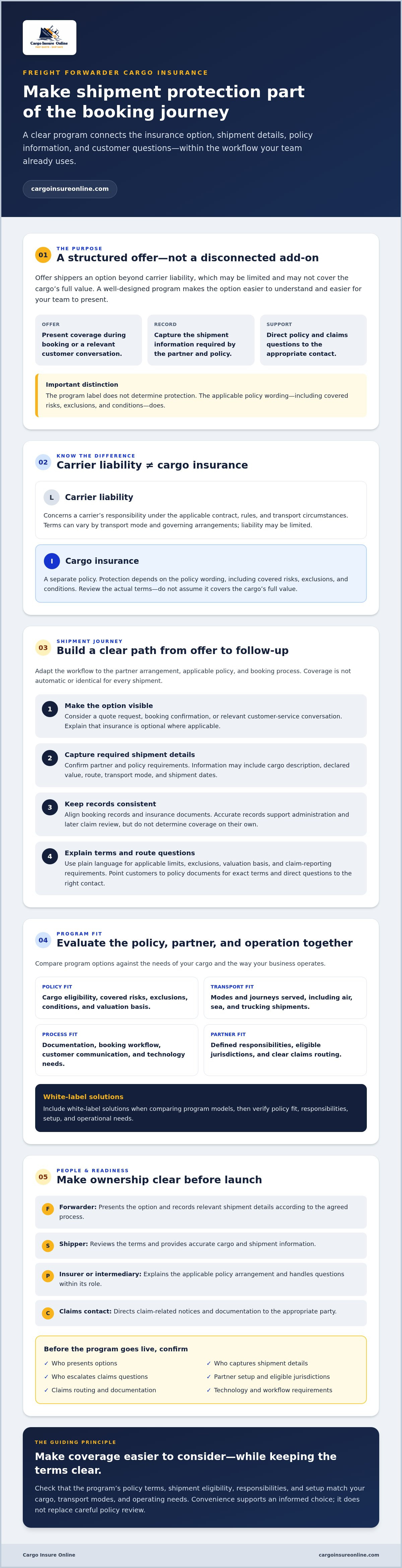
A freight forwarder cargo insurance program is an organized way to make shipment insurance available as part of the freight booking experience. It connects the offer, shipment information, relevant policy documents, and customer questions through a process agreed with an insurance partner. Program structures and protections can vary, so the applicable policy, not the program label, determines what is covered.
That distinction matters. A shipper may assume that arranging transport also protects the shipment’s full value. A well-designed program helps the forwarder explain the available option and its limits before there’s a problem. The freight forwarder already helps organize shipments and related documentation, making the booking workflow a natural place to present cargo insurance information.
How does a program differ from carrier liability?
Carrier liability and cargo insurance are distinct. Liability concerns a carrier’s responsibility under the applicable contract, rules, and transport circumstances. Cargo insurance is a separate policy, and its protection depends on its wording, including covered risks, exclusions, and conditions. Carrier liability may be limited, and terms can vary by transport mode and governing arrangements. Don’t treat it as equivalent to insurance or assume it will cover the cargo’s full value. For a closer comparison, see carrier liability versus cargo insurance.
Who benefits from a forwarder insurance program?
Shippers get a convenient opportunity to consider shipment protection during booking. Forwarders can make the experience clearer by explaining that insurance is optional where applicable, identifying the information needed to evaluate a shipment, and directing questions to the right contact. Convenience helps, but it doesn’t replace a careful policy review.
A freight forwarder cargo insurance program may involve several stakeholders, each with a defined role:
- Forwarder: Presents the option and records relevant shipment details according to the agreed process.
- Shipper: Reviews the terms and provides accurate cargo and shipment information.
- Insurer or intermediary: Explains the applicable policy arrangement and handles questions within its role.
- Claims contact: Directs claim-related notices and documentation to the appropriate party.
Consider a sea shipment that includes high-value goods. The shipper needs to understand whether the available policy fits that cargo and journey. The forwarder needs a clear way to present the option and route follow-up questions. Suitability depends on the cargo, route, shipment value, eligibility, and policy wording. Clear roles and expectations help customers make an informed choice without turning insurance into a confusing extra step.
How a Freight Forwarder Cargo Insurance Program Works Across a Shipment
A freight forwarder cargo insurance program should give each shipment a clear path from insurance offer to documented decision. The exact steps depend on the partner arrangement, applicable policy, and booking process. Treat the sequence below as a workflow to adapt, not a promise that coverage is automatic or identical for every shipment.
Where can insurance fit into booking and shipment communication?
Make the option visible where customers already make decisions: during a quote request, in a booking confirmation, or in a relevant customer-service conversation. Assign someone to present the option and identify who confirms shipment details. Explain applicable limits, exclusions, valuation basis, and claim-reporting requirements in plain language, and point customers to the policy documents for exact terms. For U.S. operations, check applicable cargo insurance requirements with the relevant authority or advisor.
What shipment information may need to be captured?
Confirm the information required by the partner and policy. This may include the cargo description, declared value, route, transport mode, and shipment dates. Keep details consistent across booking records and insurance documents. Accurate records help teams administer the offer and provide information for later claim review, but they don’t determine coverage on their own. For mode-specific context, see this guide to air freight insurance guidance.
A practical shipment-level workflow
Compare these steps with your current process, then confirm who owns each handoff:
- Identify the shipment. Check cargo type, route, transport mode, and timing against the program’s eligibility criteria.
- Present the option. Explain how the customer can review the relevant insurance terms. Avoid implying coverage is in place before the required steps are completed.
- Confirm details. Collect the requested shipment information and clarify how the value should be stated under the applicable arrangement.
- Document the decision. Record the customer’s response and retain the required policy, shipment, or transaction documents through the agreed process.
- Explain follow-up. Share where to direct questions and how to report a potential claim, including any reporting steps or deadlines stated in the policy.
Test the workflow against real booking scenarios, including a shipment that isn’t eligible or has missing details. If you’re assessing a partner, Cargo Insure Online’s cargo insurance and technology solutions for logistics partners may be one option to explore. Confirm program availability, setup, and requirements directly.
How to Evaluate Freight Forwarder Cargo Insurance Program Options
Compare the policy and the operating model together. A freight forwarder cargo insurance program may offer access for individual shipments or a broader arrangement for a logistics partner. Neither is automatically the better fit. The right choice depends on your customers, shipment mix, workflow, and the responsibilities each party agrees to take on.
Use this checklist to compare proposals. Ask for details in writing, and review policy wording and jurisdiction-specific requirements before describing protection to customers.
| Evaluation area | What to check |
|---|---|
| Coverage scope | Which risks are covered, what valuation rules apply, and whether deductibles or conditions affect protection. |
| Cargo eligibility | Which goods are eligible, including restrictions relevant to your customers’ cargo mix. |
| Transport modes | Confirm whether air, sea, and trucking shipments can be considered under the proposed arrangement. For ocean-shipment context, see sea freight insurance considerations. |
| Exclusions and conditions | Identify exclusions, policy conditions, and circumstances that could affect a claim. |
| Documentation | Clarify what shipment records, declarations, and policy documents are required, and who maintains them. |
| Operational fit | Check how the offer fits booking steps, shipment volume, customer mix, and your team’s capacity. |
| Communication and support | Agree who explains the option, answers policy questions, and directs claims inquiries. |
| Technology needs | Ask what tools or integrations are available, and verify setup requirements before relying on them. |
Which coverage and policy details deserve close review?
Read the actual wording, not just a summary. Check covered risks, exclusions, valuation rules, deductibles, claims procedures, and other conditions. Confirm eligibility for each mode and cargo type your customers need. For international shipments, the Incoterms® rules can help clarify how buyers and sellers allocate responsibilities, costs, and risks, but they don’t replace a review of the insurance policy itself.
Which program model fits your customer and operations?
Ask which models are actually available, then compare single-shipment access with any broader partner arrangement. Referral, customer-access, and white-label models may involve different workflows and responsibilities, so don’t assume availability or suitability. Weigh shipment volume, customer mix, support ownership, and internal capacity. If considering a branded cargo insurance platform, verify what the setup includes and how it fits your customer experience.
How to Prepare Your Team and Workflow Before Launch
A smooth launch starts before the first customer sees an insurance option. Map your current booking and communication process, then identify where insurance information could fit without creating duplicate work or unclear handoffs. A freight forwarder cargo insurance program needs defined owners, approved customer language, and a route for questions that staff can follow consistently.
What should a forwarder map before implementation?
Trace the customer journey from quote request through booking, shipment documentation, customer service, and claims escalation. Note which systems hold shipment details, who updates them, and what happens when information is missing or a shipment falls outside eligibility. Look closely at manual re-entry and handoffs between sales, operations, and support. These are common places for confusion to surface.
Before describing a digital workflow or integration to your team, confirm with the prospective partner whether it’s available and what setup it requires. Map the process you’ve actually agreed on, not the process you hope a tool will support.
How can teams explain the offer responsibly?
Give staff concise, approved wording that distinguishes cargo insurance from carrier liability. It should explain that eligibility, protection, exclusions, and claim steps depend on the applicable policy and arrangement. Avoid guarantees or statements that imply coverage is automatic. Train employees to direct detailed questions about policy interpretation or claims to the appropriate qualified contact rather than guessing.
Assign clear internal owners for presenting the option, recording shipment information, and routing customer questions. One person may hold several responsibilities in a smaller team, but each task still needs a named owner. After launch, collect recurring customer questions and staff feedback, then review approved materials and handoffs with your partner as needed.
Before launch, confirm that your team can:
- Identify the customer touchpoints and systems involved.
- Explain the offer using language reviewed against the applicable policy.
- Record shipment details consistently and identify the owner of each handoff.
- Direct coverage and claims questions to the agreed contact.
- Handle exceptions, including missing information or ineligible cargo.
- Review feedback and update internal guidance when the agreed process changes.
Use the checklist as a starting point, then adapt it to your partner arrangement, policy documents, and internal responsibilities. For information about cargo insurance and technology options for logistics partners, visit Cargo Insure Online.
Choose a Cargo Insurance Partner and Define Your Next Steps
The strongest partner choice isn’t the one with the longest feature list. It’s the one whose policy fit, eligible cargo, operational support, and customer experience match the shipments you handle and the way your team works. For your freight forwarder cargo insurance program, make responsibilities explicit before launch: who presents the option, who confirms eligibility, who answers policy questions, and where customers should direct claims notifications.
Use a shortlist to keep the decision focused:
- Policy fit: Do the written terms align with the shipment types and risks your customers want to address?
- Eligibility: Which cargo categories, transport modes, and territories may be considered?
- Operational support: Who handles setup questions, documentation, and customer inquiries?
- Customer experience: Can customers understand how to review the offer and what steps they need to take?
- Clear ownership: Are the partner’s and forwarder’s roles documented, including claims routing?
What questions should you ask a potential insurance partner?
Get specific, then request written answers. Ask which shipment types, cargo categories, transport modes, and jurisdictions may be eligible under the proposed arrangement. Clarify who issues or administers coverage, what shipment information and documents are required, and who handles customer questions and claim notifications. Ask what program setup involves and which technology capabilities, if any, are available. Request current policy documents and written confirmation of proposed capabilities before relying on them in customer communications.
Also check how exceptions are handled. If a customer’s cargo or route doesn’t appear to meet stated eligibility criteria, who confirms the next step? Clear answers help your team avoid implying that protection applies when the policy or arrangement hasn’t confirmed it.
How can you start a partner conversation?
Prepare a short overview of your customer segments, shipment mix, transport modes, existing booking workflow, and operational goals. Note whether you want to assess single-shipment access, a broader partner arrangement, or a white-label option, but treat each as a possibility to verify, not an assumed capability. Bring practical questions about responsibilities, documentation, customer communication, claims routing, jurisdictions, and technology.
Cargo Insure Online provides cargo insurance for air, sea, and trucking freight, along with white-label solutions for logistics partners. Discuss your requirements and explore Cargo Insure Online partner solutions to assess fit and confirm which options are available for your needs.
Make Shipment Protection Part of a Clearer Customer Journey
A strong freight forwarder cargo insurance program depends on both policy fit and practical execution. Customers need a clear way to consider shipment protection, while your team needs consistent steps for presenting the option, recording details, and directing questions. Everyone should understand that policy wording, eligibility, and responsibilities shape the protection available.
Start with your shipment mix and booking process. Then compare partners on coverage fit, operational support, customer experience, and clearly assigned responsibilities. Cargo Insure Online provides cargo insurance for air, sea, and trucking freight, and offers white-label solutions for logistics partners. The right arrangement depends on your needs, so confirm availability, setup, and applicable terms directly.
Ready to assess a fit for your operation? Explore cargo insurance solutions for logistics partners and discuss your goals and requirements with Cargo Insure Online.
Frequently Asked Questions
What is a freight forwarder cargo insurance program?
A freight forwarder cargo insurance program is an organized way to make cargo insurance available to customers alongside freight services. It may involve the forwarder, shipper, insurer or intermediary, and designated contacts for questions or claims notifications. The workflow and coverage aren’t universal. The applicable policy and partner arrangement define eligible shipments, protection, exclusions, and each party’s responsibilities.
Is cargo insurance included in a freight forwarder’s services?
Not automatically. A forwarder may arrange access to cargo insurance as an optional customer offering, but the shipper should confirm whether insurance has been selected and what documentation or steps are required. Transport services and insurance are distinct. Review the relevant policy and booking records to establish whether a shipment has insurance, what terms apply, and who to contact with questions.
Can freight forwarders offer cargo insurance to their customers?
Freight forwarders may work with an insurer or intermediary to present cargo insurance options, subject to the partner arrangement and applicable requirements. The forwarder should confirm who can explain policy terms, how customer information is handled, and who manages insurance-related questions or claim notifications. Don’t promise that a shipment is covered until the responsible party and applicable policy confirm eligibility and required steps.
How does cargo insurance differ from carrier liability?
Carrier liability concerns a carrier’s responsibility under the applicable transport terms and rules. Cargo insurance is a separate policy that can provide protection as described in its wording. Liability may be limited and shouldn’t be assumed to equal the shipment’s full value. Shippers should compare the carrier’s applicable terms with the policy’s covered risks, exclusions, valuation basis, and claim procedures before deciding what protection they need.
What cargo and transport modes can a forwarder insurance program cover?
Eligibility depends on the specific program and policy, including cargo type, route, and shipment details. Cargo Insure Online offers cargo insurance for air, sea, and trucking freight, as well as specialized offerings such as electronics and high-value devices, drones, mobile phones, and reefer products. That doesn’t mean every item or journey is eligible. Confirm the applicable terms and availability for each shipment.
How do freight forwarders integrate insurance into the booking process?
Forwarders can identify suitable customer touchpoints, such as a quote request, booking confirmation, or customer-service conversation, then define who presents the option and records shipment details. Build in a clear path for sharing policy information and routing questions. Confirm the partner’s actual process before promising automation or automatic coverage. The customer’s selection and any required documentation should be recorded according to the arrangement.
What should a freight forwarder ask an insurance program partner?
Ask which cargo, shipment types, transport modes, and jurisdictions may be eligible. Request current policy documents and clarify who administers the arrangement, explains terms, handles customer questions, and receives claim notifications. Also discuss documentation, program setup, available technology, and each party’s responsibilities. Ask the partner to confirm proposed capabilities in writing so your team can describe the offer accurately and consistently.
Can a freight forwarder offer cargo insurance under its own brand?
Potentially, through a white-label arrangement, if one is available and suitable for the forwarder. Cargo Insure Online offers white-label solutions for logistics partners, but specific setup, eligibility, technology, and responsibilities must be confirmed for the proposed arrangement. Before using your brand, agree on how customers will receive policy information, where questions go, and which party is responsible for each step.


