

A temperature logger can show that a biopharmaceutical shipment drifted out of range. It can’t, by itself, show whether your insurance will respond. Assessing biopharmaceutical temperature excursion air cargo transit coverage means looking beyond the reading to the policy wording, the cause of the deviation, and the evidence available.
Carrier liability and cargo insurance serve different purposes. When a shipment passes through several hands, from warehouse to aircraft to final delivery, tracing where and how an excursion occurred can quickly become complicated. Product quality may be at stake, while gaps in records can make a claim harder to support.
This guide explains how to assess coverage before booking, align your insurance review with the shipment’s cold-chain controls, and preserve useful records if temperatures move outside the required range. It covers policy details such as covered causes and exclusions, plus the role of monitoring logs and handoff records. The aim is a more informed decision based on the realities of your shipment.
Key Takeaways
- Assess biopharmaceutical temperature excursion air cargo transit coverage against the policy wording and circumstances of a loss, not a blanket assumption.
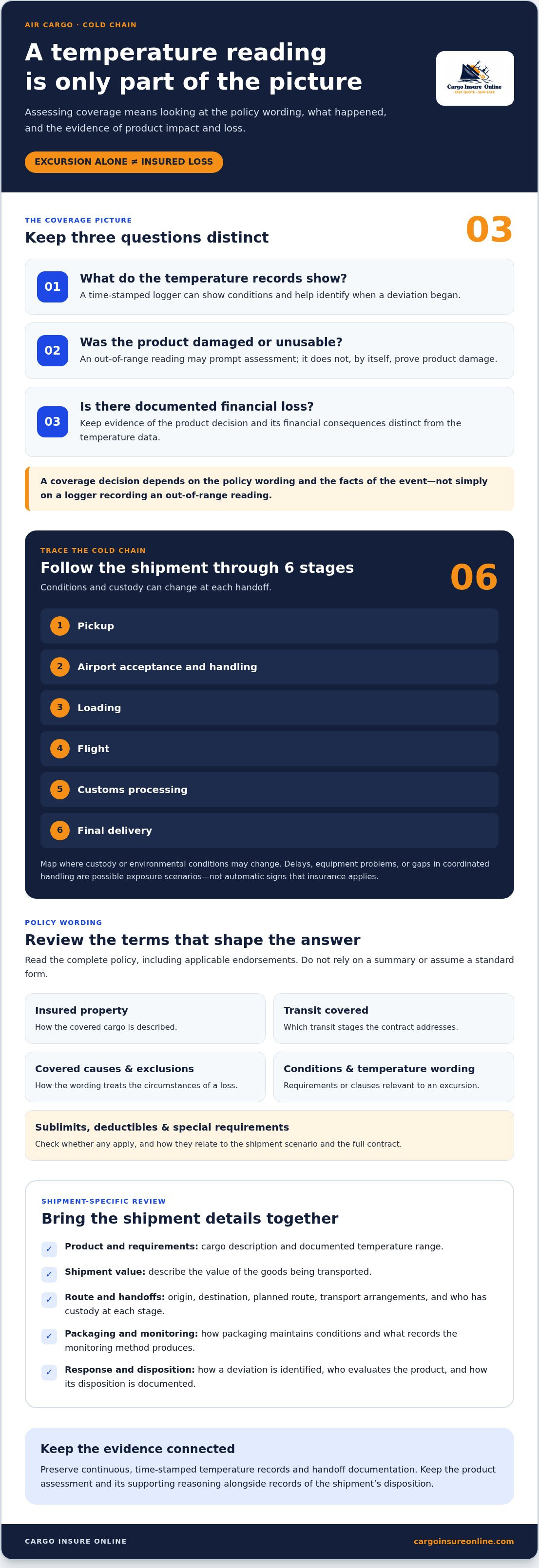
- Distinguish a recorded temperature deviation from evidence of product damage and documented financial loss.
- Use a pre-bind checklist to organize cargo details, product temperature requirements, shipment value, transit stages, and policy terms.
- Preserve continuous, time-stamped temperature records and handoff documentation to help establish what happened during transit.
- Consider air freight insurance and reefer product coverage as part of a shipment-specific risk plan, alongside cold-chain controls.
Why biopharmaceutical temperature excursions change air cargo risk
A temperature excursion is a deviation from the conditions specified for a particular shipment. There is no universal threshold: the relevant range depends on the product’s documented storage and transport requirements. In practical terms, an excursion occurs when shipment conditions move outside the product’s required temperature range.
For biopharmaceutical cargo, a deviation can raise concerns about product quality, usability, or the need for further assessment. But a quality concern and an insured loss are not the same thing. Whether a policy responds depends on its wording and the facts of the event, not simply on a logger recording an out-of-range reading. That distinction is central to evaluating biopharmaceutical temperature excursion air cargo transit coverage.
Exposure depends on the product’s sensitivity, time in transit, and conditions at each stage. A shipment with demanding temperature requirements may need a different risk assessment from one with a broader permitted range. Packaging, monitoring, route, and expected dwell times help describe the cold-chain plan. Together, these details make the risk more specific than “pharmaceutical cargo” alone.
Where air-cargo cold-chain exposure can arise
Temperature control has to hold across handoffs, not just during flight. A journey may include pickup, airport acceptance and handling, loading, the flight, customs processing, and final delivery. Tarmac delays, equipment problems, or gaps in coordinated handling could affect conditions at one or more points. These are possible exposure scenarios, not automatic signs that insurance applies.
Map the route by stage and note where custody or environmental conditions may change. A clear view of the cold chain logistics involved helps connect packaging and monitoring plans to the actual movement of the goods. Continuous records can help identify when a deviation began and which handoff needs closer review.
Why biopharmaceutical shipments need shipment-specific review
Products do not all share the same storage and transport requirements. Use the product’s documented conditions to describe the cargo, then consider how the packaging is intended to maintain those conditions and how monitoring will record performance. Route design matters too: additional handling or longer dwell periods may change exposure, even when the planned flight time is short.
Align the cargo description, value, packaging approach, monitoring plan, and transit route so the risk information reflects the shipment being arranged. Air freight adds speed, but its broader transit risks still deserve attention. The air freight insurance guide provides additional context. Cargo Insure Online offers air freight insurance and reefer product coverage as part of a shipment-specific risk plan, alongside the cold-chain operating controls that protect product integrity.
How air cargo temperature-excursion coverage is determined
A temperature record is evidence about shipment conditions, not a coverage decision. An excursion alone does not establish an insured loss. Consider the policy wording alongside the facts: what happened, what property was affected, whether there was physical loss or damage, and how the relevant terms apply. A reading outside the product’s specified range may trigger an investigation, but it does not by itself prove that the product is damaged or that insurance responds.
That distinction matters when assessing biopharmaceutical temperature excursion air cargo transit coverage. A shipment might register a brief deviation, while a product assessment finds no resulting damage. Or the product may be deemed unusable, with records connecting that decision to an event in transit. Those circumstances are not interchangeable. Keep temperature data, product assessment, and evidence of financial loss distinct so each can be considered clearly.
Policy terms that can change the coverage answer
Read the complete policy wording, including applicable endorsements, rather than relying on a summary or assuming there is a standard form. Review how the policy describes insured property and the transit covered, then examine covered causes, exclusions, and conditions. These sections help establish which circumstances and stages the contract addresses.
Look closely for temperature-related wording and any applicable sublimits, deductibles, or special requirements. A clause may affect how an event is treated, but its meaning depends on the full contract and facts. Flag any unclear clause and the shipment scenario it relates to for a precise coverage interpretation before binding. Do not infer that an excursion is covered or excluded based on the temperature reading alone.
What the insurance review needs to understand
Provide a shipment-specific picture: the product description and documented temperature range, shipment value, origin and destination, planned route, and packaging approach. Describe the transport arrangements and handoffs, including who has custody at each stage. Explain what monitoring method will be used and what records it produces.
Procedures matter too. Summarize how the shipper identifies a deviation, who evaluates the product, and how its disposition is documented. For example, distinguish a shipment held for assessment from one formally rejected or destroyed, and retain the reasoning and supporting records. This separates the temperature event from its product and financial consequences. Complete, consistent information makes it easier to compare the shipment’s actual risk with the policy terms under review.
For a shipment-specific risk plan, consider how air freight insurance fits alongside cold-chain controls and the contract wording. Cargo Insure Online offers a digital route to exploring air freight insurance, without treating a temperature deviation as an automatic coverage outcome.
Does air cargo insurance cover every biopharmaceutical temperature excursion?
No. There is no blanket assumption that every excursion is covered. The policy wording, circumstances of the event, and evidence of resulting loss all matter. A monitoring alert can show that conditions moved outside a product’s required range, but it is not proof of covered damage. The product may need assessment, and the policy terms determine how the reported facts are considered.
Keep three things distinct: a recorded deviation, suspected product damage, and a documented financial loss. A logger alert establishes a temperature event, not necessarily that the product is unusable. A quality assessment may identify a concern, but the claim review may also require evidence of the resulting loss and its connection to the event. Cause, timing, custody, and compliance with policy conditions can all shape the assessment. That is why biopharmaceutical temperature excursion air cargo transit coverage must be evaluated against the specific shipment and policy, not assumed from the alert alone.
Compare common excursion scenarios without assuming coverage
Different events call for different evidence. Consider what could help establish the cause, product impact, and whether relevant policy conditions were followed:
- Equipment failure: Record where and when the equipment stopped maintaining conditions, who had custody, and what the logger data and maintenance records show. A product assessment helps establish whether the event caused damage.
- Handling delay: Match timestamps across airport or other handoffs with the route timeline. Identify where the delay occurred and whether documented shipment-handling procedures were followed.
- Packaging issue: Preserve packaging details and records of packing and dispatch. The assessment may need to distinguish a packaging performance problem from another cause during transit.
- Incomplete monitoring records: Identify the missing period and look for supporting handoff or handling records. Gaps can make it harder to establish when a deviation happened, how long it lasted, or whether it relates to reported damage.
These examples do not determine whether a claim is covered. Compare the facts with the applicable policy wording, exclusions, and conditions before drawing a conclusion.
Why carrier liability is not the same as cargo insurance
Carrier liability concerns a carrier’s responsibility under the rules and terms governing carriage. Cargo insurance is a separate contract whose response depends on its own wording and the circumstances of the loss. A carrier’s liability limit or process for establishing responsibility should not be mistaken for the protection provided by a cargo policy.
For international air carriage, the Montreal Convention may limit carrier liability for lost or damaged cargo to approximately $20 per kilogram, subject to the convention’s applicability and terms. That liability framework is distinct from comprehensive cargo insurance and may not reflect the value of a biopharmaceutical shipment. Review the two separately. For broader cold-chain context, the reefer cargo insurance guide discusses specialized cargo protection without implying that every temperature event is an insured loss.
A practical checklist for evaluating biopharmaceutical air cargo coverage
A strong pre-bind review starts with a clear shipment profile and ends with a close read of the policy wording. Keep product information, the cold-chain plan, and insurance details aligned. If the route, packaging, or shipment value changes, update the information used for the review so it reflects the cargo that will actually move.
Information to assemble before arranging coverage
Build the shipment picture first. Gather documents and operating details that explain what is being shipped, how it will travel, and how conditions will be monitored.
- Describe the cargo. Record the product description and its documented storage and transport temperature requirements. Avoid relying on a broad category such as “biopharmaceuticals” to communicate product-specific conditions.
- Set out the shipment value. Provide the declared value and make sure it corresponds to the shipment being reviewed. Keep supporting valuation information organized so the figure can be understood in context.
- Specify the packaging. Summarize the packaging system and the information available about its intended use for the shipment. Include relevant specifications or validation records that explain the cold-chain approach.
- Map the route. List origin, destination, transit legs, and planned handoffs. Note expected handling or transfer points so the review reflects the full journey, not only the flight segment.
- Describe monitoring controls. Identify the monitoring method, where records are captured, and how they can be matched to the shipment and timestamps. Clarify how records will cover the planned transit stages.
- Outline deviation procedures. Gather procedures for detecting, escalating, and documenting a deviation. Explain who assesses the product and how its final disposition and the reason for that decision are recorded.
Questions to resolve in the policy review
With the shipment profile assembled, compare it against the complete policy wording and any applicable endorsements. Identify mismatches before the shipment is arranged, rather than assuming a temperature event has a predetermined insurance outcome.
- Transit scope: Does the described journey align with the transit covered, including route stages and handoffs?
- Policy terms: What exclusions, conditions, temperature-specific terms, sublimits, or deductibles may affect this shipment?
- Evidence: What records are relevant to support a potential loss, and how should a claim be reported under the policy?
- Operating fit: Does the policy’s stated scope align with the actual packaging, monitoring, custody arrangements, and deviation procedures?
Resolve unclear wording against the exact shipment scenario. For biopharmaceutical temperature excursion air cargo transit coverage, product requirements and the operating plan should be consistent with the details presented for review. A shipment-specific assessment can then consider those facts alongside air freight insurance and cold-chain controls.
Once your checklist is ready, review air cargo coverage options as part of your shipment risk plan.
Arrange a shipment-specific air cargo coverage review
Biopharmaceutical temperature excursion air cargo transit coverage is not a one-size-fits-all decision. It calls for a close match between the cargo, its journey, and the policy terms being considered. Cargo Insure Online provides a digital route to exploring air freight insurance and reefer product coverage for global logistics operations. The shipment details matter, and no temperature deviation should be assumed to have a predetermined coverage outcome.
What to prepare for a focused coverage decision
Organize the information that shows what is moving and how the cold chain is designed to operate. A complete, consistent shipment profile helps keep the review focused and makes gaps easier to spot before the cargo is arranged.
- Cargo and value: Provide the product description and shipment value, with supporting details that explain what the declared figure represents.
- Origin and destination: Set out the planned route, transit legs, expected handoffs, and any known points where custody or handling arrangements change.
- Product requirements: Include the product’s documented temperature requirements, rather than relying on a general description of the product category.
- Cold-chain plan: Summarize the packaging approach, monitoring controls, and operating procedures for detecting and escalating a deviation.
- Supporting records: Keep relevant packaging specifications, monitoring information, handling records, and custody documentation organized alongside the shipment details.
These materials tell a clearer story than a product name or route alone. If details are still changing, distinguish confirmed plans from estimates so the review reflects what is known and identifies what may need updating.
Move from risk questions to a coverage decision
Cold-chain controls and insurance serve related but different roles. Packaging, monitoring, and handling procedures help manage product risk. Policy wording defines how insurance may respond to a reported loss. One does not replace the other. Compare the shipment’s operating plan with the policy’s transit scope, conditions, exclusions, and any applicable temperature-specific terms.
Before arranging the shipment, focus on mismatches: a route stage that is not clearly represented, an operating procedure that differs from the information supplied, or a policy term that needs precise interpretation. Keep product requirements and relevant records together with the final route details. This gives the coverage decision a shipment-specific foundation without turning an excursion alert into an assumed claim outcome.
For a practical reference while planning, Cargo Insure Online’s coverage options include air cargo insurance for shipment risk planning.
Make coverage review part of shipment readiness
Before the next biopharmaceutical shipment moves, make coverage review a defined step in your dispatch workflow. Assign an owner to keep the cargo description, route, temperature requirements, and cold-chain plan aligned as shipment details evolve. This helps prevent a review from relying on outdated information.
Biopharmaceutical temperature excursion air cargo transit coverage calls for a shipment-specific decision, not a last-minute assumption. Cargo Insure Online offers air freight insurance and reefer product coverage for global logistics operations, providing a digital route to explore options alongside cold-chain controls. Policy response still depends on the applicable wording and circumstances of a loss.
Keep the shipment profile, route details, and cold-chain records together so they are ready for review. The cold-chain plan is already doing important work. Give the insurance review the same focused attention.
Frequently Asked Questions
Does air cargo insurance cover a biopharmaceutical temperature excursion?
It may, but an excursion does not automatically mean the shipment is insured. The policy wording and evidence of the event and resulting loss matter. A logger alert with no documented product impact is different from a quality assessment showing the goods cannot be used. Review the applicable terms against the specific shipment and circumstances rather than treating every out-of-range reading as covered.
What happens if a temperature excursion occurs during air transit?
Follow the shipment’s deviation procedure promptly. Preserve the logger data, note when the alert was identified, and record where the shipment was and who had custody. Escalate the event through the shipper’s quality and logistics process so the product can be assessed and its disposition documented. Refer to the policy’s notice and claim instructions too, since required steps and timing depend on its wording.
Can a temperature logger prove that a cargo insurance claim is covered?
No. A logger can provide useful evidence of recorded conditions, but it cannot decide whether a policy responds. Its data may show when temperatures changed, while separate records establish the cause, product impact, and financial loss. Keep the original data and preserve its context, including the device’s association with the shipment and relevant timestamps. The claim assessment considers the evidence against the policy terms.
What records should I keep after a biopharmaceutical shipment excursion?
Keep the complete temperature file, including data before and after the alert, plus any available device identification and time information. Add shipment identifiers, route and custody records, handling notes, and communications about the event. Preserve the product assessment, disposition decision, and supporting financial documents as well. Store records in their original form where possible, and make a clear timeline so reviewers can connect the evidence to the shipment.
How do packaging and route planning affect temperature-excursion risk?
Packaging and route choices influence how well a shipment’s conditions can be maintained through its planned journey. A route with transfers or longer ground dwell periods may create different operating demands than a more direct itinerary. Consider how the selected packaging fits the product’s documented requirements, and plan monitoring around handoffs and likely delays. These controls inform risk review, but do not determine insurance coverage by themselves.
Is carrier liability the same as temperature-excursion cargo insurance?
No. Carrier liability concerns a carrier’s responsibility under applicable carriage rules and terms. Cargo insurance is governed by a separate policy contract. A carrier’s liability process may focus on responsibility for loss during carriage, while an insurance review considers the insured property, policy wording, and loss circumstances. Treat them as separate routes for assessing a loss, and do not assume one replaces or guarantees the other.
How much cargo value should a biopharmaceutical shipment be insured for?
Use the value basis required by the policy and make sure it reflects the shipment being insured. Start with a documented valuation for the goods, then identify any additional components only if the policy’s valuation terms allow them. Do not assume the invoice amount, replacement cost, or potential downstream losses are interchangeable. Keep supporting records and reconcile the declared value with the shipment documents before coverage is arranged.
Ready to review coverage for your shipment? Explore air cargo coverage with Cargo Insure Online as part of your shipment planning.


