
A field crew reaches a survey site, opens the cases, and finds a damaged sensor or a missing controller. The drone may be only one part of the loss: payloads, batteries, controllers, and accessories all travel with the kit. Drone survey equipment transit insurance for field operations helps you assess what needs protection as equipment moves between sites, not just what happens once it arrives.
Drone insurance or liability insurance does not necessarily cover every stage of a job. Protection for physical equipment in transit, damage during operation, and claims involving other people are separate questions. This matters when a kit includes high-value electronics or equipment that is rented or borrowed.
This guide explains how to map transit exposures across a field journey, compare policy scope with your complete survey kit, and review limits, exclusions, deductibles, and temporary storage conditions. Use the steps to evaluate drone and specialized-goods insurance options before your team mobilizes.
Key Takeaways
- Map the equipment journey from dispatch and loading to site arrival and return. Include every transport leg and handoff.
- Start with the complete survey kit, including payloads, batteries, controllers, and accessories, when reviewing declared values.
- Compare policy options using the same route and equipment list. Check transit scope, territory, limits, exclusions, and documentation requirements.
- Keep physical equipment protection separate from liability coverage. Review the policy wording for the situations and equipment relevant to your field operations.
- Maintain an inventory with serial numbers, photographs, and declared values to support a practical review of drone survey equipment transit insurance for field operations.
Why Drone Survey Equipment Transit Insurance Matters in Field Operations
A damaged drone or missing sensor can mean more than a repair or replacement. It may leave a crew unable to collect data, delay a scheduled survey, or put deliverables at risk. The exposure begins before takeoff. Survey gear moves through multiple handling points: dispatch, vehicle loading, road or air transit, unloading at the site, and the return journey. Each stage is worth including in your insurance review.
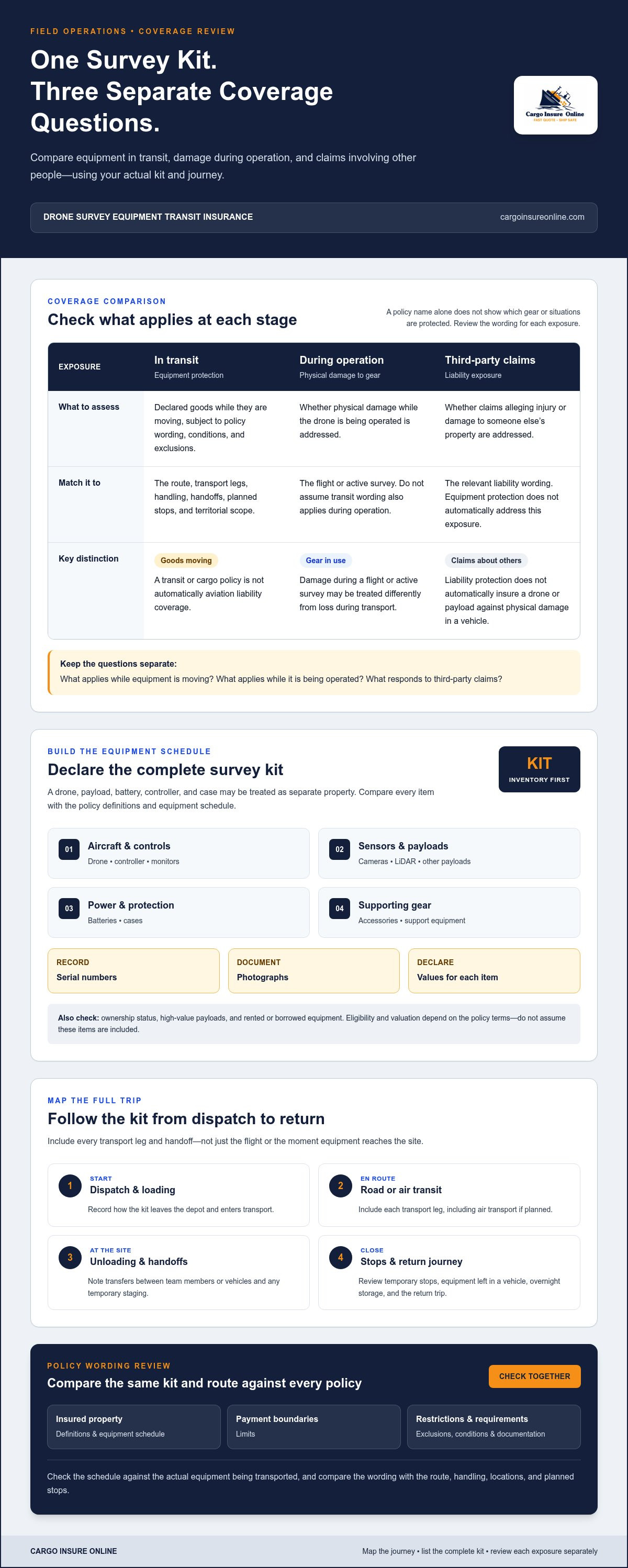
Drone survey equipment transit insurance for field operations concerns declared goods while they are moving, subject to the policy wording, conditions, and exclusions. That differs from protection for physical damage while a drone is being operated, and from liability for injury or damage to someone else’s property. A policy may address one exposure without addressing the others. Check what each coverage part applies to instead of assuming “drone insurance” covers every stage of a job.
Map the full trip, not just the flight. A kit might leave a depot in a vehicle, travel to a remote site, transfer between vehicles, and return with the team at the end of the day. If a project includes air transport, include that leg in the review. Regulations governing drone operations are a separate consideration. The Regulation of unmanned aerial vehicles overview provides broader context, but operational rules do not establish what an insurance policy covers in transit.
Which parts of a survey kit need consideration?
Build an inventory that goes beyond the aircraft. Include controllers, cameras, LiDAR or other payloads, batteries, cases, monitors, and support equipment. Record each item’s ownership status and value, then compare the list with the policy’s definitions and equipment schedule. Eligibility and valuation depend on those terms. An item’s importance to the survey does not automatically mean it is insured.
For example, a team might declare its drone but leave a separately purchased LiDAR payload off the schedule. If that payload is damaged during the journey, the policy wording and declared property list become central to how the loss is considered. Record the complete kit before dispatch and check that the schedule reflects it.
Where can transit exposure arise?
Consider loading and unloading, handoffs between team members or vehicles, temporary stops, and travel between project locations. Review how the policy treats equipment left in a vehicle, held in temporary staging, or kept overnight during a multi-day assignment. These are specific points to compare with the wording, not assumptions about what is covered.
Turn the route into a practical checklist: note how the kit will travel, where it may pause, and who will handle it at each stage. Compare those details with the policy conditions. Clear records help identify questions before equipment leaves the depot, rather than after a disruption affects fieldwork.
What Drone Survey Equipment Transit Insurance Should Be Evaluated to Cover
A policy name alone does not show which survey gear is protected or when protection applies. Read the definitions, equipment schedule, limits, exclusions, and conditions together. The schedule identifies insured property, definitions explain key terms, limits cap eligible payments, and exclusions or conditions can narrow how protection applies. Compare these details with the actual journey, including the route, handling, and planned stops.
Coverage depends on the insured property, event, location, and policy wording. When reviewing drone survey equipment transit insurance for field operations, look beyond the aircraft. Check how the policy describes equipment in transit, which events it addresses, and what territorial scope applies. Do not assume an item or situation is covered because it is central to the job. Use the wording to make the comparison.
Equipment, payloads, and accessories are not always interchangeable
A drone, sensor, camera, battery, controller, and case may be treated as separate property rather than one all-inclusive kit. Match each item and declared value to your inventory. Check whether high-value payloads are identified separately and whether accessories fall under a defined category or need to appear on the schedule. Apply the same review to rented or borrowed equipment. Its eligibility and valuation depend on the policy terms, so do not assume it is included.
Make the comparison specific. If your inventory lists a drone and camera but the survey relies on a separately valued sensor, check whether the payload is identified and how its value is represented. A mismatch between the equipment being transported and the schedule can create uncertainty when a loss is assessed.
Transit protection is different from drone liability
Equipment protection addresses potential financial loss to insured gear, subject to the policy terms. Liability addresses a different exposure: claims alleging injury or damage to someone else’s property. A transit or cargo policy is not automatically aviation liability coverage, and liability protection does not automatically insure a drone or payload against physical damage in a vehicle. Damage during a flight or active survey may also be treated differently from loss during transport.
Keep three questions separate: what applies to equipment while it is moving, what applies while it is being operated, and what responds to third-party claims? Compare the answers with your work requirements and the relevant policy wording. Cargo Insure Online offers drone and high-value electronics insurance. These categories can help frame a review of specialized survey gear. Explore drone and high-value electronics insurance as you assess the equipment portion of your protection.
Then compare limits, deductibles, exclusions, and conditions with the items and circumstances that matter to your team. Pay particular attention to wording for payloads, batteries, accessories, owned versus borrowed property, and the transit situations your work involves. A side-by-side review helps show what each coverage part is designed to address, without treating transit, operation, and liability as interchangeable.
How to Compare Transit Insurance Options for Drone Survey Teams
A useful comparison puts policy details side by side, not just product labels. Use the same inventory and journey for every option, then record what the wording says. That makes gaps easier to spot and prevents a broad description from standing in for a clear answer about your survey kit.
Use this framework to organize the review. Fill each cell from the relevant policy documents rather than assuming a blank or broad phrase means protection applies.
| Option | Insured property | Transit scope | Territory | Limits | Exclusions | Documentation |
|---|---|---|---|---|---|---|
| Policy A | List aircraft, payloads, accessories | Record modes and journey stages | Note stated geographic scope | Capture item and total limits | List relevant exclusions | Record evidence requirements |
| Policy B | Use the same item list | Compare the same route and events | Check the same operating areas | Compare like values and limits | Note differences in wording | Compare required records |
Keep the comparison consistent. Use matching declared values for the aircraft, sensors, cameras, batteries, controllers, cases, and support equipment. If one option schedules a payload separately and another groups it with the drone, record that distinction. Compare event definitions too, since similar phrases can have different meanings in different policy wording. A limit shown for one product is specific to that product, not a standard for the wider market.
Match policy scope to routes and field workflows
Write down how the team travels: road legs, air transport, transfers between vehicles, and the geographic areas where assignments take place. Compare those details with the policy’s stated transit scope. Check how it addresses handoffs and temporary storage, and whether territory or transport-mode restrictions apply. Treat each point as a document-review item rather than an assumed extension of cover.
Compare limits, exclusions, and proof requirements
Check both per-item and aggregate limits against the declared value of the complete kit. A total limit may appear sufficient while a lower item limit affects a high-value sensor. Review deductibles, valuation terms, exclusions, and conditions as written. Do not assume the same default applies across policies.
Documentation matters, too. Note what records may be required to support a claim, such as an inventory, serial numbers, purchase or ownership records, photographs, and evidence of the incident. For broader context on protecting valuable devices while they move, explore electronics and high-value devices insurance alongside your transit comparison.
Once each option is mapped to the same kit, routes, limits, and evidence requirements, the differences become easier to see. Cargo Insure Online offers drone and high-value electronics insurance categories relevant to specialized survey equipment. Explore coverage options for survey equipment with your comparison questions in view.
A Field-Ready Checklist for Insuring Drone Survey Equipment in Transit
A consistent routine makes insurance review part of field preparation. Before each trip, match the equipment list to the kit being packed. At arrival and after return, record changes or damage while details are fresh. These records do not guarantee a claim outcome, but they help you compare what travelled with the policy terms and organize information if an incident occurs.
Accurate inventories make it easier to compare declared property with policy terms. Use this checklist for each dispatch and align it with the policy’s notification and evidence requirements.
Prepare the equipment record before dispatch
Keep one current inventory for each survey kit. Identify equipment clearly, track declared values, and separate rented or borrowed items so their ownership status is not lost in a general kit total. Store the inventory with photographs and valuation records where the field manager can access them.
- List the complete kit. Record each aircraft, payload, camera, controller, battery set, case, and accessory. Include the make, model, serial number where available, and a description that distinguishes similar items.
- Document values and ownership. Keep purchase or valuation records with the inventory. Mark items as owned, rented, or borrowed, then review how the applicable policy treats each category rather than assuming all are eligible.
- Photograph the packed equipment. Take current images of the items and their condition before departure. Organize images by trip or kit so they are easy to match to the records later.
- Record packing and dispatch details. Note which case holds each item, when it leaves, the planned route and transport mode, and who takes custody. Save relevant handoff notes or transport records with the trip file.
Create a repeatable transport and claims file
Keep a simple trip log alongside the equipment record. Capture departure, arrival, vehicle or carrier details, handoffs, and any incident or unexpected stop. Store policy documents and claim instructions where field managers can access them. Use the policy wording for reporting deadlines and evidence requirements.
- Inspect on arrival. Compare the cases and kit with the dispatch record. Note missing items, visible damage, or changes in custody, and take dated photographs where useful.
- Log the return. Check the kit again after the job. Record its condition, note any discrepancy, and update the inventory if equipment was replaced or moved between cases.
- Preserve incident information. If something goes wrong, record what happened, when and where it was noticed, who had custody, and which items may be affected. Keep relevant packing records, handoff notes, photographs, and correspondence together. Follow the policy’s specific notification and evidence instructions.
This process gives your team a practical foundation for reviewing drone survey equipment transit insurance for field operations, without treating good documentation as proof that a particular loss is covered. Use Cargo Insure Online’s drone and high-value electronics insurance options as a starting point when aligning survey equipment records with your insurance review.
Choose Drone Survey Equipment Transit Insurance That Fits Your Field Operations
Start with the whole operation, not just the aircraft. Match the complete kit and its declared values to the actual route, transport modes, handoffs, and work schedule. Then compare those details with the policy terms. This gives your team a practical basis for assessing drone survey equipment transit insurance for field operations without assuming that one coverage label addresses every exposure.
Turn the comparison into a coverage decision
Bring the key details together in one review file: your inventory, ownership status, payload values, transport routes, geographic areas, and likely storage or handoff points. Include the operating context, such as whether equipment travels by road, air, or both, and whether a trip includes temporary stops. If the journey has an air leg, include it in the review and consider how air freight insurance relates to that part of the equipment’s movement.
Use this information to assess relevant drone and specialized-goods insurance categories. Cargo Insure Online offers drone insurance and insurance for electronics and high-value devices, relevant categories for survey aircraft, sensors, and other valuable equipment. The selected policy’s definitions, insured property, limits, exclusions, territory, and conditions determine how it applies. A category name alone does not establish protection for a particular item, route, storage situation, or loss.
Before deciding, walk through a realistic trip from dispatch to return. Check whether the policy scope lines up with the declared kit and its movement, and review how it treats rented or borrowed equipment. Keep physical equipment protection distinct from damage during drone operation and liability for injury or damage to someone else’s property. They address different exposures.
Move from checklist to next step
Use your inventory and trip records to test the policy against real field conditions. Review:
- Scope: Does the wording describe the property and movement your team needs to evaluate?
- Limits and valuation: Do the applicable limits align with declared item values and the total kit?
- Exclusions and conditions: Are there restrictions relevant to your transport modes, route, handoffs, or temporary storage?
- Documentation: Do your inventory, photographs, valuation records, and trip log align with the policy’s evidence and notification requirements?
Resolve uncertainties by referring to the actual policy wording, not assumptions based on broad descriptions. Keep the reviewed documents accessible to the people who prepare and manage field dispatches. Changes to a route, equipment list, or project workflow are good reasons to revisit the comparison.
Clear records and alignment between the declared kit and policy terms reduce uncertainty, though they cannot guarantee a particular outcome. Explore Cargo Insure Online’s insurance options for field equipment as you put your review into action.
Make Your Next Field Move With Greater Clarity
Your equipment plan can change as projects shift, teams add sensors, or routes evolve. Treat each change as a reason to revisit whether the declared kit and policy terms still align. That keeps your insurance review connected to the way your field operation works.
For drone survey equipment transit insurance for field operations, focus on the fit between the equipment, its movement, and the wording that governs the selected coverage. Cargo Insure Online offers drone insurance and electronics and high-value device insurance, alongside air, sea, and trucking freight insurance for relevant transit needs. Applicable protection depends on the selected policy’s terms and conditions.
Ready to take the next step? Explore drone and specialized equipment insurance and use your field inventory and journey details to guide the review.
Frequently Asked Questions
Is drone survey equipment covered while it is being transported?
It depends on whether the policy wording applies to the property and journey involved. For drone survey equipment transit insurance for field operations, check whether the transport mode, route, and planned stops fit the stated scope. For example, wording for road transit may not automatically address a separate air leg. Review the policy documents for applicable conditions and restrictions before relying on protection.
Does drone transit insurance cover survey sensors and payloads?
That depends on how the policy defines and schedules insured equipment. A sensor or camera could be listed separately, grouped with the aircraft, or subject to a specific limit. Compare the policy’s item descriptions with the actual payload, including its model and declared value. If a sensor is replaced or upgraded, update the equipment record and review whether the schedule reflects the kit being transported.
Can drone survey equipment insurance cover rented or borrowed gear?
Eligibility depends on the policy terms and how the equipment is identified. Do not assume a rented aircraft or borrowed payload is covered just because similar equipment owned by your team appears on the schedule. Keep the rental agreement or loan record, note who is responsible for damage or loss, and compare that arrangement with the policy’s definitions of insured property and ownership.
What happens if drone equipment is stolen from a vehicle during fieldwork?
The outcome depends on the policy wording, including any conditions for equipment left in a vehicle. Check how it treats unattended vehicles, overnight stops, security measures, and evidence of theft. If a theft occurs, document what is missing, when it was last seen, and where the vehicle was parked. Preserve relevant records and follow the policy’s instructions for reporting the incident and providing supporting information.
How much insurance coverage should a drone survey team consider?
Start with a realistic valuation of the complete kit, including separately valuable payloads and equipment used together on a job. Compare the total with per-item limits, any overall limit, deductibles, and the policy’s valuation basis. Consider the team’s most valuable typical configuration, not only its smallest deployment. The appropriate amount depends on the declared property and policy terms, rather than a universal figure.
Does equipment transit insurance also cover drone flight liability?
Not automatically. Transit protection concerns insured equipment as it moves, while liability coverage addresses claims for injury or damage to someone else’s property. Damage to a drone during active flight is another distinct exposure and may be treated differently. Review the policy sections separately, and consider the project’s contractual insurance requirements so equipment protection is not mistaken for liability coverage.
What records should a survey team keep when transporting drone equipment?
Keep an up-to-date equipment list with descriptions, serial numbers where available, declared values, ownership details, and purchase or valuation records. Add current photos, dispatch and arrival checks, route and vehicle information, and notes of custody handoffs. If anything is damaged or missing, record when and where it was discovered and retain related evidence. Follow the policy’s specific instructions for claim documentation and notification.


