
What if the carrier’s responsibility for your cargo falls far short of its value? A damaged, lost, or delayed shipment can create a costly gap. Carrier liability isn’t the same as sea freight cargo insurance, so start by understanding what each may protect rather than assuming your goods are fully covered.
Before cargo sets sail, the right cover depends on what you’re shipping, the route, and the policy wording, including its limits, conditions, and exclusions. Cargo Insure Online provides sea freight insurance as part of its cargo protection for global logistics. To compare options, focus on how the terms apply to your shipment, not just on a policy’s label.
This guide explains what sea freight cargo insurance may protect and where cover can have limits. You’ll learn how to compare policy terms, account for your shipment arrangement and agreed Incoterms®, and prepare the information needed to arrange protection. These steps can help you make a more informed choice for the voyage ahead.
Key Takeaways
- Understand how sea freight cargo insurance differs from carrier liability, and why the policy wording matters.
- Compare covered causes, exclusions, deductibles, limits, and conditions instead of relying on labels such as “all-risk.”
- Use your cargo, route, value, packaging, and transport arrangement to guide your coverage review.
- Gather shipment details, including origin, destination, route, and planned transport dates, before arranging insurance.
- Use a digital insurance platform to assess sea freight protection for your shipment.
What Does Sea Freight Cargo Insurance Protect, and Why Consider It?
Ocean cargo can pass through several handoffs before reaching its destination. Loading, unloading, vessel transit, transshipment, and port handling may each expose goods to loss or damage. If cargo is lost or damaged, or arrives in a condition that affects its value, the cargo owner may face a financial loss, depending on the sales contract and shipment arrangement.
Sea freight cargo insurance is financial protection for cargo during an ocean shipment, with its scope determined by the policy wording, conditions, limits, and exclusions. It doesn’t automatically cover every incident. The cause and timing of a loss matter, as does whether the event falls within the policy’s terms. For foundational context, marine insurance, a broader category that includes sea freight cargo insurance, covers several forms of maritime risk.
Which ocean-shipment risks should buyers understand?
Map the shipment before assessing its risks. Cargo could be damaged by rough handling, shifting in transit, water exposure, or an incident during loading or unloading. These are examples of exposures to consider, not a promise that a policy covers them.
The journey may include more than time at sea. Depending on the route and transport arrangement, a shipment may pass through ports, storage areas, or transfer points. Check which stages fall within the policy period and how the wording treats them. A loss can occur without the policy responding: the cause, timing, conditions, and exclusions all affect whether a claim may be covered.
Does carrier liability replace cargo insurance?
No. Carrier liability and cargo insurance are different forms of financial protection. Carrier liability concerns a carrier’s responsibility under applicable terms, rules, and circumstances. It isn’t a policy purchased to insure the cargo’s full value, and responsibility isn’t automatic for every loss.
Any liability may be limited, and how those limits apply depends on the shipment and governing terms. Don’t assume the carrier will reimburse the full value of damaged or missing goods. Likewise, don’t assume cargo insurance will respond to every cause of loss. Review the policy wording and relevant carriage terms side by side to understand where responsibilities may differ.
As a first check, identify who bears the cargo’s financial exposure at each stage and who is responsible for arranging insurance under the sales and transport agreements. Then compare that exposure with the policy’s scope. This keeps two separate questions clear: whether a carrier may be liable, and whether an insurance policy may cover a particular cargo loss.
What Sea Freight Cargo Insurance Terms Should You Compare?
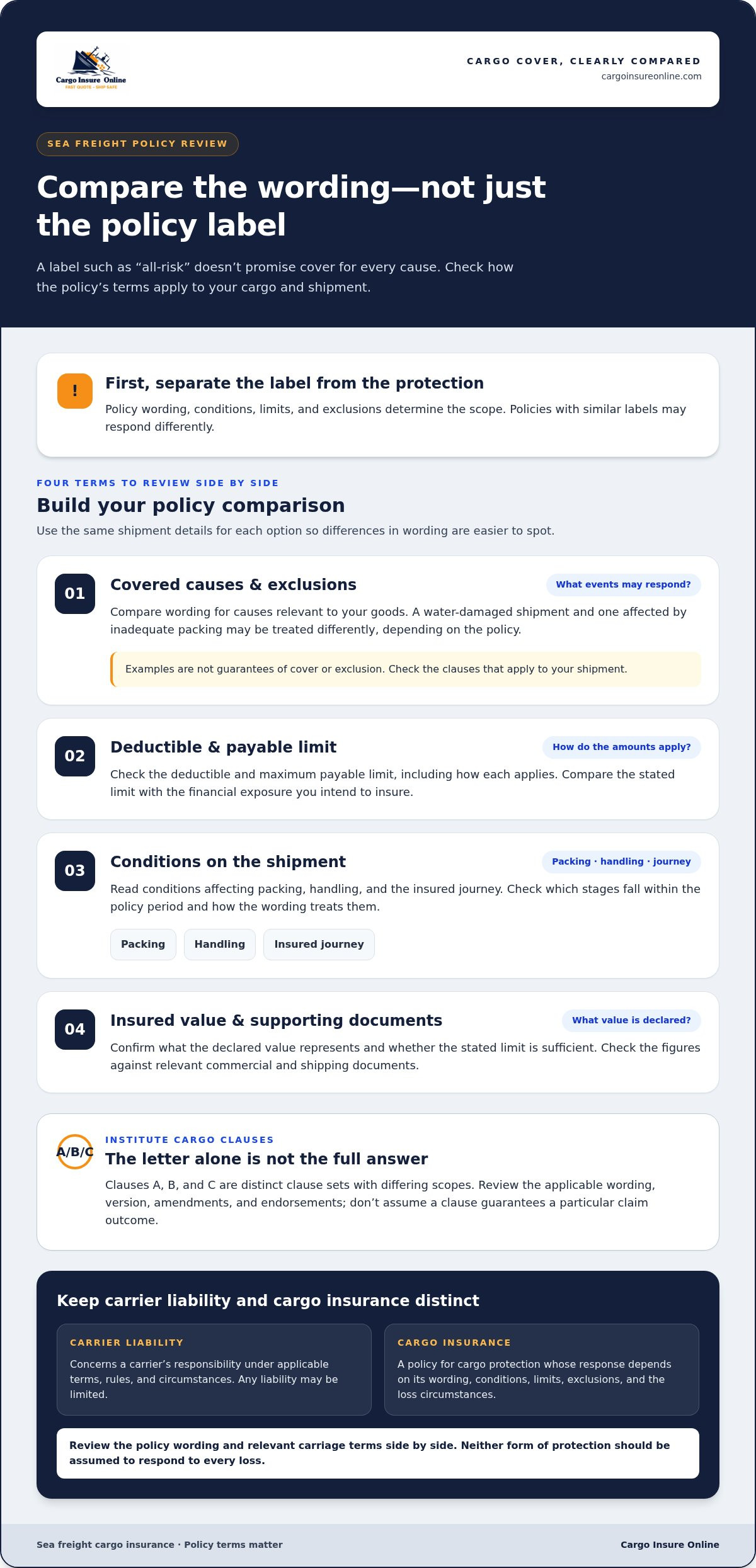
Policy wording, not a headline or short label, determines the scope of sea freight cargo insurance. Policies described with similar terms may respond differently because their covered causes, exclusions, conditions, limits, and deductibles differ. Compare the actual wording against your cargo and shipment details.
A policy label alone cannot establish whether a specific loss is covered. “All-risk,” for example, doesn’t mean protection against every possible cause. It describes a policy approach, but exclusions and conditions still shape the cover. As a general industry reference, MSC’s guide to cargo insurance can introduce common concepts; the policy itself remains the source for its terms.
How do policy scope and exclusions affect a shipment?
Compare how the wording treats causes of loss relevant to your goods. For instance, a shipment damaged by water and one damaged through inadequate packing may be treated differently, depending on the policy’s covered causes, exclusions, and conditions. These examples are illustrative, not statements that a particular policy covers or excludes either event.
Check the deductible, the maximum payable limit, and any conditions that apply to packing, handling, or the insured journey. An exclusion can change the outcome even when two shipments experience a similar event. Read the relevant clauses together rather than relying on a summary or shorthand label.
What do Institute Cargo Clauses mean for buyers?
Institute Cargo Clauses A, B, and C are distinct clause sets with differing scopes. They aren’t interchangeable labels, and the letter alone doesn’t tell you how every loss will be treated. Review the applicable clause wording, version, and any amendments or endorsements attached to the policy. Specific covered causes depend on that text, so don’t assume a clause guarantees a particular claim outcome.
Next, compare the insured value with the financial exposure you intend to insure. Don’t assume one valuation formula applies universally. Check what value is declared, what the policy says that value represents, and whether the stated limit is sufficient. Confirm the figures against relevant commercial and shipping documents before arranging cover.
A practical side-by-side review can focus on:
- Covered causes and exclusions relevant to the cargo
- Deductibles and limits, including how each applies
- Conditions affecting packing, handling, or the insured journey
- The insured value and the documents used to support it
Use the same shipment details when comparing terms, so differences in wording are easier to spot. Cargo Insure Online provides sea freight insurance through its digital platform. Keep the policy terms central to your decision.
How to Match Sea Freight Insurance to Your Shipment
Start with the shipment itself. Cargo type, route, declared value, packaging, and transport arrangement can all influence the questions to ask about sea freight cargo insurance. Durable goods may raise different risk considerations from fragile equipment or temperature-sensitive products. Don’t assume a cargo category automatically qualifies for particular protection. Give the policy review an accurate picture of what’s travelling and how.
Build a shipment snapshot before comparing options. Include the cargo’s description and condition, how it’s packed, the value you need to insure, the route, and planned stages such as port storage or transshipment. Be specific. “Machinery” may tell less than a description identifying the equipment and how it will be secured for transit.
Which shipment details can change the coverage decision?
Cargo characteristics and handling requirements can affect underwriting and policy terms. Fragile goods may call for careful attention to packing details; high-value cargo makes limits especially important to review. Temperature-controlled products raise questions about the planned cold-chain journey and how the policy wording treats relevant risks.
For reefer shipments, compare the cargo’s temperature requirements and planned transport stages with the applicable terms. Readers arranging temperature-sensitive cargo can explore reefer cargo insurance for a focused look at cold-chain protection.
- Cargo: Describe the goods accurately, including any sensitivity or unusual handling needs.
- Value: Identify the value to be insured and the documents that support it.
- Packaging: Record how goods are packed, secured, and prepared for the voyage.
- Route and stages: Map the origin, destination, and planned transit or transfer points.
- Transport arrangement: Note who arranges each stage and where responsibilities change.
How do shipping terms and responsibilities fit in?
Sales terms help clarify which party arranges transport or insurance. Incoterms® are one useful part of that picture, but an Incoterm alone doesn’t establish the scope of a policy or guarantee claim eligibility. Read the agreed term alongside the sales contract, carriage arrangements, and insurance wording.
Responsibility and financial interest can shift between buyer and seller during a transaction. Identify who bears the potential loss at relevant stages, who will arrange cover, and whose interests the policy is intended to protect. The legal meaning of an insurable interest can depend on the governing law and circumstances, so don’t treat a shipping term as a complete legal answer.
Align the shipment information, contractual responsibilities, and policy details. If the route, cargo description, value, or handling plan changes, revisit the comparison instead of relying on an earlier snapshot. Clear inputs make it easier to assess whether the proposed terms fit the actual voyage.
What Should You Prepare Before Arranging Sea Freight Cargo Insurance?
A well-organized shipment request makes the details easier to assess. Before arranging sea freight cargo insurance, gather the facts that describe what’s moving, its value, and the planned voyage. Accuracy matters more than elaborate paperwork. Inconsistent descriptions or dates across records can create confusion about the shipment being considered.
Which shipment records help clarify the request?
Collect the documents already available for the shipment. These may include a commercial invoice, packing information, booking confirmation, and transport records. They help show how the cargo is described, valued, packed, and routed. No single document guarantees coverage or a successful claim, but clear records support a more complete assessment.
Use this preparation sequence:
- Describe the cargo. Record what the goods are, their quantity, and relevant characteristics, such as fragile construction or temperature requirements.
- Organize the value information. Note the amount you intend to insure and the commercial documents that support it. Keep the description and value consistent wherever they appear.
- Map the journey. List the origin, destination, route, and planned transit dates. Include known transfer points or other planned stages.
- Summarize packing and handling. Note how the goods are packaged and flag unusual handling, storage, or transit arrangements that could affect the shipment description.
- Gather available records. Keep invoices, packing details, booking documents, and transport records together so the information can be reviewed as a coherent set.
How can you reduce avoidable coverage misunderstandings?
Start with consistency. If an invoice describes a product differently from the packing information, or shipment dates differ between records, clarify the correct details before submitting them. Make sure the declared value and cargo description match the shipment you want insured. If the goods, route, or planned dates change, update the information used for the assessment.
Be specific about anything outside a routine shipment plan. Unusual cargo, fragile packaging, special handling, temperature control, or additional transit stages can be relevant to how a request is assessed. Flagging these details helps provide a complete picture, but doesn’t determine what a policy covers.
Before proceeding, compare the protection you’re seeking with the policy schedule and wording. Check that the shipment details shown there align with your records, then review the applicable conditions, limits, and exclusions. Keep the final documents together with the commercial and transport records. This creates a clear reference point if questions about the shipment arise later.
With your shipment details organized, explore sea freight insurance through Cargo Insure Online’s digital insurance platform.
Arrange Sea Freight Cargo Insurance with a Clearer Digital Experience
Once you’ve mapped the shipment and identified the policy terms that matter, arranging cover becomes a more focused task. Cargo Insure Online provides sea freight insurance as part of its specialized insurance solutions for global logistics. Its digital platform lets you bring shipment details and coverage considerations together while keeping the policy wording and your specific voyage at the center of the decision.
What should a buyer expect from an insurance-focused digital experience?
Clarity starts with organized information. Prepare a consistent cargo description, value, route, packaging details, and transport plan. These inputs give the request context and help keep attention on the shipment rather than scattered details. A digital platform can simplify how you engage with insurance, but it doesn’t replace a careful review of the terms.
Before making a decision, compare the protection you’re seeking with the policy schedule and wording. Review the insured cargo, relevant limits, conditions, and exclusions against the actual shipment details. A digital process can make the experience more accessible, but it doesn’t establish what a policy covers or promise a particular outcome. The written terms and shipment facts remain central.
When might a related cargo insurance guide help?
Some shipments call for category-specific questions alongside the ocean-transit review. Electronics shippers, for example, may want to consider the nature and value of the devices, their packaging, and the planned route. A focused resource on electronics shipping insurance can help frame those cargo-specific considerations. Keep the main comparison anchored to the sea voyage and the policy terms that apply to it.
For any shipment, return to the same practical checks: does the policy information match the cargo, value, route, and transport arrangement? Are its limits, conditions, and exclusions clear in relation to your needs? These questions turn a broad search for sea freight cargo insurance into a shipment-specific evaluation.
Ready to take the next step? Explore sea freight cargo insurance with Cargo Insure Online and bring your shipment details into the decision.
Plan Your Next Shipment with Confidence
Use your next shipment as a chance to make protection part of the planning, not a box to tick at the last minute. A sound decision starts with a clear picture of your business’s exposure and policy wording that fits it. Keep the decision shipment-specific. Confidence comes from understanding the protection you’re arranging, not relying on assumptions.
Cargo Insure Online provides sea freight insurance within its specialized insurance solutions for global logistics. The company also offers insurance for other freight modes and specialized cargo categories. As you prepare for a voyage, keep the shipment details at hand and consider what protection makes sense for the goods and journey ahead.
Explore sea freight cargo insurance with Cargo Insure Online to review protection for your shipment.
Frequently Asked Questions
Is sea freight cargo insurance required by law?
Requirements depend on the country and shipment. In Ghana, the Ghana Revenue Authority announced that, effective October 1, 2026, importers must obtain marine cargo insurance from an insurer licensed by the National Insurance Commission. In other jurisdictions, don’t assume the same rule applies. A sales contract, lender, or trade arrangement may also require insurance even where it isn’t generally mandated by law.
Can sea freight cargo insurance cover the entire journey, including inland transport?
It can, if the policy wording includes the relevant inland legs and shipment stages. Some cover may be limited to ocean transit, while other arrangements may extend protection to transport before or after the sea journey. For example, a container moved by truck from a warehouse to a port needs the land leg addressed in the terms if you want it insured. Check the policy’s start and end points.
How much does sea freight cargo insurance cost?
The premium depends on the shipment and the terms being considered, so there isn’t one price that applies to every cargo owner. Factors may include the goods’ description and value, route, packaging, and relevant risk details. Prepare accurate shipment information rather than relying on a general estimate. Consider any premium offered alongside the policy limits, conditions, and exclusions.
Does sea freight cargo insurance cover delays or late delivery?
Don’t assume it covers a delay simply because the cargo is insured. A late arrival may create expenses or lost revenue, but whether a policy responds depends on its wording and the circumstances. For example, damage to perishable goods during a delay raises different coverage questions from a missed delivery deadline with no physical damage. Check the terms for delay-related cover and exclusions before relying on it.
Can one sea freight cargo insurance policy cover multiple shipments?
It may be possible to arrange cover for multiple shipments under a policy designed for repeated consignments, but this depends on the policy structure and terms. Check how shipments must be declared, whether they need to meet specified criteria, and how limits apply to individual consignments or groups. Don’t assume cover for one voyage automatically extends to later shipments. Each consignment should fit the policy’s requirements.
What happens if the declared cargo value is inaccurate?
An inaccurate value can create problems if a loss occurs. If the declared amount is too low, the available payment may not match the cargo owner’s financial exposure, subject to the policy’s valuation terms and limits. If it’s too high, that doesn’t guarantee a larger payment. Use consistent commercial records to support the value, and correct errors promptly through the applicable insurance process.
Does sea freight cargo insurance cover general average?
It may. General average can arise when extraordinary measures are taken to protect a vessel and the cargo on board, with cargo interests potentially asked to contribute even if their own goods arrive undamaged. Some cargo policies include cover for that contribution, but the wording and conditions determine whether a specific demand is covered. Review the policy for general-average provisions and any requirements for responding to a demand.
Is sea freight cargo insurance the same as marine insurance?
No. Marine insurance is a broader category that can include protection for cargo, vessels, and other maritime interests. Sea freight cargo insurance focuses on goods transported by sea. The distinction matters when reviewing a policy: a general reference to marine insurance doesn’t establish that a particular cargo, voyage, or loss is covered. Look at the insured subject and the actual wording to understand the policy’s scope.


