
What happens to cargo protection when a delivery stops, waits to be unloaded, or changes hands? The vehicle may be insured, but that doesn’t automatically mean the goods are. Inland marine insurance for delivery fleets focuses on shipments moving across routes and through handling points, subject to the policy’s terms.
If your fleet makes frequent stops or carries different goods on changing routes, it’s easy to confuse cargo coverage, carrier liability, and vehicle insurance. They address different exposures: cargo coverage focuses on the freight, carrier liability on responsibility for loss or damage, and commercial auto coverage on vehicle-related risks and harm to others. The distinctions matter when a loss happens between pickup and delivery.
This guide will help you map transit and handling exposures, compare coverage without mixing up cargo and vehicle protection, and build a practical review around your fleet’s actual operations. You’ll see what to consider when assessing goods, routes, loading and unloading, and temporary storage. The goal is clarity: coverage that reflects how your deliveries move, not just the miles on the road.
Key Takeaways
- Inland marine insurance for delivery fleets can address cargo exposures during transit and handling, but policy wording determines what’s protected.
- Separate cargo protection, carrier liability, and commercial auto coverage by the interest each is designed to insure.
- Map cargo types, route patterns, handoffs, delivery methods, and operational changes to identify questions for your coverage review.
- Compare limits, deductibles, exclusions, covered property, territory, and loss-reporting requirements when evaluating policy fit.
- Use consistent shipment details and a focused renewal checklist to make coverage decisions clearer and more efficient.
Why inland marine insurance matters for delivery fleets
For a delivery operator, the challenge isn’t just getting goods from pickup to destination. It’s protecting them through repeated trips, loading and unloading, and handoffs between people or locations. A shipment can be exposed before the vehicle leaves the dock and after it arrives at a stop. A useful coverage review follows the goods through each stage, not just the miles driven.
Inland marine insurance is a broad category often associated with property moving over land or exposed to transit-related risks. The name can be misleading: it isn’t vehicle insurance, and it doesn’t automatically cover every shipment or delivery activity. What is inland marine insurance? General background can help, but the policy controls the details, including covered property, locations, events, limits, exclusions, and applicable conditions.
Inland marine coverage can protect eligible goods as they move through domestic transportation, subject to the policy’s terms and limits. That’s separate from protection for the delivery vehicle. Commercial auto coverage addresses vehicle-related risks and, depending on the policy, liability for injury or damage to others. Cargo protection focuses on the goods. Don’t assume one replaces the other.
What inland marine insurance can mean for goods in transit
For a delivery fleet, inland marine insurance for delivery fleets may be relevant to cargo in transit and certain related exposures. The exact scope depends on the wording. For example, if a driver collects boxed electronics, makes several scheduled stops, and discovers a damaged carton at delivery, the cause, timing, cargo description, and records may all matter when the claim is assessed. This example isn’t a promise of coverage; it shows why policy details matter.
Where delivery fleets encounter cargo exposure
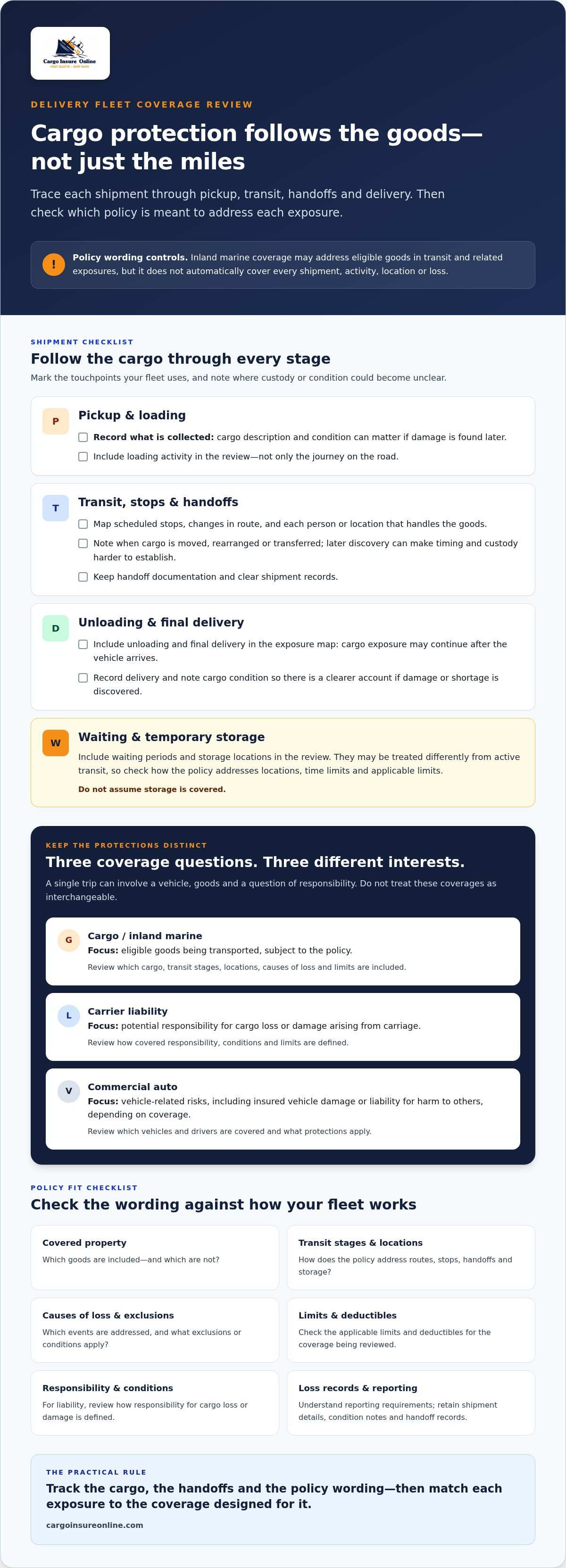
Exposure can begin at pickup, continue during loading and driving, and persist through unloading and final delivery. Each stop adds activity: goods may be moved, rearranged, or transferred to another person. If damage or a shortage is discovered later, it can be harder to establish when it happened and who had custody. Clear shipment records, condition notes, and handoff documentation help build a more complete account.
Map the delivery chain: who handles the goods, where transfers occur, and how delivery is recorded. Include any waiting periods or temporary storage in the review, but don’t assume they’re covered. Storage locations and time limits may be treated differently from active transit. Review how the policy addresses them, along with covered causes of loss and applicable limits.
Start by tracking the cargo, not just the truck. A broader fleet risk review can then distinguish vehicle exposure from goods exposure and identify policy wording that needs closer attention. This keeps coverage discussions grounded in actual routes, handling steps, and delivery records.
How inland marine coverage relates to delivery fleet insurance
A fleet can face different losses on the same trip. A collision may damage the truck, while cargo could be damaged in handling or transit. If a customer alleges the carrier was responsible, that raises a separate liability question. Inland marine insurance for delivery fleets belongs in a broader coverage review because each policy is designed around a different insured interest.
Cargo coverage addresses eligible goods; commercial auto physical damage coverage addresses the delivery vehicle. These protections aren’t interchangeable, and neither should be assumed to cover every loss. Policy wording defines what property and events are covered, along with exclusions, limits, deductibles, and conditions.
| Coverage category | Typical subject matter | Questions to review |
|---|---|---|
| Cargo or inland marine | Goods being transported, subject to the policy | Which cargo, transit stages, locations, causes of loss, and limits are included? |
| Carrier liability | Potential responsibility for cargo loss or damage arising from carriage | How does the policy define covered responsibility, conditions, and limits? |
| Commercial auto | Vehicle-related risks, including physical damage to an insured vehicle or liability for harm to others, depending on coverage | Which vehicles and drivers are covered, and what protections apply? |
Cargo coverage versus carrier liability
Cargo protection and carrier liability are related, but they’re not the same. Cargo coverage centers on the goods and the policy’s terms. Liability coverage concerns the carrier’s potential responsibility for loss or damage connected to carriage. The outcome can depend on the facts, contracts, and policy wording, so don’t assume one automatically responds whenever cargo is damaged. For a closer look at road cargo protection, see this trucking cargo insurance guide.
Cargo coverage versus commercial auto insurance
A delivery van can be damaged while its cargo remains intact, or the vehicle may be undamaged while goods are affected. These are different insurance subjects. Review cargo protection alongside the fleet’s commercial auto coverage so the vehicle, goods, and potential liability exposures are considered separately. Inland marine coverage doesn’t automatically include vehicles or drivers, and it doesn’t guarantee that every cargo loss is covered.
For a practical review, match each loss scenario to the policy intended to address it, then read the relevant wording rather than relying on a policy label alone. Note where two policies may touch the same incident, and identify any gaps or conditions that need attention. Trucking cargo insurance can be considered as one part of a broader risk-management plan.
Which delivery fleet exposures should your coverage review address?
A useful review starts with how your operation actually moves goods, not with a generic fleet description. Map what you carry, where it travels, who handles it, and what changes during busy periods. For inland marine insurance for delivery fleets, accurate operational details help frame the discussion. They don’t, by themselves, establish that a particular loss is covered.
Cargo values, types, and shipment patterns
Look beyond an average load. Compare routine shipment values with your highest-value consignments, and note how often each cargo type moves. A declared value or broad cargo description that doesn’t match actual shipments can make it harder to assess whether a policy fits the operation. Keep records that connect shipment descriptions and values to manifests, invoices, and dispatch data.
- Record typical and peak cargo values, including seasonal or promotional changes.
- Describe goods specifically, especially electronics, high-value devices, and temperature-sensitive products.
- Track shipment frequency and changes in the mix of goods instead of relying on an outdated snapshot.
These details make coverage discussions more precise and support documentation if a loss is reported. They’re review inputs, not a promise that every listed item or cause of loss is insured. E-commerce operations with cross-border legs may involve different transport stages and handoffs; cross-border e-commerce insurance is relevant to that wider shipping context.
Routes, stops, custody, and handling
Trace a shipment from dispatch to completed delivery. Include routine routes and exceptions: multi-stop schedules, loading methods, transfers between drivers or delivery partners, and the records captured at each handoff. Frequent stops create more points where damage, shortage, or a custody dispute might be noticed. Consistent timestamps, condition notes, and delivery records help clarify what happened.
- Map regular routes, route changes, and where goods wait between delivery stages.
- Document who loads, unloads, or accepts each transfer, and how the handoff is recorded.
- Flag overnight parking and temporary holding as policy wording review points.
- Assess theft, damage, and delay as possible exposures, not as losses automatically covered.
Note operational changes such as new delivery methods, added routes, different cargo, or new custody arrangements. Include those changes alongside shipment records in a coverage review. Then compare the operation with the policy’s descriptions of covered property, transit, locations, and conditions. A clear map helps show where the wording aligns with daily practice and where closer review is needed.
How to evaluate inland marine insurance for a delivery fleet
A useful review moves from real operations to the details that govern coverage. Start with how goods travel and finish with the policy wording, not assumptions based on a product label. A policy review should mirror real cargo movement, from dispatch and handling through delivery, so the details can be compared with the fleet’s actual work.
- Map fleet operations. List vehicle types, delivery areas, typical routes, stops, loading methods, and custody changes. Note which teams or partners handle goods at each stage, including delivery methods that differ from the routine process. This creates a practical picture of the operation the coverage is meant to address.
- Reconcile shipment data and values. Compare declared cargo descriptions and values with recent shipment records. Include ordinary loads, peak values, and unusual or high-value shipments. If cargo types or values shift by season or customer, record that pattern rather than relying on a single average. Accurate information keeps the coverage discussion grounded in actual fleet activity.
- Choose representative scenarios. Consider situations such as cargo damaged during loading, a shortage discovered after several stops, or goods held overnight before the next delivery stage. Use these examples to identify questions about transit, custody, and handling. They’re review scenarios, not predictions of whether a claim would be accepted.
- Compare limits and deductibles. Look at how limits apply to individual shipments, loads, or other defined units, and compare them with the values your operation transports. Review deductibles alongside the fleet’s ability to absorb a loss. Check whether special limits or sublimits apply to specific property or circumstances.
- Review territory and loss reporting. Match the policy’s territorial scope to delivery areas and route changes. Note the reporting steps, required information, and any time-sensitive conditions stated in the policy. Make sure dispatch and incident-handling staff know where records are kept and how shipment details can be retrieved.
- Read the policy wording against the operation. Check definitions of covered property, covered events, exclusions, conditions, limits, and deductibles. Review how the wording addresses each scenario, including temporary holding or handoffs where relevant. This step is essential: a summary can help organize the review, but the actual wording determines how the policy applies.
Keep dated shipment, delivery, and incident records in a consistent format. Manifests, invoices, proof of delivery, condition notes, and dispatch records can help explain what moved, when it moved, and who handled it. Revisit the review when the fleet adds routes, changes its cargo mix, or alters delivery practices. This keeps inland marine insurance for delivery fleets connected to the operation you actually run.
To include cargo protection in your fleet review, consider trucking cargo insurance alongside your other coverage.
Put a delivery fleet coverage plan into action
Turn your review into a compact renewal or placement file. A clear snapshot of how the fleet operates keeps the conversation focused on cargo movement, real exposures, and relevant policy terms. Inland marine insurance for delivery fleets should be considered as part of the operation’s broader risk review, alongside vehicle and liability coverage.
Prepare for a focused coverage review
Start with current information, then flag what has changed since the last review. Consistent shipment data makes it easier to compare declared cargo details with the work your fleet actually performs. Keep records organized by route, shipment, or another format your team can maintain.
- Summarize fleet operations, vehicle types, delivery areas, routes, stops, and custody handoffs.
- Describe cargo categories, shipment frequency, typical and peak values, and unusual loads.
- Gather available loss history and records that explain incidents, shipment condition, and delivery status.
- Note changes in delivery volume, goods carried, handling methods, temporary holding, or route patterns.
- Keep the current policy wording and relevant schedules handy for comparison.
Consistency matters more than complexity. Use the same cargo descriptions across shipment records and review documents, and make sure declared values reflect the loads the fleet moves. Record changes clearly. This gives decision-makers a sound basis for discussing limits, exclusions, deductibles, territory, and reporting requirements without treating a checklist as proof that a loss will be covered.
Before renewal or placement, assign someone to maintain the information and note when it was last updated. Dispatch records, manifests, invoices, proof of delivery, and incident notes can each help complete the picture. Tie questions to specific operations: which shipments, routes, or handling steps need closer comparison with the applicable policy terms? This keeps the discussion practical and makes gaps easier to identify.
Explore cargo insurance for trucking operations
Cargo Insure Online provides trucking cargo insurance as a freight-focused option for a broader coverage review. Consider it in relation to the goods your fleet transports and the movement patterns you’ve documented. The relevant policy wording determines applicable coverage, conditions, and limits, so base the discussion on shipment information rather than assumptions about particular terms or benefits.
Have your fleet, route, cargo-value, shipment, and loss-history details ready? Explore trucking cargo insurance for your delivery operation.
Make your next coverage review more connected
Your delivery operation won’t stand still. Routes shift, shipment volumes change, and new goods can reshape cargo exposures. Revisit inland marine insurance for delivery fleets when operations change, rather than waiting for renewal to discover that coverage details no longer reflect the work.
Bring current shipment information and operational changes into your next review. Use them to discuss cargo protection as part of your fleet’s wider risk-management plan. Cargo Insure Online provides freight and specialized cargo insurance solutions through a digital-first journey designed to make exploring coverage more straightforward.
Ready to take the next step? Explore trucking cargo insurance for your delivery fleet and move your coverage review forward.
Frequently Asked Questions
Is inland marine insurance the same as cargo insurance?
Not exactly. Inland marine is a broad insurance category, while cargo insurance focuses on goods being transported. Cargo coverage may be written under an inland marine form, but the terms depend on the policy. For example, a policy may define eligible goods or transit stages in specific ways. Compare the insuring agreement and definitions, not just the policy title, to understand the protection intended.
Does inland marine insurance cover goods during loading and unloading?
It may if the policy wording includes those handling stages and the shipment meets its conditions. Coverage could depend on where loading occurs, who handles the goods, and what caused the damage. If a carton is dropped while being transferred from a loading bay into a van, record when and where it happened, who was present, and the condition of the goods before and after handling.
Can inland marine insurance cover deliveries with multiple stops?
It can be structured to address goods moving through multi-stop delivery routes, but stop patterns and policy terms matter. A route that includes customer drop-offs, transfers, or return trips may raise different questions from a direct delivery. Share a representative route schedule and explain how goods are separated or secured between stops. Then compare those details with the policy’s transit description and relevant conditions.
Does inland marine insurance cover goods left in a delivery vehicle overnight?
That depends on the policy’s wording and conditions. Overnight parking may raise questions about whether transit is considered paused and what requirements apply to an unattended vehicle. Review any wording about storage, security measures, time limits, or vehicle use. If a fleet regularly carries goods overnight, describe the routine clearly rather than assuming transit protection continues unchanged while the vehicle is parked.
What information does a delivery fleet need to review inland marine coverage?
Prepare a current snapshot of vehicle and route operations, cargo categories, shipment frequency, declared values, handoffs, and overnight holding. For inland marine insurance for delivery fleets, consistent records make it easier to compare policy details with actual shipments. Useful supporting documents may include manifests, invoices, dispatch logs, proof of delivery, and incident reports. Note which records are available and how they connect to individual shipments.
Does inland marine insurance cover damage to delivery vans or trucks?
Generally, cargo protection and vehicle damage are separate insurance subjects. If a van is damaged in a collision, review the fleet’s commercial auto coverage for applicable vehicle protection. Cargo coverage focuses on goods, and a vehicle policy shouldn’t be assumed to protect the shipment. For an incident involving both a damaged truck and damaged goods, document each loss separately and review the relevant policy wording.
Can a delivery fleet insure high-value or temperature-sensitive goods?
Specialized cargo protection is available for categories such as high-value electronics and temperature-sensitive products, but the specific goods and applicable terms matter. Describe the products accurately, including how they’re packaged and transported, and keep shipment values and handling records available. Cargo Insure Online provides specialized cargo insurance solutions for these types of goods; the policy wording sets the applicable coverage, limits, exclusions, and conditions.


