

An unplugged reefer cord can start a cargo claim clock before the damage is fully understood. Give notice of cargo damage within three days, and submit a formal carrier claim within 30 days when the bill of lading sets that deadline. Insurance for a reefer container whose power cord is unplugged at a port terminal may help address covered cargo loss, but the policy terms and evidence matter.
When a reefer container power cord is unplugged at a port terminal, getting power restored is only the first step. Preserve the timeline, document any temperature impact, and establish who controlled the container during the delay. Missing records can make it harder to show what happened and when.
This guide explains how to notify the carrier, assess possible carrier and forwarder responsibility, and gather useful evidence, including reefer readings and connection details. It also covers power and monitoring arrangements during port delays or storage, helping you protect the cargo and prepare for a potential claim.
Key Takeaways
- Act quickly on claim notices, then use the bill of lading to identify the formal filing deadline.
- Build a clear timeline of who controlled the container and when the power interruption occurred.
- Preserve timestamped reefer readings, photos, and records of any changes made to the unit.
- During delays, assign responsibility for confirming power, monitoring temperatures, and responding to alarms.
- Before stationary storage, match the power source and connection to the reefer’s electrical requirements.
1. Cargo claim notice and filing deadlines
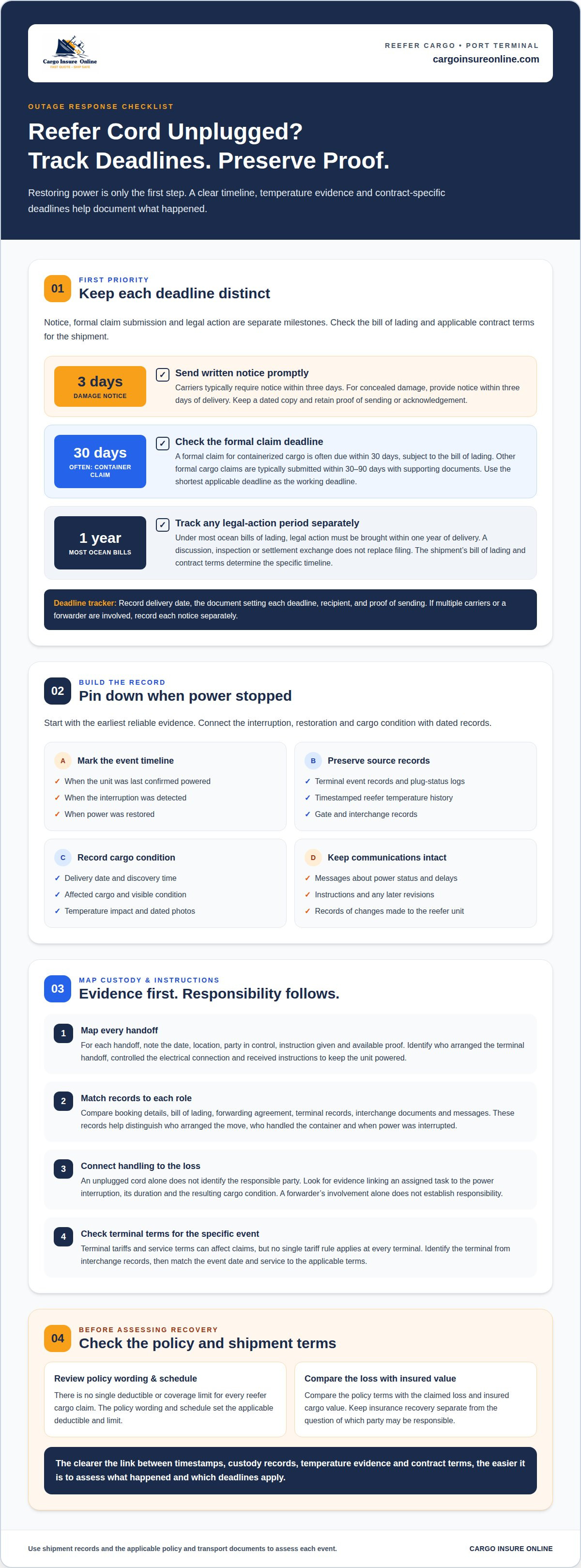
Act quickly if a refrigerated container arrives with damage or a temperature excursion. Carriers typically require notice of cargo damage within three days. Send written notice as soon as you identify the damage and keep a dated copy with the shipment file. Notice creates a record, but does not replace a formal claim.
A formal carrier claim for containerized cargo is often due within 30 days, subject to the bill of lading terms. Other formal cargo claims are typically submitted within 30-90 days with supporting documents. Treat the shortest applicable deadline as the working deadline. Don’t assume a longer claims period overrides a shorter requirement in the transport document.
For concealed damage, provide notice within three days of delivery. This is important when spoilage is discovered only after the container is opened or the goods are examined. Record the delivery date, discovery time, affected cargo, and visible condition. Send notice to the carrier through a traceable channel and retain the acknowledgement or delivery record.
Legal action under most ocean bills of lading must be brought within one year of delivery. This period is separate from initial notice and claim submission. Do not treat a pending discussion, inspection, or settlement exchange as a substitute for filing. The bill of lading and applicable contract terms determine the specific timeline for the shipment.
If a cord was unplugged at a port terminal, start the timeline with the earliest reliable evidence. Preserve the terminal event record, reefer temperature history, gate and interchange records, and messages about power status. Note when the container was last confirmed powered, when the interruption was detected, and when power was restored. These timestamps help connect the event to delivery and notice dates.
There is no single deductible or coverage limit that applies to every reefer cargo claim. The policy wording and schedule set the applicable deductible and limit. Compare those terms with the claimed loss and insured cargo value.
Use a deadline tracker with separate entries for carrier notice, formal claim submission, and any legal-action date. Include the delivery date, the document setting each deadline, the recipient, and proof of sending. If the loss involves multiple carriers or a forwarder, record each notice separately, since one message may not meet every contract’s requirements. Track a reefer container power cord unplugged at port terminal insurance claim alongside these deadlines, with its timeline tied to shipment records to help clarify which policy and transport documents apply.
2. Carrier and freight-forwarder liability
An unplugged reefer cord signals a disruption, but does not automatically identify the responsible party. Start with the container’s custody timeline: who arranged the terminal handoff, who controlled the electrical connection, and who received instructions to keep the unit powered? Compare booking details, terminal records, interchange documents, and messages. A carrier, freight forwarder, terminal operator, or cargo owner may have handled a different part of the move.
Separate the transport contract from the operational event. The bill of lading can identify the carrier’s role and relevant terms, while the forwarding agreement can show what the freight forwarder undertook to arrange. A forwarder’s involvement alone does not establish responsibility for unplugging a cord. Evidence should link the party’s assigned task to the power interruption, its duration, and the resulting cargo condition.
U.S. port terminal tariffs may set service terms and limits that affect claims involving reefer outages or unplugged containers. No single tariff rule applies at every terminal. The relevant terminal tariff, service terms, and transport documents determine the conditions. Identify the terminal in the interchange record, then match the event date and service to the applicable terms.
Terminal operator liability does not automatically cover cargo spoilage caused by an unplugged reefer. A claim needs evidence connecting the terminal’s handling to the power loss and cargo damage, along with the terms governing the terminal service. Temperature records, plug-status logs, terminal work records, and contemporaneous messages can help establish that link.
Map responsibility before assigning fault. For each handoff, record the date, location, party in control, instruction given, and available proof. For example, a booking may show that a carrier arranged terminal delivery, while a terminal log records a later unplugged status. These records answer different questions: who arranged the move, who handled the container, and when the power interruption occurred.
Trace the instruction chain as well. A shipper may specify a required temperature, a forwarder may pass instructions on, and a terminal may manage the container during its stay. Compare each instruction with records of what happened. If instructions were incomplete or changed, preserve both the original and revised versions. The difference can help show whether a communication failure contributed to the loss.
Keep responsibility separate from insurance recovery. The cause of loss and the policy response are related, but they are different questions. For a reefer container power cord unplugged at port terminal insurance review, compare the policy terms with the cargo, route, and event records. This can clarify what the coverage addresses while the parties’ responsibilities are assessed.
Keep the event evidence organized for any insurance discussion. A reefer container power cord unplugged at port terminal insurance claim can be easier to assess when the custody timeline and terminal records are clearly connected. Cargo owners can also consider cargo risk planning alongside the contract and event records.
3. Emergency measures and claim documentation
When a reefer is found unplugged, alert the terminal team and request prompt power restoration. Record who received the report, when it was made, and what action followed. Do not alter the unit’s settings without authorization. A clear response record can show whether the container was reconnected and how its condition changed afterward.
Capture the reefer display as soon as you can access it. Where possible, photograph the reading, container number, and any visible alarm or power status together. Add the date and time to each image, or preserve the original file metadata. A reading without a timestamp provides less context than one showing when it was recorded.
Preserve the unit’s records before routine handling changes them. Request available temperature history, alarm logs, power interruption records, and terminal event data. Keep copies of messages, work orders, and inspection notes. If a terminal representative says the cord was reconnected, record their name, the reported time, and the action described.
Document the damage without unnecessarily disturbing the cargo. Photograph the container exterior, connection point, reefer display, and affected packaging. Images of the connection point, nameplate data, or equipment specifications can help identify the required electrical configuration. Preserve the original images, then label working copies with the container number and capture time.
Create one event log while details are fresh. Use a consistent format for each entry:
- Record the container number, location, date, and time.
- Enter each reefer reading with its timestamp, including readings after power returns.
- Describe changes made to the unit, such as a setting adjustment or restart.
- Identify the person or organization reporting each observation.
- Attach the matching photo, message, terminal record, or inspection note.
Record what happened, not just that someone “checked” the reefer. Shipment records should include a timestamped reading and any changes made, rather than simply stating that the unit was checked. For example, note the displayed temperature and alarm status, then say whether the unit was plugged in or restarted. This makes separate observations easier to compare.
Keep cargo evidence linked to equipment evidence. Match inspection findings, affected product descriptions, and packaging photos to the same container and shipment records. If a survey or inspection takes place, save its findings and supporting images with the event log. This file can show the sequence from power interruption to observed cargo condition.
Store originals in a dated folder and share copies through a controlled record system. Use consistent filenames, such as the container number, capture date, and evidence type. An organized file helps a claims reviewer follow the event without relying on scattered messages or memory.
4. Reefer power contingency during port or yard delays
A delayed pickup requires an active power plan, not just a revised appointment. Assign one named person to confirm that the reefer stays plugged in and monitored at each stop, including the terminal, CES, and warehouse. If customs release comes after the original pickup window, confirm that power and monitoring continue until a new appointment is set.
Marine cargo insurance may respond to temperature damage after a terminal power failure if the policy covers that cause of loss. The policy wording, temperature-damage terms, exclusions, and evidence linking the interruption to the cargo loss all shape the claim. Do not assume every policy treats an unplugged reefer or resulting spoilage in the same way.
Exclusions for reefer temperature changes and power interruptions depend on the policy wording. Review how the policy addresses temperature variation, refrigeration equipment failure, power interruption, and delay. These terms can determine whether the event is covered or excluded, and whether conditions apply during storage or transit.
Build a contingency around the shipment’s required temperature and the location’s available power. In one transshipment example, frozen shrimp sat unplugged for 18 hours; the temperature rose to -5°C instead of remaining at -18°C. That example shows why a delay plan needs both an electrical response and temperature monitoring, not simply a note to keep the container at the yard.
Before a hold or missed pickup, identify who can approve an extension of free time and provide the alternate carrier’s contact details. Shipment instructions should also name an alternate waiting location and confirm it has power and routine unit checks. If customs selects the cargo for examination, arrange power throughout the hold.
Set a clear escalation path for reefer alarms. When calling the yard, provide the container number, actual reading, and timestamp. Shipment instructions should specify which reading triggers a recheck, which triggers a service call, and who receives that call. Clear thresholds and contacts make the next action easier when readings change or an alarm arrives.
For longer delays, consider backup power and monitoring options suited to the operating setup. Reefer containers can use battery backups for brief outages, automatic power switches to change between sources, and monitoring systems that alert operators to power disruptions or temperature anomalies. These measures support response planning, but do not replace confirming that the unit is powered and being checked.
Keep contingency instructions practical. Record the responsible contact, approved alternate location, reefer’s required temperature, and escalation steps. This lets terminal or yard staff respond to a specific alarm report instead of reconstructing instructions during a disruption.
5. Stationary reefer container storage power
A reefer in stationary storage still needs a compatible three-phase power source, such as a generator or grid connection. Before placing the container, match the supply to the unit’s electrical requirements. A connection that looks suitable may still have the wrong voltage, phase, amperage, or plug type.
Reefer containers typically use a 440/480 V, three-phase supply and a 32 A male pin-and-sleeve plug. IEC 60309 is identified as the typical plug standard. These are general configurations, not a substitute for checking the specific container and supply. Electrical setups vary among reefers and eTRUs, so confirm all four details: voltage, phase, amperage, and connector.
Connector arrangements vary by equipment. A reefer container typically has a built-in cord with a male pin-and-sleeve plug. For an eTRU, the power source, such as a dock, pedestal, or building, provides a cord with a female connector. Identify the arrangement before planning the connection. Photos of the connection point, nameplate, or equipment specifications can help clarify the required setup.
Follow proper electrical procedures. Do not adapt or handle a connection based on appearance alone. Have the responsible electrical personnel confirm that the receptacle and supply match the unit’s specifications before energizing it. A mismatch in voltage, phase, amperage, or plug type can disrupt the storage plan and create avoidable operational risk.
For a stationary hold, assign a named person to oversee the power arrangement and routine unit checks. Record when the reefer is connected, who confirmed the supply, and any later interruption or change. If the container moves to another storage position, check compatibility at the new outlet rather than assuming it matches the previous connection.
Plan for continuity, too. A generator or grid connection provides power, but storage instructions should also state who responds to an interruption and who receives reefer alarms. Link each report to the container number and recorded temperature. This creates a useful record if the cargo condition needs review later.
Keep power details with the storage and shipment records: container identification, electrical configuration, connection point, responsible contact, and inspection notes. For example, recording the unit’s specified voltage and plug alongside the storage outlet details helps show whether the connection was correct. Update the records if the reefer changes location or power source.
Use a clear storage plan that pairs the correct supply with named oversight and documented checks. Review your reefer risk planning as part of preparing cargo for stationary storage.
Cargo Insure Online: Reefer Product
Cargo Insure Online offers Reefer Product coverage for businesses moving temperature-sensitive cargo. It can be relevant when insuring a reefer shipment exposed to delays, storage, or power interruptions. Review the policy terms and exclusions against your cargo, route, and shipment details to understand how a specific loss may be handled.
For a reefer cord incident, keep the event timeline, temperature records, and transport documents together when considering insurance. These records help connect the interruption to the shipment and clarify questions a claim may raise. Cargo Insure Online also offers Sea Freight Insurance, Air Freight Insurance, and Trucking Insurance for cargo moving by those modes.
Contact Cargo Insure Online to discuss insurance for your reefer cargo.
Build a stronger plan for the next shipment
Use the disruption as a prompt to strengthen future cargo planning. Before a shipment moves, align the transport plan, temperature requirements, storage arrangements, and insurance terms. A clear plan gives everyone a shared reference when schedules shift or a container waits longer than expected.
If a reefer container’s power cord is unplugged at a port terminal, insurance terms are part of the response, not a substitute for a continuity plan. Review how the cover fits your cargo and route, and keep shipment information organized. Good preparation can make the next decision easier when an unexpected delay puts temperature-sensitive goods at risk.
For a tailored conversation about reefer cargo protection, contact Cargo Insure Online. A little planning now can help you move forward with greater clarity on your next shipment.
Frequently Asked Questions
Who is liable if a reefer container is unplugged at a U.S. port terminal?
Liability depends on the contracts, terminal terms, and evidence showing who controlled the container when power stopped. For example, the carrier may have arranged delivery while terminal records show the container’s later handling. These facts help distinguish responsibility for arranging transport from responsibility for terminal operations. A tariff may affect terminal service terms, so identify the relevant terminal and compare its terms with shipment documents before drawing conclusions.
What evidence is needed to file an insurance claim for reefer cargo temperature damage?
Provide evidence connecting the reefer event to the cargo condition. A useful file matches the container number across temperature history, alarm records, inspection findings, and cargo documents. Include original photos and explain what each shows, such as product condition or an equipment display. If shipment instructions set a required temperature, include the version in effect during the incident. Consistent identifiers make records from different parties easier to match.
What are the deadlines for reporting reefer cargo damage to a carrier, terminal, or insurer?
Give the carrier written damage notice within three days, and check the bill of lading for the formal claim deadline, often 30 days for containerized cargo. Concealed damage notice should be given within three days of delivery. Terminal and insurer reporting periods follow their applicable service terms and policy instructions, so record those deadlines separately. Don’t treat a carrier notice as automatically meeting another party’s reporting requirements.
What steps should a shipper take immediately after discovering a reefer was unplugged at port?
Report the interruption to the terminal and ask authorized personnel to restore power. Record the container number, discovery time, displayed temperature, and any alarm. Ask the terminal to preserve relevant event records, then notify the carrier and insurer through their stated reporting channels. Keep the container’s original settings and records intact where possible. If the cargo is inspected, link the findings to the same container and shipment identifiers.


