
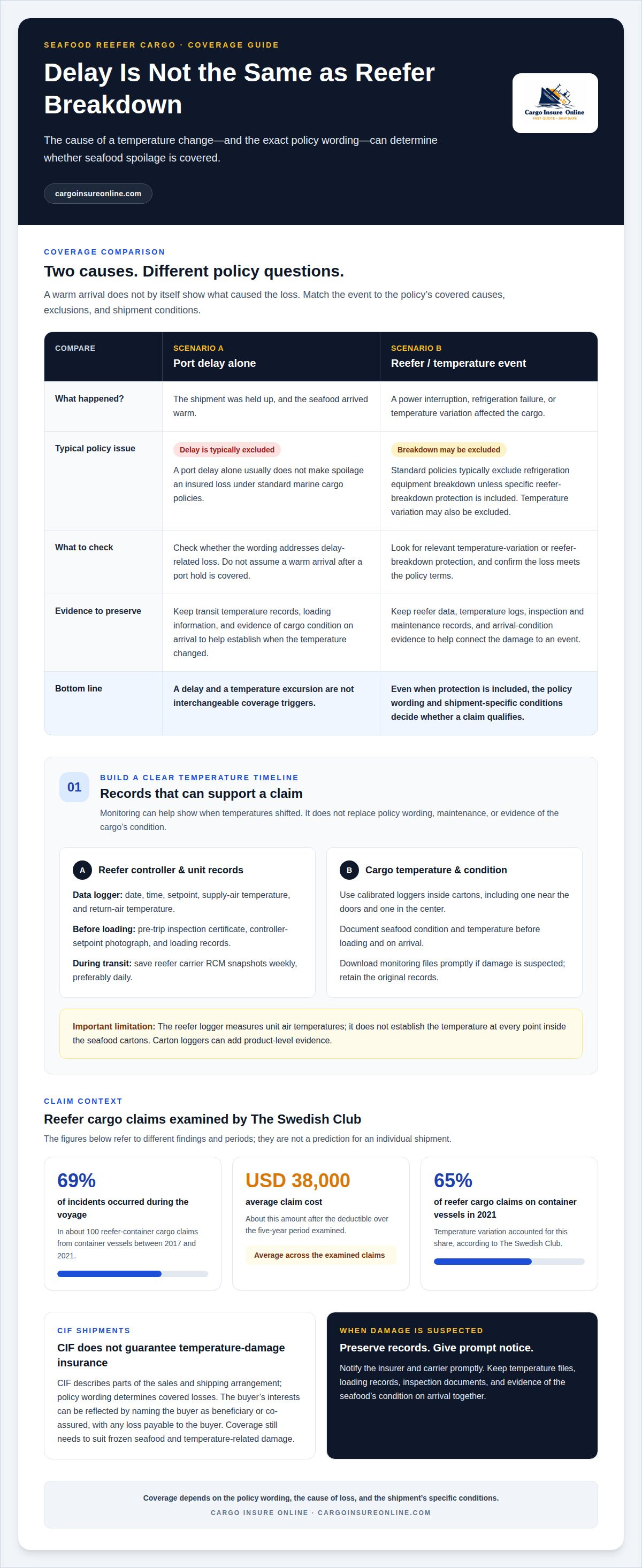
A port delay alone usually doesn’t make seafood spoilage an insured loss: standard marine cargo policies typically exclude losses caused by delay. Seafood reefer container temperature variation tolerance insurance may cover spoilage when the policy includes relevant temperature-variation or reefer-breakdown protection and the loss meets its terms.
That distinction matters when a shipment arrives warm after a port hold, power interruption, or refrigeration failure. The cause of the temperature change, the policy wording, and records of the cargo’s condition can all affect whether a claim is covered.
Here, you’ll learn how delay and reefer-breakdown coverage differ, what temperature evidence can support a claim, and which factors shape coverage and cost. The aim is to clarify how protection may apply, and where exclusions may leave a loss uninsured, before seafood is in transit.
Key Takeaways
- Read the policy wording for the cause of spoilage, not just the cargo type; delay and reefer breakdown may be treated differently.
- Temperature logs, controller records, and cargo-condition documents can help show when an excursion occurred and how it affected the seafood.
- Understand how CIF allocates shipment responsibilities, and don’t assume the trade term itself guarantees temperature-damage insurance.
- Compare the coverage wording with the seafood’s required temperature range, breakdown conditions, exclusions, and deductible.
- If damage is suspected, prompt notice to the insurer and carrier, supported by clear records, can help move the claim forward.
1. Does marine cargo insurance automatically cover refrigeration failure?
No. Standard marine cargo policies typically exclude refrigeration equipment breakdown unless they include specific reefer-breakdown coverage. Temperature variation and delay may also be excluded, so a cargo policy alone doesn’t guarantee payment when seafood spoils. For seafood reefer container temperature variation tolerance insurance, review the policy wording for covered causes, exclusions, and shipment-specific conditions.
There isn’t one temperature range for every chilled seafood shipment. The setpoint must match the specific commodity and its transport requirements. A reefer maintains cargo temperature by circulating and adjusting air; it isn’t designed to cool warm seafood. That makes the cargo temperature at loading and the reefer setpoint important from the start.
A temperature excursion can damage seafood, cause spoilage, shorten its usable shelf life, and create food-safety hazards. Even brief exposure outside the required range can matter. Whether the loss is insured is separate from whether the seafood remains suitable for sale or consumption.
Claims can be severe. The Swedish Club examined about 100 reefer-container cargo claims from container vessels between 2017 and 2021. It found that 69% of incidents occurred during the voyage, and the average claim cost was about USD 38,000 after the deductible over the five-year period examined. Temperature variation accounted for 65% of reefer cargo claims on container vessels in 2021, according to The Swedish Club.
Before loading, document the seafood’s condition and temperature, the reefer setpoint, and evidence that the container was pre-cooled. Inspect the unit and confirm that it maintains its set temperature while empty. If seafood enters warmer than required, its core may take days to reach the appropriate temperature. Setting the reefer correctly won’t immediately fix a loading-temperature problem.
For a claim, temperature records can help connect damage to an event in transit. Preserve the reefer’s data, cargo temperature logs, loading records, inspection documents, and evidence of the seafood’s condition on arrival. Notify the insurer and carrier promptly if you find damage. Clear records help establish when temperatures changed and how long the cargo was exposed.
Reefer insurance premiums and minimum charges vary with shipment value, route, commodity, deductible, and selected protection. The price depends on the case and is provided after a quote request. The value of seafood reefer container temperature variation tolerance insurance depends on whether its terms address the shipment’s actual exposure. If a policy excludes breakdown or temperature variation, it may leave the central spoilage risk uninsured.
2. Does CIF cover temperature damage in a reefer?
CIF describes parts of a sales and shipping arrangement, but it doesn’t guarantee that temperature damage is insured. The policy wording determines which losses are covered. For a CIF shipment, the buyer’s interests can be reflected by naming the buyer as beneficiary or co-assured, with any loss payable to the buyer. That arrangement still needs coverage suited to frozen seafood and temperature-related damage.
Monitoring records help build a timeline if a reefer problem occurs. The unit’s data logger records the date, time, setpoint, supply-air temperature, and return-air temperature. These readings can show whether the unit’s air temperatures moved away from the setpoint during transit. They don’t establish the temperature at every point inside the seafood cartons.
For a fuller picture, place calibrated temperature loggers inside cartons, including one near the doors and one in the center. Download the files promptly if damage is suspected. Before transit, agree which records will be used if a claim arises; the reefer’s own logger is one recommended reference. Shipper loggers can also record conditions such as humidity, light exposure, and location.
A pre-trip inspection certificate and a photograph of the controller setpoint before loading can document the unit’s condition and intended setting. During transit, save reefer carrier RCM snapshots weekly, preferably daily. Keep loading records and temperature files together. A clear record set can help distinguish a reefer malfunction from a problem that began before the freight entered the container.
Remote monitoring can track cargo-space or product temperatures in near real time through cellular or satellite communications. Periodic manual checks can also help detect a power outage or reefer failure during storage. Temperature mapping uses sensors around the container to reveal hot and cold spots a single reading may miss. This can help when investigating uneven temperatures across a shipment.
Monitoring supports evidence, but it doesn’t replace maintenance or clear policy wording. Records can show when temperatures shifted; inspection and maintenance information can help explain why. Preserve those documents alongside controller data and evidence of the cargo’s arrival condition. If you find temperature damage, notify the insurer and carrier promptly and retain the original monitoring files.
For seafood moving by sea, sea freight insurance is the relevant cargo-protection category. The useful next step is matching the policy wording to the shipment’s temperature risks, monitoring records, and the parties’ CIF arrangement.
3. How much does reefer cargo insurance cost per container?
There isn’t one fixed per-container price for specialized perishable cargo cover. The premium depends on the insured shipment value, route, seafood type, selected protections, and deductible. The price is determined for the specific case after a quote request, with those details shaping the assessment. Coverage for temperature variation or reefer breakdown addresses a different risk profile from basic cargo protection.
A claim also involves distinct roles. The freight forwarder coordinates shipment arrangements and can help assemble transport documents. Carriers can provide records about the reefer, power supply, handling, and events in transit. The insurer assesses the policy wording, reported cause of damage, and supporting evidence. These roles are related, but a carrier’s operational record doesn’t determine whether the policy responds.
Act promptly when you discover a cold-chain failure or spoiled seafood. Notify the insurer and carrier, describe the suspected damage, and preserve temperature records, photographs, delivery documents, and communications. Include the container number and shipment details so the parties can identify the affected freight and relevant transit records.
At destination, keep a suspected warm-cargo container sealed until the appointed surveyor arrives, as advised in the claims procedure. Breaking the seal or unloading before inspection can change the evidence available about the container’s condition. The surveyor can inspect the cargo and document visible damage, packaging condition, and temperature information for the claim file.
Keep evidence connected to the shipment instead of scattering it across separate email threads. Useful records include the bill of lading, commercial invoice, packing details, temperature logger files, reefer records, photographs, and the carrier’s incident report. For example, matching a logger’s temperature rise with a carrier record of a power interruption can help establish a timeline. The insurer considers that timeline alongside exclusions, deductibles, and the insured cause of loss.
Timing matters after delivery. Concealed damage in containerized ocean freight should typically be reported within three days of delivery. Formal claims are typically submitted within 30–90 days with supporting documents. These are stated as general timelines, not a substitute for the policy’s notification and claims requirements. Delayed reporting can make it harder to inspect the seafood or preserve records, so send notice as soon as damage is identified.
For a perishable seafood shipment, the practical cost question isn’t just the premium. It’s whether the selected protection matches the likely loss, including reefer failure, temperature change, and any delay-related exclusion. Clear shipment values and route details help frame the coverage decision, while well-kept claim records can show what happened if the cold chain breaks.
4. Temperature variation and reefer breakdown endorsements
A temperature-variation endorsement and a reefer-breakdown endorsement address related but distinct risks. The first focuses on cargo damage after temperatures move outside the required range. The second focuses on loss caused by mechanical or electrical failure of the refrigeration unit. Standard marine cargo cover may exclude refrigeration breakdown, so the policy wording matters as much as the cargo description.
Don’t assume a broad cargo policy automatically covers temperature loss in a refrigerated shipment. Even ICC(A) cover may exclude temperature issues unless an appropriate endorsement is added. Read the clauses for covered causes, any breakdown-duration condition, and exclusions. A policy may treat mechanical failure differently from an incorrect setpoint, poor monitoring, or a delay that exposes seafood to unsuitable temperatures.
Clause details can change the outcome. CL 423 is the Institute Frozen/Chilled Food Clauses (A) with a 24-hours-breakdown condition. Under the CL 263 example, a refrigeration unit stopped for 23 hours doesn’t meet the clause’s 24-consecutive-hour coverage threshold. That illustrates why the length of an interruption and the exact clause wording matter. A shorter failure can still spoil cargo without satisfying that threshold.
Power loss during transshipment can create a different exposure. In one example, frozen shrimp that should remain at -18°C reaches -5°C after an 18-hour period unplugged at port. The temperature log may show the excursion, while port and carrier records can help establish when the reefer unit lost power. An endorsement’s terms determine whether that event falls within coverage.
Reefer units also need a stable power supply. Voltage fluctuations outside the 390V-460V range can trip the unit or damage electrical components. A failure may result from a mechanical fault, electrical problem, or interruption in power; monitoring and maintenance records can help explain which event occurred. Those records support the claim, but don’t replace the policy’s coverage conditions.
The Swedish Club found that temperature variation accounted for 18% of container cargo claims examined from 2017–2021. For seafood cargo, the practical review is whether the endorsement addresses temperature damage, reefer breakdown, and the applicable interruption threshold. Compare those terms with the shipment’s operating plan and monitoring evidence. A named temperature allowance or breakdown condition should be read literally, not assumed to mean every excursion is covered.
For refrigerated seafood, a focused endorsement can address risks that general cargo wording may leave out. Don’t ask only whether the policy includes “reefer” protection. Check whether its wording matches the failure scenario, temperature evidence, and cargo loss being insured.
5. Commodity-specific temperature and operating modes
For qualifying U.S. food shipments, the FDA’s Sanitary Transportation of Human and Animal Food rule requires shippers, loaders, motor-vehicle and rail carriers, and receivers to use sanitary transportation practices. Seafood setpoints still depend on the specific product and whether it travels chilled or frozen.
There’s no single temperature-variation tolerance for all seafood during ocean transport. Exposure outside a product’s required range, even briefly, can damage goods, cause spoilage, or create safety hazards. Species, product condition, packaging, and time outside the range all affect the likely impact.
Frozen fish commonly uses reefer setpoints of -18 to -22°C. That range is a starting point for this cargo type, not a setting for every seafood shipment. A container’s operating range may be -30 to +30°C, but the chosen setpoint should match the commodity’s requirements, not simply the equipment’s limits.
Chilled seafood needs its own specified setpoint. Don’t substitute a frozen-fish setting, or assume a general chilled setting works for every species. For example, a container set to +5°C instead of -20°C for frozen seafood can expose the cargo to a serious mismatch during transit. The bill of cargo instructions and reefer controller setting should reflect the same product-specific requirement.
Operating mode matters as much as the setpoint. A reefer maintains temperature by circulating and adjusting air; it doesn’t rapidly cool warm seafood after loading. Pre-cool the cargo and allow airflow through proper stowage. Overpacking can block circulation and create hot spots, leaving parts of a shipment warmer than the controller reading suggests.
Inspection and loading practices can prevent avoidable temperature problems. Confirm the reefer’s setting, condition, and airflow path before loading. Keep the doors open only as long as loading requires, since warm air and humidity can enter. A blocked floor drain can also allow water to accumulate inside the container.
For sensitive seafood, match the operating plan to the commodity, not a generic “seafood” label. Fresh-air exchange settings suit some products, such as fruits and vegetables, but aren’t a universal seafood mode. Clear product instructions, container records, and temperature monitoring help explain damage and support later claims. They can also help distinguish a setpoint error from refrigeration failure or uneven cooling.
For cargo protection designed around refrigerated shipments, explore reefer cargo coverage alongside the seafood’s operating requirements.
The FDA rule requires shippers, loaders, carriers, and receivers to use sanitary transportation practices, but it sets no universal seafood temperature limit or tolerance. Set the reefer to the specific product’s chilled or frozen requirement, pre-cool seafood before loading, and maintain airflow with proper stowage.
There’s no single recommended temperature range for all chilled seafood; use the specified setpoint for the particular product.
Cargo Insure Online: Reefer Product
Cargo Insure Online offers Reefer Product for businesses moving temperature-sensitive cargo. It’s a relevant option when seafood shipments need cargo protection that reflects refrigeration and temperature-variation risks. The policy wording matters: covered causes, exclusions, deductibles, and any breakdown conditions shape how protection applies. For an ocean shipment, Sea Freight Insurance may also fit the transport mode; Air Freight Insurance and Trucking Insurance address other freight legs.
When reviewing a shipment, have its route, cargo type, insured value, and temperature requirements ready. These details help frame the coverage discussion without assuming every delay or temperature excursion is insured. To discuss cargo protection for a seafood shipment, contact Cargo Insure Online.
Build a stronger plan for your next shipment
Use the next shipment-planning cycle to connect cargo protection with decisions across purchasing, logistics, and delivery. Choosing seafood reefer container temperature variation tolerance insurance means considering how the seafood, route, and transport handoffs shape the risks you want insured. Discuss those priorities before the cargo moves, while the shipment plan can still guide the protection selected.
Think beyond a single leg. A seafood load may move between transport modes, and each handoff can change who manages the cargo and its risks. Cargo Insure Online offers Sea Freight Insurance, Air Freight Insurance, and Trucking Insurance for those freight modes. Matching protection to the shipment’s route is a practical starting point for planning cover across its journey.
Ready to discuss your cargo protection needs? Contact Cargo Insure Online to take the next step with a clearer plan for your seafood shipment.
Frequently Asked Questions
Are delays at port covered if my chilled products spoil?
Usually, a port delay alone isn’t covered under standard marine cargo wording, which typically excludes delay-related losses. Spoilage may be considered if the policy specifically covers the cause of temperature damage, but a reefer-breakdown extension doesn’t automatically insure delay itself. Records showing the container’s power status during a port hold can help establish what happened. Notify the insurer and carrier promptly if chilled seafood arrives damaged.
Does CIF cover temperature damage in a reefer?
No. CIF is a trade term, not a promise that temperature damage is insured. The shipment’s insurance wording determines covered risks and exclusions. For a CIF arrangement, the buyer can be named as beneficiary or co-assured, with any claim payment payable to the buyer. This clarifies who is intended to receive insurance proceeds, but doesn’t replace specific protection for seafood spoilage or reefer failure.
Does marine cargo insurance automatically cover refrigeration failure?
No. Standard marine cargo policies typically exclude mechanical breakdown of refrigeration equipment unless they include specific reefer-breakdown cover. Before shipment, identify whether the wording responds to mechanical or electrical failure and whether a time threshold applies. A brief stoppage may have a different outcome from a prolonged outage. The policy’s stated conditions, not the general label “cargo insurance,” define the protection.
How much cargo spoilage coverage do seafood distributors typically require?
Seafood distributors commonly choose at least $75,000 in cargo spoilage coverage, but the right limit depends on the shipment’s potential loss. Consider the value of the seafood and the cost of replacing it, not only the invoice amount. For example, a shipment with several high-value lots may need a different limit from a smaller consignment. The selected limit should reflect the cargo exposure the business intends to insure.
How much does reefer cargo insurance cost per container?
There isn’t one fixed price per container. The premium depends on factors such as shipment value, route, commodity, deductible, and selected coverage. The price is determined for the specific case after a quote request. Compare the quoted protection with the shipment’s relevant risks, including temperature variation and reefer breakdown. A lower premium won’t help if the policy excludes the loss scenario you need covered.
What Does This Mean for Shippers?
For shippers, cargo protection starts by aligning the seafood’s transport requirements, insurance wording, and shipment documents. Before the cargo moves, make sure the policy reflects the intended journey and the risks being insured. Keep responsibilities clear among the seller, buyer, and transport parties, especially when the shipment changes hands. If a loss occurs, prompt notice and preserved records make it easier to explain the event and support a claim.
What temperature range is recommended for frozen seafood in reefer containers?
Typical frozen-fish reefer setpoints are -18 to -22°C. The suitable setting still depends on the specific seafood and its transport requirements, so don’t treat one range as universal for every product. The cargo should be frozen to its required condition before loading; reefer containers maintain temperature rather than rapidly cooling warm goods. Clear product instructions help prevent a mismatch between the cargo requirement and controller setting.
What reefer temperature records and sensor data do insurers need for seafood cargo claims?
Useful records include the reefer unit’s date-and-time log, setpoint, supply-air and return-air temperatures, and calibrated logger files from inside the cartons. Keep the files linked to the container and shipment, alongside loading and arrival-condition documents. Preserve original downloads, not just screenshots or summaries. Together, timestamps and readings can help map a temperature change to a transit period and support investigation of the reported seafood damage.


