
A shipment’s risks do not stop at the waterline. Maritime insurance can protect cargo during an ocean journey, but what is covered depends on the policy’s terms, conditions, and exclusions. Total loss, partial loss, and damage during the land leg can each raise different coverage questions.
One policy does not automatically cover every stage of an international shipment. Ocean marine insurance may protect cargo at sea, but the route, insured interest, and policy wording determine where coverage begins and which losses it addresses.
This guide explains what ocean marine insurance can cover, how cargo protection may extend across land and sea, and what total loss means for a claim. It also explains how warranties and seaworthiness can affect coverage, helping you understand the terms before arranging shipment protection.
Key Takeaways
- Understand how marine cargo protection can apply to goods moving by sea and land, and what policy terms shape the scope.
- Learn how ocean marine insurance differs across cargo, vessel hull, and third-party liability coverage.
- See why a shipment’s route, duration, destinations, and exposure to hazards matter when assessing cargo risk.
- Distinguish actual total loss from constructive total loss and understand why the policy wording matters.
- Explore how warranties and seaworthiness can affect coverage, and when sea, air, trucking, or GAP insurance may fit a shipment.
How many maritime insurance companies are there based in the United States?
There is no single useful count without defining which businesses qualify as maritime insurers, such as insurers, agencies, or specialist intermediaries. U.S. directory data gives context instead: records average 32.8 tracked contacts per company, the median employee-size range is 1-10 employees, and New York represents 6.1% of the largest-city concentration, as of Nov 6, 2026.
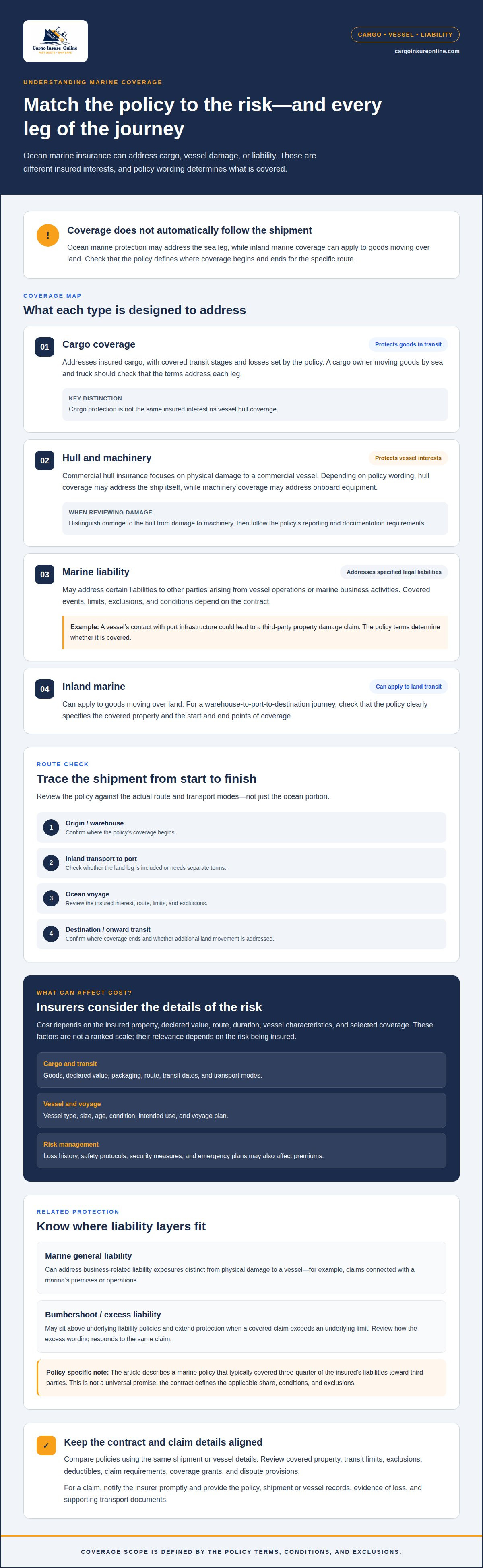
Marine insurance can include cargo protection, vessel hull and machinery coverage, and liability insurance for marine businesses. For example, a cargo owner shipping goods by sea and truck needs terms that address each leg, rather than assuming ocean coverage automatically extends inland.
Ocean marine insurance generally addresses risks linked to ocean shipments, vessels, and related liabilities. Inland marine coverage can apply to goods moving over land. Policy wording determines which property, transit stages, and losses are covered. For a warehouse-to-port-to-destination journey, check that the policy clearly defines where coverage starts and ends.
Vessel owners may arrange hull and machinery coverage for physical damage to a vessel and its equipment. Marinas, charter operators, and other marine businesses may need coverage tailored to their operations and liability exposures. Risk management also considers the vessel’s condition and use, along with safety procedures.
Compare marine insurance policies side by side, looking at covered property, transit limits, exclusions, deductibles, and claim requirements. Use the same shipment or vessel details for each quote so you can see differences in coverage without varying assumptions obscuring them.
In the United States, applicable law depends on the policy and the legal context of the risk. No single policy wording answers every coverage question. Review the contract’s governing terms, coverage grants, exclusions, and dispute provisions for the specific shipment or vessel.
To arrange coverage, businesses typically provide details relevant to the shipment or vessel. Cargo information may include the goods, value, packaging, route, transit dates, and transport modes. Vessel details may include type, size, age, condition, intended use, and voyage plan.
Cost depends on the insured property, declared value, route, duration, vessel characteristics, and selected coverage. Loss history, safety protocols, security measures, and emergency plans may also affect premiums. For a claim, notify the insurer promptly and provide the policy, shipment or vessel records, evidence of loss, and supporting transport documents.
Marine policies are typically underwritten on a subscription basis, with underwriters responsible for their respective shares rather than jointly for the entire risk.
What is ocean marine insurance?
Ocean maritime insurance addresses risks connected with ocean transport, vessels, and marine business operations. It can include cargo protection, commercial hull coverage, and liability protection, but each policy defines its own insured interests and exclusions. For example, a cargo policy and a vessel hull policy protect different property, even when both relate to one voyage.
Commercial hull insurance focuses on physical damage to a commercial vessel. Depending on the policy wording, hull coverage may address damage to the ship itself, while machinery coverage may address onboard equipment. When reviewing a claim, distinguish damage to the hull from damage to machinery, then follow the policy’s reporting and documentation requirements.
Marine liability insurance addresses certain legal liabilities to other parties. These may arise from vessel operations or marine business activities, with the policy specifying covered events, exclusions, and limits. For example, a ship’s contact with port infrastructure could lead to a third-party property damage claim. The policy terms determine whether the incident is covered.
Marine general liability can address business-related liability exposures distinct from physical damage to a vessel. A marina, for example, may face claims connected with its premises or operations. Distinguish this protection from hull coverage: one addresses specified liability exposures, while the other concerns damage to the insured vessel.
Some marine policies also address third-party liabilities connected with a vessel. The marine policy described in this context typically covered three-quarter of the insured's liabilities toward third parties. This is not a universal promise for every policy. The contract identifies the applicable share, covered liability, and any conditions or exclusions.
Bumbershoot coverage is a form of excess liability protection associated with marine risks. It may sit above underlying liability policies, extending protection when a covered claim exceeds an underlying limit. Before considering it, map the underlying policies and their limits, then review how the excess wording responds to the same claim.
Worldwide operations add complexity. A vessel may move between ports, jurisdictions, and infrastructure systems during a single voyage. Marine insurance terms need to match the insured’s operations, navigational scope, and liability exposures. A clear incident report, prompt notice, and relevant records help insurers assess a claim against the contract.
For businesses arranging protection for ocean cargo rather than vessel liability, sea freight cargo coverage addresses a different insured interest. Keep the distinction clear: commercial hull, marine liability, and cargo coverage respond to different risks, and each policy’s terms control the outcome.
Underwriters carefully evaluate the vessel’s type, size, age, condition, and intended use. Insurers consider those factors when assessing marine risks. The Institute Time Clauses Hulls referenced for marine third-party liabilities are dated 1.10.83.
Cargo insurance across land, sea, and international borders
International cargo may move through several transport modes before reaching its destination. About 90% of international trade is transported by sea, so connecting inland legs matter too.
Cargo Protection During Transit and Storage
Cargo protection can be arranged around a shipment’s journey, including inland transit, ocean transit, and specified storage stages. An inland marine policy may address goods moving over land, while ocean cargo coverage addresses the sea leg. The policy should identify the covered property, transport modes, journey boundaries, and any storage locations.
For example, a shipment may travel by truck from an American warehouse to a port, then by vessel to an overseas buyer. Align the coverage period with the actual movement and any planned storage between legs. Goods delayed at a terminal may raise different coverage questions from goods damaged during truck transit.
Route details shape marine risk assessment. Insurers consider a voyage’s route, duration, and destinations, including exposure to weather, piracy, and geopolitical instability. Vessel type, size, age, condition, and intended use also inform the assessment. These details help define the risk of a specific shipment rather than treating every international route alike.
Ocean Cargo Coverage
Ocean cargo insurance protects goods against covered loss or damage during sea transit, subject to the policy’s terms, conditions, and exclusions. For example, a shipment of electronics carried by vessel needs coverage that identifies the goods and relevant voyage. The insured party, declared cargo details, and covered journey should align with the policy documents.
Ocean protection may sit alongside inland marine coverage when goods travel by truck before loading or after discharge. Map each leg, including carrier handoffs and storage stops. The policy’s territorial scope and transit wording clarify where protection applies. Gaps can arise when inland and ocean coverage describe different endpoints.
Natural catastrophes ranked as a top shipping-industry business risk for 32% of respondents in 2026, compared with 29% in 2025. The route and destination matter: weather exposure for one voyage may differ from another. Specialized cargo, such as temperature-sensitive goods, also calls for attention to the policy’s covered property and conditions.
Cargo Losses from Theft, Weather, and Damage
Theft, severe weather, and equipment damage can affect cargo at different points in transit. A container may face weather exposure aboard a vessel, during port handling, or while awaiting onward transport. Coverage depends on the insured event and policy wording, so the shipping documents and stated route should match the actual movement.
Effective cargo risk management starts with practical shipment details. Insurers assess the route, duration, destination, cargo characteristics, and transport arrangements. For example, a shipment passing through a port after a storm may involve both weather exposure and handling damage. Clear records of the cargo’s condition and movement help establish what happened and when.
For domestic and international shipments, compare covered risks, exclusions, storage provisions, and transit boundaries. A U.S. business shipping goods abroad should account for inland movement on both sides of the ocean leg. This route-focused review distinguishes cargo protection from vessel insurance and keeps coverage aligned with the shipment’s actual journey.
Actual and constructive total loss
A total-loss claim depends on what happened to the insured property and how the policy defines the loss. An actual total loss generally describes property that is destroyed or irretrievably lost to its owner. For example, a vessel that sinks and cannot be recovered is fundamentally different from one that remains afloat but needs substantial repairs.
A constructive total loss describes a different situation: the property may still exist, but recovery or repair is considered uneconomic under the applicable policy terms. Imagine a damaged vessel stranded far from a repair facility. The decision depends on its condition, recovery prospects, expected repairs, and policy definitions, not simply on whether damage occurred.
For a cargo owner, the insured property is the goods, not the vessel carrying them. A container lost overboard could lead to a total-loss claim for its cargo, while damage to a ship’s machinery concerns the vessel’s insurance. Claims begin by identifying the insured interest and matching the evidence of loss to the relevant policy wording.
A total-loss-only policy covers the total loss of a vessel, not partial loss. This distinction matters when a ship suffers limited damage and remains usable. A vessel owner relying on this type of policy should understand that repairable damage is not the same as total loss. Any broader coverage depends on the contract’s terms.
Underwriting and risk assessment shape how insurers evaluate global vessel exposures. A vessel’s loss history, operator record, safety protocols, security measures, and emergency response plans can help identify vulnerabilities and trends. The route, vessel condition, intended use, and recovery conditions also inform the context of a potential total loss.
After an incident, build a claim file that connects the event to the insured property. It may include the policy, cargo or vessel records, transport documents, photographs, survey findings, repair estimates, and recovery communications. For example, a repair assessment can help distinguish extensive vessel damage from a loss treated as constructive under the contract.
Clear reporting matters to a claim. The policy sets the notice and documentation requirements, while the incident record establishes the sequence of events. Cargo owners should preserve shipping records and evidence of the goods’ condition; shipowners should retain vessel, maintenance, and damage records. These details help the insurer assess the claim against the coverage purchased.
Demand for protection varies with the property, voyage, and business exposure. A global operator with several vessels may have a different underwriting profile from an owner insuring one ship. Often, the key practical difference is policy scope: whether it covers total loss alone or also responds to partial damage.
Insurance warranties and seaworthiness
A marine policy may contain warranties, exclusions, and limits that shape how claims are assessed. A warranty is a policy requirement connected with the insured risk. For a vessel, seaworthiness concerns whether it is fit for its voyage. Policy wording matters: a claim involving an unfit vessel raises different issues from cargo damaged during inland transit.
According to the Marine Insurance Act, section 39(1) implies a warranty that a vessel is seaworthy at the start of a voyage under a voyage policy. This connects the vessel’s condition to the voyage insured. For example, a claim after a departure may require consideration of the vessel’s readiness and condition at the voyage’s start, alongside the policy terms.
Section 41 of the Marine Insurance Act implies a warranty that the insured voyage is legal. A route or voyage that raises legal questions can therefore affect coverage analysis. The insured voyage, the policy description, and the relevant facts need to be considered together rather than treating the vessel’s condition as the only warranty-related issue.
According to the Marine Insurance Act 1906, section 34(3) provides for an insurer to waive the right to invoke a breach of warranty through its conduct. This makes the insurer’s actions relevant to how a warranty issue is handled. The policyholder’s broker can help organize the policy wording, communications, and claim records for review.
Under section 39 of the UK Marine Insurance Act 1906, an insurer is not liable for loss attributable to unseaworthiness if the assured knowingly sends a ship to sea in an unseaworthy state under a time policy, according to UK Government, legislation.gov.uk. This is a UK rule, not a universal statement about every country’s marine policy or law.
What are the main exclusions and limitations in marine insurance policies? Exclusions, coverage limits, warranties, and conditions define the policy’s boundaries. The insured property and cause of loss determine how they apply. For example, an unseaworthiness issue under a time policy differs from cargo damage during inland transport.
Keep the policy, voyage details, vessel condition and maintenance records, and insurer communications together for a claim. If damage occurs, prompt reporting and clear evidence help connect the event to the insured voyage and relevant terms. A broker can help organize insurance documents, but the contract remains central to assessing coverage and losses.
For cargo moving by sea, explore sea freight insurance options designed for shipment protection. Clear cargo details and transit information help align insurance solutions with the goods and journey being insured.
Restrictions may concern an unseaworthy vessel, an illegal voyage, or damage outside the insured voyage, such as cargo damage during inland transit. Their effect on a claim depends on the policy’s exclusions, coverage limits, warranties, and conditions.
Cargo Insure Online
Cargo Insure Online helps businesses arrange cargo protection around a shipment’s transport modes and risks. Its options include Air Freight Insurance, Sea Freight Insurance, Trucking Insurance, and GAP Insurance. The right fit depends on the goods, how they move, and where coverage needs to apply.
Consider Cargo Insure Online when a shipment crosses land and sea, moves by air, or calls for protection against a coverage gap. Details about the goods, route, transport modes, and shipment value help shape the insurance request. Policy terms determine which losses are covered, so understanding the journey is an important part of arranging protection.
Contact Cargo Insure Online to explore cargo insurance for your shipment.
Set Up Protection for the Route Ahead
Start by matching protection to the shipment’s actual journey, not just its ocean leg. Gather the cargo details, transport modes, route, and planned storage points. This information gives a maritime insurance professional a clear picture and helps focus attention on policy wording relevant to your business.
Cargo Insure Online offers Air Freight Insurance, Sea Freight Insurance, and Trucking Insurance for different transport needs. If a shipment moves between modes, frame the coverage request around those transitions. The policy’s terms, conditions, and exclusions remain central to understanding what protection applies.
Good preparation makes the next conversation more focused. Gather the shipment information you already use to plan transport, and identify where you want coverage to begin and end. This moves the discussion from general questions about maritime insurance to the specifics of your cargo and route.
Contact Cargo Insure Online to discuss cargo protection for your shipment. A clear route plan is a practical first step toward moving forward with confidence.
Frequently Asked Questions
What is maritime insurance and what does it cover?
Maritime insurance protects specified interests connected with marine transport and operations, as defined by the policy. It may cover cargo, a vessel, or certain liabilities, but these protections are distinct. For example, a business shipping machinery may insure the goods separately from the vessel carrying them. The policy’s insured property, covered causes of loss, exclusions, and transit terms determine how protection applies.
How do hull insurance and protection and indemnity insurance differ?
Hull insurance covers physical damage to the insured vessel, while protection and indemnity insurance generally addresses specified third-party liabilities arising from vessel operations. For example, damage to a ship’s structure concerns hull coverage; a covered claim involving injury or damage to someone else’s property concerns liability protection. The scope, limits, and exclusions depend on each policy’s wording, so one type should not be treated as a substitute for the other.
How much does maritime insurance cost in the United States?
Cost depends on the insured property, declared value, route, duration, vessel characteristics, and selected coverage. Loss history, safety protocols, security measures, and emergency plans may also affect premiums.


