
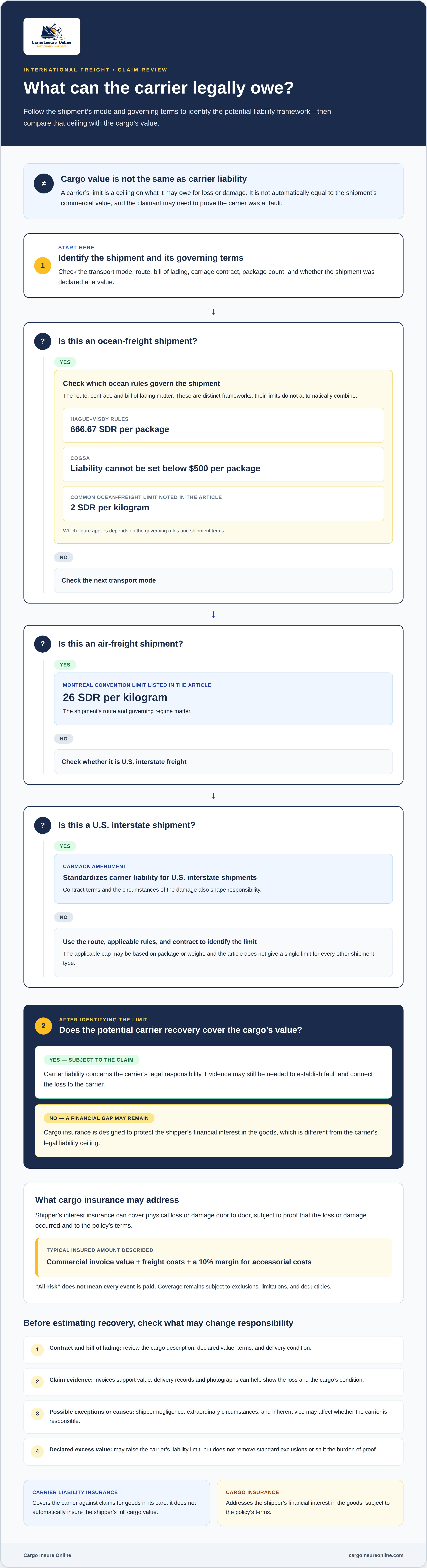
A carrier’s legal liability is not the same as the full value of your cargo. For ocean freight, a common limit is 2 SDR per kilogram; under COGSA, liability cannot be set below $500 per package. Explaining a carrier’s limited liability to an angry logistics client starts with separating what the carrier may legally owe from what the shipment was worth.
It’s frustrating when a claim falls short, especially when the damage is clear. But the applicable limit depends on the transport mode, governing rules, and shipment details, and exceptions may affect whether the carrier is responsible. This guide explains international carrier limits, what COGSA claim deadlines mean, and how exceptions such as shipper negligence or extraordinary events may affect recovery. It also clarifies why carrier liability and cargo insurance address different financial risks, so you can respond with a clearer understanding of what may be recoverable.
Key Takeaways
- Carrier liability limits depend on the transport mode, governing rules and shipment terms, so they may fall well below the cargo’s value.
- Separate the carrier’s potential legal responsibility from cargo insurance, which can protect the shipper against a broader financial loss.
- For ocean shipments, the article explains the COGSA claim and lawsuit deadlines and why prompt documentation matters.
- Events such as shipper negligence or extraordinary circumstances may affect whether the carrier is liable.
- Understand how Air Freight Insurance, Sea Freight Insurance, Trucking Insurance and GAP Insurance can address different shipping risks.
What is Carrier Limit of Liability for International Shipping?
A carrier limit sets a ceiling on what a carrier may owe for damaged or lost freight. It is not automatically equal to the cargo’s commercial value. The applicable limit depends on transport mode, governing rules, and the contract, including the bill of lading. For example, the Hague-Visby Rules state an ocean-freight limit of 666.67 SDR per package, while COGSA states a minimum of $500 per package. These are distinct legal frameworks, not amounts that automatically combine.
Weight-based limits can produce a very different recovery from package-based limits. Air freight follows a different framework: the Montreal Convention limit is listed as 26 SDR per kilogram. The shipment’s route and governing regime matter.
Carrier liability and cargo insurance protect different interests. Carrier liability concerns the carrier’s legal responsibility for loss or damage, and a claimant may need to prove the carrier was at fault. Cargo insurance is designed to protect the shipper’s financial interest in the goods. Shipper’s interest insurance can cover physical loss or damage door to door, subject to proof that the loss or damage occurred. This distinction matters when a carrier’s legal payment is less than the cargo’s value.
“All-risk” describes broader cargo protection, not payment for every possible event. Coverage remains subject to the policy’s exclusions, limitations, and deductibles. Typical cargo-insurance coverage is described as the commercial invoice value, freight costs, and a 10% margin for accessorial costs. A shipper should distinguish that insured amount from the carrier’s liability ceiling. They answer different questions: what the cargo was worth, and what the carrier may legally owe.
Declaring excess value may raise a carrier’s liability limit, but it does not remove standard exclusions or shift the burden of proof. Carrier liability insurance is different again: it covers the carrier against claims for goods in its care, rather than automatically insuring the shipper’s full cargo value. For a circuit-board shipment worth €100,000, a weight-based cap could leave a substantial gap after transit damage. Freight costs, package count, cargo condition, and the applicable convention all shape the claim. Cargo insurance can address financial exposure beyond the carrier limit, subject to its terms.
Why does carrier liability matter in transport?
For U.S. freight claims, the Carmack Amendment standardizes carrier liability for interstate shipments. Contract terms and the circumstances of the damage also shape responsibility, so identifying the applicable framework is an essential first step.
Common-Carrier and Contract-Carrier Responsibilities
A common carrier offers freight transport broadly, while a contract carrier moves a shipment under an agreement with a particular customer. This distinction helps identify which carriage terms apply when cargo arrives damaged or is lost. For example, a shipment booked under an individual transport agreement may be governed by its specific terms, rather than assumptions about another carrier’s standard service.
In either arrangement, the central question is the carrier’s responsibility for the goods during the agreed transport. The contract, route, and circumstances of the loss help define that responsibility. National rules may also affect the claim, especially when a shipment crosses jurisdictions.
Liability Caps in Carriage Contracts
A liability cap is a contractual limit on what a carrier may owe for loss or damage. It may be calculated per package or by weight, so the same shipment value can lead to different potential recoveries under different terms. A carrier’s contract may also offer a declared-value option that raises the limit.
A higher limit does not automatically remove exclusions or prove that the carrier caused the damage. The claimant still needs evidence linking the loss to the carrier’s responsibility. For a high-value shipment, the gap between the cargo’s worth and the contractual cap can define the financial exposure.
Bill of Lading and Shipping Contract Terms
A bill of lading records key shipment details and forms part of the carriage agreement. Its terms can identify the carrier, describe the goods, and set out liability limits or conditions that affect a freight claim. Its wording may determine which cap applies to a particular package or unit of weight.
Compare the cargo description, declared value, and delivery condition with the claim evidence. A mismatch can complicate the question of what the carrier accepted and what was damaged. Read the bill of lading alongside other contract terms rather than treating it as a standalone summary.
Types of Carrier Liability
Contractual liability comes from the carriage agreement; statutory liability comes from applicable law, including the Carmack Amendment for U.S. interstate shipments. Tort liability concerns a claim based on conduct outside or alongside the contract. These categories help explain why one incident can raise several legal questions.
For instance, a contract may set a cap, while negligent handling may affect the liability analysis. Inherent vice, meaning a product’s own tendency to deteriorate or sustain damage, can also complicate responsibility. The governing rules, contract, and evidence determine which route applies.
For an efficient claim review, connect each document to a specific question: which carrier accepted the shipment, what terms governed, and what evidence establishes the cargo’s condition before and after transport? An invoice supports value; delivery records and photographs can help show the loss. A clear timeline helps distinguish carrier handling from other possible causes, including shipper actions or the goods’ inherent condition.
Exceptions to carrier liability
A carrier’s responsibility depends on why the loss or damage occurred, not just on the package’s condition at delivery. Natural disasters and acts of war can place cargo loss outside carrier liability. Acts of God and shipper negligence are also recognized exceptions. These circumstances do not automatically erase every claim; the governing contract and rules, together with evidence about the event, determine whether an exception applies.
Consider freight damaged during a severe storm. The storm may be relevant as an act of God, but the event alone does not establish that the carrier had no responsibility. The timing, handling records, and cargo condition before transport help explain what happened. The claim should distinguish an external event from damage caused by the carrier’s handling or another factor.
Shipper negligence can affect liability when the shipper’s own actions contributed to the loss. For example, inadequate packaging could leave a fragile package vulnerable to impact during ordinary handling. The goods’ condition at pickup, packaging details, and photographs of the damage can help clarify the cause. Assess a carrier’s reliance on shipper negligence against the evidence, rather than treating it as a complete explanation on its own.
Some contracts and carrier liability insurance policies also include exclusions, limitations, or deductibles. An exclusion describes a risk the policy does not cover; a limit caps payment, while a deductible leaves part of a covered loss with the insured party. These are separate terms. A carrier’s policy addresses its liability for goods in its care, while the carriage contract and governing rules affect the shipper’s claim.
That distinction matters when a carrier raises an exception. It may argue that an act of war, natural disaster, or shipper action caused the loss. The claimant still needs evidence of shipment value and damage, and the carrier’s explanation must be assessed against the circumstances. Delivery receipts, photographs, and cargo condition reports can help establish when the damage appeared and whether the claimed exception fits.
Keep the evidence tied to the specific exception. If the carrier cites a storm, records of the shipment’s route and condition can help establish the sequence of events. If it cites packaging, images and handling details can show the package’s condition before dispatch. For a claim involving several packages, identify the affected units and document each one separately. Clear records keep the dispute focused, without assuming that liability coverage guarantees reimbursement.
Meaning and scope of carrier liability
Carrier liability describes a carrier’s legal responsibility for cargo loss or damage during transport. Its scope depends on the governing law, contract, transport mode, and circumstances of the shipment.
Scope of Carrier Liability
The scope defines the losses a carrier may be liable for and the conditions that shape that responsibility. For cargo damaged between pickup and delivery, the timeline and handling evidence help establish when the damage occurred. The goods’ nature also matters: a product that can deteriorate on its own raises different questions from an item damaged by impact.
International shipments can involve several carriers and transport modes. The rules for one leg may differ from those for another, so the claim’s scope may depend on where the loss occurred. For road freight under the CMR convention, the stated liability limit is 8.33 SDR per kilogram. That limit makes shipment weight relevant to risk management, even when the cargo’s commercial value is much higher.
Carrier Legal Liability
Carrier legal liability is the obligation to answer for loss or damage under an applicable contract or legal framework. The Carmack Amendment shapes U.S. interstate carrier liability, while the Hague-Visby Rules and Montreal Convention are frameworks relevant to international ocean and air shipping. The mode and route help determine which framework governs a claim.
Liability does not mean responsibility for every reported loss. The claimant must establish the shipment’s value and the loss, while the carrier’s responsibility depends on the circumstances. An invoice can support the goods’ value, and delivery records and photographs can help show the damage. The evidence connects the event to the legal question.
Limited Liability in Freight Shipping
Limited liability means a carrier’s potential payment may be capped by law or carriage terms, even when the cargo’s value is higher. Under CMR, the stated road-freight cap is 8.33 SDR per kilogram. A low-weight, high-value shipment can therefore face a gap between its value and the carrier’s potential liability. The cap describes a limit, not an automatic payment.
For practical risk management, separate three questions: which rules govern, how the loss occurred, and how any cap applies. Assessing those facts helps clarify whether exceptions affect the claim and how the carrier-shipper relationship shapes responsibility. A carrier’s stated limit alone does not establish that the carrier is liable or that the claimant can recover that amount.
What does carrier limited liability mean in freight shipping?
Carrier limited liability means a carrier’s responsibility for freight loss or damage is capped by a contract or governing rule. The cap may be based on weight, package count, freight class, or another stated measure. It does not automatically equal the shipment’s sale price. Potential recovery therefore depends on the applicable terms and how they calculate the limit, not simply on the invoice value.
Less-than-truckload, or LTL, claims show how sharply those calculations can differ. For new LTL items, carrier liability can range from about $1-2 per pound to $25 per pound for the highest freight classes. For used or resold LTL goods, it typically starts at $0.10 per pound regardless of freight class. These figures are examples of potential limits, not guaranteed claim payments.
Freight class is only one factor. LTL liability also varies with packaging, commodity type, and other conditions. A properly packaged new item and a used item of the same weight may face different limits. The bill of lading and shipment terms help establish which conditions apply. For an actual claim, consider the stated cap alongside evidence of the goods’ value and the loss.
Try a simple comparison before estimating exposure: identify the shipment weight, determine whether the goods are new or used, then review the relevant carrier terms. For used goods, the stated starting point of $0.10 per pound can leave a wide gap against resale value. For new freight, the class-based range can change the calculation. Neither example establishes what a carrier will pay for a specific claim.
Limited liability is also different from cargo insurance. A liability cap measures the carrier’s potential responsibility under applicable terms; cargo insurance can address the shipper’s financial interest, subject to policy terms. This distinction matters for high-value goods moving by air or sea. The carrier’s cap may be based on weight or packages, while the shipper’s loss reflects the cargo’s value and condition.
For air or ocean shipments, consider how Air Freight Insurance and Sea Freight Insurance can address cargo-value exposure beyond a carrier’s liability limit. The right risk-management approach starts by matching the transport mode and cargo value with the financial exposure a cap could leave behind.
Cargo Insure Online
Cargo Insure Online offers cargo insurance options for shipments by air, sea, and truck. Consider coverage when a carrier’s liability limit could leave a gap between potential recovery and your cargo’s value. The right fit depends on the shipment and the risks you want to address. Air Freight Insurance, Sea Freight Insurance, Trucking Insurance, and GAP Insurance can support different freight and financial exposures. Policy terms determine the coverage that applies, so distinguish insured cargo protection from a carrier’s legal responsibility. That clarity can help you plan risk management before goods move, rather than relying on a carrier limit after loss or damage. For a conversation about your shipping risk, contact Cargo Insure Online.
Build a clearer plan for the next shipment
When explaining carrier limited liability to an angry logistics client, focus the conversation on a practical next step. Identify which financial risks the business is prepared to retain and where additional protection may help. This shifts attention from blame to planning, without suggesting that insurance changes a carrier’s legal responsibility or removes policy conditions.
A useful way of explaining carrier limited liability to an angry logistics client is to connect future coverage decisions to each shipment’s route, cargo value, and business priorities. Cargo Insure Online offers Air Freight Insurance, Sea Freight Insurance, and Trucking Insurance. A clear internal handoff can assign responsibility for retaining claim documents and reviewing future shipment risks, so logistics and finance teams can apply what they learn.
Ready to explore coverage for your cargo? Discuss your shipping needs with Cargo Insure Online and take a confident next step.
Frequently Asked Questions
How does carrier liability work in logistics?
Carrier liability determines whether a carrier is responsible for cargo loss or damage and what amount may be recoverable. Start with the transport agreement and identify the carrier responsible when the loss occurred. Then compare the damage evidence with the shipment’s documented condition and value. A delivery receipt noting visible damage, for example, can support a claim, though a carrier’s limit may still restrict potential recovery.
When Does Liability Begin and End?
Liability is assessed against the agreed transport service and the carrier’s custody of the goods. Shipment records help establish when that responsibility began and which party held the cargo when damage occurred. Pickup receipts, transfer records, and delivery documents can clarify handoffs between carriers or terminals. If several carriers handled the route, the timeline can help identify which transport leg corresponds to the reported damage.
How do carrier liability limits differ from cargo insurance coverage?
Carrier liability concerns the carrier’s legal responsibility; cargo insurance addresses the insured party’s financial loss under the policy terms. A carrier may dispute responsibility or rely on a contractual cap, while an insurance claim is assessed against the policy’s covered risks, limits, exclusions, and deductible. Damaged goods might be worth more than the carrier’s potential payment. Insurance can address that exposure when the damage falls within the policy’s coverage.
What are common carrier liability limits for trucking, air freight, and ocean shipping in the United States?
Limits depend on mode and governing terms, so there is no single figure for every shipment. LTL liability for new items can range from about $1-2 per pound to $25 per pound for the highest freight classes; used or resold goods typically start at $0.10 per pound. Ocean figures include 2 SDR per kilogram and COGSA’s $500 per-package floor. Air figures include approximately $12.95 per pound under Montreal and a listed limit of 22 SDR per kilogram.
How do declared value and released value affect a carrier's liability?
Declared value can raise the carrier’s liability limit when the carrier accepts that value under its terms. Released value is a lower liability level accepted under the applicable carriage arrangement, not insurance for the cargo’s full worth. Neither term automatically proves carrier fault or removes exclusions. Declaring a higher value may change the potential cap, but the claimant still needs evidence of the shipment’s value and loss.
What exceptions can limit or eliminate a carrier's liability for cargo loss or damage?
Shipper negligence, natural disasters, acts of war, and the goods’ inherent condition can affect whether a carrier is liable. The cause matters: a fragile item damaged after inadequate packaging raises different questions from cargo damaged in a documented storm. Compare pickup and delivery condition records, photographs, handling reports, and the carrier’s explanation. These details help determine whether an asserted exception fits the actual loss and governing contract.
What deadlines apply to filing freight loss or damage claims and lawsuits in the United States?
Deadlines vary by transport mode and governing terms. The listed U.S. ground-shipping claims process gives nine months from delivery to file, with less than two years from claim denial to initiate a Carmack lawsuit. Ocean-shipment claim and lawsuit deadlines can depend on the applicable terms. Air-cargo claims typically have a 120-day limit from notice of non-delivery; lawsuits must begin within two years of delivery.
How are freight claims valued and what documentation is required?
A freight claim needs evidence of both the shipment’s value and the amount of the loss. An invoice can document value; photographs, inspection reports, and repair estimates can show the damage and its extent. Keep delivery receipts and records of what happened, too. For example, a damaged-goods claim can link an invoice to photos of the affected packages and a repair estimate, creating a clearer account of the claimed loss.


