

A shipment can look perfect and still have a cold-chain problem. A pharmaceutical cold-chain excursion occurs when an active ingredient is exposed to temperatures outside its prescribed transport or storage range, which is specific to the product. Understanding cold-chain excursion transit insurance for pharmaceutical active ingredients means looking beyond the temperature reading: the exposure history, product stability information and policy wording all matter.
It’s reasonable to want a clear answer about what counts as a temperature excursion and whether insurance may respond. This guide explains how product-specific limits shape that decision, where delays and equipment issues can put transit at risk, and what records help establish what happened. You’ll also see how temperature-deviation and refrigeration-breakdown endorsements may apply, and why an excursion does not automatically mean a shipment is unusable or covered. The goal is to clarify each step, from identifying the event to understanding the insurance questions that follow.
Key Takeaways
- An excursion means exposure outside a product’s prescribed temperature range; there is no single limit that fits every active ingredient.
- Transit delays, customs inspections, and refrigeration problems can put temperature control at risk, even when a shipment is properly packed.
- Temperature records, exposure duration, and product-specific stability information help clarify the event and support an insurance assessment.
- Policy endorsements may address temperature deviation, spoilage, or refrigeration breakdown, but the wording determines what losses are covered.
- Understand how the shipment’s route, transport mode, and policy terms fit together before a temperature incident occurs.
What Is a Pharmaceutical Cold Chain Excursion?
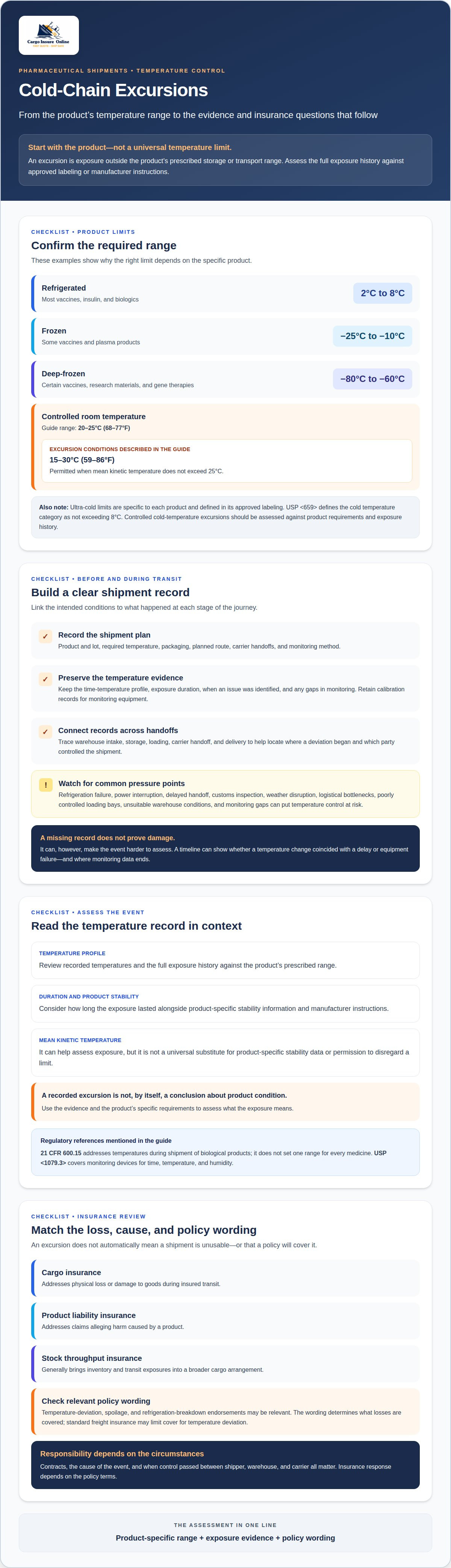
A pharmaceutical cold-chain excursion occurs when a time- and temperature-sensitive product experiences conditions outside its prescribed storage or transport range. That limit comes from the product’s approved labeling or manufacturer instructions, not from a universal temperature rule. Even a brief reading outside the target range needs to be assessed against the product’s full exposure history.
Common storage categories illustrate why product-specific limits matter. Most vaccines, insulin, and biologics are refrigerated at 2°C to 8°C. Some vaccines and plasma products use frozen conditions from -25°C to -10°C. Certain vaccines, research materials, and gene therapies require deep-frozen storage from -80°C to -60°C. Ultra-cold limits are specific to each product and defined in its approved labeling.
Controlled room-temperature products have a different profile. The guide’s controlled room-temperature range is 20-25°C (68-77°F). It permits an excursion between 15 and 30°C (59 and 86°F) when mean kinetic temperature does not exceed 25°C. Controlled cold-temperature excursions should be assessed against the product’s specific requirements and exposure history. USP <659> defines the cold temperature category as not exceeding 8°C.
Biological products also have a shipment-specific regulatory reference. U.S. regulation 21 CFR 600.15 addresses temperatures during shipment of biological products. It does not establish one temperature range for every medicine. For each shipment, the product’s approved labeling and manufacturer instructions remain central to setting the temperature range and evaluating a deviation.
Planning starts by matching shipment conditions to the product’s required range. Document the product and lot, required temperature, packaging, planned route, carrier handoffs, and monitoring method. These details link the intended conditions to the actual journey. Written response procedures also clarify what to do if a temperature alarm sounds or monitoring records are incomplete.
Monitoring records help show what happened in transit. Temperature sensors and data loggers can capture readings; gateways and automated alerts can flag a deviation. Records should preserve the time-temperature profile, when an issue was identified, and any gaps in monitoring. Pharmaceutical carriers should retain calibration records for monitoring equipment. USP General Chapter <1079.3> covers monitoring devices for time, temperature, and humidity.
Mean kinetic temperature can help assess exposure, but it is not a universal substitute for product-specific stability data or permission to disregard a limit. A useful assessment considers recorded temperatures and exposure duration alongside product instructions. Together, these details distinguish a recorded excursion from an evidence-based decision about the product’s condition.
Cold-chain problem points during storage and transit
Temperature control can fail at warehouse handoffs, during transit delays, or when refrigeration equipment breaks down. Supply-chain records help identify where a deviation began and which party controlled the shipment.
Storage and Transit Excursion Causes
A cold-chain excursion can follow refrigeration failure, a power interruption, a delayed handoff, or a shipment held during customs inspection. Weather disruptions and logistical bottlenecks can also extend transit and expose cargo to temperature fluctuations. The timing, duration, and location of each event help explain the temperature record.
Storage creates its own pressure points. A poorly controlled loading bay, unsuitable warehouse conditions, or a gap between monitoring records can obscure whether the product stayed within its required range. USP General Chapter <1079> covers risks and mitigation strategies for storing and transporting finished drug products. For investigational medicines, USP <1079.1> addresses storage and transportation risks.
A food-grade warehouse is not automatically suitable for pharmaceutical storage. Drug storage needs to match the product’s stated conditions, including temperature, humidity, and light. Under U.S. regulation 21 CFR 211.142, drug companies must have written warehousing procedures covering suitable storage conditions. That makes facility controls and operational records relevant, not just the temperature of the vehicle.
Useful records connect each distribution stage: warehouse intake, storage, loading, carrier handoff, and delivery. When an alarm or delay occurs, the timeline can show whether the product remained within required conditions, whether equipment failure coincided with a temperature change, and where monitoring data ends. A missing record does not prove damage, but it can make the event harder to assess.
Insurance for Transit and Storage
Cargo insurance addresses physical loss or damage to goods during insured transit, while product liability insurance addresses claims alleging harm caused by a product. Stock throughput insurance generally brings inventory and transit exposures into a broader cargo arrangement. For pharmaceuticals, policy wording on temperature deviation, spoilage, and refrigeration breakdown needs careful attention.
Who pays after an excursion depends on the contracts, the cause, and when control passed between the shipper, warehouse, and carrier. A carrier or shipper may bear financial responsibility if evidence links the loss to an obligation that party accepted. Insurance response depends on the policy terms.
Standard freight insurance may limit cover for temperature deviation, spoilage, regulatory seizure or destruction, and consequential losses from recalls. Some policies also exclude spoilage caused by transit delays or refrigeration-unit failures. The distinction matters: cover for cargo damage does not automatically extend to every business loss linked to a rejected shipment.
For a potential claim, records can connect policy questions to the event: temperature data, delay details, equipment reports, handoff times, and the product’s condition. Clear documentation helps establish what happened without treating a temperature alarm alone as proof of loss. Review the relevant cargo insurance wording alongside the shipment’s storage and transit arrangements.
Pharmaceutical cargo insurance endorsements
A cargo policy’s base wording and endorsements determine how a pharmaceutical loss is treated. An endorsement changes or adds policy terms, potentially addressing temperature deviation, resulting spoilage, or refrigeration and equipment breakdown. For an active ingredient shipment, the practical question is whether the cause of loss and resulting damage fall within the wording attached to that insured movement. Assessing pharmaceutical active ingredient cold chain excursion transit insurance starts with those terms, not the temperature alarm alone.
Temperature protection is not an automatic, all-purpose benefit. A temperature-deviation endorsement may address product damage after readings move outside the required range; a separate provision may address spoilage caused by refrigeration failure. The insurer’s assessment can depend on the event timeline, shipment temperature records, and policy conditions. A recorded alarm alone does not establish that the cargo suffered insured damage.
Exclusions vary by policy wording. Some policies exclude spoilage caused by transit delays or refrigeration-unit failures, and inadequate packaging can affect the response under applicable packing terms. Read a temperature endorsement alongside delay, machinery, and packing provisions rather than assuming it removes every exclusion. These details define the scope of pharmaceutical active ingredient cold chain excursion transit insurance for a particular shipment.
Other gaps can sit beyond the physical condition of the shipment. Standard freight insurance may not cover regulatory seizure or destruction, or consequential losses from a product recall. For example, an import delayed at customs could involve both a temperature event and a clearance issue; the policy’s delay wording and any relevant endorsement help determine whether resulting cargo damage falls within cover. ICC (A) 2009 Clause 4.5 is the delay exclusion relevant to losses arising from customs-clearance delay.
- Temperature deviation: The wording can define whether damage from an excursion is covered, and what records support the claim.
- Refrigeration breakdown: Check whether the endorsement addresses failure of the refrigeration unit and resulting spoilage.
- Delay and packaging: Review delay exclusions and packing terms against the shipment’s route, packaging, and event history.
- Recall and regulatory action: Distinguish physical cargo damage from recall costs or regulatory seizure and destruction.
Before transit begins, the manufacturer, shipper, and logistics parties can align shipment details with the insured terms. Relevant information includes the product, declared value, route, transport mode, required temperature conditions, and packaging arrangements. Whether the shipment moves by sea, air, or truck, the applicable policy should match the insured transit and its stated limits.
Claims documentation puts those terms into context. Preserve the temperature profile, carrier and warehouse handoff records, equipment reports, delay notices, packaging details, and communications about the affected lot. If a customs hold or refrigeration failure preceded the excursion, its timing may help distinguish the cause from the resulting loss. A clear assessment matches the policy wording to the evidence rather than assuming every temperature incident triggers the same cover.
Definition and scope of pharmaceutical cold-chain excursions
WHO defines a temperature excursion as exposure outside the prescribed storage or transport range for a time- and temperature-sensitive pharmaceutical product. The definition is product-specific: a reading qualifies as an excursion only when compared with the product’s required conditions. The same temperature may be acceptable for one medicine and outside the limits for another.
This distinction matters across pharmaceutical supply chains. Vaccines, biologics, monoclonal antibodies, insulin products, and controlled room-temperature medicines do not share one universal handling profile. Their approved labeling or manufacturer instructions set the relevant conditions. An active ingredient’s temperature history must therefore be assessed against its own requirements, not a general product category.
An excursion describes exposure, not necessarily a loss of product integrity. A temperature reading outside the stated range identifies an event, but does not by itself establish whether the medicine remains suitable for use. Assessment considers the complete time-temperature profile, cumulative exposure, and product-specific stability information. Mean Kinetic Temperature can support that review, but it cannot replace stability data or justify ignoring a temperature limit.
Regulatory requirements also extend beyond an individual shipment. Pharmaceutical cold-chain operations must account for Good Distribution Practice, WHO guidelines, and country-specific requirements. The FDA framework combines several requirements rather than relying on one dedicated cold-chain regulation. A shipment moving through several countries may therefore encounter different handling and recordkeeping expectations at different supply-chain stages.
For biological products in the United States, 21 CFR 600.15 addresses temperatures during shipment. Separately, 21 CFR 211.142 requires written warehousing procedures covering suitable conditions, including temperature, humidity, and light. These provisions address distinct parts of distribution. A transit reading cannot describe warehouse conditions, and warehouse records alone cannot establish what happened on the carrier’s route.
Some excursions can be assessed scientifically rather than treated as automatic product failure. Health Canada guidance allows brief temperature excursions when stability data and scientific or technical justification demonstrate that product quality is unaffected. The key is evidence: a documented assessment tied to the specific medicine and exposure, supported by relevant stability information.
For insurance, the definition identifies the event to investigate, not the policy outcome. Temperature records can show an excursion, while product assessment addresses potential quality impact. Policy wording then determines whether resulting physical damage falls within cover. Keeping these questions separate helps prevent a temperature alarm, a quality decision, and an insurance claim from being treated as the same conclusion.
How should a pharmaceutical shipment temperature excursion be detected, documented, and assessed?
A reliable assessment connects the temperature signal to the affected product, shipment timeline, and policy. Insurance professionals use monitoring records and supporting documents to establish what happened, identify possible damage, and compare the loss with the policy wording. A single alarm is a starting point, not a complete claim record.
Once a deviation is identified, quarantine the affected stock immediately. Record when the issue was detected, the shipment and lot involved, and who was notified. Preserve the complete time-temperature profile, including any gaps. Notify the insurer promptly and retain evidence before equipment data, packaging, or cargo condition changes.
Assessment then examines the exposure against product-specific evidence. The reviewer considers the highest or lowest temperature reached, duration, product type, packaging, previous exposure, and manufacturer guidance. Authorized quality or manufacturer advice helps assess whether the affected active ingredient’s stability may have changed. USP <1079.2> is relevant to Mean Kinetic Temperature assessment, but that calculation does not replace product stability data.
Read the monitoring file alongside the shipment documents. Useful records include:
- Temperature logger or sensor output, with timestamps and any missing intervals.
- Calibration records for the monitoring equipment and details of sensor placement.
- Shipping documents, route information, and warehouse or carrier handoff records.
- Delay notices, refrigeration or equipment reports, and communications about corrective action.
- Product identification, lot details, packaging information, and the resulting quality assessment.
Insurance professionals can use this evidence to link an excursion to a potential physical loss. For example, a logger may show when temperatures moved outside the required range, while a carrier report explains a refrigeration failure. Together, those records help distinguish the cause, duration, and affected shipment segment. The policy wording then determines whether the documented damage falls within insured cover.
Gaps matter. A missing logger interval does not establish the product’s condition during that period. Reviewers may compare available sensor readings with route events, handoff timestamps, equipment reports, and other records. If evidence conflicts, the timeline should show which sources support each conclusion. Keep original files and accurate copies so the sequence remains clear.
Assessment should separate three decisions: whether an excursion occurred, whether product quality was affected, and whether the policy responds to the resulting loss. A manufacturer’s stability advice informs the product-quality decision; policy terms govern the insurance response. Clear records make these separate evaluations easier to follow and support a more complete claim review.
Cargo Insure Online
Cargo Insure Online helps businesses arrange cargo insurance for pharmaceutical shipments moving by air, sea, or truck. The right cover depends on the route, declared shipment value, and risks addressed in the policy wording. Temperature records and product assessments explain what happened during an excursion; insurance terms determine how a covered cargo loss is handled.
Air Freight Insurance, Sea Freight Insurance, and Trucking Insurance address different transport modes. GAP Insurance may also be relevant when there is concern about a shortfall between the insured amount and the cargo’s value. These options help clarify how transit risks and financial exposure fit together, without treating every temperature deviation as automatically covered.
Contact Cargo Insure Online to discuss cargo insurance for a pharmaceutical shipment.
Make the next shipment easier to assess
Make the temperature-control plan part of practical shipment planning. Before cargo moves, align the route, handling arrangements, monitoring approach, and insurance terms with the product’s needs. This gives everyone involved a shared basis for responding to a disruption. Reviewing transit insurance for a pharmaceutical active ingredient cold-chain excursion can help connect the transport mode with the financial risks under consideration.
Cargo Insure Online offers Air Freight Insurance, Sea Freight Insurance, and Trucking Insurance for cargo moving through these transport modes. Discuss how the shipment and its transit risks fit the available cover. Clear questions about the route, cargo, and policy wording can make the conversation more focused.
Contact Cargo Insure Online to discuss cargo insurance for your pharmaceutical shipment. A clearer plan starts with the next conversation.
Frequently Asked Questions
Does Every Temperature Excursion Cause a Recall?
No. A temperature excursion does not automatically require a recall. Product quality depends on the medicine’s stability, exposure profile, and the manufacturer’s assessment. For example, a brief reading outside the stated range may be evaluated using stability data and scientific justification. A recall decision involves product quality and distribution considerations, while an excursion record alone establishes neither that the product is unsafe nor that it must be withdrawn.
How Long Should an Excursion Investigation Take?
There is no single investigation duration that applies to every shipment. The review depends on how quickly investigators can assemble the temperature profile, identify monitoring gaps, obtain product-specific stability information, and understand the shipment timeline. A logger file covering the full journey and clear carrier handoffs can support a more direct assessment than fragmented records. Quarantine the product and notify the insurer promptly while preserving the product and evidence.
What is a pharmaceutical cold chain temperature excursion during transit?
It is exposure during transport to conditions outside the product’s prescribed temperature range. For example, a refrigerated active ingredient may experience a deviation during a loading delay or vehicle refrigeration problem. The temperature record identifies when and how far conditions departed from requirements; product-specific stability information helps assess potential impact. An alarm is evidence of a temperature event, but does not alone establish product damage or an insurance outcome.
What temperature ranges and excursion limits apply to common pharmaceutical products?
Common refrigerated products, including most vaccines, insulin, and biologics, are listed at 2°C to 8°C. Some vaccines and plasma products use -25°C to -10°C, while certain vaccines, research materials, and gene therapies use -80°C to -60°C. Controlled room-temperature medicines may be maintained at 20-25°C. These categories are reference points, not substitutes for the individual product’s approved labeling and manufacturer instructions.
What do pharmaceutical transit insurance policies cover for temperature excursions and product spoilage?
Coverage depends on policy wording and applicable endorsements. Terms may address temperature deviation, resulting spoilage, or refrigeration equipment breakdown, while exclusions may apply to delay-related spoilage or inadequate packaging. A policy may treat physical damage differently from recall costs, regulatory seizure, or other consequential losses. A temperature reading outside the required range must be linked to covered damage under the policy terms before compensation is considered.
What information should shippers provide to support a professional temperature-excursion insurance claim?
Provide the shipment and lot identifiers, complete logger file, and time the issue was detected. Add route and handoff records, carrier reports, delay notices, packaging details, and refrigeration equipment information. Calibration records can help establish the monitoring device’s reliability. Include the product assessment and manufacturer or authorized quality advice, along with communications about quarantine and corrective action. Together, these materials help connect the event, product impact, and claimed loss.
How do professional packaging, monitoring, and routing practices reduce cold chain transit excursion risk?
Qualified packaging helps maintain required conditions during the planned journey, while temperature sensors and data loggers record conditions as the shipment moves. Route profiling can identify vulnerable handoffs, delays, or storage transitions before dispatch. Written response procedures clarify how teams should act on alarms. For air transport, packaging designed to maintain the required temperature beyond the expected transit time can provide additional resilience if a route disruption extends the journey.


