
Carrier liability is not the same as cargo protection. A supply chain executive’s risk assessment of uninsured freight liabilities starts by estimating the likelihood and financial impact of a loss, then comparing that exposure with what carrier liability may cover. The difference is the risk your business may still have to absorb.
It is easy to focus on a shipment’s value and overlook the costs of a delay or damaged delivery. Replacement costs, operational disruption, customer relationships, and carrier-liability limits all shape the real exposure.
This guide explains how to estimate cargo risk, assess threats to international shipments, and identify where carrier liability may leave a gap. It also shows how cargo insurance can fit into the picture, helping you make a clearer decision about protecting high-value freight.
Key Takeaways
- Estimate cargo exposure by weighing the likelihood of a loss against its financial and operational impact.
- Map risks across each transport leg, including weather, theft, political unrest, and documentation problems.
- Prioritize scenarios that could cause the greatest disruption, not just those affecting the shipment’s replacement value.
- Compare carrier liability limits with your actual exposure; carrier liability is not the same as cargo insurance.
- Match protection to the freight’s route and mode, and consider where a gap could leave your business absorbing a loss.
1. How should you estimate your cargo risks?
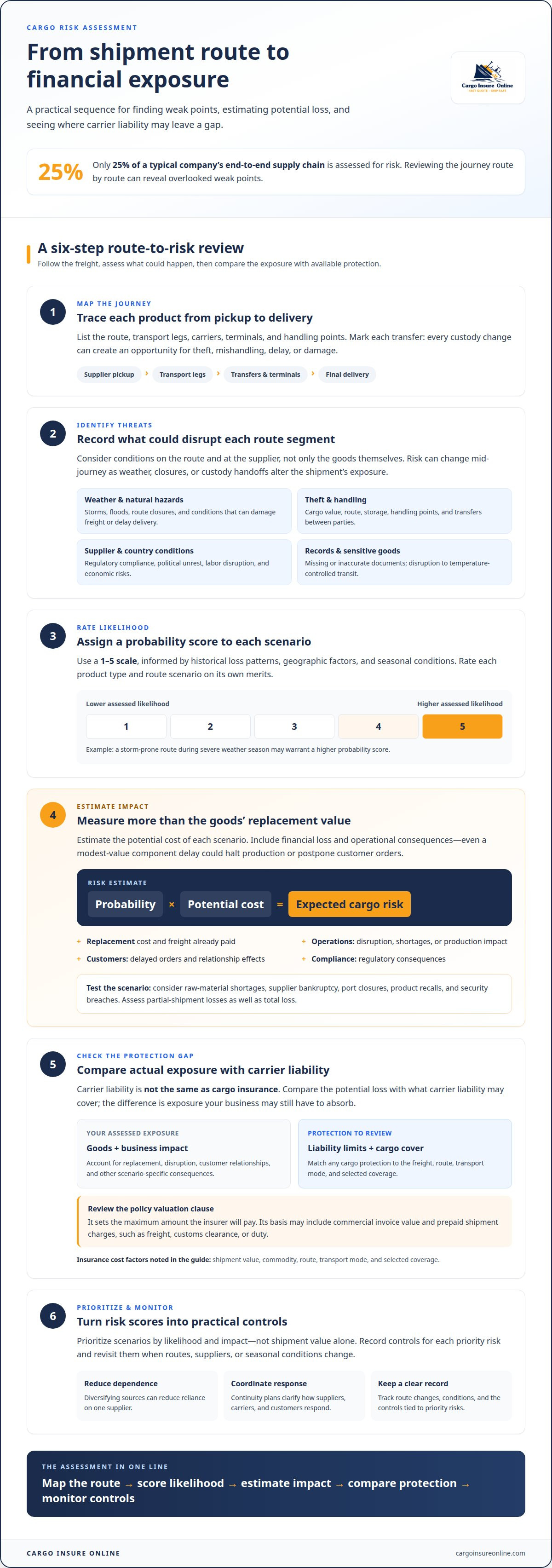
Start by mapping each product’s journey, from supplier pickup through final delivery. Supply chain risk management means identifying, analyzing, mitigating, and monitoring exposures. Only 25% of a typical company’s end-to-end supply chain is assessed for risk, so a route-by-route review can reveal overlooked weak points.
Estimate expected cargo risk by multiplying the probability of an event by its potential cost. Assign each product type a probability score on a 1-5 scale, using historical loss patterns, geographic factors, and seasonal conditions. For example, a shipment traveling through a storm-prone area during severe weather season may warrant a higher probability score.
Map weather risks across every leg of the journey. Storms, floods, and other natural hazards can damage freight, delay delivery, or close transport routes. For each scenario, record the affected goods, route segment, and likely operational consequences. A temperature-sensitive product, for example, may face physical damage and spoilage if disruption interrupts controlled transit.
Assess theft exposure based on cargo value, route, and handling points. High-value electronics may warrant a different risk rating from lower-value goods traveling along the same corridor. Include documentation risks, too: missing or inaccurate shipment records can complicate claims, disrupt handoffs, or delay cargo at a critical point in transit.
Review suppliers for regulatory compliance, country conditions, and economic and political risks. A supplier’s location may expose freight to political unrest, labor disruption, exchange-rate fluctuations, or sudden regulatory action. Also assess how suppliers treat employees, source materials, and work with partners. Health and safety problems in a supplier’s operations can create human, reputational, and business liabilities.
Prioritize scenarios by weighing likelihood against impact. Account for replacement costs, operational disruption, customer relationships, and regulatory consequences. A delayed component could halt production even if its individual value is modest. Consider disruptions such as raw-material shortages, supplier bankruptcy, port closures, product recalls, and security breaches.
For U.S. shippers, cargo insurance costs depend on the case and are given after a quote request. Factors include shipment value, commodity, route, transport mode, and selected coverage. A policy’s valuation clause sets the maximum amount the insurer will pay; its basis may include commercial invoice value and prepaid shipment charges such as freight, customs clearance, or duty.
Record controls for each priority risk and revisit them as routes, suppliers, and seasonal conditions change. Diversifying sources can reduce reliance on one supplier, while coordinated continuity plans clarify how suppliers, carriers, and customers respond to disruption. This turns a risk score into practical decisions about prevention and financial exposure.
2. Cargo risks during international transportation
An international shipment can pass through several carriers, terminals, and handling points before delivery. Each transfer creates an opportunity for theft, mishandling, delay, or damage. Risk can also change mid-route: a port closure may reroute cargo, while political unrest can interrupt road or rail connections and extend transit time.
Theft deserves a distinct place in the assessment. CargoNet reported that cargo theft increased by 13% in the second quarter of 2025, with losses exceeding $128 million during that quarter. High-value goods can be attractive targets, but ordinary freight can also be exposed during stops, handoffs, or storage. Map where custody changes and consider how a loss at each point would affect the shipment.
Physical damage can result from an accident, water exposure, poor handling, or conditions that harm sensitive goods. A reefer shipment, for example, may suffer loss if a delay disrupts the conditions needed to preserve its contents. The exposure extends beyond damaged freight: a delayed component can interrupt production, postpone customer orders, or force a replacement shipment.
Estimate potential losses by scenario, not just by invoice value. Include the cost of replacing goods, freight already paid, and the likely operational impact of a delay. Then consider how the loss changes if only part of the shipment is affected. This gives decision-makers a more useful picture than treating every disruption as a total loss.
Sea transport can also involve general average. If a voluntary sacrifice is made to protect a sea venture, stakeholders may be required to share the resulting loss. Cargo owners may therefore face financial exposure even when their own goods were not sacrificed. Include this possibility when reviewing ocean shipments and their insurance arrangements.
Strong claims management starts with a clear timeline. Record when the cargo was last known to be intact, where damage or shortage was identified, and which parties had custody at each stage. Preserve shipment records and evidence of the goods’ and packaging’s condition. Prompt, organized documentation helps establish what happened and supports assessment of the loss.
Separate the immediate response from the root-cause review. First, document the affected goods and limit further damage where practical. Then trace the route, handling transfers, and disruption that preceded the incident. The record can help reveal recurring vulnerabilities, such as a risky transfer point or a route that repeatedly exposes freight to delays.
For online orders moving through multiple transport legs, E-Commerce Cargo Insurance can be part of the financial protection plan. Match the protection to the goods and transportation journey, then review the remaining exposure alongside the response process.
4. Carrier liability limits under international laws and treaties
Carrier liability and cargo insurance address different risks. Liability concerns a carrier’s responsibility for loss or damage under applicable rules and contracts; cargo insurance separately protects the shipment owner’s financial interest. A carrier’s liability limit may leave a gap between the amount recoverable and the cargo’s actual value.
International transportation doesn’t follow one universal liability formula. Air cargo is subject to international conventions, while ocean cargo is governed by admiralty law. The Carriage of Goods by Seas Act limits carrier liability to $500. The relevant mode, route, and governing documents therefore matter when estimating what a carrier might owe.
For U.S. motor-carrier shipments, no single limit applies to every loss scenario. The amount at issue depends on the rules and contractual terms governing the shipment, including any agreed valuation terms. Review the bill of lading and transportation contract together, then compare their terms with the cargo’s value and potential loss.
State-specific rules and insurance requirements can affect freight operations, but they do not create one nationwide figure for every shipment. Identify the states involved in the route and the rules that apply to the carrier and movement. Distinguish required carrier insurance from protection for the goods themselves; one does not automatically establish the other.
A bill of lading records shipment details and may include terms relevant to liability. A transportation contract may set agreed conditions or valuation terms. Incoterms allocate certain responsibilities between buyer and seller, such as responsibility for arranging transportation at a point in the transaction. Together, these documents help show who bears exposure, but they do not make carrier liability equivalent to cargo insurance.
Uninsured freight losses can lead to disputes over responsibility, claims, and the financial amount each party must absorb. A lawsuit may follow when parties disagree about a carrier’s obligations or the value of damaged goods. A material loss or liability may also need to be reflected in the company’s accounting process. The outcome depends on the facts and governing terms, so preserve the contract, bill of lading, and loss records.
Use practical checks to identify gaps before a shipment moves. Compare the cargo’s declared value with contractual valuation terms, identify which party bears risk at each handoff, and map the route’s applicable legal framework. If an ocean shipment’s value exceeds the stated carrier limit, for example, the difference is potential uninsured exposure unless separate protection addresses it.
Review the analysis whenever the route, carrier, contract, or cargo value changes. A revised bill of lading or new delivery arrangement can shift the allocation of responsibility. This supply chain executive risk assessment turns complex liability terms into a clear comparison: potential loss, carrier responsibility, and the remaining exposure your business must manage.
5. Shipping vulnerabilities in high-value supply chains
High-value freight concentrates exposure in a small number of shipments. A truck carrying smartphones, a container of electronics, or a shipment of specialized equipment can create a large loss from one incident. The risk extends beyond theft: damage, delays, supplier failures, and gaps between cargo value and potential recovery can all affect the business.
Start with the shipment’s full financial role, not just its purchase price. A cargo policy may value goods at production cost rather than sale value, leaving a gap between those amounts. For finished electronics, that difference can matter if the sale price includes costs and value not reflected in production figures. Include freight and other relevant shipment charges in the exposure review.
Next, map the supply chain parties that handle the goods. Suppliers and subcontractors can create financial exposure for the shipper or recipient, particularly when their work causes damage for which another company may be liable. For example, a subcontractor handling packaging could affect product condition before the carrier receives the freight. Review each handoff and identify whose interests transit and logistics coverage protects.
High-value cargo also depends on the surrounding network. A single component shortage can delay a finished product, while a damaged shipment may disrupt customer commitments. For each critical product, record its replacement cost, operational role, and the effect of a delayed delivery. A small component with no ready substitute can cause more disruption than its invoice value suggests.
- Value gap: Compare the policy valuation basis with the shipment’s commercial value and relevant charges.
- Custody gap: Map each supplier, subcontractor, carrier, and recipient handling the goods.
- Coverage gap: Identify which parties and transit stages have protection, and where responsibility changes.
- Continuity gap: Note critical products that lack an alternate source or replacement route.
Carrier liability is not insurance. It concerns a carrier’s responsibility under applicable rules and agreements, while cargo insurance protects an insured financial interest under its policy terms. Shippers, carriers, and recipients should understand whether their own interests are protected during transit and logistics activities. This distinction matters when carrier limits do not match the value of a high-value shipment.
Finally, match protection to the actual exposure. Review the goods, route, handling points, valuation basis, and parties involved, then compare those details with the intended coverage. For electronics and other high-value devices, this focused review can reveal whether a loss would leave the business absorbing a costly gap. Assess the shipment as part of its full supply chain, not as an isolated box.
5. Who is legally liable for freight loss or damage under U.S. transportation law?
Responsibility for damaged freight depends on what happened, who handled the goods, and the duties attached to each party. A carrier, shipper, supplier, subcontractor, broker, or recipient may be part of the liability analysis. Start with the shipment timeline: identify when the goods were last known to be intact, when the loss appeared, and which party controlled each handoff.
Carrier responsibility is only one part of the picture. A transportation contract and bill of lading can record shipment terms, parties, and agreed responsibilities. If a shipment arrives damaged after changing hands, for example, records of its condition at pickup and delivery can help clarify where the damage occurred. These documents inform the review, but do not alone establish every party’s legal responsibility.
Supplier and subcontractor conduct can also create exposure. A corporation may be held liable for damage caused by supply-chain partners if it had a duty to prevent the damage and failed to do so. Consider a supplier’s unsafe handling that damages goods before carrier pickup. The carrier’s role may differ from the supplier’s, so the investigation should distinguish the location, cause, and timing of the damage.
Freight brokers face a separate issue when assigning a shipment to a carrier. Contingent cargo insurance covers freight brokers when they are liable for cargo loss involving a carrier to which they assigned the freight. This covers the broker’s liability; it should not be mistaken for the shipper’s own cargo protection.
For a clear liability review, assemble records that connect the goods, parties, and event:
- Shipment records: Keep the bill of lading, contract, shipment details, and cargo valuation together.
- Custody timeline: Record each handoff, including supplier, subcontractor, carrier, and recipient.
- Loss evidence: Document the condition of the goods when damage or shortage is discovered.
- Responsibility map: Note each party’s role and any relevant duty or contractual commitment.
These steps help separate legal responsibility from financial protection. Carrier liability is not insurance, and a business may still face a loss when another party’s responsibility is limited or disputed. Match potential exposure to the protection held by the shipper, carrier, and recipient, rather than assuming one party’s coverage protects everyone.
For shipments moving by air or sea, explore air freight and sea freight insurance as part of your cargo-protection review. The key is to understand who may be responsible, what the records show, and which financial exposure remains with your business.
Cargo Insure Online
Cargo Insure Online helps businesses address financial exposure from freight moving through international and domestic supply chains. When carrier liability limits fall short of shipment value, or responsibility shifts between parties, cargo insurance can provide a separate layer of protection, subject to the policy terms.
Air Freight Insurance, Sea Freight Insurance, Trucking Insurance, and GAP Insurance address different transportation needs and coverage gaps. The right fit depends on the shipment’s mode, value, route, and the exposure your business wants to manage. Reviewing those factors can connect your risk assessment to a practical insurance decision.
For a conversation about freight exposure and coverage options, contact Cargo Insure Online.
Turn your risk review into a clear next step
A supply chain executive’s risk assessment of uninsured freight liabilities is most useful when it leads to a decision: which exposures to transfer, manage operationally, or retain. Make that decision part of shipment planning, not a response after a loss. Revisit it when a route, supplier, product value, or transportation arrangement changes. This keeps protection aligned with how the business moves goods.
Cargo Insure Online offers Air Freight Insurance, Sea Freight Insurance, and Trucking Insurance. These options can help businesses consider protection across different freight modes as they evaluate their exposure and the limits of carrier liability. The next step is to discuss how your shipment profile and transportation needs fit into a coverage review.
Contact Cargo Insure Online to talk through your freight exposure. A focused review can help you move forward with greater clarity.
Frequently Asked Questions
How should you estimate your cargo risks?
Build an exposure record for each product and route, then update it when sourcing or delivery plans change. A supply chain executive’s risk assessment of uninsured freight liabilities works best when it captures a product’s role in the business, not just its purchase value. Record alternative supply options, likely delay consequences, and who bears responsibility at each handoff. This helps prioritize shipments that could interrupt operations.
Should I get insurance?
Consider cargo insurance when a potential financial loss would be difficult for your business to absorb, or when carrier liability may not match the shipment’s value. The decision depends on the goods, transport mode, route, and who carries the risk under the transaction terms. A business shipping high-value goods through several handlers may assess insurance differently from one shipping lower-value items on a familiar route.
What is supply chain liability?
Supply chain liability is potential legal or financial responsibility connected to harm or loss involving a company’s suppliers, subcontractors, logistics partners, or products. It can arise beyond the carrier’s custody. For example, a business partner’s unsafe handling may damage goods before pickup, while a company’s failure to prevent harm despite having a duty to do so may create further exposure. The facts, duties, and agreements shape each situation.
What freight liabilities can a supply chain executive face when cargo is uninsured or underinsured?
A supply chain executive’s risk assessment of uninsured freight liabilities should include potential customer and operational impacts. The business may need to absorb losses it cannot recover from a carrier or insurer, alongside disputes over contractual responsibility. A shipment shortfall, for example, could leave the company paying for replacement stock while managing delayed orders. The specific exposure depends on the parties’ roles, applicable terms, and circumstances of the loss.
How can companies quantify uninsured freight exposure and calculate potential losses?
Estimate the financial impact of a loss scenario, then account for its likelihood. Build the estimate from relevant components, such as replacing goods, transport already paid, operational interruption, and customer consequences. Next, compare the estimated loss with amounts potentially recoverable under applicable contracts or insurance. A partial shortage may create both a goods loss and additional fulfillment costs, so assess those impacts separately.
What steps should executives take after discovering an uninsured cargo loss?
First, protect people and cargo, and take reasonable steps to prevent further damage. Document the goods’ condition, shortage, packaging, location, and discovery time. Preserve shipment records, contracts, bills of lading, and communications with suppliers or carriers. Notify relevant parties and follow applicable policy or contract procedures. Then estimate the loss and record operational effects, such as delayed production or customer orders, for a clear internal review.
What limits apply to motor carrier liability for lost or damaged freight in the United States?
There is no single limit for every U.S. motor-carrier loss. The amount depends on the rules and contract terms governing the shipment, including any agreed valuation terms. Review the bill of lading and transportation contract against the cargo’s value and potential loss.
What state-specific rules or insurance requirements affect freight liability in the United States?
State-specific rules and insurance requirements can affect freight operations, so identify the states on the route and the rules that apply to the carrier and movement. Required carrier insurance does not automatically protect the goods themselves.


