
Does 110% mean 110% of the invoice, the contract price, or the CIF value? The answer matters when a shipment is damaged and the paperwork does not line up. The CIF contract 110 percent invoice valuation rule marine insurance buyers ask about sets a minimum insured amount, not a promise that every loss will be paid in full.
It is easy to assume the seller’s insurance obligation means the buyer is fully protected. Under Incoterms® 2020, the seller arranges insurance for the buyer’s benefit for at least 110% of the contract price, in the contract currency. CIF’s minimum cover is limited, and the policy terms, exclusions, and deductible affect how a claim is assessed.
This guide explains how to check the calculation against your contract, invoice, and insurance evidence, and what to confirm about the coverage. You will also see where the seller’s insurance obligation ends and the buyer’s risk begins, plus when broader cover may be worth considering.
Key Takeaways
- The CIF contract 110 percent invoice valuation rule marine insurance sets a minimum insured amount, but the sale contract determines the valuation basis.
- Use the agreed contract price as the calculation base, then check that the 110% amount and currency on the insurance documents match the contract.
- Verify the insured party, shipment details, route, dates, amount, and currency before the goods ship.
- Do not treat the insured amount as a guaranteed payout. Coverage depends on the policy, cause of loss, exclusions, deductibles, and claim assessment.
- Compare the policy’s scope with your cargo’s value and risks to decide whether CIF’s minimum is enough or additional cover is worth exploring.
What does the CIF 110% marine insurance rule require?
CIF means Cost, Insurance and Freight. Under this Incoterm, the seller arranges and pays for carriage and insurance to the named destination port. CIF is intended for sea and inland waterway transport. The sale contract should identify the named port and state which edition of the Incoterms rules applies. For background, see the Incoterms 2020 rules, including the CIF provisions.
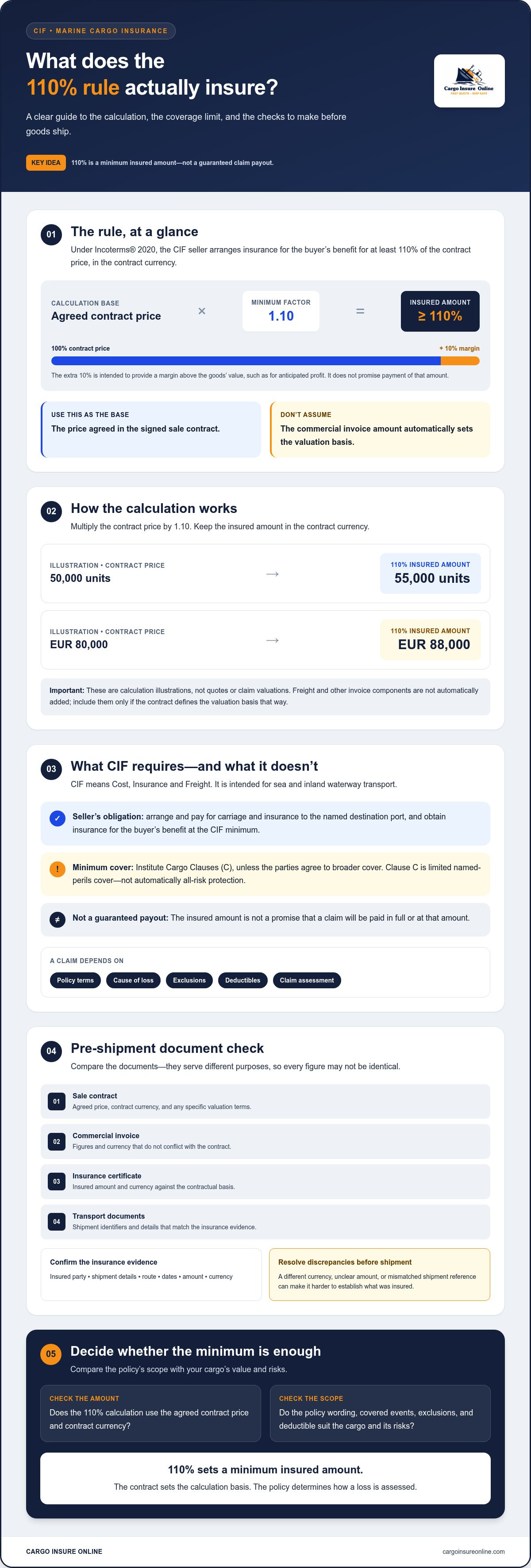
Under Incoterms® 2020, the seller must obtain insurance for the buyer’s benefit for at least 110% of the contract price, expressed in the contract currency. This is a minimum insured amount, not a promise that the buyer will receive that amount after a claim. Check the signed sale contract and insurance documents to confirm the applicable terms and shipment details.
Is 110% based on the invoice or the CIF contract price?
The contractual basis is the contract price, not automatically the figure on the commercial invoice. The amounts may differ because of adjustments, credits, separate charges, or the way the transaction documents present the sale. Confirm the agreed price in the signed contract, then check that the insured amount and currency shown on the insurance evidence match the contractual terms.
For example, if the contract price is stated as 50,000 units of the contract currency, 110% would be 55,000 units. This is a simple illustration, not a substitute for checking the wording of your contract and policy.
What does the seller have to arrange under CIF?
The seller must procure insurance that meets CIF’s minimum and enables the buyer, or another party with an insurable interest, to claim directly under the policy. Incoterms® 2020 sets the minimum level at Institute Cargo Clauses (C), unless the parties agree to broader cover. Clause C is limited named-perils cover, so it is not automatically equivalent to all-risk protection. The policy wording determines which events are covered and which exclusions or conditions apply.
Under CIF Incoterms® 2020, the seller must arrange insurance for the buyer’s benefit for at least 110% of the contract price, expressed in the contract currency.
Before shipment, compare the agreed price, insured amount, currency, insured party, and policy terms. If a detail is unclear or the minimum cover appears too narrow for the cargo, resolve the issue in the contract or with the insurer before the goods move.
How to calculate the CIF 110% insured amount
Start with the contract price specified in the sale agreement, then multiply it by 1.10. The calculation is straightforward, but the base matters: an invoice may include amounts that are not part of the agreed contract price, or the contract may define a different valuation basis. Check the CIF contract 110 percent invoice valuation rule marine insurance against the wording of your transaction rather than applying 110% to an invoice by default.
A simple example of the 110% calculation
Illustrative example only, not a quote or claim valuation: If a contract sets the price at EUR 80,000, the calculation is EUR 80,000 × 1.10 = EUR 88,000. The insured amount is expressed in the contract currency, so this example stays in euros. The calculation is exact, with no rounding needed.
This example assumes the contract price is the agreed base. Freight or other invoice components are not automatically added to it. Include them only if the contract defines the valuation basis that way. The extra 10% is intended to provide a margin above the goods’ value, such as for anticipated profit. It does not guarantee that a claim will be paid at the insured amount. Freight180 also explains the rationale behind 110% of the CIF Value.
Which documents should match?
Before shipment, compare the sale contract, commercial invoice, insurance certificate, and transport documents. They serve different purposes, so every figure may not be identical. Check that the insured amount and currency meet the valuation requirement in the contract, and that the documents clearly refer to the same shipment.
- Sale contract: Confirm the agreed price, currency, and any specific valuation terms.
- Commercial invoice: Check that its figures and currency do not conflict with the contract.
- Insurance certificate: Verify the insured amount and currency against the contractual basis.
- Transport documents: Match shipment identifiers and details to the insurance evidence.
Do not dismiss discrepancies as harmless. A different currency, unclear amount, or mismatched shipment reference can make it harder to establish what was insured. Ask the seller or insurer to explain any difference before the goods ship, and keep the relevant documents together.
If you are comparing protection beyond the CIF minimum, review Sea Freight Insurance options alongside your cargo and policy needs.
Does 110% CIF insurance guarantee full compensation?
No. The 110% figure is an insured amount, not a guaranteed claim payment. It sets a minimum amount of insurance under the applicable CIF rule, but it does not determine whether a particular loss is covered or how much an insurer will pay. The CIF contract 110 percent invoice valuation rule marine insurance addresses the value insured, while the policy wording sets the coverage terms.
An insured value sets the amount for which cargo is insured; compensation depends on the covered loss and the policy’s terms.
What the 110% figure does, and doesn’t, mean
Think of a claim as a series of checks, not an automatic payout of the stated insured amount. The insurer assesses whether the reported event is covered, the loss sustained, and the evidence provided. Exclusions, deductibles, policy limits, and other conditions may affect the result. A total loss and a partial loss will not necessarily produce the same payment, even when the shipments have the same insured value.
Keep these three figures and concepts separate:
| Item | What it tells you |
|---|---|
| Insured amount | The value declared or limit arranged for the shipment, subject to the policy. |
| Scope of cover | The events and circumstances insured, as defined by the policy clauses and exclusions. |
| Claim payment | The amount assessed for an eligible loss under the policy, including applicable deductibles and conditions. |
Minimum CIF cover versus broader cargo protection
Under Incoterms® 2020, CIF’s minimum is generally Institute Cargo Clauses (C), a named-perils level of cover. This does not mean every cause of damage or loss is insured. Theft, rough handling, or temperature damage, for example, may not be covered unless the circumstances fall within a specified insured peril. The policy wording decides, so do not rely on the label alone.
Broader cover may suit a shipment with risks the minimum does not address. Compare the actual clauses, exclusions, and conditions rather than assuming “all risks” means every possible loss is covered. If the minimum does not fit the goods, route, or risk tolerance, ask whether additional protection is appropriate before shipment.
Before relying on CIF insurance, read the policy wording and confirm how to notify a loss, what evidence is required, and how the insurer handles claims. If a loss occurs, follow the stated claims process and keep relevant records. The 110% amount is a starting point for understanding the insurance, not a prediction of the outcome.
How to check CIF insurance before the goods ship
A certificate of insurance is a useful snapshot, but it may not include every term that affects a claim. Review it alongside the policy wording and your sale and transport documents. The CIF contract 110 percent invoice valuation rule marine insurance requirement is only one part of the check. The paperwork should also identify the right cargo, journey, insured party, and coverage terms.
A practical CIF insurance document checklist
Before shipment, compare the insurance evidence with the transaction documents. Check that they describe the same goods and movement, and that the insured amount reflects the valuation basis agreed in the sale contract.
- Insured party: Confirm the buyer or other intended beneficiary is named or otherwise able to claim under the policy. Ask how the buyer can access the full policy wording.
- Cargo description: Match the goods, quantity, and identifying details against the invoice and transport documents. Flag descriptions that are too broad or do not reflect the shipment.
- Route and dates: Check the origin, destination, relevant ports, and shipment dates against the agreed journey and transport records.
- Amount and currency: Compare the insured amount and currency with the contract’s 110% requirement. Ask for clarification if the basis or calculation is not clear.
- Terms and claims process: Review the stated cover clauses, exclusions, and deductible in the policy documents. Record where and how to report a claim, along with any required contact details or notice steps.
Do not treat missing or inconsistent details as harmless paperwork issues. Ask the seller for the certificate or other evidence of insurance, and request clarification from the seller or insurer before the goods ship. Keep written confirmation with the transaction records.
When should the buyer request clarification or broader cover?
Request clarification if it is unclear who is insured, how to access the applicable policy terms, or whether an exclusion could affect the shipment. Then compare the cover with the goods and route. For high-value electronics, for example, check whether the policy wording addresses risks relevant to those items rather than relying on the insured amount alone. A sea freight insurance guide can also help frame a broader review of marine cargo protection.
If the stated cover does not appear to fit your shipment, discuss the gap before dispatch and ask whether additional protection is appropriate. To explore options, compare sea freight insurance against your cargo and coverage needs.
What to do when CIF’s 110% minimum is not enough
CIF sets a baseline, not a custom-fit answer for every shipment. Consider whether the insured amount and policy terms suit your cargo’s value, journey, and risk tolerance. High-value goods, costly replacement logistics, or a letter of credit that calls for a higher amount may justify a closer review. Treat the CIF contract 110 percent invoice valuation rule marine insurance as a starting point for that review, not the finish line.
A simple decision path for importers
First, confirm the contract’s valuation basis and minimum insured amount. Next, read the policy wording to identify covered risks, exclusions, deductibles, and claim requirements. Consider whether a gap could leave your business carrying a loss it cannot comfortably absorb. If the amount or policy scope does not align with the shipment, ask the seller or insurer for clarification before dispatch.
Keep the checks in order:
- Value: Does the insured amount meet the contractual requirement and any higher amount specified elsewhere in the transaction documents?
- Risks: Do the policy’s covered events and exclusions fit the goods, route, and handling needs?
- Claims: Are the notice steps, required records, and claims contact clear?
Explore marine cargo protection beyond the minimum
If material gaps remain, discuss additional cover with a qualified insurance provider and compare the actual terms, not just the headline insured amount. Ask what risks are covered, which exclusions apply, how deductibles work, whether the shipment’s full route is addressed, and what evidence is needed to make a claim. Do not assume a policy covers every loss or guarantees reimbursement. The applicable wording and claim assessment matter.
Cargo Insure Online offers Sea Freight Insurance to explore, though suitability depends on your shipment and the applicable policy terms. Use the questions above to compare your needs with the coverage available, then explore sea freight insurance options for your shipment.
Check the Details Before Your Shipment Moves
The CIF contract 110 percent invoice valuation rule marine insurance sets a minimum insured amount, but the amount alone does not tell you what a claim will pay. Confirm the valuation basis in your sale contract, then check that the insurance evidence matches the shipment, insured party, amount, and currency.
Next, read the policy wording. Cover clauses, exclusions, deductibles, and claim requirements all shape how protection works. If CIF’s minimum leaves a gap for your cargo or risk tolerance, ask about suitable additional cover before shipment rather than assuming the standard arrangement is enough.
Cargo Insure Online offers Sea Freight Insurance and cargo insurance for sea, air, and land transport. Explore the available information and compare it with your shipment’s needs through sea freight insurance options. Check the documents and policy terms before your shipment moves, then explore coverage options for your cargo.
Frequently Asked Questions
Does CIF require insurance for 110% of the invoice value?
Not necessarily. Under Incoterms® 2020, CIF requires the seller to arrange insurance for at least 110% of the contract price, expressed in the contract currency, for the buyer’s benefit. The commercial invoice may show that price, but do not assume its value is automatically the contractual basis if the figures differ. Check the signed sale contract and insurance evidence. The CIF contract 110 percent invoice valuation rule marine insurance depends on the agreed transaction terms.
How do you calculate 110% insurance under a CIF contract?
Multiply the contract price by 1.10, using the currency specified in the contract. For example, an illustrative contract price of £20,000 gives a minimum insured amount of £22,000. Use the agreed contractual valuation basis rather than automatically adding every charge shown on an invoice. Check the insurance certificate or other policy evidence to confirm the insured amount matches the contract requirement, and ask for clarification if the calculation basis is unclear.
Does CIF insurance cover the full value of the goods?
Not automatically. The 110% figure is the minimum insured amount, but it does not guarantee payment of that amount or mean every type of loss is covered. A claim depends on whether the cause of loss is insured, the loss assessment, exclusions, deductibles, and other policy conditions. Read the policy wording to understand the actual protection. The amount insured and the amount payable after a claim are separate things.
Who arranges and pays for insurance under CIF?
Under CIF, the seller arranges and pays for the required insurance for the buyer’s benefit, subject to the sale contract and applicable Incoterms rules. The buyer should still review the insurance evidence and policy wording, including who is insured, the insured amount, and how to access the claims process. The seller’s duty to arrange insurance does not by itself mean the buyer has broad protection against every loss.
Does CIF transfer risk when the goods reach the destination port?
No. Under CIF, risk generally transfers from seller to buyer when the goods are loaded on board the vessel at the port of shipment, not when they arrive at the destination port. The seller arranges and pays for carriage and insurance to the named destination, but that does not mean the seller bears transit risk for the entire journey. Check the sale contract and applicable Incoterms edition for the agreed delivery details.
Is CIF insurance the same as all-risk marine cargo insurance?
No. CIF’s minimum insurance under Incoterms® 2020 is generally Institute Cargo Clauses (C), which covers specified named perils. It is not automatically equivalent to broader “all-risks” cover, and policy wording can contain exclusions and conditions. The parties can agree to broader protection, but confirm the clauses in the contract and policy rather than relying on a label. Review the cover against the cargo and route before shipment.
What documents should I check for CIF marine insurance?
Compare the signed sale contract, commercial invoice, insurance certificate or other insurance evidence, and transport documents. Check the insured party, cargo description, route, shipment dates, insured amount, and currency. Then review the policy wording for cover clauses, exclusions, deductibles, and claim-reporting instructions. If documents are missing, inconsistent, or unclear, ask the seller or insurer to explain and resolve discrepancies before the goods ship.


