

Can a clean signature really erase damage you couldn’t see at delivery? If you’re searching for “clean bill of lading signed with concealed cargo damage dispute,” you may be worried that the paperwork has already decided the outcome. It hasn’t. A clean bill of lading records the shipment’s apparent condition when received. It doesn’t automatically prove that concealed damage wasn’t present.
A clean delivery record can still make a claim harder to support. That matters when damage appears only after unpacking and you’re unsure what to photograph, whom to notify, or how much time you have.
This guide explains what the signature does and doesn’t establish, then walks through practical steps to document the damage, preserve packaging, and give prompt written notice. It also explains why carrier claims and cargo insurance claims follow different paths, which parties may need to hear from you, and why deadlines depend on the shipment and applicable rules. A clean receipt isn’t the end of the conversation. Clear evidence and timely action can help you decide what to do next.
Key Takeaways
- A clean receipt records apparent condition, not necessarily the condition inside sealed or unopened packaging.
- For a clean bill of lading signed with concealed cargo damage dispute, build a clear record with photos and shipment documents, and keep all packaging and materials available.
- Carrier claims and cargo insurance claims are separate paths. Check the relevant transport documents and policy wording before deciding where to submit a claim.
- Follow a simple workflow: record what you found, send written notice promptly, submit the required evidence, and track each response and deadline.
- For future shipments, strengthen inspection and packaging records, then review insurance options based on the cargo and transport mode. Don’t assume a particular loss will be covered.
What a clean bill of lading means in a concealed cargo damage dispute
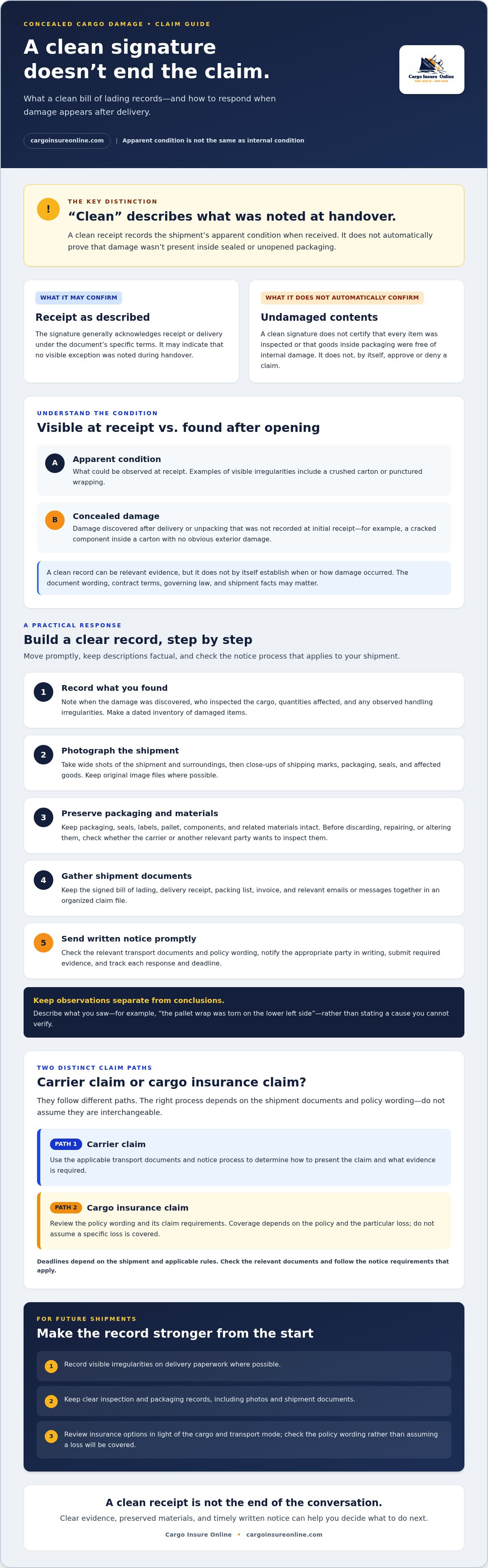
A clean bill of lading is a transport receipt with no recorded exceptions about the shipment’s apparent condition when it was received. “Clean” describes what was noted on the document at that point. It doesn’t certify that every item inside was inspected or that the cargo was free of internal damage.
A Bill of lading can serve as a receipt, evidence of the carriage contract, and, in some contexts, a document of title. Which function matters in a dispute depends on the document and shipment. The wording, governing law, contract terms, and facts all count. A clean signature doesn’t automatically approve or deny a claim.
What does signing a clean bill of lading confirm?
The signature generally acknowledges receipt or delivery as described by the document’s specific terms. It may indicate that no visible exception was noted during handover. That’s different from confirming the internal condition of goods that couldn’t reasonably be seen without opening the packaging.
Visible damage, such as a crushed carton or punctured wrapping, can be recorded at receipt. A sealed box may look intact even though its contents haven’t been seen. A clean record can therefore be relevant evidence, but it doesn’t by itself establish when or how damage occurred. If you’re dealing with a clean bill of lading signed with concealed cargo damage dispute, focus on the full shipment record, not the signature alone.
What counts as concealed cargo damage?
Concealed cargo damage is damage discovered after delivery or unpacking that wasn’t recorded when the shipment was initially received. For example, a carton may arrive with no obvious exterior damage, but inspection reveals a cracked component inside. The problem only becomes visible once the packaging is opened.
The gap between handover and discovery can make the cause harder to establish. Packaging may show impact, compression, moisture, or signs of disturbance. Handling records and the timing of inspection can help clarify what happened and when, though no single detail proves the full account.
- At handover: Record visible irregularities on the delivery paperwork, where possible.
- After opening: Photograph the cargo, packaging, labels, and damage, and keep the materials intact.
- As soon as damage is found: Note when and how the inspection took place, then check the relevant document and applicable notice requirements.
The distinction is straightforward: apparent condition is what could be observed at receipt; concealed condition may only become clear later. Your next step is to build a careful record linking delivery, packaging, inspection, and discovery of the damage.
How to document concealed damage after signing a clean bill of lading
Move quickly, but keep your record factual. In a clean bill of lading signed with concealed cargo damage dispute, clear evidence can help show what arrived, what was damaged, and when the damage was discovered. A bill of lading can carry legal significance; Cornell Law School’s Legal Information Institute describes it as a legal instrument. Read the document and related contract terms closely, and follow the notice process that applies to your shipment.
What evidence should you preserve?
Start an organized claim file as soon as you find damage. Before discarding, repairing, or altering shipment materials, check whether the carrier or another relevant party wants to inspect them. Keep the packaging, seals, labels, pallet, and any components or materials associated with the damage.
- Photograph the scene: Take wide shots showing the shipment and its surroundings, then close-ups of shipping marks, packaging, seals, and affected goods. Keep original image files where possible.
- Gather shipment records: Save the signed bill of lading, delivery receipt, packing list, invoice, and relevant emails or messages together.
- Write an inspection note: Record the discovery date, who inspected the cargo, quantities affected, and any observed handling irregularities. Create a dated inventory identifying each damaged item.
Separate what you observed from what you suspect. “The pallet wrap was torn on the lower left side” is a factual description. “The carrier dropped the pallet” is a conclusion unless you have evidence to support it. This distinction keeps your report precise and credible.
Who should receive notice, and when?
Notify the carrier and other relevant shipping parties promptly, using the contact method and process stated in the governing documents. Identify the shipment, describe the damage, state when you discovered it, and ask for written instructions about an inspection. Where practical, wait for those instructions before disposing of packaging or arranging repairs. Keep copies of notices and replies.
Deadlines vary by transport mode, contract, and applicable law, so don’t rely on one timeline for every shipment. For U.S. trucking, written notice of concealed damage is required within five business days of discovery. That is separate from the formal freight claim deadline, which must be at least nine months from delivery. Other shipments may follow different rules. Check the relevant documents promptly, and get qualified legal guidance if the deadline or applicable rules are unclear.
Once the immediate record is secure, consider reviewing cargo insurance for future shipments. Explore cargo insurance options and check the actual policy wording for terms relevant to your cargo and shipping mode.
Carrier claim or cargo insurance claim: compare the two paths
A carrier claim and an insurance claim ask different questions. The carrier route considers whether the carrier is responsible under the transport contract and applicable rules. The insurance route considers whether the shipment and loss fall within the policy’s terms. A clean bill of lading signed with concealed cargo damage dispute may involve both assessments, but neither route guarantees recovery.
Use this comparison to identify the documents and evidence each party may need. Requirements vary, so follow the specific claim instructions and notify relevant parties promptly where appropriate.
| Point to compare | Carrier claim | Cargo insurance claim |
|---|---|---|
| Who receives it? | The carrier identified in the transport documents, following its stated claim process. | The insurer or claims contact named in the policy, using the policy’s reporting process. |
| What governs? | The bill of lading, transport contract, route, mode, and applicable legal regime. | The policy wording, including its insuring agreement, exclusions, duties, and claim procedures. |
| What evidence matters? | Delivery and transport records, damage documentation, and evidence relevant to the shipment’s condition and handling. | Policy and shipment records, proof of the loss, and information required for the insurer’s review. |
| What may recovery depend on? | Whether responsibility is established, subject to applicable limits, defenses, and terms. | Whether the loss meets the policy’s coverage terms, subject to exclusions and other conditions. |
What determines a carrier’s responsibility?
Start with the transport contract and bill of lading terms, then confirm the shipment’s mode and route. Rules such as the Carmack Amendment for certain U.S. interstate trucking shipments or COGSA for certain U.S. ocean shipments may apply, but not to every movement. The relevant jurisdiction, legal regime, liability limits, and defenses depend on the facts and documents. Ask qualified counsel to assess legal questions specific to the shipment.
What determines whether insurance may respond?
Read the actual policy, not just a summary. Check the insuring agreement, relevant exclusions, notice duties, and claim-submission instructions. The insurer will assess the facts, documentation, and policy wording. Don’t assume concealed damage is covered. For a broader explanation of how the paths differ, see a guide to carrier liability versus cargo insurance.
Keep the two files distinct, even if you notify both parties. A carrier’s position doesn’t decide the insurer’s coverage assessment, and an insurance review doesn’t establish carrier responsibility. Track each notice, request, and response separately. If a policy or contract sets a specific process, follow it and ask the appropriate claims contact or qualified adviser for clarification when needed.
A practical concealed-damage dispute workflow for shippers and consignees
A clear sequence keeps a damage dispute moving and reduces the chance that key records get lost. In a clean bill of lading signed with concealed cargo damage dispute, track each event from delivery to follow-up. Use the shipment documents to confirm who must be notified, how, and by when. Don’t wait for the cause or repair cost to be confirmed before checking notice requirements.
What should a first notice include?
Send a factual written notice to the carrier and any other party identified in the contract or policy process. Include the shipment reference, delivery date, affected items, observed damage, and date of discovery. Attach initial photos if available. Ask for written instructions about inspection and claim submission, then retain the sent message and any acknowledgment.
Keep the wording precise. Describe what you saw, not what you assume happened. For example, state that a component was cracked when unpacked rather than asserting where or when the crack occurred without supporting evidence.
How should you prepare a claim file?
Build one organized file for each shipment. Add transport documents, invoices and packing records, inspection notes, photographs, notices, and replies. Keep confirmed facts separate from estimates or unanswered questions about cause. A dated timeline makes the sequence easy to review:
- Delivery: Record the date and any observations made at receipt.
- Unpacking and discovery: Note when inspection began, who took part, and when damage was found.
- Notice and submission: Log the recipients, transmission dates, documents sent, and any instructions received.
- Follow-up: Record requests, inspections, responses, and the next action or deadline stated by the relevant party.
Before sending a formal claim, compare the file with the carrier’s submission instructions and the policy’s claim procedures, if you’re also notifying an insurer. Requirements can differ by transport mode and document. For mode-specific context, consult relevant air, sea, or trucking insurance guidance, then verify the actual contract and policy terms for your shipment.
If the parties dispute the applicable law, liability, or cause of damage, or if an inspection requires specialized assessment, involve qualified legal or technical professionals. A checklist alone can’t resolve those questions.
Planning future shipments? Review cargo insurance options for your shipments, and confirm current availability and policy wording before relying on any coverage.
Reduce future shipment risk with clear records and cargo insurance review
Good preparation won’t prevent every loss, but it can make a later investigation clearer. Consistent records help connect the cargo’s condition before dispatch with what happened at handoffs and what was observed at delivery. They also give you a stronger starting point if a clean bill of lading signed with concealed cargo damage dispute arises.
Which shipment records help prevent disputes?
Build a repeatable process for each shipment. Photograph goods before packing and loading, record how they’re secured, and document seal numbers or other identifiers where used. Set packaging standards for the cargo, and keep records of who loaded, sealed, or inspected it. At handoffs and delivery, note visible irregularities and retain the relevant receipts and shipment documents.
Make inspection practical, too. Tell receiving staff what to check, who should record findings, and how to escalate an exception. For mode-specific context, review an appropriate air freight, sea freight, or trucking insurance guide, then confirm requirements in the actual shipment and policy documents.
How can cargo insurance fit into a risk plan?
Consider the transport mode and the goods together. Air, sea, and trucking shipments can involve different documents and claim procedures, while cargo value can help frame the level of risk you’re assessing. Cargo Insure Online offers Air Freight Insurance, Sea Freight Insurance, and Trucking Insurance options to evaluate against shipment needs. Confirm availability and terms before relying on any coverage.
Review the policy wording, not just a product description. Check which causes of loss may be covered, what exclusions apply, how cargo value is assessed, and what notice and claim steps are required. Ask how the wording applies to the specific goods and journey. A policy is a separate risk-management tool, not a guarantee that a concealed-damage loss will be covered or paid.
Before your next shipment, pair a clear documentation routine with a careful coverage review. Explore Cargo Insure Online’s cargo insurance options and confirm the current policy terms fit your shipment before making a decision.
Make your next shipment easier to protect
A clean bill of lading records apparent condition at handover. It doesn’t automatically prove that goods were free of hidden damage or decide a claim on its own. If you’re facing a clean bill of lading signed with concealed cargo damage dispute, preserve the evidence, notify the relevant parties promptly, and check the specific documents and deadlines that apply.
Keep carrier responsibility and insurance coverage as separate questions. A well-organized timeline, clear photographs, delivery records, and careful notes can help make the facts easier to assess. For future shipments, build consistent inspection and packaging records, then review insurance terms against the cargo and transport mode.
Cargo Insure Online offers insurance options for air, sea, and trucking freight, as well as specialized cargo such as high-value electronics. Coverage depends on the applicable policy wording, so review the terms before relying on any protection. Explore cargo insurance options for your next shipment and take a more prepared approach to the journey ahead.
Frequently Asked Questions
Does a clean bill of lading prevent a concealed damage claim?
No. A clean bill of lading records that no exception to the cargo’s apparent condition was noted at receipt; it doesn’t confirm that unseen contents were damage-free. A clean bill of lading signed with concealed cargo damage dispute may make the evidence more important, since you may need to show when damage was discovered and support how it relates to the shipment. The document’s wording, contract terms, and applicable law also matter.
Can you dispute cargo damage after signing a clean delivery receipt?
Yes, a clean delivery receipt doesn’t automatically eliminate the possibility of disputing concealed damage. The outcome depends on the shipment documents, applicable rules, facts, and evidence. Record when you unpacked or inspected the goods, photograph the damage and packaging, and preserve shipment materials. Then review the required notice and claim process. A signature is relevant to the record, but it doesn’t by itself decide whether the carrier is responsible or insurance may respond.
What should I do first when I discover concealed freight damage?
Document the condition before moving, repairing, or discarding anything, if it’s safe and practical to do so. Photograph the goods, packaging, labels, seals, and pallet. Note the date of discovery, affected items, quantities, and who inspected them. Preserve the materials, then promptly check the transport documents and policy for notice instructions. Send factual written notice to the appropriate parties and keep copies of everything you send and receive.
How long do I have to report concealed cargo damage?
There isn’t one deadline for every shipment. For U.S. trucking, written notice of concealed damage must be given to the carrier within five business days of discovery. That’s separate from the formal freight claim deadline, which must be at least nine months from delivery. Ocean shipments and other routes can follow different rules. Check the governing documents and applicable law promptly, and don’t treat a notice period as the formal claim deadline.
Does cargo insurance cover damage found after delivery?
It may, but coverage isn’t automatic just because damage is discovered after delivery. The insurer assesses the loss against the actual policy wording, including covered causes, exclusions, notice duties, and claim requirements. The shipment’s facts and supporting evidence matter too. Report the damage according to the policy process and ask the insurer or claims contact what documentation is needed. Don’t assume concealed damage is covered until the applicable terms have been reviewed.
Should I contact the carrier or my cargo insurer first?
Check the transport documents and policy, then notify the carrier and insurer promptly where appropriate. Their reviews are separate: the carrier considers responsibility under transport terms and applicable rules, while the insurer assesses the loss under the policy. Each may have different notice procedures and documentation requirements. Keep separate records of notices, requests, and responses, and don’t wait for one party’s decision if that could put another applicable deadline at risk.
What evidence is needed for a concealed cargo damage claim?
Gather clear wide and close-up photos of the cargo, damage, packaging, shipping labels, seals, and pallet. Keep the signed bill of lading, delivery receipt, packing list, invoice, and relevant correspondence. Add a dated inventory of affected goods and inspection notes identifying when damage was discovered and who inspected the shipment. Preserve packaging for possible inspection. Describe observed facts separately from estimates or assumptions about when, where, or how the damage occurred.


