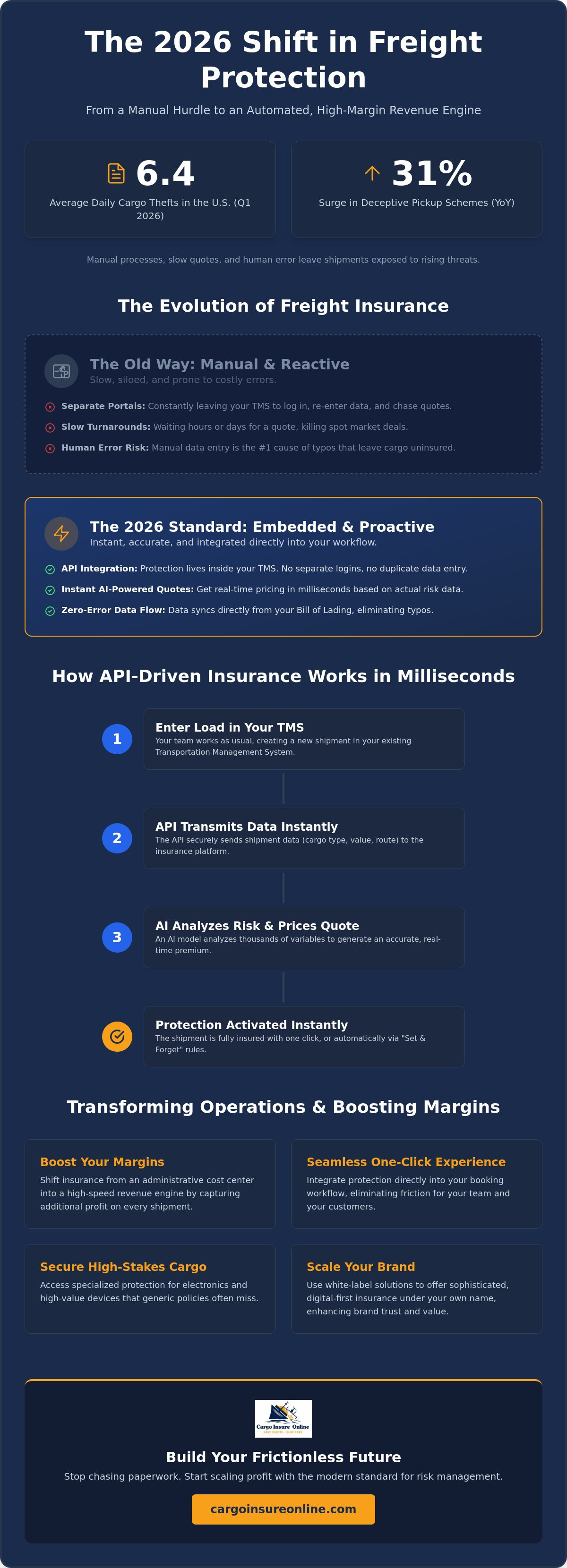
In the first quarter of 2026, the U.S. averaged 6.4 cargo theft incidents every single day, while deceptive pickup schemes surged by 31% compared to last year. It's a brutal reality for logistics leaders. You likely agree that manual data entry is a recipe for human error and slow quote turnarounds are the fastest way to kill a spot market deal. For too long, embedded insurance for freight companies felt like a distant concept, while your team struggled with complex procurement that left shipments exposed.
That era is over. This guide promises to show you how invisible, API-driven protection is transforming freight from a risky logistics hurdle into a high-margin revenue engine. We'll preview the 2026 shift toward instant, one-click insurance at the point of sale and explore how total risk visibility can finally protect your bottom line. It's time to stop chasing paperwork. Start scaling profit with the modern standard for risk management.
Key Takeaways
- Stop chasing manual quotes. Learn how to integrate protection directly into your booking workflow for a seamless, one-click experience.
- Master the tech behind the trend. See how embedded insurance for freight companies uses APIs to sync your TMS with real-time AI pricing in milliseconds.
- Secure high-stakes cargo. Discover specialized protection strategies for electronics and high-value devices that generic policies often miss.
- Boost your margins. Shift insurance from an administrative chore into a high-speed revenue engine by capturing additional profit on every shipment.
- Scale your brand. Use white-label solutions to offer sophisticated, digital-first insurance under your own name while we manage the risk.
The Evolution of Freight Protection: Why 'Embedded' is the 2026 Standard
Stop calling brokers. Stop waiting for confirmation emails. Start clicking buttons. The old way of securing cargo is officially obsolete. In 2026, freight protection isn't a separate administrative hurdle; it's the invisible layer that makes your entire workflow actually function. We've moved past the era of "buying insurance" and entered the age of "activating protection."
At its core, embedded insurance for freight companies is protection integrated directly into the freight booking workflow via API. It's the most impactful application of Financial technology (fintech) in the logistics sector today. This isn't just a new interface. It's a fundamental shift from reactive claims to proactive, data-driven risk mitigation. Traditional insurance portals have become the "fax machines" of 2026 logistics; they're slow, siloed, and completely out of sync with the speed of global trade.
From Manual Portals to Invisible Infrastructure
The "separate login" is dead. Every time your team has to leave your TMS to secure a load, you're losing money and momentum. Modern logistics requires a single-pane-of-glass dashboard where insurance lives exactly where the booking happens. This transition to invisible infrastructure does more than just save time. It eliminates the number one cause of cargo loss: human error in data entry. When the data flows directly from your booking system to the underwriter, the risk of a typo leaving a high-value shipment uninsured vanishes. Embedded insurance is the 2026 standard for digital-first logistics.
The 'Just-in-Time' Insurance Mandate
The spot market moves too fast for traditional underwriting. If you're waiting three hours for a quote, that deal is already gone. Today's shippers and e-commerce sellers expect an Amazon-like checkout experience where protection is a simple checkbox. They don't want to navigate a complex procurement process; they want instant certainty. To stay competitive, you need to understand the fundamentals of What is Cargo Insurance? and how it's being rebuilt for speed. This "just-in-time" model ensures that every load is covered the moment it's booked, keeping your operations lean and your customers confident.
Decoding the Mechanism: How API-Driven Insurance Powers Modern Logistics
Stop waiting for underwriting teams to wake up. Modern logistics requires a heartbeat that never skips. The secret behind embedded insurance for freight companies is the API, a digital bridge that connects your Transportation Management System (TMS) directly to the risk provider. This isn't just a connection; it's a continuous, high-speed conversation. When you enter a load into your system, the API transmits that data instantly. There's no manual entry. There's no back-and-forth. It's a frictionless exchange that secures your shipment before the truck even leaves the dock.
Real-time pricing is the byproduct of AI analyzing thousands of variables in milliseconds. It looks at the route. It evaluates the carrier history. It assesses the specific cargo type. This level of technology innovations in the insurance industry allows for dynamic premiums that reflect the actual risk of every individual load. You can even implement "Set and Forget" logic. By automating coverage based on pre-defined value thresholds, you ensure that every high-value shipment is protected without a single human intervention. It's efficient, it's accurate, and it's built for the speed of 2026 trade.
The system also handles the heavy legal lifting. With the FMCSA implementing updated financial responsibility requirements in 2026, including the $75,000 bond for property brokers, staying compliant is more complex than ever. Embedded systems automatically track these standards, reducing your compliance burden and ensuring your operations remain within regulatory guardrails. If you're ready to see how this works in practice, you might want to explore a modern cargo protection platform that prioritizes this level of automation.
API vs. Web Portals: The Efficiency Gap
Web portals are often just "digital paperwork." You're still logging in, still typing, and still waiting for a PDF to download. APIs represent true automation. They ensure your insurance policy always matches your bill of lading because the data comes from the same source. This synchronization pays off during the claims process. Because the data was verified at the point of booking, claim resolution moves at a pace that traditional brokers simply can't match. It's the difference between a manual process and a digital engine.
Scalability for Global Trade
Global trade isn't linear. Your shipments might move from a truck to a plane to a container ship. A single API integration can handle these multi-modal complexities with ease. It navigates cross-border compliance and international regulations without requiring an in-house legal team. This is particularly vital for Sea Freight Insurance, where global API stacks provide total protection across the high seas. Whether you're moving electronics across a state line or machinery across an ocean, the mechanism remains the same: fast, invisible, and absolute.
Beyond Basic Coverage: Protecting High-Value and Niche Cargo
General coverage is a trap for high-stakes logistics. If you're moving a million dollars in semiconductors or life-saving pharmaceuticals, a basic policy with a $100,000 limit is a liability, not a safeguard. Standard embedded insurance for freight companies often fails because it treats every pallet the same. In 2026, sophistication is the only way to survive a landscape where electronics theft accounts for 17% of all cargo incidents. You need protection that recognizes the specific DNA of your cargo.
The shift toward specialized protection isn't just about higher limits. It's about automated triggers. Imagine a system that recognizes a high-value shipment and instantly applies additional security requirements or adjusted premiums based on the latest theft hotspots in California or Texas. This isn't a manual process anymore. It's an intelligent, embedded response to a changing threat landscape.
Safeguarding High-Value Electronics
Theft of auto parts increased by 142% in early 2026, proving that criminals are getting more surgical. Mobile phones and high-end tech components require more than just a checkbox. They need dynamic pricing that adjusts to the volatility of tech markets in real time. Electronics Shipping Insurance integrates with embedded platforms to provide instant coverage for the most targeted category in cargo theft. This integration allows for automated triggers that activate specific security protocols based on the cargo's value and route, ensuring that high-volatility tech remains protected from dock to door.
Temperature-Sensitive and Perishable Logistics
The cold chain is a high-wire act. One failed compressor or a three-hour delay in a summer heatwave can wipe out an entire shipment of perishables. Embedded systems are now integrating directly with IoT sensors to monitor reefer health in real time. If the temperature deviates from the set range, the system can trigger a "spoilage alert" before the cargo is even unloaded. This data-driven approach allows for instant reefer claims and utilizes Reefer Cargo Insurance to bridge the financial gap between a total loss and a minor setback. It's about turning sensor data into financial certainty.
The Drone Frontier
Autonomous delivery is no longer a pilot program. As UAV shipping becomes a standard part of last-mile logistics, the insurance must keep pace. We're seeing the rise of automated insurance for autonomous delivery, where the drone's flight path and health data are used to underwrite the risk in real time. It's fast. It's precise. It's exactly what the next decade of freight looks like. Stop settling for "one size fits all" and start using protection built for the specific risks of 2026.
The Business Case: Transforming Insurance from a Chore into a Revenue Stream
Insurance isn't just a safety net. It's a growth engine. For decades, freight companies viewed insurance as a necessary evil; a dry, bureaucratic tax on doing business. That mindset is dead. In 2026, embedded insurance for freight companies has flipped the script. It's no longer about paperwork. It's about profit. By removing the friction from the procurement process, you transform a perceived administrative chore into a high-energy value-added service that your customers actually want.
Monetizing Risk Management
Stop leaving money on the table. When you integrate insurance into your booking flow, you aren't just protecting cargo. You're creating a new revenue stream. The math is simple. You capture a small margin on every load across your entire fleet. These incremental gains scale rapidly without increasing your operational headcount. You should position protection as a premium feature of your logistics platform rather than an afterthought. Check out our deep dive on Cargo Insurance for 3PL Providers to see how the top players are structuring these deals to maximize their bottom line.
Frictionless upselling is the secret to 100% coverage adoption. The best time to offer "All-Risk" cover is the exact moment of booking. That's when customer anxiety is highest. By providing a one-click solution, you offer immediate relief. You transform a stressful moment into a seamless, positive experience. This isn't a hard sell. It's a high-value service that protects your customer and your margins simultaneously.
Eliminating Administrative Overhead
How many hours does your team waste chasing insurance certificates? It should be zero. Manual reconciliation is a relic of the past. Modern embedded insurance for freight companies uses automated billing to handle the heavy lifting. The system reconciles every premium and every policy in the background. It's the silent hero of your back office. You aren't just saving money on premiums; you're reclaiming hundreds of staff hours that can be redirected toward scaling your core business.
Integrated protection also builds long-term customer loyalty. When a claim happens, and it's handled instantly because the data was already verified at the point of booking, your customer doesn't just feel covered. They feel empowered. This reliability reduces churn and turns one-time shippers into long-term partners who trust your digital-first approach. If you're ready to stop chasing brokers and start scaling, it's time to build your high-margin insurance engine today.
Implementation Strategy: Building Your Frictionless Future with Cargo Insure Online
Stop settling for legacy systems that slow you down. The right partner shouldn't just provide a policy. They should provide a platform. When choosing an ally for embedded insurance for freight companies, look for a digital-first specialist that speaks the language of APIs and automation. You don't need another bureaucratic layer. You need a high-speed engine that integrates into your existing workflow in days, not months. The transition from your first API key to your first insured shipment should be near-instantaneous.
Keeping your brand front and center is non-negotiable. Our White Label Solutions allow you to offer sophisticated protection under your own logo. We handle the complex underwriting and the risk management. You keep the customer relationship and the increased margins. It's about empowering your brand to act as a modernizing force in the industry. This is the CIO promise: high-energy support for a high-speed industry that never sleeps.
White-Label vs. Referral Models
White-labeling is the bold choice for logistics innovators. A referral model sends your customers away to a third-party site. It breaks the user journey and creates friction. A white-label journey keeps them in your ecosystem. It allows you to maintain a sense of playful enthusiasm throughout the booking process. You can customize the experience to match your brand's specific personality. It's about providing relief and excitement, not administrative dread. When protection is a seamless part of your interface, adoption rates skyrocket.
Next Steps for Freight Forwarders and 3PLs
Ready to dominate the 2026 market? Start with a simple audit. Audit your current insurance workflow and count the clicks it takes to secure a single load. If it is more than one, you are losing efficiency every hour. Next, consult with a tech-savvy insurance partner to map your API integration. We provide the connectivity. You provide the vision. This isn't just about embedded insurance for freight companies; it's about building a digital-first infrastructure that scales with you.
- Audit: Identify every manual touchpoint in your current procurement process.
- Consult: Map your TMS data fields to our cargo insurance API for a perfect sync.
- Launch: Activate your new revenue engine and start capturing margins on every shipment.
The future of freight isn't just about moving goods. It's about moving data with total confidence. By automating your risk management today, you ensure your operations are lean, protected, and ready for the next decade of global trade. Don't just participate in the 2026 trend. Lead it.
Secure Your Competitive Edge in the 2026 Freight Market
The logistics landscape is moving faster than ever. You've seen how invisible, API-driven protection eliminates the human error that once plagued manual data entry. By shifting toward embedded insurance for freight companies, you aren't just checking a box; you're building a scalable, high-margin revenue engine. From specialized niche protection for electronics and reefer cargo to seamless API integration for 3PLs and forwarders, the tools for total risk visibility are finally within reach.
Stop letting slow quotes kill your spot market deals. It's time to replace administrative dread with digital-first efficiency. We've mastered the complexities of global trade so you don't have to. At Cargo Insure Online, we're dedicated to modernizing global trade and empowering your team with the speed they deserve. The future is frictionless, automated, and ready for you to lead. Start scaling your profit today.
Ready to automate your risk? Explore our White-Label Cargo Insurance Solutions now!
Frequently Asked Questions
What exactly is embedded insurance for freight companies?
Embedded insurance for freight companies is protection integrated directly into your digital booking workflow via an API. It removes the need for separate logins or manual data entry by syncing with your TMS. Instead of a separate administrative chore, it becomes a seamless part of the shipment creation process. It's the modern standard for 2026, ensuring every load is covered the moment it's booked without human intervention.
How does embedded insurance differ from traditional cargo insurance?
Traditional insurance relies on manual portals, emails, and slow broker turnarounds. Embedded insurance is instant. It uses real-time data to provide immediate quotes and coverage at the point of sale. You don't wait for a PDF certificate; the system generates it automatically. It transforms insurance from a reactive safety net into a proactive, data-driven utility that scales with your shipment volume without increasing your headcount.
Do freight companies need a special license to offer embedded insurance?
You don't typically need an insurance license to offer these solutions when partnering with a digital-first provider like us. We handle the complex regulatory heavy lifting and licensing requirements on our end. Your role is simply to provide the platform where the protection is activated. This allows you to focus on logistics while we manage the risk and compliance behind the scenes through our white-label solutions.
Can embedded insurance handle high-value goods like electronics or drones?
Yes, it is specifically designed for high-stakes cargo. While general policies often have low limits that leave you exposed, embedded insurance for freight companies supports specialized protection for electronics, mobile phones, and even drone deliveries. The system uses automated triggers to adjust coverage based on the cargo's specific value and risk profile. It ensures that even the most targeted categories in 2026 remain fully protected.
How long does it take to integrate a cargo insurance API into a TMS?
Integration is built for speed. You can move from receiving an API key to insuring your first shipment in just a few days. Our documentation is designed for modern developers, making the connection to your TMS or ERP straightforward and clean. It's a high-speed setup for a high-speed industry. There's no long development cycle; just a digital bridge that starts delivering value almost immediately.
Does embedded insurance cover international air and sea freight?
It provides total protection across all modes of transport. Whether you are moving cargo via air freight, sea freight, or trucking, the API handles the multi-modal complexity automatically. It navigates international regulations and cross-border requirements without needing an in-house legal team. It's a global solution that protects your shipments whether they're crossing a state line or an ocean, keeping your global trade operations frictionless.
How are claims handled in an embedded insurance model?
Claims are resolved faster because the data is verified at the point of booking. Since the policy and bill of lading are perfectly synced through the API, there's no dispute over shipment details or values. The process is digital and direct. This transparency reduces friction and ensures that your customers receive their settlements quickly, turning a potential loss into a moment of brand-building reliability and customer trust.
Is embedded insurance more expensive than traditional policies?
It's highly competitive because data accuracy reduces the risk for underwriters. You aren't just paying for a policy; you're investing in an automated system that eliminates administrative overhead. More importantly, it allows you to capture additional margins on every load. It transforms a cost center into a revenue engine, making it a far more profitable choice than traditional, manual alternatives that waste your team's time.


