

Statutory carrier liability rules were built to protect airlines from bankruptcy, not to protect your balance sheet from catastrophic loss. If a high-value shipment vanishes on the tarmac, the carrier won't reimburse your commercial invoice. Under legacy treaties, airlines pay by weight, not value. That harsh math defines the Warsaw Convention air cargo liability cap financial exposure facing modern logistics teams. At roughly 17 SDR per kilogram, a damaged pallet of lightweight electronics can instantly wipe out hundreds of thousands of dollars.
You already know air freight moves fast, and your team doesn't have time to battle bureaucratic claims departments over century-old treaty rules. You shouldn't have to gamble your operating margins on outdated carrier limits. You'll discover how statutory air cargo liability limits create massive financial exposure, and how to protect your high-value shipments before they take off.
We'll quantify your true per-kilogram exposure across legacy air waybill contracts and show you how modern, full-value coverage eliminates balance sheet risk in seconds.
Key Takeaways
- Calculate your Warsaw Convention air cargo liability cap financial exposure across active flight routes to reveal balance sheet vulnerabilities before goods leave the tarmac.
- Unpack the massive recovery gaps between legacy weight-based carrier payouts and the actual invoice value of modern, high-density electronics.
- Discover why statutory airline liability functions as a legal defense shield for carriers rather than an insurance policy for shippers.
- Audit Master and House Air Waybill contracts to pinpoint liability gaps and prevent cargo handler pushback during damage events.
- Replace drawn-out carrier negligence disputes with digital-first freight insurance that secures instant, full-value protection for every consignment.
What Is the Warsaw Convention Air Cargo Liability Cap?
International air transport was once a fragile, high-risk gamble. To keep fledgling airlines flying, global governments stepped in with statutory legal armor. That framework originated in 1929 through the Warsaw Convention. The treaty succeeded in keeping commercial aviation solvent, but it left modern cargo owners completely unprotected. Today, your Warsaw Convention air cargo liability cap financial exposure stems from a single harsh reality: carriers don't compensate you for lost merchandise; they compensate you for lost weight. While newer treaties cover major trading nations, legacy Warsaw terms still dictate liability on key routes connecting non-signatory territories.
The Origins of Statutory Air Carrier Protection
Early twentieth-century aviation needed legal insulation against catastrophic crash liabilities. Lawmakers responded by building a defensive shield for airlines. Shipper asset protection was never the objective. The treaty capped statutory recovery at 250 French gold Poincaré francs per gross kilogram. Modern courts and international protocols convert this legacy gold standard to roughly 17 Special Drawing Rights (SDR) per kilogram. It's an outdated legal mechanism conceived in the biplane era, yet it continues to govern air waybill contracts on active trade lanes.
The Per-Kilogram Weight Trap Explained
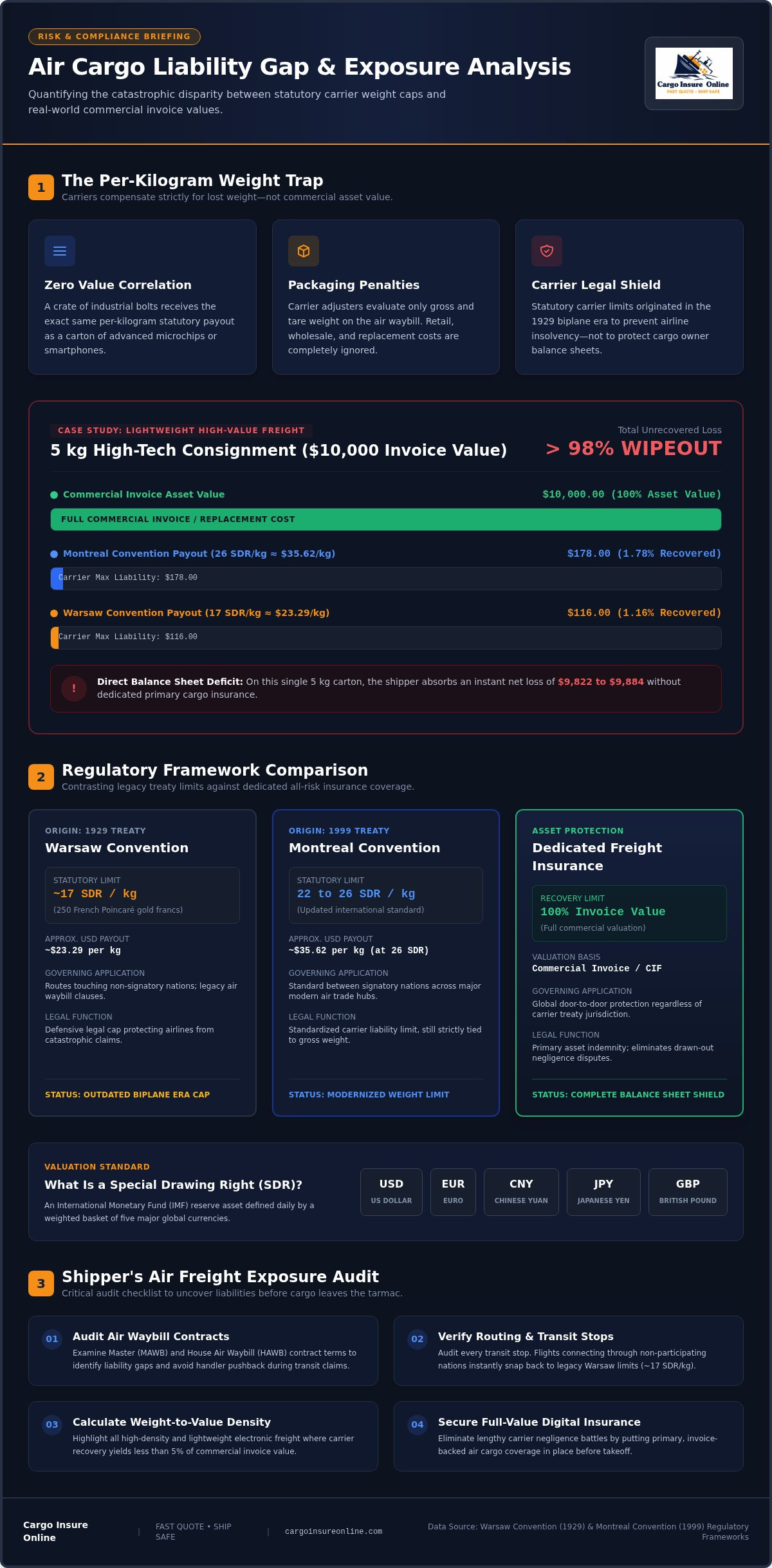
Weight-based liability treats every shipment identically on the scales. Carrier claims adjusters don't check your commercial invoice, purchase order, or replacement cost. They look strictly at the gross weight of the damaged box.
- Zero value correlation: A crate of industrial bolts receives the exact same per-kilogram payout as a carton of advanced microchips.
- Total loss write-downs: Carriers bear zero legal obligation to honor retail or wholesale invoice values during catastrophic damage events.
- Packaging penalties: Payout formulas focus solely on the physical tare and gross weight recorded on the air waybill.
When high-density freight suffers transit damage, standard statutory compensation evaporates almost instantly. Understanding your Warsaw Convention air cargo liability cap financial exposure shows that carrier liability isn't insurance at all. It's an airline defense mechanism that leaves your balance sheet wide open to unrecoverable losses.
Calculating Real-World Financial Exposure: Warsaw vs. Montreal
Most logistics managers assume international air cargo operates under uniform, modern safety nets. In reality, cross-border flights cross fractured legal territory. While modern hubs follow updated frameworks, routes touching non-signatory nations snap right back to legacy treaty caps. Calculating your Warsaw Convention air cargo liability cap financial exposure starts by examining the stark difference between these regulatory regimes.
Montreal Convention 1999 vs. Legacy Warsaw Limits
The Montreal Convention modernized carrier liability, lifting statutory cargo limits to 22 Special Drawing Rights (SDR) per kilogram and later raising them to 26 SDR. The Warsaw Convention remains anchored at roughly 17 SDR per kilogram. A Special Drawing Right is an International Monetary Fund reserve asset whose valuation is determined daily by a weighted basket of five major global currencies: the US dollar, euro, Chinese yuan, Japanese yen, and British pound. Reviewing IATA's Warsaw Convention Guidelines shows how routes connecting non-participating nations still revert to vintage Warsaw terms. Determining which regime governs your flight requires auditing every transit stop along the air waybill routing.
The Devastating Valuation Gap on Lightweight Tech
Statutory formulas fail spectacularly when cargo density drops and unit value climbs. Consider a lightweight five-kilogram carton carrying high-end smartphones or microchips worth $10,000 on a commercial invoice:
- Warsaw payout: 17 SDR per kilo yields roughly $23.29 per kilogram, totaling about $116 in carrier compensation.
- Montreal payout: 26 SDR per kilo yields roughly $35.62 per kilogram, producing about $178 in compensation.
- Shipper balance sheet loss: Over 98% of the consignment's asset value is instantly wiped out.
Instead of absorbing catastrophic deficits, forward-thinking operators secure primary air freight insurance to lock in complete invoice value protection before takeoff.
The Impossible Hurdle: Proving Willful Misconduct
Shippers often think they can shatter statutory caps in court by alleging carrier negligence. The legal standard requires proving "willful misconduct," meaning the carrier knowingly acted with intent to cause damage or with reckless disregard. Corporate airline legal teams specialize in deflecting these accusations. Filing protracted cross-border lawsuits drains capital, and legal fees quickly eclipse the total loss. Breaking the statutory limit in court is almost impossible.
Carrier Liability vs. Dedicated Air Freight Insurance
Carrier liability is not insurance. It was never intended to make shippers whole after transit mishaps. Instead, statutory carrier terms function as an airline defense shield designed to cap corporate payouts and throw up administrative hurdles. Relying on an air waybill to protect your bottom line magnifies your Warsaw Convention air cargo liability cap financial exposure, leaving your business to shoulder the burden of damaged or missing inventory.
Statutory Defenses That Leave Shippers Empty-Handed
International aviation treaties give airlines an extensive menu of statutory defenses. If a carrier proves damage resulted from unavoidable atmospheric conditions, they walk away clean.
- Severe weather and turbulence: Mid-flight shifts and sudden turbulence qualify as standard operational perils, absolving airlines of negligence.
- Inherent vice and packaging allegations: Adjusters routinely argue inner cartons were defective or insufficient, shifting fault back to your warehouse team.
- Unclear intermodal custody: When cargo moves between ground trucks and airport handling sheds, carriers deny claims by questioning where the incident occurred.
Stringent Claim Notice Deadlines and Bureaucracy
Airlines enforce rigid, non-negotiable protocols to dismiss claims on technicalities. Under international treaty rules, you must submit written notice of damage within fourteen days of receiving your freight. If your team misses that narrow window, you forfeit every legal right to pursue compensation, regardless of the incident's severity. Even if you file on time, carrier claims departments grind forward slowly. Your staff spends months submitting air waybills, packing slips, and photographic proof, only to receive a fraction of your actual commercial loss.
All-Risk Protection: Full Invoice Value Recovery
Closing these operational vulnerabilities requires modern risk management. Dedicated cargo insurance decouples financial recovery from airline liability arguments entirely. A true all-risk policy reimburses direct commercial invoice value without requiring proof of carrier fault or negligence. Claims settle quickly while insurers manage airline disputes behind the scenes. Shippers leverage dedicated air freight insurance to remove balance sheet volatility across every international flight. If you move fragile microchips, mobile devices, or avionics, deploying tailored electronics shipping insurance wipes out the lingering Warsaw Convention air cargo liability cap financial exposure before cargo ever leaves your distribution dock.
Auditing Your Air Freight Risk: A Shipper's Exposure Checklist
Passive logistics management costs money. Hoping a flight touches down smoothly is not a risk management strategy. You need a systematic audit of your shipping profiles to measure your Warsaw Convention air cargo liability cap financial exposure before cargo leaves your warehouse floor. Running proactive checks on every route gives you the leverage to eliminate coverage shortfalls instantly.
Calculating Your Net Exposure Per Shipment
Audit your manifest data with a direct formula. Take the gross weight of your cargo in kilograms and multiply it by the governing statutory rate. On routes governed by Warsaw signatories, that limit rests around 17 SDR per kilo. Next, subtract that calculated figure from the commercial invoice value. The difference is your net financial exposure. If that shortfall threatens your gross margin or quarterly earnings, you have an unhedged operational risk on your books.
Declared Value for Carriage: The Expensive Airline Trap
Airlines often market declared value for carriage as an easy fix. Shippers write a higher valuation on the air waybill and pay a hefty carrier surcharge. Don't fall for this trap. Carrier declared value is not third-party insurance. You pay premium airline surcharges, yet the carrier still demands proof of airline negligence before releasing funds. If atmospheric turbulence or typical rough handling drops your pallet, adjusters can still deny the claim. You pay more and gain zero true protection.
Operational Inspection Protocols at the Cargo Terminal
Defending claims starts the second cargo touches the tarmac. Implement strict receiving rules to protect your balance sheet:
- Inspect tamper seals: Check container seals and exterior film before signing delivery receipts.
- Capture time-stamped photos: Photograph crushed cartons or wet freight directly on the tarmac or terminal dock.
- Log exceptions on the waybill: Write specific physical discrepancies onto the proof of delivery. Never sign a clean receipt for damaged freight.
- Dispatch formal written notices: Send immediate written declarations to carriers to safeguard underlying treaty claims.
Instead of wrestling with air waybill fine print after an incident, eliminate Warsaw Convention air cargo liability cap financial exposure upfront. You can secure direct, full-value coverage in seconds when you book instant cargo insurance with Cargo Insure Online.
Closing the Liability Gap with Instant Cargo Insurance
Relying on twentieth-century treaties to protect twenty-first-century trade is an unnecessary gamble. Traditional airline claims procedures leave modern supply chain leaders exposed to brutal balance sheet write-downs. Eliminating your Warsaw Convention air cargo liability cap financial exposure doesn't require renegotiating air waybill contracts or hiring corporate aviation lawyers. It requires adopting modern, automated insurance built for digital logistics speed.
The Digital Solution to Archaic Treaty Restrictions
Old-school freight insurance used to mean endless phone calls, complex declaration spreadsheets, and manual underwriting reviews that dragged on for days. Digital platforms replace that friction with instant automation. Intelligent underwriting engines assess cargo risk in real time, issuing bound policies in seconds before shipments depart. You secure complete door-to-door protection that bypasses archaic treaty caps entirely, ensuring direct full-value claim settlements without waiting on bureaucratic carrier negligence investigations.
Tailored Safeguards for Sensitive and High-Value Cargo
Standard airline terms provide zero relief when specialized consignments encounter transit snags. Temperature fluctuations during tarmac delays or unrecorded handler drops receive zero consideration under statutory weight formulas. Targeted coverage options solve these specific vulnerabilities:
- Electronics & High-Value Devices Insurance: Safeguards fragile microcircuits, semiconductors, and server racks against handling shocks and total loss events.
- Mobile Phone Insurance and Drones Insurance: Protects compact, high-theft hardware lines where gross weight pays pennies compared to retail value.
- Reefer Product Protection: Shields temperature-managed goods against spoilage caused by mechanical failure or ground-handling delays.
Secure Instant Coverage for Every Air Consignment
Airlines built statutory caps to defend their own bottom lines, not yours. Leaving your operating margins exposed to century-old treaty rules puts your enterprise at risk every time a flight departs. Neutralize your Warsaw Convention air cargo liability cap financial exposure by shifting to automated, full-value protection. You can quote and bind your next flight in minutes when you partner with Cargo Insure Online for frictionless, comprehensive air freight insurance.
Eliminate Air Cargo Exposure and Protect Your Margins
Operating without dedicated freight insurance turns every flight into an unhedged balance sheet gamble. Statutory treaty rules pay pennies on the dollar, and airline adjusters rely on rigid legal shields to deflect responsibility. You don't have to accept devastating shortfalls when moving premium inventory across global routes. Neutralizing your Warsaw Convention air cargo liability cap financial exposure is now as simple as a few clicks.
Cargo Insure Online replaces slow, bureaucratic paperwork with a digital-first automated underwriting platform. Instead of battling carriers over negligence or absorbing catastrophic losses, you get comprehensive coverage for high-value electronics, phones, and drones. Best of all, you secure direct full-value claim settlements without relying on carrier negligence battles.
Take the uncertainty out of international aviation logistics. Shield your shipments from Warsaw caps and get instant air cargo protection today to keep your supply chain moving forward with total confidence.
Frequently Asked Questions
What is the exact financial liability limit under the Warsaw Convention?
Under the unamended Warsaw Convention, carrier liability is capped at 250 French gold Poincaré francs per kilogram, which modern courts translate to roughly 17 Special Drawing Rights (SDR). At prevailing exchange rates, that equates to roughly $23 to $24 per gross kilogram. This rigid weight formula defines the Warsaw Convention air cargo liability cap financial exposure for businesses moving goods through jurisdictions that haven't ratified modern aviation treaties.
How does the Montreal Convention differ from Warsaw regarding air cargo?
The Montreal Convention modernizes liability limits and unifies international carriage rules. While legacy Warsaw terms cap compensation at approximately 17 SDR per kilogram, Montreal increased limits to 26 SDR per kilogram. Montreal also eliminates technical air waybill defense loopholes used by airlines to deny claims. However, it still caps recovery strictly by physical weight, leaving high-value cargo owners heavily exposed during catastrophic losses.
Can airlines deny claims even if my cargo was destroyed on board?
Yes, airlines routinely reject claims for total cargo destruction by invoking statutory treaty exemptions. Carriers avoid financial liability if they establish the damage resulted from severe weather, atmospheric turbulence, inherent product vice, or inadequate packaging. If an airline argues your team improperly secured inner boxes or if you missed formal filing deadlines, the carrier can deny your payout completely.
What happens if I ship lightweight, high-value electronics without third-party insurance?
You absorb the financial deficit directly onto your balance sheet. High-density tech like microchips, tablets, and medical sensors packs immense monetary value into minimal weight. If a twenty-kilogram carton worth $50,000 gets stolen or damaged, statutory weight caps return only a few hundred dollars. Relying on carrier liability alone leaves you writing off over 95% of the replacement cost.
How much time do shippers have to file a formal cargo claim against an airline?
Shippers must deliver formal written notice to the carrier within fourteen days of receiving damaged international air cargo. For delayed goods, you have twenty-one days from delivery. Missing these narrow treaty deadlines by a single day completely extinguishes your right to claim compensation. Signing a delivery receipt without logging immediate physical exceptions can also forfeit your claim before it starts.
Is declaring value on the Air Waybill the same as purchasing cargo insurance?
No, declared value is merely an agreement that raises the carrier's maximum payout ceiling. You pay expensive airline surcharges, but you don't receive primary all-risk coverage. You must still prove airline negligence, navigate carrier exclusions, and wait out long administrative investigations. In contrast, genuine cargo insurance pays full invoice value promptly without requiring proof of carrier fault.
Can third-party cargo insurance cover losses that exceed statutory international caps?
Yes, dedicated air freight insurance completely bypasses statutory international limitations. First-party cargo coverage protects the full commercial invoice value of your goods regardless of treaty restrictions, airline defenses, or per-kilogram weight formulas. Digital platforms like Cargo Insure Online settle claims directly with shippers based on actual asset worth. This eliminates your Warsaw Convention air cargo liability cap financial exposure and leaves complex airline disputes to recovery specialists.


