
Carrier liability is designed to protect the carrier, never your customer. Relying on basic bill of lading limits is a dangerous trap, leaving your team stuck mediating ugly cargo disputes when shipments arrive crushed or soaked. Integrating modern shipper's interest insurance for freight forwarders completely rewrites that script.
You know the drill. A high-value load is wrecked, and your client expects a full payout. Instead, statutory caps like the standard $500 COGSA package limit leave them with pennies on the dollar, furious at your business while carrier negligence battles drag on for months. Clunky broker portals and manual paperwork only add painful drag to your daily operations.
It's time to ditch the friction. In this guide, you'll discover how shipper's interest insurance eliminates freight forwarder liability exposure while turning cargo protection into a scalable profit center. We'll explore how true door-to-door all-risk coverage settles claims fast regardless of carrier fault, locks in client loyalty, and unlocks an automated digital revenue stream for your business.
Key Takeaways
- Discover how shipper's interest insurance for freight forwarders replaces rigid statutory caps with full commercial invoice protection that settles fast without carrier fault disputes.
- Uncover why relying on shippers' own corporate insurance exposes your relationships to serious risk, especially when commercial deductibles dwarf standard shipment damage claims.
- Turn cargo protection into a scalable, high-margin profit center that strengthens client trust and maximizes lifetime forwarder revenue.
- Streamline daily operations by replacing slow broker portals and manual email chains with instant digital quoting and automated policy binding.
What Is Shipper's Interest Insurance in Freight Forwarding?
Put simply, shipper's interest insurance for freight forwarders is first-party, all-risk property coverage secured on behalf of the cargo owner. It breaks away from traditional liability models by insuring the physical goods rather than defending the intermediary. Rooted in the principles of Shipper's Interest Insurance, this policy safeguards the full commercial invoice value of the freight, along with shipping fees and anticipated duties.
Coverage attaches the moment freight leaves the origin facility and stays active until final offloading at the destination warehouse. Forwarders typically deploy this protection in two ways:
- Open Marine Cargo Policies: An overarching umbrella held by the forwarder that automatically covers all qualifying bookings without individual underwriting reviews.
- Transactional Single-Shipment Certificates: On-demand policies bound instantly per shipment for high-value loads, spot quotes, or one-off client requests.
First-Party Cargo Coverage vs. Third-Party Legal Liability
Many logistics teams mistakenly lean on their Freight Forwarder Legal Liability (FFL) policies to handle client claims. That is a costly error. FFL is third-party defense coverage. It only activates when a forwarder is legally proven negligent, effectively forcing your business into an adversarial stance against your own customer.
First-party shipper's interest flips that dynamic. Because it covers external physical loss and damage directly, your shipper gets paid fast without needing to establish carrier negligence. You transform a potentially toxic legal dispute into a quick claims resolution, protecting both your customer relationships and your repeat freight volume.
Warehouse-to-Warehouse Protection Across Global Supply Chains
Freight rarely travels in a straight line. Every transfer between ocean vessels, sorting hubs, and rail yards exposes shipments to dropped pallets, rough handling, and concealed transit damage. If custody becomes murky between international carriers, finding fault is nearly impossible.
Shipper's interest provides unbroken, door-to-door indemnity. It keeps freight protected while consolidating, clearing customs, and navigating final-mile routes. Integrating seamless trucking cargo insurance for road legs guarantees that domestic drayage risks never slip through the cracks, closing the operational gaps between major transport hubs.
Carrier Liability vs. Shipper's Interest: The Severe Financial Gaps
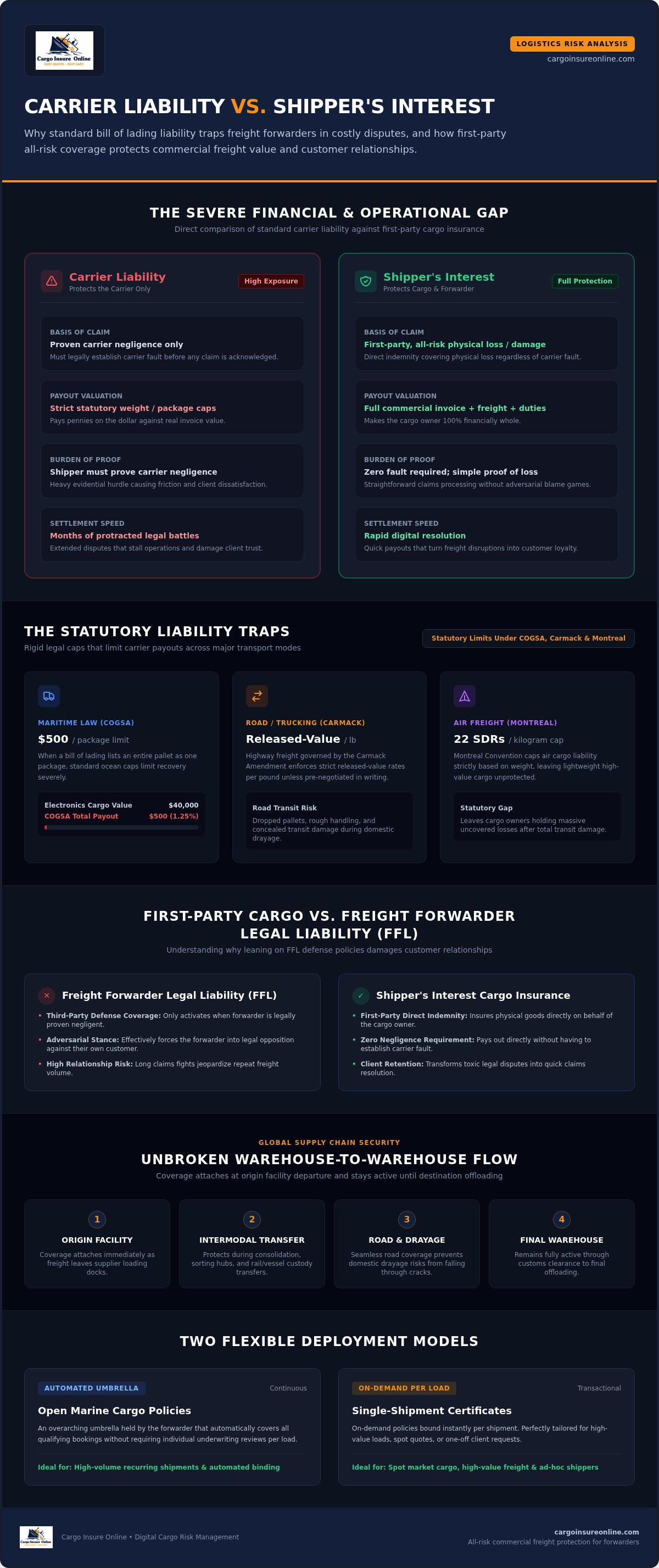
Relying on standard carrier liability is a gamble your logistics business can't afford to take. Carrier liability exists to protect the transportation company, not make cargo owners whole. If a container or linehaul trailer is damaged, statutory liability pays only pennies against the actual commercial invoice value. Worse, your team faces the brutal burden of legally proving carrier fault before seeing a single dollar.
| Feature | Carrier Liability | Shipper's Interest Insurance |
|---|---|---|
| Basis of Claim | Proven carrier negligence only | First-party, all-risk physical loss or damage |
| Payout Valuation | Strict statutory weight or package caps | Full commercial invoice value plus freight costs |
| Burden of Proof | Shipper must establish carrier negligence | Zero fault required; simple proof of loss |
| Settlement Speed | Months of protracted legal battles | Rapid digital resolution |
Statutory Limitations Under COGSA, Carmack, and Montreal
Statutory rules heavily restrict what carriers owe. Under maritime law, the U.S. Carriage of Goods by Sea Act (COGSA) caps ocean carrier liability at an archaic $500 per package. When a bill of lading lists an entire pallet as one package, a $40,000 electronics shipment might yield just $500 after a total loss. Highway freight governed by the Carmack Amendment often enforces strict released-value rates per pound unless higher values were pre-negotiated in writing. Air freight is equally restrictive, capping claims at 22 SDRs per kilogram under the Montreal Convention.
Federal agencies point out that statutes limit your mover's liability, which leaves cargo owners holding massive uncovered losses. Securing dedicated air freight insurance bypasses these rigid international caps instantly.
The Reality of Carrier Exclusions and General Average
Even when a carrier loses a load, they often owe nothing. International carriage conventions offer carriers nearly twenty distinct statutory defenses, including heavy weather, strikes, fires, and latent equipment defects. If an incident falls under an act of God, the carrier walks away without paying a cent.
Maritime transport introduces an even harsher reality: General Average. When a vessel encounters an emergency, maritime law requires all cargo interests to pay cash salvage contributions before releasing undamaged containers. Dedicated sea freight insurance absorbs General Average liabilities automatically, preventing catastrophic release delays. Providing automated shipper's interest insurance for freight forwarders shields your customer relationships when carriers invoke statutory shields. You can easily set up frictionless protection for your clients through cargoinsureonline.com before freight ever leaves the dock.
Why Freight Forwarders Cannot Rely on Shippers' Own Policies
Assuming your customer already carries adequate coverage is a massive operational risk. Many forwarders take it for granted that commercial shippers maintain active cargo endorsements. The reality? A startling number of small to mid-sized businesses, particularly fast-growing e-commerce brands, move freight completely uninsured. They assume you handle total shipment safety automatically.
When containers get crushed or pallets go missing, that misunderstanding turns toxic. Shippers don't blame obscure maritime rules; they blame you. Navigating official insurance requirements and regulations across global borders is complicated, and cargo owners count on your expertise. Providing automated shipper's interest insurance for freight forwarders bridges this critical expectation gap before a total loss damages your business reputation.
High Deductibles and Hidden Policy Exclusions
Even when a shipper holds a corporate property policy, it rarely functions well during transit. Most corporate business policies are built for static warehouse inventory, not the turbulence of intermodal freight. They frequently carry massive corporate deductibles exceeding $25,000, meaning partial losses or mid-sized freight damages produce zero payout for the shipper.
Worse, standard business insurance policies routinely contain sweeping transit exclusions. They carve out water damage, humidity, rough handling, and refrigeration breakdowns. Deploying specialized reefer cargo insurance guarantees cold-chain cargo remains protected against compressor failure and temperature spikes, preventing catastrophic spoilage write-offs.
Vulnerable Cargo Profiles: Electronics, Perishables, and High-Value Freight
Targeted freight categories require specialized underwriting that ordinary commercial policies refuse to cover. High-demand goods face severe exposure across staging yards and cross-dock facilities:
- Consumer Electronics: High-value tech goods are prime targets for organized cargo theft networks and strategic pilferage. Utilizing dedicated electronics shipping insurance keeps smart devices and microchips shielded door-to-door.
- Fragile and Sensitive Machinery: Delicate equipment suffers internal calibration failures from road vibration and rough container movements.
- Perishables and Pharmaceuticals: Time-sensitive cold cargo faces immediate depreciation during port congestion or equipment power cutoffs.
Stepping in with dedicated first-party coverage transforms your operation. Instead of leaving clients to battle uncooperative corporate insurers, offering primary shipper's interest establishes your forwarding agency as an essential, full-service logistics powerhouse.
How Offering Shipper's Interest Builds Margin and Retains Shippers
Most logistics providers treat cargo protection as an administrative chore. They view insurance as dry paperwork that slows down operations. Forward-thinking operators see the exact opposite: an untapped profit center. By integrating shipper's interest insurance for freight forwarders, you immediately elevate your forwarding service from a commoditized rate-quote into an indispensable supply chain solution.
Commodity forwarders compete strictly on freight rates, driving margins into the ground. Providing unified freight, customs clearance, and all-risk insurance on a single invoice creates massive stickiness. Shippers get simplified accounting and total peace of mind, making it nearly impossible for low-cost competitors to lure them away with cheaper base freight rates.
Turning Cargo Protection Into an Ancillary Revenue Engine
Paper applications and back-and-forth broker emails kill deals. Digital coverage embeds directly into your routine quotation workflows. With instantaneous quoting, your team can attach comprehensive coverage to every ocean container, air pallet, or linehaul truckload with a single click.
This streamlined approach lets you generate consistent administrative margin on every booking. You expand revenue per shipment without hiring additional risk staff or taking on capital liabilities. It's high-margin, scalable ancillary revenue that drops straight to your bottom line while delivering real financial protection to your customers.
Accelerating Claim Resolution to Safeguard Commercial Relationships
Traditional carrier claims drag on endlessly. Standard subrogation battles against negligent ocean or highway carriers routinely take nine to twelve months, tying up capital and destroying client goodwill. Your customer doesn't care that maritime law shields the carrier; they want their lost cargo paid for immediately.
First-party shipper's interest rewrites that timeline. Because coverage operates independent of carrier fault, digital claims settle in days once survey documentation is submitted. When disaster strikes, you don't hand your customer an attorney's contact info. You hand them a prompt settlement check.
Delivering fast payouts turns potential supply chain disasters into masterclasses in customer service. You protect your clients' balance sheets, reinforce loyalty, and safeguard future shipment volume. Ready to upgrade your logistics service? Partner with Cargo Insure Online to automate your cargo protection and launch a scalable ancillary revenue stream today.
Implementing Modern Digital Cargo Insurance in 2026
Start with an honest operational audit. How many loads moved through your forwarding network last month completely unprotected? In most mid-sized operations, dozens of shipments slip past booking desks without coverage simply because manual underwriting takes too long. Legacy portals and slow email chains force your operators to choose between closing bookings quickly or waiting for insurance confirmation.
Ditch the manual bottleneck. Embedding automated cargo protection directly into your standard quotation workflows changes everything. By placing automated rate prompts on rate sheets, booking portals, and dispatch invoices, your team presents on-demand coverage options to every customer without adding operational drag.
Automating Quotes with APIs and Digital Freight Platforms
Manual data entry belongs in the past. Re-keying commodity descriptions, container numbers, and invoice values into external legacy broker portals burns valuable operations hours. It creates administrative clutter, invites human error, and stalls booking velocity.
Modern API endpoints eliminate that friction by delivering instant, bindable rates right inside your existing TMS interface. Quotes happen in real time alongside dispatch scheduling. Logistics operators can even deploy a turnkey branded cargo insurance platform, giving your business a seamless, customer-facing insurance engine powered by modern digital underwriting.
Evaluating Policy Terms: All-Risk Scope and Claim Filing Speed
Speed at checkout means nothing if claims stall out later. When selecting an insurance partner, forwarders must look beyond the quote screen. Verify that policies deliver genuine, door-to-door all-risk coverage backed by transparent, clearly articulated terms that protect against real-world transit hazards.
Ensure your underwriting partner supports a completely paperless claims process. Modern claim setups allow shippers to upload survey reports, bills of lading, and damage photographs directly through a web interface, resolving claims in days rather than months.
Rolling out digital shipper's interest insurance for freight forwarders isn't just a defensive risk move. It is a decisive strategy to modernize daily workflows, protect client relationships, and capture automated ancillary profit on every trade lane.
Transform Cargo Protection Into Your Competitive Edge
Leaving cargo protection to chance or restrictive carrier limits puts your client relationships on the line every single day. Integrating modern shipper's interest insurance for freight forwarders completely removes that friction. Instead of wasting valuable hours in painful carrier negligence disputes, your team secures true all-risk coverage designed for global intermodal transport routes, ensuring your clients get paid fast without operational drag.
Digital-first policy issuance eliminates administrative bottlenecks for good. With instant underwriting capability across general freight, high-value tech, and reefer cargo, you can quote and bind comprehensive protection in seconds. Stop treating insurance as an administrative burden and start using it to build customer retention and capture sustainable profit on every trade lane. Upgrade your forwarding operations with Cargo Insure Online today!
Frequently Asked Questions
Is carrier liability the same as shipper's interest insurance?
No, they are fundamentally different risk structures. Carrier liability defends the transportation provider against proven negligence and caps payouts based on statutory weight or package rules. Shipper's interest insurance for freight forwarders is first-party, all-risk property coverage. It pays the cargo owner the full commercial invoice value directly, regardless of whether a carrier made an operational mistake.
Can a freight forwarder legally offer shipper's interest insurance to cargo owners?
Yes, freight forwarders routinely arrange shipper's interest coverage as open policyholders or by partnering with licensed digital intermediaries. In most jurisdictions, forwarders can procure cargo coverage on their client's behalf or integrate digital white-label insurance engines. This enables logistics providers to issue legitimate certificates of insurance directly without operating as an unauthorized underwriting entity.
What does shipper's interest insurance cover that standard carrier liability excludes?
It covers physical loss and damage caused by acts of God, severe storms, vessel groundings, and concealed transit damage that carriers legally exclude. It also absorbs General Average salvage assessments, mechanical refrigeration failure, theft, and jettison. While carriers walk away citing statutory defenses, all-risk shipper's interest pays out without requiring proof of carrier fault.
How much does carrier liability typically pay if an ocean container is lost?
Ocean carrier liability under COGSA is strictly capped at $500 per package or customary freight unit. If a bill of lading lists a 40-foot container as a single package or defines pallets as packages, the carrier might legally owe only $500 for a total loss. Shipper's interest bypasses this statutory cap by insuring 100% of the commercial invoice value.
What happens if an uninsured shipment is involved in a General Average declaration?
The cargo owner must post a substantial cash deposit before the ocean carrier will release their undamaged freight. If the shipper can't pay their apportioned share of salvage and vessel rescue expenses, maritime authorities can seize and auction their cargo. Shipper's interest insurance eliminates this catastrophic financial exposure by assuming all General Average guarantee bonds automatically.
Is shipper's interest insurance door-to-door or port-to-port?
A properly structured policy provides comprehensive door-to-door, warehouse-to-warehouse protection. It attaches the instant goods leave the supplier's loading dock and stays continuously active through all domestic trucking, airport staging, consolidation yards, and ocean or air legs. Coverage only ceases once cargo is safely delivered and offloaded at the final consignee facility.
How quickly are shipper's interest insurance claims settled compared to carrier claims?
Carrier liability claims drag on for six to twelve months while legal teams dispute fault and jurisdiction. Modern shipper's interest insurance for freight forwarders radically slashes that turnaround. Because there is no need to legally prove carrier negligence, approved claims submit via digital platforms and settle in just a few days once survey documentation is verified.


