
A carrier’s liability cap isn’t a freight forwarder’s liability cap. There’s no single figure for a forwarder’s exposure: it depends on the forwarder’s role, the contract, applicable law, and the claim. A zero-liability strategy for freight-forwarder insurance mark-ups can’t make those risks disappear.
It’s easy to assume the carrier’s liability limit sets the ceiling. But a forwarder may face separate claims over its own contractual duties, alleged negligence, regulatory obligations, or a subcontractor’s actions.
This article explains how to assess those exposures and distinguish forwarder liability from carrier liability. It covers how acting as an agent or principal, contract terms, and the type of claim affect the picture, helping you make a clearer decision about risk protection.
Key Takeaways
- Assess exposure across contract, tort, statutory, and third-party claims rather than relying on a carrier’s liability limits alone.
- Separate the forwarder’s potential responsibility from the carrier’s, then consider the role each party played in the shipment.
- Use clear trading conditions and well-kept shipment records to understand how liability caps and claim deadlines may affect a dispute.
- Distinguish liability protection from cargo coverage: they address different financial risks in the supply chain.
- Match cargo protection to the transport mode, with air, sea, and trucking insurance serving different shipment needs.
Contractual, tort, statutory, and third-party liability
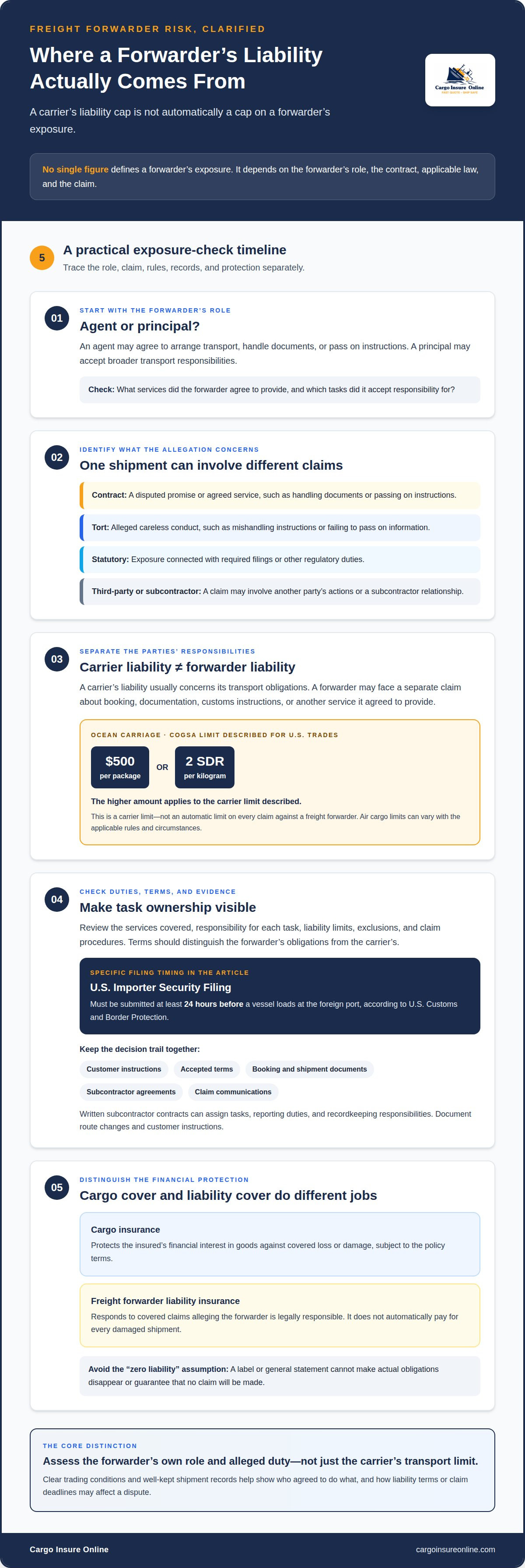
A freight forwarder’s exposure can arise from its promises, conduct, regulatory duties, or subcontractor relationships. One shipment can involve several potential claims. For example, a customer may allege that the forwarder ignored a booking instruction, while another party claims a loss during transport. The contract helps define the forwarder’s role, but it does not automatically resolve every allegation.
Contractual liability starts with the agreed service. A forwarder acting as an agent may promise to arrange transport, handle documents, or pass on instructions. A forwarder acting as principal may accept broader transport responsibilities. Review the wording for the services covered, responsibility for each task, liability limits, exclusions, and claim procedures. Terms should distinguish the forwarder’s obligations from the carrier’s. A general statement that the forwarder has “zero liability” may not reflect its actual obligations or prevent a claim.
Tort claims focus on alleged conduct, such as careless handling of instructions or failing to pass along information. Statutory exposure can arise where a shipment involves required filings. For US shipments, an Importer Security Filing must be submitted at least 24 hours before a vessel loads at the foreign port, according to U.S. Customs and Border Protection. If an agent prepares or transmits shipment information, clear task ownership and accurate records help show who handled each step.
Is it legal for U.S. freight forwarders to mark up insurance premiums or charge insurance fees? There is no universal yes-or-no answer. The charge structure, applicable state insurance rules, licensing, and contract disclosures all matter. Separate the insurance premium from any service charge, describe each clearly, and don’t present a forwarder’s fee as an insurer’s premium.
Offering cargo protection without claiming zero liability means explaining what protection is offered and who provides it. State whether the customer is buying cargo insurance or only receiving the forwarder’s liability terms. Describe the coverage, exclusions, claims process, and charges before the customer accepts. Don’t imply that a carrier’s liability limit insures the goods or that every loss is covered.
Selling insurance without the required licensing or disclosures can create compliance risks and disputes about what the customer believed was covered. A forwarder should define its role before discussing a policy and avoid implying it can perform regulated insurance activities without the necessary authority. Unclear roles can leave customers disputing responsibility after a loss.
Contract and record management make those roles visible. Keep customer instructions, accepted terms, booking details, shipment documents, subcontractor agreements, and claim communications together. Use written subcontractor contracts to assign tasks, reporting duties, and recordkeeping responsibilities. If a carrier or warehouse changes mid-route, document the change and the customer’s instructions. A dated decision trail can clarify what each party agreed to do.
Clear contracts and detailed shipment, agreement, and communication records help manage claims. Written subcontractor contracts are advisable. Freight forwarders typically need freight forwarder liability insurance to address legal and contractual risks.
Freight forwarder liability versus carrier liability
A carrier’s liability usually concerns its transport obligations. A forwarder’s exposure depends on its own role and promises. If a carrier damages cargo, the applicable liability framework may cap recovery. The forwarder may still face a separate claim over booking, documentation, customs instructions, or another service it agreed to provide. One shipment can therefore lead to distinct claims against different parties.
For ocean carriage, the applicable rules matter. Under the COGSA limit described for U.S. trades, carrier liability is capped at $500 per package or 2 SDR per kilogram, whichever is higher. Air cargo liability limits can vary depending on the applicable rules and circumstances. These are carrier limits, not automatic limits on every forwarder claim.
Consider an international shipment with damaged goods and a missing document. The carrier’s liability analysis may focus on damage during transport. The forwarder’s exposure may depend on whether it accepted responsibility for preparing or transmitting the document. Customs penalties or a customer’s third-party claim can raise separate issues. Trading conditions and shipment records help clarify each party’s obligations.
How does cargo insurance differ from freight forwarder liability insurance? Cargo insurance protects the insured’s financial interest in goods against covered loss or damage, subject to the policy terms. Freight forwarder liability insurance responds to covered claims alleging that the forwarder is legally responsible. It does not automatically pay for every damaged shipment.
How do freight forwarders compare cargo insurance providers, coverage, and claims service? They assess policy wording against the shipment’s cargo, transport mode, route, exclusions, limits, and claims process. A useful comparison also clarifies who handles claim notifications and which documents support a claim, such as invoices, transport records, and evidence of damage.
How do freight forwarders price and mark up cargo insurance for customers? Depending on the arrangement and applicable requirements, a charge may combine the insurer’s premium with a separately disclosed service fee or markup. The contract and invoice should identify each amount and explain what it covers. There is no single markup rule or standard figure for every transaction.
What are typical cargo insurance premiums and freight forwarder insurance markups? There is no single typical amount. Premiums depend on factors such as cargo value, transport mode, route, and selected coverage. Markups also vary by commercial arrangement, so disclose each charge clearly instead of implying it is part of the insurer’s premium.
Commercially, forwarders can differentiate by making protection easy to understand, matching it to shipment needs, and explaining claims steps before booking. For example, separate air, sea, and trucking options can make the customer’s choice clearer without confusing cargo coverage with carrier liability. Explore freight insurance options for shipments that need cargo protection.
The applicable framework can vary with the transport involved: transport is subject to national and international laws, and regulations for each transport mode limit the carrier’s liability. For air freight, carriers pay up to $24 per kilogram. These limits concern the carrier’s responsibility and do not by themselves determine a forwarder’s separate exposure.
Standard trading conditions and liability caps
Standard trading conditions define how a forwarder’s contractual responsibility may be limited. They can set liability caps, exclusions, notice requirements, and claim deadlines. Their effect depends on the agreed terms, the forwarder’s role, and applicable law. A cap is not a promise to pay that amount. It limits liability only when the contract and governing rules make it effective. A zero liability freight forwarder insurance mark up commercial strategy should describe these limits accurately, not suggest that every claim disappears.
A typical trading-condition cap for forwarder loss or damage is 2 SDR per kilogram. Under a weight-based cap, the maximum liability depends on the shipment’s weight and the applicable terms. The cargo’s actual value may be much higher. That gap shows why customers should distinguish the forwarder’s contractual liability from protection for the goods themselves.
Other transport frameworks use different measures. The Hague-Visby Rules set a sea-freight limit of 666.67 SDR per package or unit, or 2 SDR per kilogram of gross weight, whichever is higher. The CMR Convention sets a road-freight limit of 8.33 SDR per kilogram of gross weight. The Montreal Convention limit shown for air freight is 26 SDR per kilogram. These figures concern transport liability frameworks, not a universal forwarder-policy limit.
What coverage limits and exclusions apply to freight forwarder liability insurance in the United States? There is no single limit or exclusion set for every policy; wording, declared operations, and the selected limit determine the cover. A policy example uses a USD 500,000 limit, while exclusions and defence-cost treatment depend on its terms.
Read the limit alongside the defence-cost clause. If defence costs sit inside the main limit, legal expenses reduce the amount left for settlement. In one example, USD 100,000 in defence costs and a USD 450,000 claim exceed a shared USD 500,000 limit. If defence costs are outside the limit, the policy may treat them differently, subject to its wording.
Claim deadlines matter too. Typical standard trading conditions set time bars of 9 months for loss or damage claims and 14 days for delay claims. A late notice or missed deadline can complicate recovery, even where a party believes it has a valid claim. Keep the booking, delivery record, correspondence, and claim notice together.
Review these terms as a connected set. Check which parties the cap protects, how it applies to subcontracted operations, and whether delay, documentation errors, or particular cargo types receive different treatment. BIFA’s 2005 Standard Trading Conditions are for the exclusive use of its members. In the United States, read the contract with applicable national rules to assess actual exposure. A zero liability freight forwarder insurance mark up commercial strategy works best when its wording separates insurance charges from liability caps and explains each plainly.
Freight forwarder liability as agent versus principal
A freight forwarder’s role affects the obligations it may assume for a shipment. As an agent, it may book cargo with shipping lines, airlines, rail operators, or road carriers for an importer or exporter. Its core task is arranging transport on another party’s behalf. As a principal, it may undertake the transport itself and assume carrier obligations, increasing its potential liability exposure.
The contract is a starting point, not the only clue. Review what the forwarder promised, whose name appears on transport documents, and who selected and instructed the carrier. For example, a forwarder may arrange an ocean booking as an agent, then separately agree to deliver cargo using its own road transport. Those activities can create different responsibilities within one shipment.
Operational conduct also matters. If a forwarder takes control of transport, issues its own transport document, or accepts responsibility for delivery, a customer may argue that it acted as principal. Those details don’t decide every dispute on their own. They help explain the parties’ relationship alongside the written agreement and the events that caused the loss or damage.
Imagine a shipper asks a forwarder to book an airline and relay handling instructions. If the airline damages the cargo, the carrier’s conduct is central to its liability. If the forwarder transmits an incorrect instruction, a separate claim may focus on the forwarder’s own act. The agent label doesn’t erase responsibility for a task the forwarder agreed to perform.
Now consider a forwarder carrying goods using its own road transport. It is no longer only arranging another carrier’s service. It may have direct transport obligations, and its exposure can differ from an agent’s. For a multimodal shipment, map each leg separately: identify who arranged it, who physically carried the cargo, and which agreement governed that leg.
Cargo insurance addresses a different interest. It can protect the insured’s goods against covered loss or damage, while liability cover concerns claims alleging the forwarder is responsible. Neither “agent” nor “principal” automatically means the cargo is insured. When assessing a loss, separate coverage for the goods from each party’s potential legal responsibility.
For clearer decisions, forwarders can document their role at booking and preserve evidence as the shipment moves. Record customer instructions, carrier bookings, transport documents, subcontracting arrangements, and any change in responsibility. If the route changes from air to road, update the shipment record and communicate the change. A clear trail helps distinguish arranging transport from undertaking it.
For each claim, build a responsibility map: list the forwarder’s agreed tasks, the carrier’s transport role, and the act alleged to have caused the loss. Then compare that map with the contract and shipment records. This makes the agent-versus-principal distinction practical without assuming that a label alone settles liability.
What does zero-liability freight forwarder insurance mean?
“Zero liability” sounds absolute, but it isn’t a magic switch that erases a forwarder’s responsibilities. Freight forwarder liability insurance can respond to covered claims alleging legal responsibility. Whether a claim is covered depends on the policy wording, the forwarder’s role, and the incident.
Imagine a forwarder arranging an international shipment that arrives damaged. The customer may allege that the forwarder failed to follow an instruction, even if a carrier physically handled the cargo. Liability insurance may help address covered legal and contractual risks. It doesn’t automatically insure the goods or guarantee payment for every loss.
Covered incidents may include cargo damage, transit loss, customs fines or penalties, and third-party claims. Each category remains subject to the policy terms. A customs penalty claim, for example, may raise different questions from a claim that cargo was damaged during transport. The insured’s actions, contractual role, and policy exclusions all matter.
The phrase can also blur two separate ideas: limiting legal responsibility and transferring financial risk. A contract may set liability terms between the forwarder and customer. Insurance may respond when a covered claim alleges that the forwarder is legally responsible. Neither changes the other automatically. A liability cap doesn’t make cargo insured property, and insurance doesn’t erase every contractual promise.
For a practical assessment, match the alleged act to the policy and shipment record. If a customer alleges an instruction was mishandled, identify who received it, who acted on it, and what the contract required. If goods were lost in transit, separate the forwarder’s conduct from the carrier’s. This helps clarify whether the claim concerns the goods, the forwarder’s service, or both.
Then read the policy as a working document, not just a limit on a certificate. Review covered operations, exclusions, how defence costs are treated, claim notification requirements, and how subcontracted work is addressed. A forwarder arranging air transport may have different operational details from one arranging trucking. The policy’s definitions and conditions determine how those activities fit.
Clear customer communication matters too. Describe the forwarder’s role accurately, distinguish cargo protection from liability cover, and explain the claim process without promising an outcome. Customers should understand what protection is offered, what the contract says, and which conditions apply. That clarity can reduce disputes when a loss occurs.
For a commercial strategy, avoid selling “zero liability” as a guaranteed outcome. Explain the actual cover and its boundaries, then connect the customer’s shipment needs to a suitable cargo-protection option. Explore cargo insurance options to consider protection for goods moving by air, sea, or road.
Cargo Insure Online
Cargo Insure Online helps businesses manage cargo risks with insurance options for freight movement. Turn to it when carrier liability limits don’t match the financial protection your shipment needs, or when you want to distinguish cargo cover from a forwarder’s legal responsibilities.
Air Freight Insurance, Sea Freight Insurance, Trucking Insurance, and GAP Insurance address different points in shipping and the supply chain. The right fit depends on the transport mode and the risk you want to address. Clear coverage terms help you make an informed choice without treating liability as zero or assuming every loss is covered.
For a clearer next step, contact Cargo Insure Online to discuss cargo protection for your freight needs.
Make the Next Shipment Decision With Clarity
Use your exposure assessment to shape a protection approach that fits how your business arranges freight. A commercial strategy for freight forwarder insurance mark-ups should never rely on promising zero liability. Clear terms, transparent charges, and a distinction between cargo protection and legal responsibility give customers a sound basis for deciding.
Cargo Insure Online offers Air Freight Insurance, Sea Freight Insurance, and Trucking Insurance for businesses seeking cargo protection across transport modes. Consider which shipments need cover and how that fits your customer communication and commercial approach.
Contact Cargo Insure Online today to discuss cargo protection for your freight needs. A clearer approach starts with the right conversation.
Frequently Asked Questions
How Do You Quantify Your Actual Liability Exposure?
Build an exposure estimate from the claims your operations could generate, then test each against contracts and insurance. For a shipment, record the service promised, parties involved, potential loss, applicable cap, policy limit, deductible, and treatment of defence costs. Then model a scenario where the claim exceeds available protection. A separate review of recurring operational issues, such as booking or document errors, can help identify controls to reduce future exposure.
Who is liable when cargo is damaged or lost under U.S. freight forwarding law?
Responsibility depends on who handled the cargo, what each party agreed to do, and what caused the loss. A carrier may face a claim for damage during transport; a forwarder may face a separate claim over its own booking, instructions, or other promised service. Preserve the bill of lading, delivery record, damage evidence, and communications. These details help distinguish the carrier’s conduct from the forwarder’s role and assess the relevant contract.


