
Could a single watch shipment carry more value than the protection attached to its carrier booking? For dealers, brands, and logistics teams, that gap can turn a small parcel into a significant financial exposure. Luxury watch freight transit insurance can help protect eligible cargo against covered losses during transit, based on the shipment’s value and subject to the policy terms.
Careful packing and a reputable carrier can help reduce risk, but they don’t make carrier liability equal to a watch’s full value. The practical safeguards are to document the item and its condition, map the shipment’s route, and arrange cover that fits the movement.
This guide explains how to assess luxury watch freight transit insurance, identify potential coverage gaps, and build a repeatable protection workflow. You’ll learn what to record before a watch moves, how route and transport mode affect your review, and why policy wording governs eligibility, valuation, exclusions, and claim evidence. For repeat freight shipments, Cargo Insure Online’s digital quote, policy issuance, and downloadable certificate process can make arranging cargo cover easier to manage.
Key Takeaways
- Assess luxury watch freight transit insurance against the shipment’s value, route, and applicable policy terms.
- Compare carrier liability, cargo insurance, and self-retained exposure to identify potential gaps.
- Use a repeatable pre-shipment checklist for valuation details, condition records, and transport documents.
- Policy wording determines eligible events, valuation, exclusions, and the evidence needed for a claim.
- CIO’s online quote-to-certificate workflow helps organize cover administration for repeat freight shipments.
Why luxury watch freight transit insurance needs a shipment-specific view
A small package can hold a watch with substantial commercial value. That mismatch between physical size and shipment value makes a one-size-fits-all approach unhelpful. Luxury watch freight transit insurance is cover for eligible cargo losses during a covered movement, subject to the policy’s terms, conditions, exclusions, and valuation basis. The shipment details matter: what is being sent, how it travels, and which stages are included in the cover.
Freight insurance is part of the broader category of shipping insurance. For a shipper, the practical question is whether cover applies to this watch and its route. A watch sent directly to a buyer and a consignment passing through several freight stages can have different handling and documentation needs. Start with the actual movement, not just the item category.
Which watch-shipment risks should freight teams consider?
Loss, theft, accidental damage, and transit incidents are possible exposures, not inevitable outcomes. A watch may pass through collection, sorting, storage, transfers between transport modes, and final delivery. At each handoff, consistent shipment identifiers, custody records, and condition documentation can help establish what happened if a problem is reported.
Keep the distinction clear: physical loss or damage during a covered movement is different from a buyer dispute, dissatisfaction after delivery, or a change in market value. Freight cover addresses eligible cargo loss under its policy terms. It isn’t a substitute for personal watch insurance, and a commercial disagreement doesn’t automatically qualify as a transit loss.
How does freight insurance differ from carrier liability?
Carrier liability is the carrier’s responsibility under applicable terms; cargo insurance is cover intended to protect eligible cargo value under a separate policy. A carrier’s liability terms may limit or define recovery and may not match the value of a luxury watch. Don’t assume that declaring a shipment’s value makes carrier liability equivalent to cargo insurance.
Cargo cover can be arranged around the insured cargo value, subject to the policy’s valuation basis, eligibility, exclusions, and conditions. This distinction helps a shipper assess the potential gap between what a carrier may owe under its terms and the financial interest in the watch itself. It also makes accurate shipment information essential: the value, route, transport mode, and movement details should align with the policy.
For an air movement, consider how the air-freight stage fits into the overall transit plan. The air freight insurance guide adds mode-specific context. A shipment-specific review changes the question from “Is the watch insured?” to “What movement, value, and loss scenarios does this cover address?”
What luxury watch cargo insurance can cover, and what policy terms decide
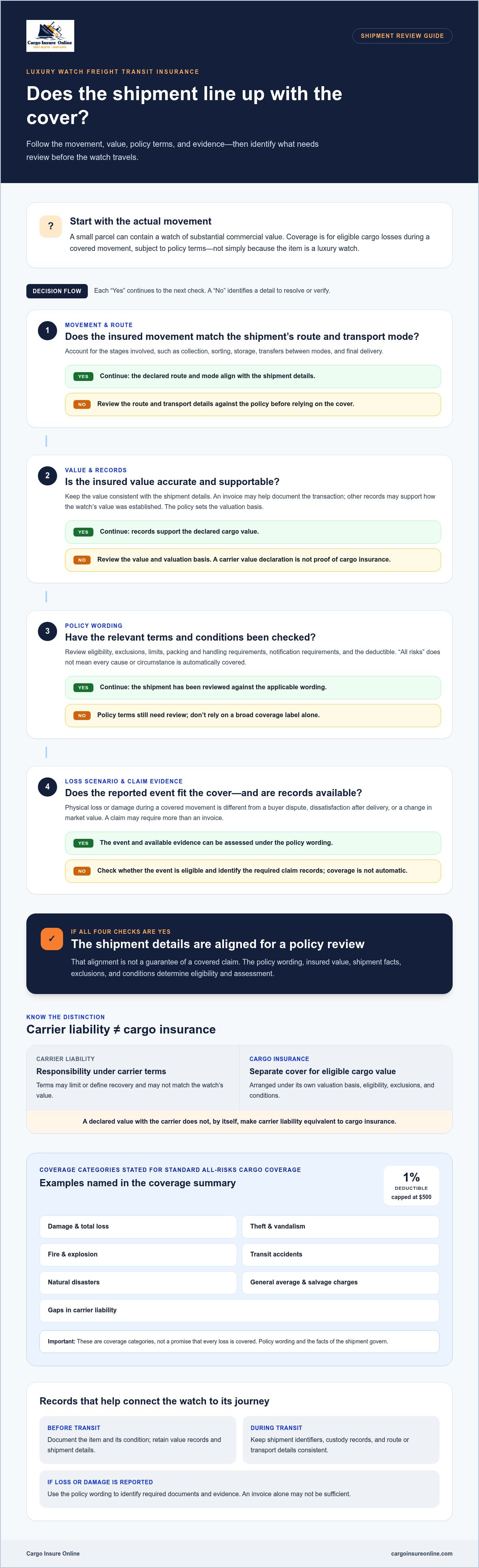
Luxury watch freight transit insurance can protect eligible cargo against covered losses during transit. Cargo Insure Online’s standard all-risks cargo coverage includes damage, total loss, theft, vandalism, fire, explosion, and transit accidents. Stated coverage features also include natural disasters, general average, salvage charges, and gaps in carrier liability. These are coverage categories, not a promise that every loss will be covered.
The policy wording, insured value, and facts of the shipment determine whether a claim is covered and how it is assessed. “All risks” doesn’t mean every cause, circumstance, or type of loss is automatically included. Eligibility, exclusions, limits, conditions, and the specific movement all matter. Use the policy wording as the operating guide, not just the coverage summary.
How should shippers think about declared value and insured value?
Arrange cover using an accurate, supportable cargo value. An invoice may help document the transaction, while other records can support how the watch’s value was established. Keep these materials consistent with the shipment details submitted for insurance. The applicable policy wording determines the valuation basis, so don’t assume one formula applies to every shipment.
A carrier’s declared-value procedure is separate from setting insured value under a cargo policy. The carrier’s terms govern its liability process, while cargo insurance is arranged under its own terms. A declaration to the carrier shouldn’t be treated as proof that the watch has cargo cover for the same amount or circumstances.
Which exclusions and conditions deserve attention?
Before the watch moves, review the policy’s exclusions, packing requirements, deductible, and claim conditions. These details affect how coverage applies and what records may be needed if loss or damage occurs. Don’t rely on a broad “all risks” label alone. Check how the wording applies to the particular shipment, its route, and the evidence needed to support a claim.
For a practical review, focus on the details that connect the policy to the shipment:
- Covered movement: Check that the declared transport mode and route align with the insured shipment.
- Valuation: Confirm the insured value and the policy’s basis for assessing it.
- Conditions: Note any packing, handling, or notification requirements stated in the wording.
- Claim records: Understand which documents and evidence the policy requires. Don’t assume an invoice alone will be sufficient.
The deductible is 1%, capped at $500. Review how it applies alongside the policy’s other conditions before arranging cover. For a closer look at freight cover and its terms, explore Cargo Insure Online cargo insurance as part of your shipment planning.
Compare watch freight insurance options by value, route, and workflow
Choosing protection starts with the shipment’s value and planned movement. Carrier liability, cargo insurance, and self-retained exposure work differently. Compare them by the losses they may respond to, how they apply to the route, and the records you’ll need. Luxury watch freight transit insurance should fit the actual shipment, not just the fact that it contains a watch.
Use this comparison as a starting point. Carrier terms and cargo policy wording control the details, including limits, covered events, and claim conditions.
| Option | Value and covered events | Modes and evidence | Administration |
|---|---|---|---|
| Carrier liability | Recovery is governed by applicable carrier terms and may not match the watch’s commercial or declared value. | Applies to the carrier’s service and terms. Retain shipment, handoff, condition, and loss records. | Follow the carrier’s reporting and claim process. |
| Cargo insurance | Cover can be arranged around insured cargo value, subject to policy terms and eligible events. | Air, sea, truck, and courier movements can be insured, with route and shipment facts relevant to review. | Arrange cover for the movement and retain the certificate and supporting shipment records. |
| Self-retained exposure | The shipper bears eligible financial loss that isn’t recovered elsewhere. | Applies to any mode chosen, with internal records still useful for assessing the loss. | No insurance arrangement, but the business manages the financial impact and records. |
When can carrier liability leave a value gap?
Hypothetical example: A business ships a watch whose commercial value is higher than the amount recoverable under the carrier’s applicable terms. If the shipment is lost, the carrier may assess liability under those terms rather than reimburse the full commercial value. The carrier might respond, but the outcome and amount depend on its obligations and the facts. Cargo insurance may address a separate value gap, subject to policy terms and claim assessment.
How does transport mode change the insurance decision?
Air, sea, truck, and courier movements can involve different handling steps, transfers, and policy details. A direct courier delivery may have a different custody trail from a sea movement followed by truck transport. Map each leg, identify the parties handling the shipment, and align records with the insured route. For air movements, the electronics shipping insurance guide offers adjacent context for high-value cargo. Sea shippers can also review sea freight insurance details.
Before selecting an approach, match the stated value, route, and handoff records to the cover being considered. Keep invoices, shipment documents, condition records, and relevant carrier communications together. This gives you a clearer trail for reviewing a loss and helps make repeat shipping decisions more consistent.
Prepare a luxury watch shipment with a repeatable insurance checklist
A consistent pre-dispatch routine connects the watch, its declared details, and the records that may help explain a loss. Keep the process simple enough to repeat, but specific to each movement. This is how luxury watch freight transit insurance becomes an operational workflow, not just a policy document.
- Identify the shipment. Record the watch identity, quantity, shipment reference, destination, transport mode, and planned route. Use the same identifiers across internal records and shipping documents.
- Establish the value. Record a supportable commercial value and retain the invoice or other relevant valuation documents. Make sure the insured declaration matches the shipment details and applicable policy wording.
- Review the policy terms. Check that the movement details align with the cover. Review relevant conditions, exclusions, packing requirements, and claim instructions before dispatch.
- Document condition. Photograph the watch clearly before packing. Note its condition and link the images to the shipment reference.
- Retain the records. Store the policy documentation, certificate, invoice, photographs, packing records, shipping documents, and handoff records together in an accessible file.
Secure, discreet packaging is a sensible risk-control measure. It can help protect the watch and avoid drawing unnecessary attention, but it doesn’t replace insurance or change what a policy covers. Record how the item is packed and retain that information with the shipment file.
What should the shipper document before dispatch?
Build one clear record for each shipment. Capture the watch identity, quantity, condition, commercial value, and shipment references consistently. Keep photographs, invoices, packing details, and transport documents together, then match them to the insured declaration and policy documentation. A connected evidence trail is easier to use than searching across inboxes if questions arise.
What should teams do if loss or damage occurs?
Act promptly. Preserve the packaging, shipping documents, photographs, and any available handoff or condition records. Record what was observed and when, and notify the relevant parties in line with the applicable policy and carrier requirements. Follow the specific claim instructions in those documents. Requirements vary, so don’t assume a particular deadline or that a claim will automatically be approved.
For repeat shipments, a digital quote-to-certificate process can make the insurance step easier to build into dispatch. Cargo Insure Online provides online quoting, policy issuance, and downloadable certificates. Get a cargo insurance quote and certificate as part of your shipment workflow.
Arrange luxury watch freight transit insurance online with CIO
Once shipment details and records are organized, arranging cover can become a repeatable part of dispatch. Cargo Insure Online offers standard all-risks cargo coverage for freight movements by air, sea, truck, and courier, subject to applicable policy terms. For luxury watch freight transit insurance, enter details that reflect the movement you’re arranging. Policy wording governs eligibility and cover for the shipment.
How does CIO's online cargo insurance process work?
Create a free account, enter the shipment details, review a real-time quote, and purchase online. After policy issuance, download the certificate for your shipment records. Keep it with the corresponding invoice, packing details, and transport documents so the insurance record stays connected to the freight movement it describes.
Before purchasing, check that the information entered matches the planned shipment, including its value, route, and transport mode. A certificate is useful documentation, but it doesn’t replace the policy wording. Review the applicable terms and conditions to understand what the cover includes and what requirements apply. Online access makes arranging cover more direct, but it doesn’t mean every watch shipment is automatically eligible or every claim will be paid.
How can logistics teams scale insurance administration?
Repeat shipments need a process teams can follow consistently. A shared workflow can connect quote details, policy documents, certificates, and shipment references, helping staff locate the right records without rebuilding the file for each dispatch. CIO also offers API and White-Label integration for logistics businesses and agents, allowing cargo insurance functionality to connect with their platforms or customer-facing workflows.
Keep responsibilities clear across the team: decide who enters shipment information, who checks it against dispatch records, and where certificates are stored. For integrated workflows, align the data passed through the system with the information needed to arrange cover. This helps reduce mismatches between the shipment and its insurance documentation.
Build the quote and certificate step into the same process as shipment preparation. For a single movement, enter accurate details and retain the issued documents. For recurring freight, use a consistent routine across air, sea, truck, and courier shipments while reviewing each movement on its own terms.
Explore a cargo insurance quote for your watch shipment. A clear online process supports the workflow, while the right protection still depends on the shipment facts and applicable policy terms.
Build protection into your next shipment
Make insurance part of the shipping decision, not a task left until the watch is already moving. An internal checkpoint can help your team pause when the declared value, route, transport mode, or handling plan changes. That keeps each shipment’s protection aligned with the movement being arranged, rather than relying on a process built for a different consignment.
For teams shipping regularly, consistency matters as much as speed. Decide who enters shipment details, who reviews them against the planned movement, and where the resulting documents are kept. With that routine in place, luxury watch freight transit insurance is easier to manage as operations evolve, while policy wording remains the guide to what applies.
Take the next step by arranging cover for your planned shipment. Cargo Insure Online’s platform lets you move from quote to policy documents online, helping your team keep the process clear and organized. Get an instant cargo insurance quote and make it part of your watch-shipment workflow.
Frequently Asked Questions
Does luxury watch freight transit insurance cover theft and accidental damage?
Yes. Cargo Insure Online’s standard all-risks cargo coverage includes theft and damage, subject to policy terms and shipment eligibility. If a watch is reported missing after a documented handoff or arrives with impact damage, preserve the packaging and record what you observe. Take photographs and keep delivery records. The policy wording and circumstances of the claim determine whether coverage applies.
Is carrier liability enough to protect a luxury watch shipment?
Not necessarily. Carrier liability is determined by the carrier’s applicable terms, which may not provide recovery equal to the watch’s commercial value. A carrier may assess a loss under its own liability rules even when the watch’s documented value is higher. Compare those terms with the shipment’s financial exposure, then consider whether separate cargo cover fits the movement and value. Neither recovery nor an insurance payment is automatic.
How do I insure a luxury watch shipment by air, sea, truck, or courier?
Provide accurate details for the shipment’s value, origin, destination, transport mode, and route, then review the applicable policy terms before arranging cover. If the journey uses more than one mode, include the relevant legs and transfers in the shipment information. Keep the resulting policy documents with the transport records. Air, sea, truck, and courier movements can be insured, but their handling and policy details may differ.
What documents should I keep when shipping a luxury watch?
Keep records that connect the watch to its shipment: an invoice or valuation support, clear condition photographs, packing details, shipping documents, and carrier handoff or delivery records. Use the same shipment reference across the file so the documents can be matched quickly. For a consignment containing multiple watches, record each item and quantity clearly. The applicable policy wording determines what evidence is required for a claim.
Can I insure multiple luxury watch shipments through an online cargo platform?
An online cargo platform can support repeat shipment workflows, but don’t assume one shipment entry automatically covers every later consignment. Enter accurate details for each movement and retain the corresponding policy documentation. CIO’s multi-user platform supports team workflows, while API and White-Label integration can connect insurance functionality with broker or logistics platforms. Each shipment’s cover remains subject to its applicable policy terms and details.
How quickly can I get a cargo insurance quote and certificate?
CIO provides real-time online quotes, immediate policy issuance after purchase, and downloadable certificates. Its quote engine describes quote generation as “less than 0 seconds.” To keep the process moving, have the shipment’s route, mode, value, and reference details ready. Review the quote and applicable policy terms before purchasing, then save the certificate with the matching shipment records.
What should I do if a luxury watch is lost or damaged during freight transit?
Notify the carrier and insurer promptly, following the procedures and requirements in their applicable documents. Record when and where the issue was identified, and preserve the packaging, photographs, delivery records, and handoff information. Avoid discarding or altering relevant evidence where practicable. The policy wording and carrier process determine the required claim steps and documentation, so follow those instructions rather than assuming a deadline or outcome.


