

A “delivered” scan lands, but the customer says there’s no package. Is it porch piracy, or did the shipment go missing while the carrier still had it? The answer to e-commerce porch piracy vs in transit carrier delivery dispute insurance starts with one detail: when and where the shipment disappeared.
That uncertainty can lead to a slow investigation, refund pressure, and a frustrated customer. A delivery scan, carrier liability, and cargo insurance don’t automatically point to the same outcome. The records and applicable policy terms matter, so keep the carrier dispute separate from the insurance review.
This guide explains how to classify a missing shipment by its custody stage, what records to preserve, and how to compare protection options without assuming every loss is covered. Start with the timeline, then match the next step to what the records show. For future shipments, e-commerce cargo insurance can provide a separate layer of protection alongside carrier processes, subject to the policy terms.
Key Takeaways
- Classify the incident by when the shipment disappeared: after a recorded delivery, at a possibly incorrect location, or before confirmed delivery.
- A delivery scan records a carrier event. It doesn’t automatically prove the recipient physically received the package.
- Keep order details, tracking history, delivery records, customer communications, and shipment value documents together.
- Separate the carrier dispute from the insurance question. Each process considers different records, terms, and circumstances.
- Use the e-commerce porch piracy vs in transit carrier delivery dispute insurance framework to compare protection options, and review policy wording before assuming post-delivery theft is covered.
Porch Piracy vs. an In-Transit Delivery Dispute: Where Did the Shipment Go Missing?
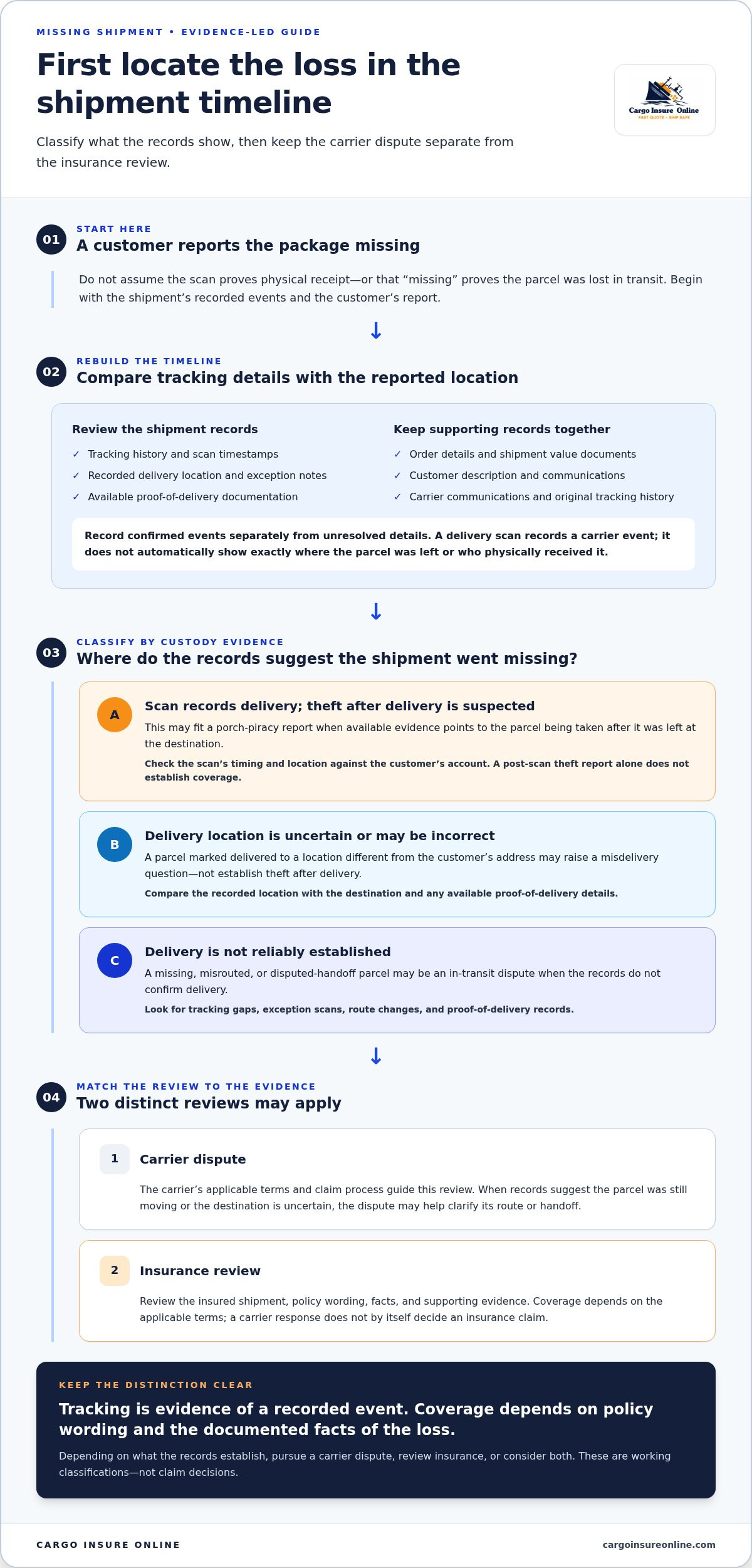
The key difference is the shipment’s recorded delivery status. Porch piracy is suspected theft after tracking records delivery. An in-transit dispute concerns a parcel that goes missing, is misrouted, or has an uncertain handoff before delivery is established. A scan helps build the timeline, but it doesn’t automatically prove the recipient physically received the package.
Porch piracy case: Tracking records delivery, and available evidence points to the parcel being taken after it was left at the destination.
In-transit dispute: Delivery hasn’t been reliably established, and the records leave open whether the parcel was lost, misrouted, or handed off elsewhere.
These are working classifications, not claim decisions. The scan’s timing and location, along with supporting records, help show what may have happened. They don’t resolve every question about custody. For a useful overview of the term, Package theft, often referred to as porch piracy, describes theft of parcels after delivery.
Start with custody because the timeline helps identify the relevant review path. If records suggest the shipment was still moving or the destination is uncertain, a carrier dispute may help clarify the route or handoff. An insurance review is separate: the applicable policy wording, the facts, and the supporting evidence determine whether the loss falls within coverage. Depending on the records, you may need to pursue a carrier dispute, review insurance, or consider both. The e-commerce porch piracy vs in transit carrier delivery dispute insurance question is less about the label and more about what the evidence can establish.
What counts as porch piracy after a delivery scan?
A customer may report a parcel missing after tracking shows it was delivered to a doorstep, lobby, or mailroom. Theft is one possibility, but not the only one. The parcel may have been left at the wrong address, placed somewhere inaccessible, or marked delivered before the handoff actually occurred. Compare the scan’s details with the reported delivery location and any available proof-of-delivery records. A post-scan theft report alone doesn’t establish insurance coverage. The policy wording and evidence matter.
What makes a missing parcel an in-transit dispute?
A parcel may be missing, misrouted, or subject to a disputed handoff while delivery remains unconfirmed. Look for tracking gaps, exception scans, route changes, and proof-of-delivery records. For example, a delivery scan that identifies a location different from the customer’s address may raise a misdelivery question rather than establish theft after delivery. Carrier procedures guide the dispute process, while policy terms govern an insurance review. Keep those reviews distinct, even when they rely on some of the same records.
Build the timeline from the earliest shipment record through the customer’s report. Note what tracking actually shows, where delivery was recorded, and whether the records support that location. Don’t treat “delivered” as the end of the investigation, or “missing” as proof the parcel was lost in transit. Separate confirmed events from unresolved details, then match the next step to the evidence.
Why a Delivery Scan Does Not Resolve Every E-Commerce Insurance Dispute
A delivery scan is one piece of the record, not a verdict. It shows that a carrier recorded a delivery event, but by itself may not establish exactly where the parcel was left, who received it, or whether the goods were physically in the customer’s possession. A clear review separates three questions: what the tracking records show, what the carrier’s dispute process considers, and what the insurance policy covers.
Tracking is evidence of a recorded event; coverage depends on policy wording and the documented facts of the loss. This distinction prevents a scan from being treated as automatic proof of possession, and a carrier’s decision from being mistaken for an insurance decision.
How to read tracking and proof-of-delivery records
Review scan timestamps, the recorded delivery location, exception notes, and any available proof-of-delivery documentation. Then compare those details with the customer’s report. A scan for a mailroom, for example, may conflict with a report that the building has no accessible mailroom. Neither record alone settles the disagreement, but the mismatch shows what needs investigation.
Preserve the original tracking history and carrier communications. Save the order details and the customer’s description, too. These records help establish the sequence of events without relying on a later summary or assuming either account is conclusive.
Carrier liability and cargo insurance answer different questions
A carrier liability claim is considered under the carrier’s applicable terms and claim process. Cargo insurance is reviewed against the insured shipment, the policy wording, and evidence of the loss. The reviews may use overlapping records, but they aren’t interchangeable. A carrier’s response doesn’t, by itself, determine whether an insurance claim meets the policy terms.
This distinction matters when carrier liability doesn’t match the shipment’s documented value. Cargo Insure Online’s standard all-risks Cargo Insurance provides full-value cargo protection and addresses gaps in carrier liability, subject to the policy wording and facts. It isn’t an automatic supplement to every carrier decision, and it shouldn’t be assumed to cover a parcel simply because tracking says “delivered.” For high-value devices, the shipment’s contents and value also shape the evidence needed. This guide to electronics shipping insurance explores that consideration.
For broader context on how cargo risks and insurance relate during transportation, see Understanding cargo in-transit risks and insurance coverage. Review the carrier process and policy wording side by side, but assess each on its own terms. That’s the heart of e-commerce porch piracy vs in transit carrier delivery dispute insurance: match the records to the right review rather than treating one scan or claim outcome as the whole story.
- Tracking record: What event, time, and location does it document?
- Carrier review: What does the carrier’s process consider about the reported loss?
- Insurance review: What do the policy wording, insured shipment details, and evidence support?
Organizing those three threads can make the next step clearer. For shipments where carrier liability may leave a value gap, explore e-commerce cargo insurance as a separate layer of protection. Any claim is assessed under the applicable policy terms.
Compare Porch Piracy, Misdelivery, and In-Transit Loss Side by Side
Start with the incident pattern, then line up the records that support or challenge it. This comparison helps identify a relevant first review without treating a category as a finding. A scan, customer report, or carrier response may clarify the timeline, but none alone decides responsibility or insurance coverage.
| Incident pattern | Timing | Likely evidence | First review path | Insurance question |
|---|---|---|---|---|
| Post-scan theft | Tracking records delivery before the parcel is reported missing. | Scan details, reported delivery location, customer statement, and any available delivery evidence. | Review the delivery record and the customer’s report; assess the carrier’s process if the handoff is disputed. | Do the policy wording and documented facts address the reported loss after the recorded delivery? |
| Possible misdelivery | A delivery event is recorded, but the parcel may have been left at a different or inaccessible location. | Recorded drop-off location, order delivery details, proof-of-delivery records, and customer communications. | Compare where the carrier recorded delivery with the destination on the order. | How do the policy terms apply to the facts established about the shipment’s location and custody? |
| Loss or damage before confirmed delivery | The parcel goes missing, is misrouted, or is reported damaged before delivery is established. | Tracking history, exception records, carrier communications, and shipment documentation. | Use the carrier’s applicable dispute process to examine the shipment’s route or handoff. | Does the cargo policy apply to the reported loss or damage, based on its wording and the evidence? |
Match the incident pattern to the records available
For a post-scan theft report, preserve the scan details alongside the customer’s account and any available delivery evidence. For suspected misdelivery, compare the recorded drop-off location directly with the order’s delivery details. For a possible in-transit loss, gather the full tracking history, exception records, and carrier communications. The goal is to identify what the records establish, not to force an uncertain case into a convenient label.
Compare the carrier dispute route with insurance review
A carrier dispute examines the shipment under the carrier’s process and applicable terms. An insurance review considers the insured shipment, policy wording, and evidence. Cargo coverage may address stated gaps in carrier liability, subject to those terms. A carrier response doesn’t replace a policy review. For international selling, cross-border e-commerce insurance adds another useful lens for understanding how shipment context fits into a protection plan.
Facts can overlap. A delivery scan may exist even when its location is disputed, or tracking may show movement while the final handoff remains unclear. Preserve the records and review both relevant processes when the evidence raises questions for each. This is the practical value of e-commerce porch piracy vs in transit carrier delivery dispute insurance: organize the evidence by incident type, then assess carrier responsibility and coverage separately. The table is a starting point, not a claim outcome.
Use This Evidence Checklist Before You File a Delivery Dispute
A tidy case file makes it easier to explain what happened without turning a customer report into a proven fact. For e-commerce porch piracy vs in transit carrier delivery dispute insurance, build a neutral record first, then route the case based on the timeline and applicable terms. Keep confirmed events, reported details, and open questions clearly separate.
- Record the report. Note when the customer notified you, what they said was missing or damaged, and where they expected the parcel to be. Label this as a customer report, not a confirmed cause or location of loss.
- Establish the timeline. Record dispatch, carrier scans, delivery status, the customer notification, and when the customer says they discovered the issue. Mark gaps or conflicting timestamps for follow-up.
- Preserve the source records. Save order details, the original tracking history, delivery records or proof of delivery, carrier communications, and relevant customer messages. Keep copies together so the sequence can be reviewed without relying on memory.
- Document shipment value. Retain the invoice, order confirmation, and other records that show what was shipped and its value. These details help identify the shipment under review and support an insurance assessment where applicable.
- Classify the incident and review terms. Decide whether the records point to post-scan theft, possible misdelivery, or loss or damage before confirmed delivery. Then review the carrier’s dispute process separately from the applicable policy wording.
Build a clean shipment and incident timeline
Use one case log with separate fields for confirmed events, customer-reported details, and unresolved questions. For example, list a delivery scan as a recorded event, the customer’s statement that nothing arrived as a report, and the actual drop-off location as unresolved if records don’t establish it. Save original records and messages, and flag discrepancies rather than filling gaps with assumptions.
Route the case using facts, not assumptions
Recorded delivery status helps identify the likely review path, but it doesn’t settle the claim. A post-delivery scan with an uncertain drop-off may call for a closer look at the delivery record; no confirmed handoff may point toward an in-transit dispute. Carrier requirements and insurance terms are separate, so review the relevant documents for each process. Don’t assume one review replaces the other.
For shipments that need a cargo protection layer, Cargo Insure Online provides e-commerce cargo insurance. Coverage is assessed under the applicable policy wording and evidence. You can get an instant Cargo Insurance quote online. A quote or policy doesn’t determine the outcome of a specific missing-package claim; the documented facts and policy terms remain central.
How Cargo Insure Online Fits Into an E-Commerce Protection Plan
Carrier procedures and insurance serve different roles in a shipment protection plan. Cargo Insure Online’s e-commerce cargo insurance provides standard all-risks Cargo Insurance for e-commerce cargo, with full-value cargo protection. Its stated coverage includes theft and gaps in carrier liability, subject to the applicable policy wording, shipment facts, and evidence. That doesn’t mean every theft after a delivery scan, including every porch-piracy report, qualifies for coverage. The policy terms determine how a specific loss is reviewed.
Think of cargo insurance as a separate layer to assess alongside the carrier’s dispute process. A carrier review considers the shipment under the carrier’s applicable terms. An insurance review considers the insured goods and the circumstances against the policy. Keep records for each pathway organized, even where both reviews draw on the same tracking history or delivery documents.
What to compare with carrier processes
Before relying on coverage, compare the shipment’s insured value with your order and shipping records. Then review which events the policy covers, what exclusions apply, and the relevant coverage period. Pay close attention to how the wording addresses theft and gaps in carrier liability. Those features are useful to understand, but they don’t establish that a particular incident is covered. The facts and policy terms still matter.
For example, a carrier may record delivery while the recipient reports the parcel missing. That scan can be relevant to a carrier inquiry, but the insurance question is whether the documented circumstances fall within the policy. Keep the carrier file and insurance records distinct: record carrier communications in the dispute file, and retain the policy and shipment documentation for insurance review. The workflows may relate to the same event without being interchangeable.
Get an online quote and keep shipment records ready
The platform lets e-commerce businesses create a free account, obtain a real-time quote, purchase coverage online, and download a certificate. Policy issuance is immediate after purchase. There are no upfront fees; customers pay only when they insure. Keep order details, shipment value documentation, and relevant carrier records accessible so the coverage information and shipment file are easy to organize.
Use the quote process to evaluate cargo insurance as part of your protection plan, not as a shortcut around classifying a loss. If a shipment goes missing, assess the carrier process and the policy separately. A certificate documents the policy, while the applicable wording and evidence guide review of a reported claim.
For another perspective, revisit the e-commerce porch piracy vs in transit carrier delivery dispute insurance distinction: determine what the records show, then assess the relevant carrier and insurance pathways on their own terms. Get an instant Cargo Insurance quote.
Make Shipment Protection Part of Your Next Decision
Turn each missing-package case into a clearer decision point. Use what you learn to refine how your team records shipment details, responds to customer reports, and reviews protection before the next order ships. A consistent process can help keep a confusing delivery event from becoming a confusing insurance review.
That’s the practical value of understanding e-commerce porch piracy vs in transit carrier delivery dispute insurance: let the evidence and policy guide your next step, not just a tracking label. Cargo Insure Online Cargo Insurance is underwritten by A-rated insurers. Any claim remains subject to applicable policy wording, facts, and evidence.
Ready to evaluate cargo coverage for your shipments? Get an instant Cargo Insurance quote and take a clear next step toward a more deliberate protection plan.
Frequently Asked Questions
Is porch piracy covered by e-commerce cargo insurance?
It may be, but coverage depends on the policy wording, insured period, circumstances, and evidence. Cargo Insure Online’s Cargo Insurance includes theft coverage; that doesn’t mean every post-delivery theft qualifies. For the e-commerce porch piracy vs in transit carrier delivery dispute insurance question, review how the applicable policy addresses the shipment and reported loss. Keep delivery records, the customer’s report, and shipment documentation together for review.
Does a delivered tracking scan prove the customer received the package?
No. A scan records a carrier event, but it may not establish who physically received the parcel or exactly where it was left. Review the scan’s timestamp and location, along with any available proof-of-delivery information, then compare those details with the customer’s report. For instance, a scan showing delivery to a shared lobby doesn’t, by itself, establish that the customer took possession of the package.
What should an e-commerce seller do when a customer reports a missing delivery?
Start by logging the report and preserving the order’s tracking history, delivery details, and related messages. Compare the recorded destination with the address on the order and note any signs of possible misdelivery. Keep confirmed events separate from assumptions, such as whether someone took the parcel. Then review the carrier’s dispute process and the applicable insurance wording. Follow the relevant documents for next steps; don’t assume deadlines or outcomes.
Can a merchant pursue a carrier dispute and an insurance review at the same time?
Both may be relevant, depending on the incident and the applicable terms. The carrier process examines the shipment under the carrier’s rules, while an insurance review considers the policy and evidence. Keep separate, organized records of submissions, responses, and supporting documents for each route. Starting one review doesn’t determine the other’s result, so assess each on its own terms.
What evidence helps distinguish porch piracy from an in-transit loss?
Gather the tracking history, delivery scans, available proof-of-delivery information, customer communications, order details, and shipment value records. A delivery scan may focus attention on what happened after the recorded event, while tracking gaps or exception notes may leave the transit stage uncertain. Compare each record with the customer’s account and note discrepancies. This evidence can help classify the incident, but it doesn’t decide coverage or responsibility by itself.
Does cargo insurance replace a carrier delivery dispute?
No. Cargo insurance and a carrier dispute are separate review routes, not automatic substitutes. Carrier liability is assessed under the relevant carrier terms; insurance is assessed under the policy wording and evidence. Cargo Insure Online’s Cargo Insurance provides full-value protection and addresses carrier-liability gaps, subject to policy terms. A merchant can still review the carrier process and shouldn’t assume every loss qualifies for insurance.
How can an online seller get cargo insurance for shipments?
Create a free account with Cargo Insure Online, get a real-time quote, and purchase online using a credit card or e-wallet. The platform provides immediate policy issuance and a downloadable certificate. There are no upfront fees; customers pay only when they insure. Keep shipment details and value information handy while arranging coverage, then review the issued policy wording so you understand the terms that apply to the shipment.


