

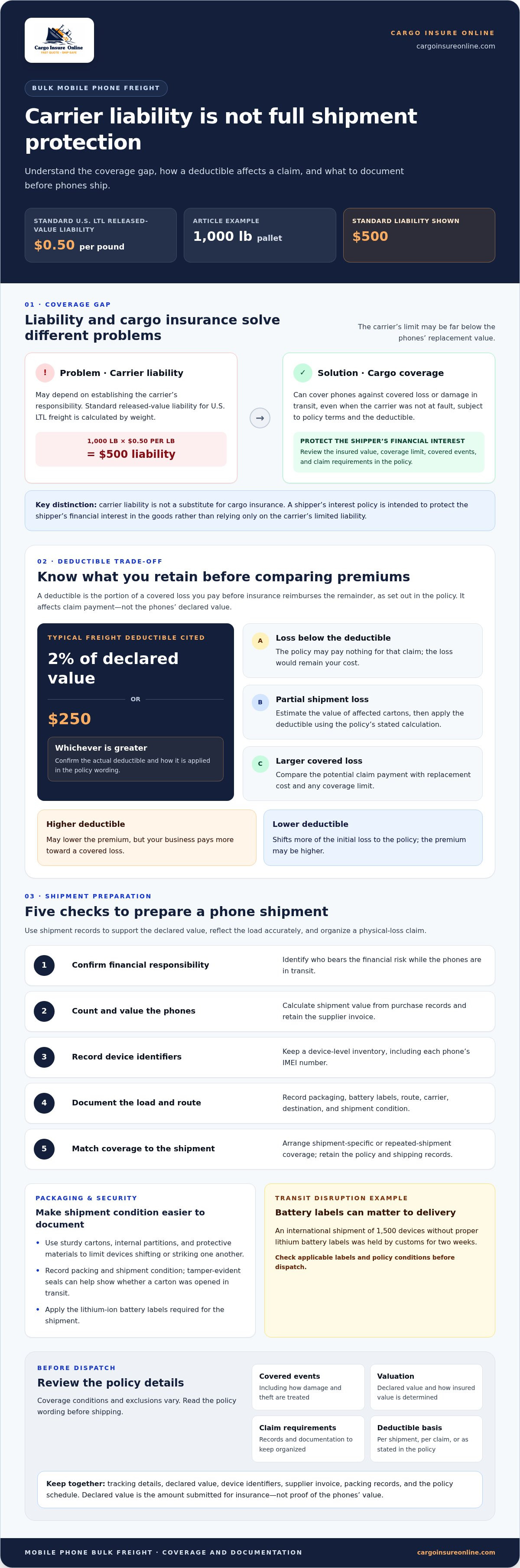
Carrier liability isn’t the same as full shipment protection. Mobile phone bulk freight transit insurance can cover phones lost or damaged in transit, whether or not the carrier was at fault, subject to the policy’s terms and deductible. For standard released-value liability on U.S. LTL freight, the limit is $0.50 per pound, so a 1,000-pound pallet has $500 in standard liability.
That gap matters when a shipment of phones represents substantial inventory value. You need to know what protection applies, what you would pay toward a covered loss, and how the shipment’s value and transit risks affect the premium.
This guide explains what freight insurance can cover, how declared values and deductibles affect claims, and how to assess coverage against your route, packaging, and exposure to loss or damage. It also clarifies the difference between carrier liability and cargo insurance, so you can make an informed decision about bulk phone shipments.
Key Takeaways
- Separate carrier liability from cargo insurance: liability may depend on proving carrier negligence, while cargo coverage can protect against covered loss or damage regardless of fault.
- Compare the deductible with the loss you could absorb. It affects how much of a claim you recover, not just the premium.
- Commodity type and risk profile influence insurance rates. Declared value, route, handling, and packaging also help shape the coverage decision.
- Assess who owns the phones during transit and how a damaged or delayed shipment could affect cash flow, customer commitments, and profit.
- For a physical-loss claim, keep shipment records organized, including tracking details, declared value, device identifiers, and the supplier invoice.
What does freight insurance cover?
In the United States, cargo insurance can cover smartphones shipped by freight, subject to the policy terms. Mobile phone bulk freight transit insurance can protect against covered loss or damage even when the carrier was not at fault. Carrier liability may apply only when you can establish the carrier’s responsibility, so it is not a substitute for cargo insurance.
That distinction matters for incoming phone inventory. Standard released-value liability for U.S. LTL freight is $0.50 per pound. A 1,000-pound pallet therefore has $500 in standard liability, which may fall far short of its replacement value. Shipper’s interest insurance for LTL freight protects the shipper’s financial interest in the goods rather than relying only on the carrier’s limited liability.
Coverage may be arranged for an individual shipment or through a policy covering repeated shipments. For mobile phone bulk freight transit insurance, match the arrangement to the shipment details, including the phones’ value, route, and destination. Keep the named insured, shipment records, and delivery details aligned so they accurately reflect the insured load.
Packaging and security help document the shipment’s condition. Use sturdy cartons, internal partitions, and protective materials to limit devices shifting or striking each other. Record packing and shipment condition; tamper-evident seals can help show whether a carton was opened in transit. Lithium-ion batteries also require applicable shipping labels. An international shipment of 1,500 devices without proper lithium battery labels was held by customs for two weeks, showing how labeling problems can disrupt delivery.
Exclusions and conditions vary by policy. Review the wording before dispatch to understand covered events, claim requirements, packaging conditions, and documentation needs. Pay particular attention to damage, theft, and how the insured value is determined.
Declared value is the amount submitted for insurance, not proof of the phones’ value. Keep the supplier’s invoice and a device-level inventory. For a claim, organize the tracking number, shipment value, IMEI list, and supplier invoice.
Use this sequence to insure a bulk shipment:
- Confirm who bears the financial risk during transit.
- Count the phones and calculate shipment value from purchase records.
- Record each device’s IMEI number and retain the supplier invoice.
- Document packaging, battery labels, route, carrier, and destination.
- Arrange shipment-specific or yearly coverage, then retain the policy and shipping records.
For freight shipments in the United States, cargo insurance is an option for protecting smartphones against covered loss or damage during transit.
Insurance deductibles
A deductible is the portion of a covered loss you pay before insurance reimburses the remainder, as set out in the policy. It affects the claim payment, not the phones’ declared value. If a covered loss is below the deductible, the policy may pay nothing for that claim. For a larger loss, the deductible is applied according to the policy terms.
A typical freight insurance deductible is 2% of declared value or $250, whichever is greater. These examples show why the stated deductible matters as much as the premium when comparing coverage.
For bulk shipments, check whether the deductible applies per shipment, per claim, or on another basis stated in the policy. A damaged pallet and several damaged cartons may be assessed differently if a separate deductible applies to each shipment or event. Read the wording alongside the declared value and coverage limit, and do not assume one deductible applies across all shipments.
Minimum premiums can affect smaller shipments and policies covering repeated shipments. If the calculated premium falls below the policy minimum, the minimum may still apply. The actual premium depends on factors such as declared value, commodity, route, handling, coverage terms, and shipment frequency. Compare the premium with the deductible and the amount of loss your business could retain.
Before choosing a deductible, model realistic loss scenarios using your inventory records:
- Small loss: If several phones are damaged, compare the estimated loss with the deductible. A loss below the deductible would remain your cost.
- Partial shipment loss: Estimate the value of affected cartons, then apply the deductible using the policy’s stated calculation.
- Large loss: Compare the potential claim payment with the replacement cost of the affected phones and any coverage limit.
A higher deductible may lower the premium, but it also means your business pays more toward a covered loss. A lower deductible shifts more of that initial loss to the policy, while the premium may be higher. Consider shipment value, available cash reserves, and how frequently your business moves inventory.
Keep the written quote and policy schedule together. Confirm the deductible, minimum premium, valuation basis, and whether each shipment is insured individually or under a broader arrangement. For a freight policy review, explore freight insurance coverage options alongside your shipment details.
Cargo insurance premiums by commodity type
Commodity classification helps insurers assess a cargo’s transit exposure. Mobile phones fall within electronics and sensitive equipment; fragile goods, perishables, and general freight offer different comparison categories. The category alone does not determine the premium. Declared value and the shipment’s overall risk profile also matter.
Electronics and sensitive equipment have a different typical insurance rate from fragile goods or perishable items. That reflects differences in how each cargo type can be damaged or lose value during transit. Phones can be vulnerable to impact, handling damage, and theft. The relevant policy terms and the journey’s circumstances influence how those risks are assessed.
Compare a quoted premium with the declared value and the protection set out in the policy. Freight insurance is commonly priced in relation to cargo value, with the commodity and risk profile also influencing the rate. A quote is specific to the shipment. Relevant factors include cargo type, declared value, route, handling, packaging, and selected coverage.
To assess a bulk phone shipment, separate the phones’ value from the shipping charge and support the valuation with purchase records. Then map the journey, including transport modes, transfers, handling points, and delivery arrangements. These details give the insurer a clearer picture than the label “electronics” alone. Careful packaging and straightforward handling present a different risk profile from fragile packing or multiple transfers.
- Electronics and sensitive equipment: Use this category for phones, then document the shipment value and protective packaging.
- Fragile goods: Compare how breakage exposure and handling affect the assessment.
- Perishable items: Treat this as a distinct cargo class, since its risks differ from electronics.
- General freight: Use it as context, not as a direct substitute for a phone-specific assessment.
Commodity categories can help explain why premiums vary, but a category label does not establish coverage or determine a claim outcome. Review the policy terms alongside the quote: check covered causes of loss, exclusions, how declared value is assessed, and how the deductible applies. Compare the complete protection, not just the premium.
For a practical comparison, prepare a shipment profile with consistent details: declared value, route, packaging, and handling plan. Use the same profile to assess how the cargo classification affects the quote. This keeps the comparison grounded in the actual phone shipment rather than assumptions based only on its product category.
Deciding whether to insure based on risk and cost
Carrier liability and cargo insurance respond differently to damage or loss. Carrier liability may apply only when you can establish the carrier’s responsibility. Cargo insurance can cover a lost or damaged shipment regardless of carrier fault, subject to the policy terms. This distinction matters when there is no clear evidence that the carrier caused the loss.
Start by confirming ownership and responsibility. Under FOB Origin terms, the buyer owns the phones once they leave the supplier’s warehouse and bears transit losses unless insured. The seller’s handoff does not remove the buyer’s exposure. Confirm the agreed shipping terms and when financial risk transfers, then compare that exposure with your available cash reserves.
Next, estimate what a transit loss would do to your margin. A 2% damage rate can eliminate profit for wholesale phone distributors with single-digit margins. In one example, 6% of a wholesaler’s shipment of 2,000 phones arrived with cracked screens. These figures show why even partial damage can matter: the affected devices may require replacement, while the remaining inventory still needs to reach customers on schedule.
Packaging changes the risk calculation, but it doesn’t replace insurance. For a 1,000-unit iPhone 13 shipment, estimated damage rates range from 8% with minimal packaging to 1% with professional packaging. Standard bubble wrap and cartons are associated with a 3% estimate, while premium climate-controlled container packaging is associated with less than 0.5%. These are scenario estimates, not a prediction for every route or load.
Use a simple decision process for each shipment:
- Record the phones’ value, ownership terms, route, and planned handling.
- Estimate how much inventory could be lost or damaged, including replacement needs.
- Compare that exposure with your deductible, available cash, and policy limits.
- Consider whether packaging improvements can lower risk alongside insurance.
- Review the coverage terms and claim requirements before dispatch.
All-risk cargo insurance is commonly described at a typical rate of 0.5-2% of cargo value, but the rate isn’t the only decision point. Compare the coverage scope, deductible, exclusions, and valuation basis with your likely exposure. A lower premium may not serve your needs if the deductible or exclusions leave a large share of a realistic loss with your business.
Finally, consider claims readiness. Keep invoices, shipment records, device inventory, and packaging evidence together so a loss can be documented. For repeated long-haul shipments, historical damage rates of 5-10% for wholesale phones make route performance and packaging controls useful parts of the review. Reassess when suppliers, carriers, routes, or packing methods change.
First-party coverage for physical loss or damage in transit
First-party cargo coverage protects the insured’s financial interest when phones are physically lost or damaged in transit, subject to the policy terms. Unlike a carrier-liability claim, it does not require proof that carrier negligence caused the loss. This distinction can matter when cartons arrive crushed, devices go missing, or responsibility is unclear.
The potential exposure can be substantial. Full-value coverage is commonly listed at a typical rate of 1-3% of cargo value, but the policy’s valuation basis determines how a covered loss is assessed. Review how the policy treats replacement value, the declared shipment value, deductibles, limits, and exclusions before dispatch.
First-party coverage does not automatically protect against every supply-chain problem. It focuses on physical loss or damage. Delays, lost sales, and changes in resale value are different financial impacts, so do not assume they are covered as physical damage. Match the policy wording to the loss your business wants to insure, and identify who owns the phones at each stage of transit.
If a shipment is damaged or missing, report the loss promptly and follow the policy’s claim requirements. Filing deadlines vary, so prompt notice helps preserve the ability to submit a claim. Where practical, keep the shipment together, photograph damaged cartons and devices, and record shortages on the delivery paperwork. These records help connect the reported loss to the shipment.
Prepare the essential claim documents:
- Tracking number: Identifies the shipment and its recorded transit history.
- Shipment value: Shows the amount claimed and supports the valuation.
- IMEI list: Identifies the specific phones reported missing or damaged.
- Supplier invoice: Helps substantiate the devices’ purchase value.
Keep the records consistent. If an invoice covers a larger order, identify which devices belong to the affected shipment. Compare the IMEI list with the packing record and delivery count. For damaged phones, preserve images of the packaging and devices. For missing phones, record the expected and received quantities. Clear, consistent evidence makes the claim easier to explain.
Before shipment, save the policy schedule, declared value, and proof of dispatch together. After delivery, record exceptions promptly and retain carrier correspondence. For coverage focused on physical loss or damage to phones in transit, explore mobile phone insurance and review how it fits your shipment needs.
Cargo Insure Online: Air Freight Insurance
Cargo Insure Online offers Air Freight Insurance for businesses moving phone inventory by air. Start by aligning the shipment’s declared value, route, handling details, and policy terms with the risks you have identified. Review how the coverage addresses physical loss or damage, the deductible, and the documents needed to support a claim.
For phones moving across multiple transport modes, Cargo Insure Online also offers Sea Freight Insurance and Trucking Insurance. GAP Insurance can address financial risks under its policy terms. Before dispatch, organize purchase records, device inventories, and shipping documents. A shipment-specific review is more useful than relying on a general assumption about cargo coverage.
To discuss freight protection for your phone shipment, visit Cargo Insure Online.
Plan Protection Before Your Next Shipment
Use each booking as a checkpoint: identify who carries the risk, what a disruption could mean for your operation, and how the route shapes the protection you need. This makes mobile phone bulk freight transit insurance part of shipment planning, rather than a last-minute checkbox. Build the review into purchasing and dispatch workflows so the right people can align shipment records, delivery plans, and coverage priorities before the goods move.
Revisit the process when suppliers, transport modes, or delivery arrangements change. A consistent workflow helps your team make informed decisions across new routes and changing inventory needs, instead of relying on assumptions from an earlier shipment.
Cargo Insure Online offers Air Freight Insurance, Sea Freight Insurance, and Trucking Insurance for businesses moving freight across different modes. Bring your shipment details and priorities to the quote process to focus on protection relevant to your operation.
Contact Cargo Insure Online to discuss your freight coverage needs. Take the next step with a clearer plan for every shipment.
Frequently Asked Questions
What insurance covers bulk shipments of mobile phones in transit?
Cargo insurance protects goods in transit, while carrier liability depends on the carrier’s legal responsibility for a loss. For bulk phone shipments, choose coverage that reflects the cargo value, transport mode, and route. Cargo Insure Online offers Mobile Phone Insurance alongside freight insurance for air, sea, and trucking shipments. Match the policy to the full journey, especially when the shipment changes transport modes before delivery.
How much does mobile phone freight transit insurance cost per shipment?
The premium depends on the shipment and is provided with a quote. Key factors include the phones’ declared value, commodity classification, route, handling, packaging, transport mode, and selected coverage. For a useful comparison, prepare consistent shipment details and note whether the load is a one-off or part of regular shipping. Then assess the quote against the protection and terms offered.
What factors affect insurance rates for bulk phone shipments?
Rates reflect the shipment’s declared value and risk profile. Phone quantity, packaging, route, transport mode, handling points, and coverage terms all help describe that exposure. A shipment with multiple transfers and minimal protective packaging presents a different profile from one with secure packing and a direct route. Provide accurate cargo and journey details so the quote reflects the actual load, not a generic electronics assumption.
What are typical coverage limits and deductibles for phone freight insurance?
Coverage limits depend on the policy’s stated insured value and terms. Cargo Insure Online’s standard cargo coverage is full-value, with a 1% deductible capped at $500. Review the policy schedule to see how the insured value applies to the shipment and how the deductible affects a claim. Don’t treat a carrier’s liability limit as the cargo policy limit; they measure different responsibilities.
Are theft, loss, damage, and water damage covered during phone transit?
Cargo coverage can include physical damage, total loss, and theft, subject to the policy terms. Cargo Insure Online’s standard cargo coverage also includes vandalism, fire, explosion, transit accidents, and natural disasters. Water damage depends on the policy wording, including covered causes and exclusions. Before dispatch, review those terms and keep evidence of packaging and shipment condition, so the cause of loss and affected devices can be documented clearly.


