
What if your courier accepts responsibility for a lost parcel, but its liability still falls short of the shipment’s value? That’s the gap third-party courier shipping insurance is designed to address. A courier’s liability is set by its terms or applicable rules. Declaring a higher value may affect that liability, but it isn’t the same as cargo insurance.
It’s easy to assume the courier’s cover will make you whole if goods are lost or damaged. But carrier liability and insurance work differently, and the terms can affect what you recover. Cargo insurance can provide full-value protection for covered events, subject to the policy’s terms, exclusions, and claim requirements.
This guide explains how third-party cover differs from courier liability, what cargo insurance may protect, and what to review before shipping. You’ll also see how Cargo Insure Online makes it straightforward to get a quote, arrange cover online, and download your certificate. One important distinction: standard cargo policies exclude delay-related losses, which require separate Cargo Delay Insurance.
Key Takeaways
- Third-party courier shipping insurance is separate from the courier’s liability terms. Compare those terms with the value of the goods you need to protect.
- Review which covered events and costs may apply to your shipment, including damage, theft, transit accidents, and salvage charges. Policy wording and exclusions matter.
- Before shipping, assess the shipment’s value, transport details, cover needs, policy terms, and purchase details.
- Cargo Insure Online lets you create a free account, get a quote, purchase with a credit card or e-wallet, and download your certificate.
- Standard cargo policies exclude delay-related losses. Cargo Delay Insurance is a separate product.
What Is Third-Party Courier Shipping Insurance?
Third-party courier shipping insurance is cargo cover arranged separately from the courier’s liability terms. It can address specified financial losses involving goods in transit, subject to the policy wording, insured value, exclusions, and claim requirements. The distinction is straightforward: the courier’s terms concern its responsibility as a carrier, while a cargo policy sets out protection for insured goods.
This matters when a shipment is worth more than the amount the courier may be responsible for under its terms. The insured value is the cargo value used for the policy’s protection, subject to its conditions. It isn’t automatically the same as a courier’s liability limit, and it doesn’t mean the courier will reimburse that amount. Claims are assessed under the applicable policy, so cover doesn’t mean every loss will be paid.
For a foundational overview, see What is shipping insurance?. Cargo Insure Online (CIO) offers Cargo Insurance for courier shipments as well as shipments moving by air, sea, or truck. Its standard cargo cover is all-risks coverage, with the policy wording determining what applies to a specific shipment. Courier shipments can be insured from any origin to any destination.
How Is Third-Party Cover Different From Courier Liability?
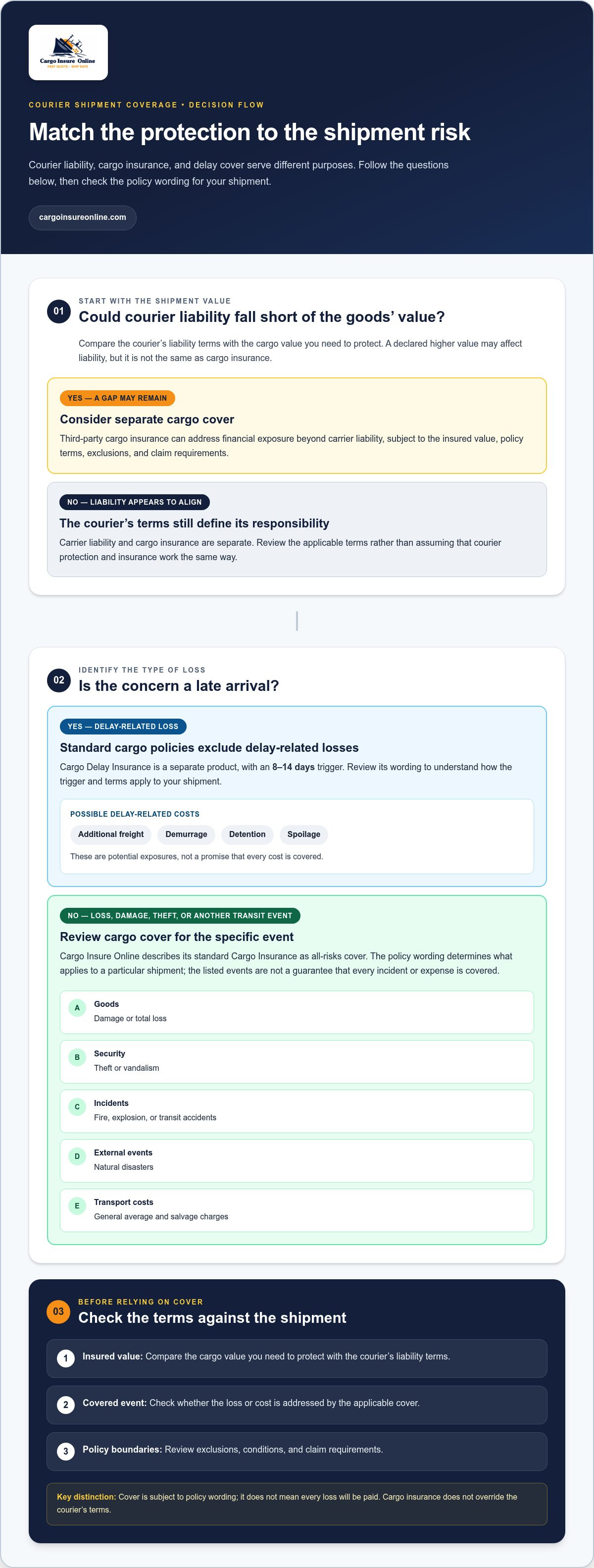
Carrier liability and cargo insurance are separate forms of protection with different terms and purposes. A courier’s terms define its responsibility as the carrier; a cargo policy sets out cover for insured goods and the conditions for a claim. Third-party courier shipping insurance can fill financial gaps when carrier liability doesn’t match the shipper’s exposure. It doesn’t override the courier’s terms or promise payment for every loss. For a closer comparison, see carrier liability versus cargo insurance.
Which Courier Shipments Might Need Separate Cover?
Consider the shipment’s value and the financial impact if the goods are lost or damaged. A retailer sending electronics, a business shipping commercial inventory, or an online seller fulfilling customer orders may have more at stake than the courier’s liability terms address. Focus on the exposure: could your business absorb the cost of replacing the goods or managing an unfulfilled order?
The same comparison applies to domestic and international courier movements. Assess the cargo value you need to protect, then compare it with the courier’s liability terms. Before arranging cover, review the policy wording for covered losses, exclusions, and claim requirements. This helps you make a decision based on the shipment’s actual value and terms, rather than assuming courier protection works the same way for every parcel.
What Can Courier Shipping Insurance Cover, and Where Are the Gaps?
Coverage is about more than whether a parcel arrives. Cargo Insure Online’s Cargo Insurance is all-risks cover, with stated protection for damage, total loss, and theft. Other listed events and charges include vandalism, fire, explosion, transit accidents, natural disasters, general average, and salvage charges. These categories show the range of potential exposures, but they don’t promise that every incident, cause, or expense will be covered.
The policy wording sets the boundaries. The circumstances of a loss, applicable terms, and exclusions all matter. Treat the list as a guide to what the insurance may address, not as a substitute for reviewing the policy for your shipment. Carrier-liability gaps are another consideration: cargo insurance can address financial exposure beyond carrier liability, subject to the policy’s terms.
Loss, Damage, Theft, and Other Covered Perils
Think of the listed protection in practical groups. Physical loss or damage includes damage to goods and total loss. Theft and vandalism involve goods being taken or deliberately damaged. Fire, explosion, transit accidents, and natural disasters are other events identified in the stated cover. General average and salvage charges relate to costs that can arise during a serious transport incident.
- Goods: damage or total loss.
- Security: theft or vandalism.
- Incidents: fire, explosion, or transit accidents.
- External events: natural disasters.
- Transport costs: general average and salvage charges.
Each item remains subject to policy terms and conditions. A particular cause or cost may have specific requirements or limitations, so a label alone doesn’t determine the outcome of a claim.
Why Delivery Delays Need Separate Attention
Standard cargo policies exclude delay-related losses. A shipment may arrive late without suffering physical damage, yet the delay can still create costs for the shipper. Cargo Delay Insurance is a separate product with an 8-14 days trigger. It addresses a different exposure from loss or damage to the cargo itself.
Potential delay-related costs include additional freight costs, demurrage, detention, and spoilage. A late delivery might require extra transport, extend time-related charges, or affect goods with a limited usable window. These are possible business exposures, not a promise that every cost is covered. Review the separate delay policy’s wording to understand how its trigger and terms apply to your shipment.
To assess both cargo and delay exposure, compare the goods’ value and the consequences of a late arrival with the protection you need. Explore courier cargo insurance as you review available cover and policy terms.
Third-Party Insurance vs Courier Protection: How to Compare
Start with one practical question: does the courier’s liability match the financial value you need to protect? Courier liability terms and a cargo insurance policy address different things, and the details can vary by carrier and shipment. Use this framework to compare them without assuming one option works the same way for every parcel.
| What to compare | Courier liability or declared value | Separate cargo insurance |
|---|---|---|
| Who provides it | The courier, under its applicable terms. | An insurer under a separate cargo policy. |
| Exposure addressed | The courier’s responsibility as carrier, as set out in its terms. | Financial exposure relating to insured cargo, subject to policy wording. |
| Value | Any liability limit or declared-value option depends on the courier’s terms. | The policy’s insured value defines the cargo value covered, subject to its conditions. |
| Events and delays | Applicable events and treatment of delays depend on the courier’s terms. | Covered events and exclusions depend on the policy. Standard cargo cover excludes delay-related losses. |
| Claims | The courier’s terms govern its claim process. | The policy governs its claim requirements and assessment. |
What to Check in the Courier’s Own Protection
Review the courier’s current liability terms and any declared-value option for the service you’re using. Note what the carrier’s responsibility covers, what limits or conditions apply, and whether declaring a value changes its liability. Keep that separate from the cargo value your business needs to protect. A higher declared value may affect carrier liability under its terms, but it isn’t automatically a separate cargo insurance policy.
When Separate Cargo Cover May Fit Better
Third-party courier shipping insurance may be worth considering when the goods’ value or potential financial impact exceeds the protection available under the courier’s terms. Compare the shipment value with the policy’s insured value, covered events, exclusions, and claim requirements. The right fit depends on your exposure and the actual wording, not on a blanket promise that one option is always easier or faster.
Cargo Insure Online offers Cargo Insurance for courier shipments and goods moving by air, sea, or truck. If a courier handles one part of a shipment’s journey and road freight handles another, consider how each transport mode relates to the cover you need. CIO’s trucking cargo insurance can also help you assess the road-freight leg.
For a clear decision, compare the courier’s terms with the cargo policy. Check value, covered events, delay treatment, and claim processes side by side. Then assess whether your business is prepared to carry any remaining financial exposure.
A Practical Checklist Before Insuring a Courier Shipment
A review before dispatch can help you spot gaps while there’s still time to make an informed decision. Work through the shipment from its value to the policy terms and purchase details. Keep the courier’s liability separate from the cargo value you want to protect.
- Assess the value exposure. Identify the goods and their value, then compare that figure with the courier’s applicable liability terms and any declared-value option. Consider what a loss or damage would mean for your business, including replacement costs or an unfulfilled customer order. Don’t assume the courier’s liability equals the value of the goods.
- Record the transport details. Note what’s being shipped, its origin and destination, and the courier service or transport mode involved. These details help you describe the shipment accurately when reviewing cover. For international online orders, cross-border e-commerce insurance is useful context for assessing exposure across borders.
- Define the cover you need. Decide which financial risks matter for these goods, such as physical damage, total loss, theft, or other covered events. Match that need to the policy wording. Don’t assume every item or circumstance is automatically eligible for cover, or that requirements used by another insurer or shipping platform apply universally.
- Read the terms before dispatch. Review covered events, exclusions, insured value, and the claim requirements stated in the policy. Pay special attention to delay treatment. CIO’s standard cargo cover excludes delay-related losses; separate Cargo Delay Insurance has its own 8-14 days trigger. If late arrival could create costs for your business, consider that exposure separately.
- Complete the purchase details. Make sure the information you enter accurately reflects the goods and shipment you intend to insure. Review the quote and policy details before purchasing, and keep the policy certificate with your shipment records. The policy wording, not assumptions about how insurance usually works, sets out the applicable cover.
Match the Shipment to the Cover
Use the product description, shipment value, route, and courier mode as a starting point for your review. Then compare your financial exposure with the policy’s insured value and terms. A high-value electronics parcel, for example, may need closer attention than a shipment whose loss your business could readily absorb. The right fit depends on the shipment details and applicable wording.
Review Terms, Timing, and Claim Expectations
Check exclusions and claim requirements before the parcel leaves, not after a problem arises. Standard Cargo Insurance doesn’t cover delay-related losses; separate delay cover has its own trigger and terms. No checklist can determine a claim outcome, so focus on understanding the policy and keeping shipment details accurate. Ready to put your shipment details into a quote? Get a courier cargo insurance quote.
Get Courier Cargo Insurance Online With Cargo Insure Online
Arranging third-party courier shipping insurance doesn’t have to mean a long paper trail. Cargo Insure Online (CIO) brings the quote, purchase, policy issuance, and certificate into one online workflow. Access the platform 24/7, get a real-time quote, and review the cover details before deciding whether to insure your courier shipment.
From Account to Downloadable Certificate
The process is simple: create a free account, enter your shipment details for a quote, then review the policy terms and purchase if the cover fits your needs. Payment is by credit card or e-wallet. After purchase, the policy is issued immediately, subject to its terms, and you can download the certificate for your records.
- Create your account. Set up a free account to access the online platform.
- Get a quote. Enter the shipment information to receive a real-time quote for courier cargo cover.
- Review and purchase. Check the quoted cover and policy wording, then complete your purchase using a credit card or e-wallet.
- Download your certificate. Once the policy is issued, download its certificate and keep it with your shipment records.
Work through these steps when they fit your shipping workflow. No Upfront Fees - Pay Only When You Insure. The purchase decision remains yours, and the policy wording explains the cover that applies.
A Digital Cargo Solution for Logistics Teams
For teams managing shipments at scale, CIO offers a multi-user SaaS platform and API connectivity for logistics systems. These tools can support cargo insurance within a broader digital workflow. CIO’s Cargo Insurance applies to courier shipments as well as shipments moving by air, sea, or truck, helping logistics teams consider cargo cover across transport modes.
Policies are underwritten by A-rated insurers, including CHUBB, TSM Assurances, Probitas 1492, and a Lloyd’s Syndicate. This is useful context when assessing who underwrites a policy, but it doesn’t determine how a particular claim will be assessed. Covered events, exclusions, and claim requirements remain subject to the policy terms.
Before purchasing, make sure the shipment details and insured value reflect what you intend to protect. Standard cargo policies exclude delay-related losses, so consider that limitation separately if late delivery could create financial exposure. Cargo Delay Insurance is a separate product with its own terms.
Explore courier cargo cover and start your online quote with Get started with Cargo Insure Online.
Make Shipment Protection Part of Your Routine
Make insurance review part of your shipping decisions, rather than a last-minute scramble after a parcel is already moving. For each shipment, identify the value at stake, understand what the courier’s terms address, and decide whether separate cover fits the business exposure. A consistent process makes it easier to spot when third-party courier shipping insurance deserves a closer look, especially when goods, routes, or customer commitments change.
Start with an upcoming shipment. Review its details, read the applicable policy wording, and decide what level of exposure your business is prepared to carry. Build that review into your dispatch process so protection decisions are deliberate rather than rushed. Cargo Insure Online gives shippers an online way to explore cargo cover for courier shipments and take the next step when it fits. Get started with Cargo Insure Online and make a quote for your shipment.
Frequently Asked Questions
Is third-party courier shipping insurance different from carrier liability?
Yes. Carrier liability is governed by the courier’s terms, while third-party courier shipping insurance is a separate policy for the shipper’s financial interest in covered goods. They aren’t interchangeable. Before dispatch, compare the courier’s terms with the policy’s insured value, covered events, and exclusions. CIO’s Cargo Insurance applies to courier transport and can address carrier-liability gaps, subject to its policy wording. This distinction clarifies which terms apply if a shipment is lost or damaged.
Can third-party courier insurance cover international shipments?
Yes. CIO provides cargo coverage from any origin to any destination, including shipments sent by courier, air, sea, or truck. The policy wording still governs the shipment, including applicable covered events and exclusions. For online sellers assessing cross-border shipping exposure, the cross-border e-commerce insurance guide offers related context. Review the policy for the specific goods and route rather than assuming every shipment has identical terms.
Does courier shipping insurance cover delivery delays?
CIO’s standard Cargo Insurance excludes delay-related losses. Cargo Delay Insurance is separate cover, with an 8-14 days trigger. Its stated exposures include additional freight costs, demurrage, detention, consequential losses, market loss, production downtime, spoilage, inventory holding costs, and liquidated damages. A late delivery could affect production or leave perishable inventory unsold. Whether a particular delay qualifies depends on the separate product’s terms and trigger.
How much does third-party courier shipping insurance cost?
Premiums start at $47.40, subject to the number of shipments per month. The applicable premium depends on shipment details, so there isn’t one rate for every parcel. CIO’s online platform provides real-time pricing through a quote based on the information entered. Create an account and generate a quote to see the premium for the goods you plan to send before deciding whether to purchase cover.
How quickly can I get courier shipping insurance online?
CIO provides real-time quotes, immediate policy issuance after purchase, and online access 24/7. Create a free account, enter shipment details for a quote, purchase with a credit card or e-wallet, then download the certificate. The quote engine provides a quote in “less than 0 seconds.” Review the policy terms before purchasing; fast online issuance doesn’t determine whether a future claim is covered.
Is there an upfront fee to insure a courier shipment with CIO?
No. CIO’s stated model is “No Upfront Fees - Pay Only When You Insure.” You can create a free account and obtain a quote before deciding whether to buy cover. The quote lets you review the premium for your shipment; it doesn’t make the insurance policy free. If you choose to insure the shipment, payment is made as part of the purchase, with no upfront fee to access the process. Create a free account and get a courier cargo insurance quote.


