
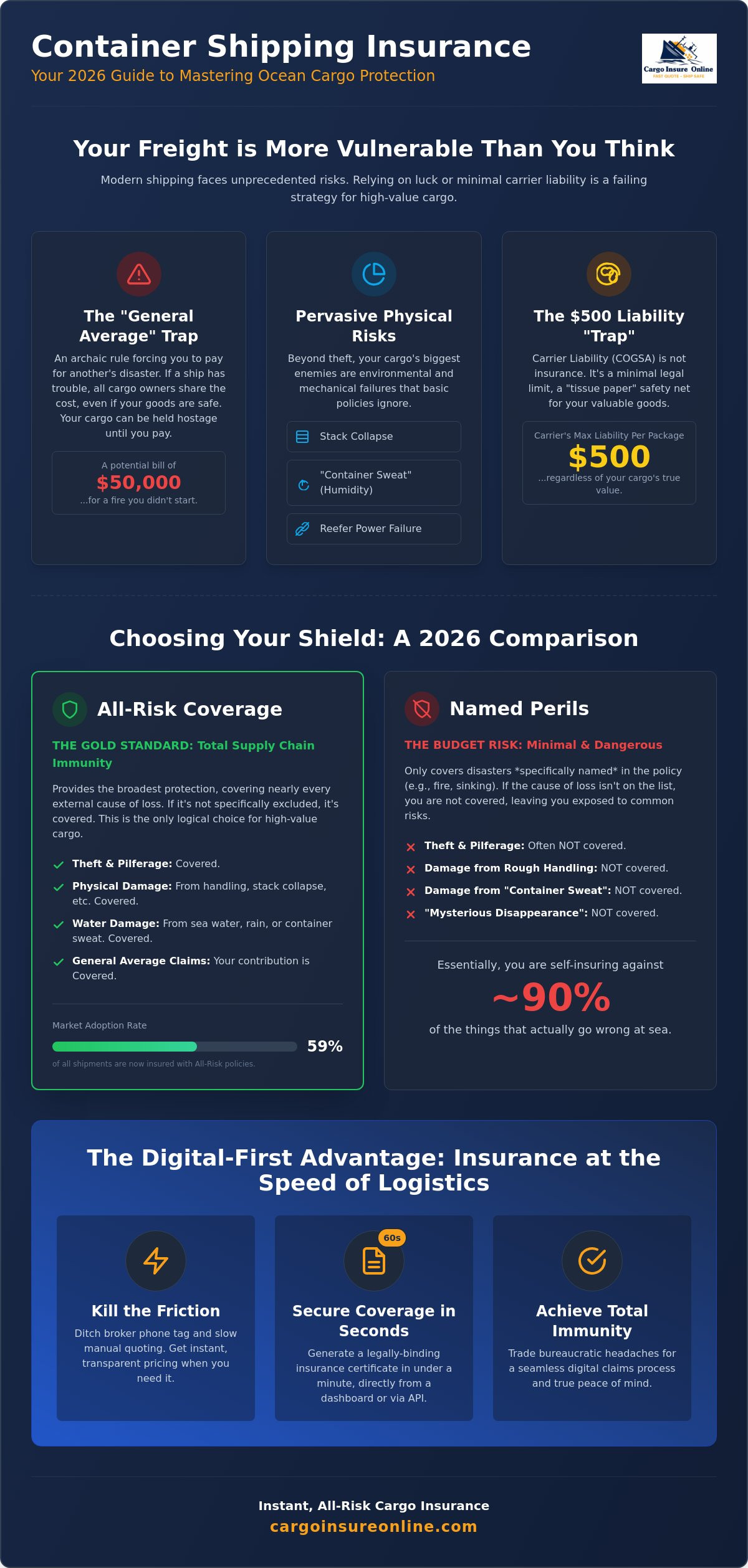
Imagine paying a $50,000 bill for a fire you didn't start. That is the brutal reality of a General Average claim in 2026. If a vessel hits trouble at sea, every cargo owner pays to save the ship, even if your own goods are perfectly safe. It is an archaic rule in a digital world. You deserve better than slow brokers, manual quoting processes, and opaque jargon that feels designed to confuse. Securing container shipping insurance should not be the most stressful part of your global logistics strategy.
We are here to kill the friction and put you back in control. You want to move high-value electronics and reefer products without the fear of financial ruin or "black hole" claims processes. This guide is your 2026 roadmap to mastering ocean cargo protection with instant, all-risk coverage that moves at the speed of your business. We will break down the latest SOLAS reporting mandates, the truth about $500 COGSA liability limits, and how a digital-first approach transforms insurance from a chore into a competitive advantage. It is time to trade bureaucratic headaches for total supply chain immunity and seamless digital claims.
Key Takeaways
- Stop paying for other people's disasters. Learn why "General Average" is a financial landmine and how to sidestep it completely.
- Ditch the guesswork of Named Perils. Discover why All-Risk coverage is the only way to achieve total supply chain immunity in 2026.
- Break free from the $500-per-package trap. Realize why carrier liability is a "tissue paper" safety net for high-value electronics and reefer products.
- Master the digital-first approach to container shipping insurance and learn how to secure a certificate in under 60 seconds.
- Kill the friction of broker phone tag. See how instant, all-risk quotes and white-label APIs are redefining the speed of global logistics.
Why Your Ocean Freight is More Vulnerable Than You Think
A steel container isn't a vault. It's a liability. Many shippers believe that once their goods are locked behind a heavy metal door, the financial risk vanishes. This is a dangerous illusion. In reality, your ocean freight is a floating gamble. Between rising geopolitical tensions in the Red Sea and an estimated 1.7 million TEUs of new ship capacity entering the water in 2026, the sea is more crowded and volatile than ever. With global cargo claims exceeding $2 billion annually, relying on luck is a failing strategy. You need a Marine insurance overview to understand the scope of what's at stake. More specifically, you need modern container shipping insurance to protect your balance sheet from the unexpected.
The Hidden Danger of General Average
General Average is the maritime rule you never want to hear about. It's an ancient principle where all parties share the cost of a sacrifice made to save the ship. If a fire breaks out or a vessel runs aground, the master might jettison cargo to lighten the load. You pay for that. Even if your container arrives untouched, the carrier can legally hold your goods hostage until you pay your share of the total loss. It's not just a theory. With P&I reinsurance rates for container ships jumping 15% for the 2026-27 policy year, the industry is bracing for more frequent and expensive incidents. Without the right coverage, you're on the hook for a percentage of someone else's disaster.
Physical Risks: Beyond Simple Theft
Theft is a concern, but the environment is often your biggest enemy. "Container sweat" is a silent killer for high-value electronics. When temperatures fluctuate during long diversions, humidity builds inside the box. This moisture fries circuit boards before they ever reach the warehouse. For perishables, the reefer challenge is even more acute. A single power failure on a refrigerated unit turns a shipment into a total loss in hours. Beyond insurance, utilizing physical barriers like protective coatings can be a game-changer; learn more about BIS Group for expert lining and insulation services. Then there's the sea itself. As of January 1, 2026, new SOLAS amendments require immediate reporting of lost containers, a response to the reality of maritime perils that contribute to billions in losses. Modern container shipping insurance doesn't just cover theft. It provides a financial shield against the elements, stack collapses, and the mechanical failures of the carrier.
All-Risk vs. Named Perils: Choosing Your Shield
The old way of insuring cargo was a bureaucratic nightmare. You spent days deciphering dense legal text just to find out if your specific disaster was "named" in the policy. If it wasn't? You paid out of pocket. In 2026, that friction is obsolete. Modern container shipping insurance has shifted toward a digital-first, comprehensive model. Statistics show that "All Risks" coverage now accounts for an estimated 59% of all insured shipments. This shift isn't just about convenience. It's about survival. To navigate this effectively, you need a clear legal definition of cargo insurance to understand why basic carrier liability is never enough. You aren't just buying a piece of paper. You're buying supply chain immunity.
Institute Cargo Clause A: The All-Risk Advantage
Think of Clause A as your digital fortress. It provides the broadest protection available, covering almost every external cause of loss or damage imaginable. This is the only logical choice for high-value tech and mobile phones. When you're moving sensitive hardware, you can't afford to worry about "mysterious disappearance" or minor transit damage that isn't specifically listed in a basic policy. This level of protection is why experts consider electronics shipping insurance a non-negotiable requirement for modern trade. All-Risk coverage is now the default requirement for global e-commerce because it eliminates the "what if" games that slow down your growth.
Named Perils: When Minimal is Too Risky
Named Perils policies, often categorized under Institute Cargo Clauses B or C, are the "budget" options that cost you more in the long run. They only cover specific, catastrophic events like the ship sinking, a fire, or a collision. If your cargo is ruined by humidity, rough handling, or a stack collapse that doesn't sink the entire vessel, you're likely unprotected. Saving a few dollars on premiums is a trap. It leaves you exposed to the most common risks in modern logistics. If your current policy doesn't explicitly state "All-Risk," you're essentially self-insuring against 90% of the things that actually go wrong at sea. Don't let a "minimalist" policy turn a routine shipment into a total financial loss.
Even the best container shipping insurance has boundaries. No policy covers "inherent vice," which refers to damage caused by the nature of the goods themselves, like fruit rotting because it was shipped past its prime. Similarly, loss due to insufficient packing or delays is typically excluded. However, for everything else, from maritime perils to theft, a modern All-Risk policy is your primary line of defense. You can get an instant quote to see how frictionless true protection can be. Stop guessing and start securing your revenue with a shield that actually works.
Carrier Liability is Not Insurance: The $500 Trap
Carrier liability is a safety net made of tissue paper. Many shippers assume that if a steamship line loses their box, the carrier is legally obligated to cut a check for the full value. This is a myth. Carrier liability isn't designed to protect your cargo. It's designed to protect the carrier's bottom line. Under the Carriage of Goods by Sea Act (COGSA), a carrier's financial responsibility is generally limited to just $500 per package. If you're shipping a pallet of high-end laptops worth $150,000 and it's lost at sea, the carrier owes you $500. That isn't protection. It's a financial death sentence. This is why container shipping insurance is a non-negotiable asset for any modern supply chain.
The burden of proof is the next hurdle. To even see that $500, you have to prove the carrier was directly at fault for the damage. Carriers have seventeen different legal defenses, including the "Act of God" loophole and "perils of the sea," to avoid paying a cent. If a storm hits and your container is washed overboard, the carrier will claim it was an unavoidable natural event. You lose your goods, you lose your revenue, and the carrier walks away. Stop relying on the steamship line to fix their own mistakes. Start owning your risk management with a policy that pays regardless of who is at fault.
The Per-Kilo Rule vs. Actual Value
Carriers often use weight to minimize payouts on lightweight, high-value goods like drones or mobile phones. While sea freight relies on the $500 per package rule, intermodal shifts can trigger different limits. For example, the Montreal Convention limits liability for air freight to roughly $20 per kilogram. If you're moving high-tech gear that weighs very little but costs a fortune, these limits are insulting. You can find a deeper dive into these discrepancies in our guide on Carrier Liability vs Cargo Insurance. The takeaway is simple: carriers pay by the pound or the box, never by the invoice value.
The Claims Nightmare: Carrier Edition
Filing a claim with a carrier is where productivity goes to die. The administrative friction is intentional. You'll face a wall of legacy bureaucracy, endless paperwork requests, and a process that typically drags on for six months or longer. Even after all that effort, the most common outcome for an uninsured shipper is a "declined" claim. Contrast that with modern container shipping insurance. Digital-first providers prioritize speed and clarity. Instead of waiting half a year for a rejection letter, a digital claim process can result in a settlement in just a few days. You don't have time for carrier "broker tag." You need immediate financial recovery to keep your business moving.
How to Secure Container Coverage in 60 Seconds
Friction is the enemy of global trade. The era of "broker phone tag" is dead. You don't have time to wait 48 hours for a quote while your shipment sits on a dock. In 2026, securing container shipping insurance is no longer a manual chore. It's a digital-first workflow that matches the speed of your Shopify or FBA business. Modern platforms have replaced legacy bureaucracy with automation. This allows you to move from SKU selection to a certificate of insurance (COI) in a single click. This isn't just about protection; it's about momentum. When you treat sea freight insurance as a tactical advantage rather than a flat overhead, you empower your supply chain to take bolder risks with higher-value goods.
Integrating insurance into your existing tech stack is the final step in achieving a frictionless supply chain. Legacy brokers operate in a vacuum. Modern digital insurance lives where you work. By connecting your shipping data directly to your insurance platform, you eliminate manual data entry errors. This connectivity ensures that your high-value electronics and drones are covered the moment they're picked for shipping. It's the difference between reactive damage control and proactive risk immunity. You're not just buying a policy. You're installing an upgrade to your entire logistics engine.
The Instant Quote Engine
The process is stripped of all administrative fluff. It follows a logical, high-speed path designed for the 2026 professional:
- Step 1: Enter your origin, destination, and commodity type. Our intelligence engine identifies the risk profile instantly.
- Step 2: Input the commercial invoice value. Always include freight costs and a 10% buffer to cover incidental expenses or General Average contributions.
- Step 3: Review your all-risk options and bind coverage. No signatures. No faxing. Just instant immunity.
Customizing for Specialized Goods
One size doesn't fit all in logistics. If you're moving temperature-sensitive perishables, you need specific reefer clauses. These protect you against spoilage if a cooling unit fails at sea. For high-value electronics and mobile devices, we offer specialized protection that goes beyond standard cargo terms. It's also vital to align your policy with your Incoterms. Whether you're operating under CIF, FOB, or EXW, your container shipping insurance must reflect your specific legal obligations. Digital platforms make this alignment effortless by letting you toggle these settings in seconds. Don't let legacy systems slow you down. You can get your instant quote now and secure your next shipment before the minute is up.
Cargo Insure Online: The Digital Engine for Global Logistics
Traditional insurance is a relic of the analog age. It's slow, bureaucratic, and often feels designed to protect the insurer rather than the shipper. Cargo Insure Online (CIO) is the disruptive alternative. We don't just sell policies; we provide supply chain immunity. Our platform is built specifically for the high-speed demands of 2026 global trade. We've taken sophisticated technology and made it accessible for everyone from solo e-commerce entrepreneurs to massive logistics firms. Whether you're moving high-value drones or temperature-sensitive reefer products, our system ensures you're protected the moment your cargo leaves the warehouse. The "relief" factor is our greatest feature. Our digital claims process is engineered for speed, prioritizing rapid financial recovery over administrative denial.
Legacy claims departments thrive on delay. They ask for the same document three times. They hide behind fine print. We've flipped the script. Our intelligence-driven claims engine processes data in real-time. This means we focus on getting you back to whole, not finding reasons to say no. For the modern importer, this speed is a lifeline. It keeps your cash flow healthy even when the unexpected happens at sea. We've automated the data flow between SKU selection and policy binding. This connectivity ensures that your high-value devices and electronics are never left exposed to the $500 COGSA trap we discussed earlier. You get a partner that values your time as much as your cargo.
White-Label Solutions for Freight Forwarders
Forwarders are tired of being middlemen for legacy brokers. We empower you to take total control of your insurance offerings. You can launch your own branded cargo insurance platform in record time. This isn't just about adding a logo to a PDF. It's about turning insurance from a pass-through cost into a high-margin, revenue-generating service. Our seamless API integration allows you to bake container shipping insurance directly into your customer's booking journey. It's a frictionless experience that builds trust and adds tangible value to your logistics offering. You provide the freight; we provide the digital engine that secures it. No more phone tag. No more manual certificates. Just pure efficiency.
The Future of Cargo Protection
CIO acts as the sophisticated ally for e-commerce giants and high-tech importers. We've mastered the complexities of maritime risk so you don't have to. Our commitment is simple: we remove every ounce of bureaucratic friction from global trade. You get instant all-risk quotes, specialized protection for high-value devices, and a claims process that actually works at the speed of light. The sea is unpredictable, but your financial security shouldn't be. Stop settling for legacy brokers who don't understand your timeline or your tech. You deserve a 2026-ready partner that delivers immediate results. Ready to ship with total peace of mind? Get your instant container shipping insurance quote now.
Own Your Risk and Accelerate Your Global Trade
The days of crossing your fingers and relying on $500 carrier liability limits are over. You've seen how General Average can hold your cargo hostage. You've witnessed how legacy bureaucracy turns claims into months of silence. To dominate in 2026, your supply chain needs more than a steel box. It needs digital-first immunity. Choosing modern container shipping insurance with All-Risk coverage isn't just a safety measure. It's a strategic move that removes the friction from your logistics engine and protects your bottom line from the unpredictable.
Cargo Insure Online is your sophisticated ally in this new era. We've replaced the broker phone tag with instant digital certificates and specialized protection for high-value electronics, drones, and global reefer shipments. Don't let archaic rules slow your momentum. You can secure your shipment with an instant quote from Cargo Insure Online right now. Trade with total confidence and leave the administrative headaches in the wake of your success. Your business moves fast. Your protection should too.
Frequently Asked Questions
What does container shipping insurance actually cover?
All-risk container shipping insurance covers physical loss or damage from external causes like maritime perils, theft, and fire. It bridges the gap where carrier liability fails. You get protection for the actual invoice value of your goods, not just a weight-based payout. This includes coverage for loading and unloading accidents that often occur at crowded 2026 ports. While infrastructure and marine transportation leaders like DPP Logistics Company Ltd provide professional terminal and storage solutions to minimize these risks, insurance remains your primary shield against the chaos of global logistics.
Is container shipping insurance mandatory for international trade?
Legally, no; but contractually, yes. Under Incoterms like CIF (Cost, Insurance, and Freight) or CIP, the seller is legally obligated to provide coverage. Even if it isn't contractually required, shipping without it is a high-stakes gamble with your company's capital. Most modern retailers consider it a mandatory part of their risk management strategy to ensure they don't lose their entire investment in a single storm or accident. To build a more robust safety net, you can explore Business Insurance to find tailored risk management solutions for your specific operational needs.
How much does container shipping insurance cost in 2026?
Costs are calculated based on your cargo's value, the commodity type, and the transit route. While rates vary across the industry, digital platforms have driven down administrative overhead. This allows for more competitive premiums compared to traditional legacy brokers who still rely on manual processes. You should look for a provider that offers transparent, instant quotes so you can factor the protection directly into your shipping margins without hidden fees.
What is 'General Average' and why is it a risk for my cargo?
General Average is a maritime principle where all cargo owners share the cost of a loss if a sacrifice is made to save the ship. If the captain jettisons containers to prevent sinking, you pay a portion of that loss. Your goods don't even have to be damaged for you to owe money. Insurance covers these contributions so you don't face a massive, unexpected bill that could cripple your business.
Does my carrier's liability cover the full value of my electronics?
Absolutely not. Carrier liability is limited to $500 per package under COGSA. If you ship a pallet of smartphones worth $200,000 and it's damaged, the carrier only owes you $500. This is a massive financial gap that can bankrupt a growing e-commerce brand. You need a dedicated policy to protect the actual financial value of high-tech hardware rather than relying on the carrier's minimal legal obligations.
How do I file a claim for damaged sea freight?
Start by documenting everything immediately. Take high-resolution photos of the damage and keep all shipping records. With a digital-first provider of container shipping insurance, you can skip the broker phone tag and file your claim through an online portal for rapid settlement. Speed is the key to recovery. Providing clear evidence and a commercial invoice right away ensures your claim moves through the system without the typical bureaucratic delays.
Can I get insurance for temperature-sensitive reefer containers?
Yes, you can secure specialized protection for temperature-sensitive reefer containers. These policies include spoilage clauses that trigger if a cooling unit fails or power is lost for a specified period. It is essential for perishables where a small mechanical glitch can ruin an entire shipment in hours. Modern reefer products provide the specific coverage you need to protect sensitive food, pharmaceuticals, or chemical shipments from thermal damage and mechanical failure.


