
Stop treating cargo insurance like a speed bump in your digital workflow. Why should your team spend hours waiting for a quote while a shipment sits on the dock? Most logistics providers are trapped in a cycle of manual data entry and fragmented portals that drain productivity. Integrating a high-speed insurance API for freight forwarders changes the game entirely. It turns a clunky administrative chore into a seamless, high-velocity asset that lives right inside your existing TMS.
You already know the frustration of carrier liability limits, like the $500 COGSA cap, that leave your clients exposed to massive losses. With 2026 regulations like the IATA Direct Air Waybill framework shifting more responsibility onto your shoulders, the old way of doing things isn't just slow; it's risky. This article shows you how to transform your platform into a revenue-generating powerhouse with automated certificates and frictionless claims. We'll explore how to deliver instant, all-risk coverage for high-value goods while building a branded experience your customers will love.
Key Takeaways
- Eliminate the manual insurance wall. Learn how an insurance API for freight forwarders replaces slow email chains with instant, all-risk quotes directly inside your TMS.
- Accelerate your operations. Discover how automated certificate issuance happens in milliseconds, ensuring your cargo never waits on the dock for paperwork.
- Own the customer experience. See why a white-label insurance engine is superior to generic integrations for building brand loyalty and generating new revenue.
- Simplify the technical hurdle. Follow our 4-step developer guide to map shipment data and launch your integration in a risk-free sandbox environment.
- Protect high-value tech with ease. Find out how specialized coverage for drones, mobile phones, and reefers can be automated for maximum peace of mind.
The Manual Insurance Wall: Why Freight Forwarders Are Switching to APIs
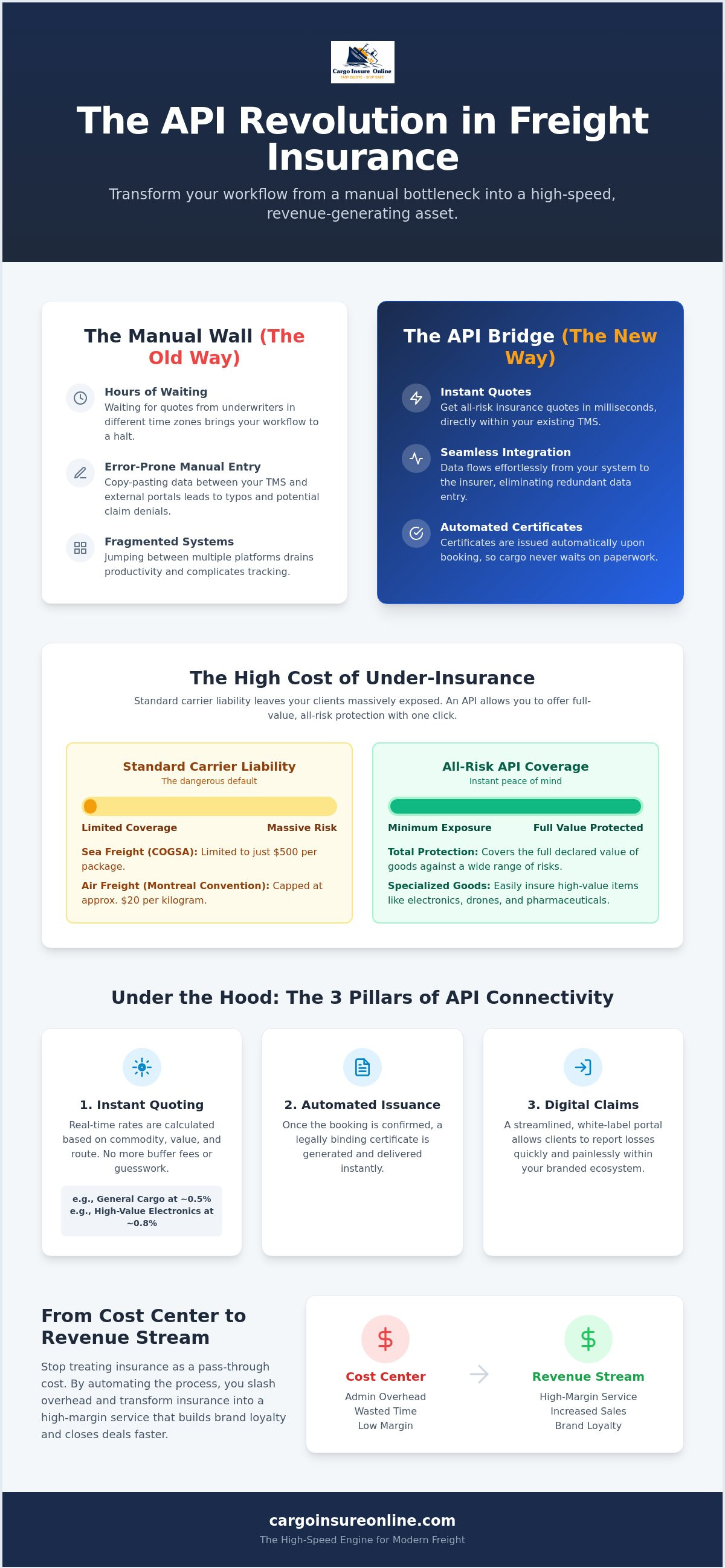
Manual insurance is a productivity killer. You know the drill. You copy data from a TMS into a separate portal. You wait for an underwriter to wake up in a different time zone. You send email chains that disappear into the void. For a modern freight forwarder, this isn't just an annoyance. It's a bottleneck. While your cargo moves at the speed of flight, your insurance process is stuck in the era of fax machines. This is the manual insurance wall. It's where efficiency goes to die.
Legacy firms are hitting this wall every single day. They spend hours on administrative tasks that an insurance API for freight forwarders handles in milliseconds. This isn't just about saving time. It's about precision. Manual entry leads to typos. In the insurance world, a typo is a claim denial waiting to happen. Digital-first forwarders aren't just faster. They're more reliable. They've stopped treating insurance as a checkbox. They've started using it as a competitive weapon to outpace the competition.
Breaking the 'Per-Kilo' Trap with All-Risk Automation
Relying on carrier liability is a dangerous game for your clients. For sea freight, you're often looking at a $500 per package limit under COGSA. Air freight isn't much better; the Montreal Convention limits liability to roughly $20 per kilogram. Explaining carrier liability vs cargo insurance is the most important conversation you'll have with a shipper. Most don't realize they're exposed until a container goes overboard or a pallet is stolen. An API lets you offer All-Risk protection at the exact moment of booking. It eliminates the gap for high-value electronics, drones, and specialized goods.
From Cost Center to Revenue Stream
Stop viewing insurance as a pass-through cost. When you automate, you slash the overhead of managing individual policies. This transforms insurance from a drain on your resources into a high-margin service. Instant quotes mean you close more deals. Clients want security. They'll pay for the convenience of one-click protection that lives right inside your platform. By integrating an insurance API for freight forwarders, you're not just moving boxes. You're building a premium, secure logistics experience that scales without adding a single person to your back-office team. It's time to turn your administrative chore into a revenue-generating powerhouse.
Under the Hood: How a Modern Cargo Insurance API Works
An insurance API for freight forwarders isn't just a piece of code. It's a high-speed bridge. It connects your TMS directly to a global insurance engine, eliminating the need for manual portals or redundant data entry. No more jumping between tabs. No more copy-pasting shipment weights and values. The data flows effortlessly from your existing database to the underwriter. This is the core of API integration in modern insurance. It's about turning complex logistics into a series of instantaneous, automated handshakes.
The 3 Pillars of API Connectivity
- Instant Quoting: Your team gets real-time rates for sea freight insurance or air cargo the moment they enter shipment details. The system calculates premiums based on current 2026 benchmarks, where general cargo might sit at 0.5% while high-value electronics reach 0.8%.
- Automated Issuance: When the booking is confirmed, the certificate is born. It's legally binding and ready to go. No human intervention is required, meaning your cargo never waits for an admin's approval.
- Digital Claims: If something goes wrong, your clients don't want to call a hotline. They want a button. A streamlined portal inside your ecosystem makes reporting losses fast and painless, keeping the experience entirely within your brand.
Real-time premium calculation is the engine's fuel. It doesn't just guess. It looks at the commodity type, the total insured value, and the specific route. It cross-references global risk databases instantly. This ensures you're always offering the most accurate price without the "buffer" fees that manual brokers often add to cover their own time. It's precision at scale, allowing you to explore our digital-first insurance solutions and see the difference speed makes.
Security and Compliance in the Digital Age
We're talking about sensitive client data and high-value cargo details. Encryption and strict privacy protocols aren't optional; they're the foundation. A modern insurance API for freight forwarders automatically checks global shipping routes against sanctions and trade standards. It ensures every certificate generated meets the strict requirements of international trade laws. You don't have to be a legal expert to stay compliant. The code does the heavy lifting, ensuring your operations remain bulletproof as you scale across borders.
White Label vs. Generic Integration: Branded Protection for Forwarders
Generic APIs are a detour. They solve the immediate problem of coverage, but they push your customers toward a third-party portal. This fractures the user experience and dilutes your authority. Why send your clients to a competitor's website when you can own the entire journey? A white label insurance API for freight forwarders keeps your brand front and center. It transforms your TMS into a branded cargo insurance platform. Your brand becomes the hero, providing the safety net your clients need under your own logo.
The psychological impact of "instant" protection is massive. When a shipper confirms a booking and receives a certificate with your branding in seconds, trust is locked in. You aren't just a logistics provider anymore. You're a one-stop-shop for global trade security. This seamless integration eliminates the friction of fragmented workflows. It builds long-term loyalty because you've made the complex feel effortless. Your brand handles the freight, the paperwork, and the peace of mind. That's how you win in a crowded market.
Customizing the User Journey
One size never fits all in global logistics. A white-label engine allows you to tailor coverage options to your specific niche. If you specialize in high-value tech, you can prioritize electronics shipping insurance as a default option. You control the margins. You set the pricing rules. You maintain a consistent visual identity from the initial quote to the final claim. This level of customization ensures that every interaction feels like a natural extension of your core service, not a bolted-on afterthought.
The Future of Embedded Insurance
Embedded insurance is the new global standard. By July 2026, shippers expect protection to be baked into the booking process, not sold as an extra step. Freight forwarders are rapidly evolving into "insurtech" partners. They use an insurance API for freight forwarders to leverage shipment data and predict client needs before they even ask. This data-driven approach allows you to offer the right coverage at the right time. You're no longer just reacting to risks; you're proactively managing them. This shift from service provider to sophisticated ally is what defines the modern, digital-first forwarder.
Integrating Peace of Mind: A 4-Step Guide for Developers
Integrating an insurance API for freight forwarders isn't a months-long ordeal. It's a strategic sprint. Modern logistics tech thrives on speed; your integration process should be no different. By following a clear, developer-focused roadmap, you can move from a manual workflow to a fully automated insurance powerhouse in days, not weeks. This is about removing friction for your team and your customers simultaneously.
Step 1: Accessing the Sandbox. Every great integration starts in a playground. The sandbox environment allows your team to test API calls, simulate responses, and iron out bugs without any financial risk. It's the space where you prove the concept before touching a single real shipment.
Step 2: Mapping Shipment Data. This is the bridge-building phase. You'll connect your TMS fields, like weight, value, and destination, to the API's requirements. Our documentation makes this simple. It ensures that the data you already have fuels the insurance engine without manual intervention.
Step 3: Customizing the Logic. Not every shipment is the same. You can set specific triggers to automate coverage for high-risk routes or specific modes, such as trucking cargo insurance or urgent air freight. This logic ensures that the right protection is applied at the right moment, every time.
Step 4: Going Live. Once testing is complete, you flip the switch. Moving to production means real-time issuance, instant billing, and a frictionless experience for your clients. Your TMS is now officially an insurance-generating asset.
Developer-First Documentation
Logistics tech moves fast. That's why RESTful APIs and JSON are the non-negotiable gold standard. Our documentation provides clear endpoints and simple authentication through secure API keys. We've designed the system to handle rate limits and errors gracefully. This ensures that a minor technical hiccup never disrupts your user's journey or halts your operations.
Ongoing Support and Scaling
The best insurance API for freight forwarders grows as you do. Whether you're handling 10 shipments a month or scaling to 10,000, the infrastructure remains rock-solid. You'll receive regular updates, from new feature rollouts to specialized support for drones or reefers. Plus, you get access to a technical support team that actually understands the difference between a bill of lading and a 404 error. Ready to build? Start your integration journey today and see how easy automation can be.
Cargo Insure Online: The High-Speed Engine for Modern Freight
Speed is the heartbeat of global logistics. You don't have time for bureaucratic delays, manual paperwork, or "we'll get back to you" emails. Cargo Insure Online (CIO) delivers a solution built for the future. Our insurance API for freight forwarders isn't just about meeting basic standards. It's about exceeding them with pure velocity. We've replaced the slow, traditional underwriter with a digital-first engine that thinks as fast as your business moves. This isn't just software; it's a competitive advantage that lives directly inside your TMS.
Niche Protection that Others Miss
Most insurance tools treat every box the same. They ignore the unique risks of high-value tech or temperature-sensitive goods. CIO is different. We provide reefer cargo insurance automation that handles cold chain protection with surgical precision. We offer specialized protection for drones and high-value electronics with specific clauses that actually reflect the tech landscape of 2026. You can also integrate flexible GAP insurance and e-commerce cargo protection directly into your workflow. This ensures no shipment is left under-insured, regardless of its value or complexity. It's about protecting the tech of tomorrow, today.
The claims process shouldn't be a second tragedy. Traditional firms bury you in forms and wait weeks to respond. We've dismissed that outdated model. Our digital-first claim process removes the bureaucracy entirely. It's transparent, fast, and handled through the same branded portal your clients already trust. This is how high-performing logistics firms operate. They don't just move freight; they provide a bulletproof security layer that scales effortlessly from ten to ten thousand shipments. You get the relief of knowing every claim is handled with the same speed as your bookings.
Your Next Move: Frictionless Integration
Stop waiting for the industry to catch up. The immediate impact on your team's productivity is measurable from day one. You'll slash administrative hours and boost your bottom line by turning insurance into a revenue-generating powerhouse. Our insurance API for freight forwarders is designed for easy deployment. You get the documentation, the sandbox, and the technical support you need to go live without the headache. Join the ranks of modern logistics leaders who value their time and their clients' peace of mind. Ready to automate? Launch your branded insurance engine today!
Own the Future of High-Speed Logistics
The era of manual data entry and fragmented portals is over. You've seen how a modern insurance API for freight forwarders shatters the administrative wall and turns a dry chore into a high-octane revenue stream. From instant quotes to automated certificates, the technology exists to make your TMS a powerhouse. By choosing a white-label engine, you don't just protect cargo; you protect your brand's reputation for innovation and speed.
Cargo Insure Online delivers a Red Dot-level digital experience that matches the velocity of your global operations. Our global coverage spans air, sea, and land, providing specialized protection for high-value tech and reefers that legacy insurers often overlook. It's time to trade the endless email chains for instant issuance and the bureaucratic delays for a seamless, branded journey. Stop reacting to risks and start automating your growth.
Ready to disrupt the status quo? Integrate the CIO Insurance Engine now!
The road to frictionless logistics is open. We're ready to help you lead the charge and transform your business into a digital-first leader.
Frequently Asked Questions
What is an insurance API for freight forwarders?
An insurance API for freight forwarders is a software bridge that connects your TMS directly to a global insurance engine. It automates the entire lifecycle of cargo protection, from quoting to certificate generation, without requiring your team to leave their existing platform. It replaces slow manual portals with instant, digital-first connectivity.
How long does it take to integrate a cargo insurance API into my TMS?
Integration is a strategic sprint that typically takes just a few days. Your technical team will spend time in a risk-free sandbox environment to test API calls before mapping your TMS data and moving to production. It's a developer-first process designed to move as fast as your logistics business.
Can I use the API to insure specialized goods like electronics or drones?
Yes, the engine is built specifically to handle high-value tech including drones and mobile phones. You can automate specific clauses that address the unique risks of these goods. It also provides specialized reefer protection, ensuring your cold chain remains covered through every leg of the journey.
Is white-labeling available for the cargo insurance API?
White-labeling is a core feature of the CIO engine. You can brand the entire insurance experience with your own logo and visual identity, from the initial quote to the final claim. This turns your TMS into a branded platform that builds customer loyalty and keeps your brand at the center of the transaction.
How does the API handle cargo insurance claims?
Claims are managed through a streamlined, digital-first portal that lives inside your own ecosystem. Clients report losses directly through your branded interface, which removes the traditional bureaucracy and paper-heavy delays. It's a fast, transparent process that prioritizes your customer's time and peace of mind.
Do I need a developer to set up the insurance API?
You'll need a developer to connect the insurance API for freight forwarders to your internal systems. Our documentation uses RESTful standards and JSON, which makes the setup straightforward for any modern technical team. We provide a sandbox environment and full technical support to ensure the integration is frictionless.
What is the difference between an API and a white-label portal?
An API is the underlying technical connection that moves data between systems; a white-label portal is the branded interface your customers actually see. The API does the heavy lifting of quoting and issuance while the portal provides the visual experience. Together, they create a seamless, one-stop-shop for your clients.
Can the API provide quotes for all-risk sea, air, and trucking freight?
The system provides instant, all-risk quotes for sea, air, and trucking freight across the globe. It uses real-time 2026 data to calculate premiums based on the specific route, commodity type, and cargo value. You get comprehensive protection for every mode of transport without the long wait times of a manual broker.


