What if your ocean carrier hits a storm, loses zero of your containers, but still sends you a bill for $50,000 before they'll release your stock? It's called General Average, and it's a maritime trap waiting to sink your margins in 2026. Most sellers assume their required liability policy covers their inventory during transit. It doesn't. Amazon protects your account, but Amazon FBA cargo insurance protects your capital. Without it, you're one rough sea or one stolen truck away from a total financial loss.
We know the struggle. You're tired of traditional brokers who take three days to return an email while your goods sit on a dock. You want protection that's as digital as your business. We agree that insurance shouldn't be a bureaucratic nightmare. That's why this guide shows you how to secure frictionless, all-risk coverage from factory to fulfillment center. You'll learn how to bypass slow claim processes and get instant digital quotes that keep your supply chain moving. We're breaking down how to achieve zero-stress transit and full capital protection so you can focus on scaling.
Key Takeaways
- Stop assuming Amazon Global Logistics has you fully covered. Learn why your inventory is at risk the moment it leaves the factory floor.
- Discover the critical difference between mandatory liability policies and Amazon FBA cargo insurance to ensure your capital is protected against logistics failures.
- Master your Incoterms and learn how to calculate the true value of your shipments, including duties and shipping costs, for a bulletproof claim.
- Transition from slow, traditional brokers to instant digital quotes that provide all-risk protection across air, sea, and trucking routes.
- Secure your 2026 margins by implementing a frictionless insurance strategy that scales as fast as your e-commerce sales.
Why Your Amazon FBA Inventory is at Risk Before it Reaches the Warehouse
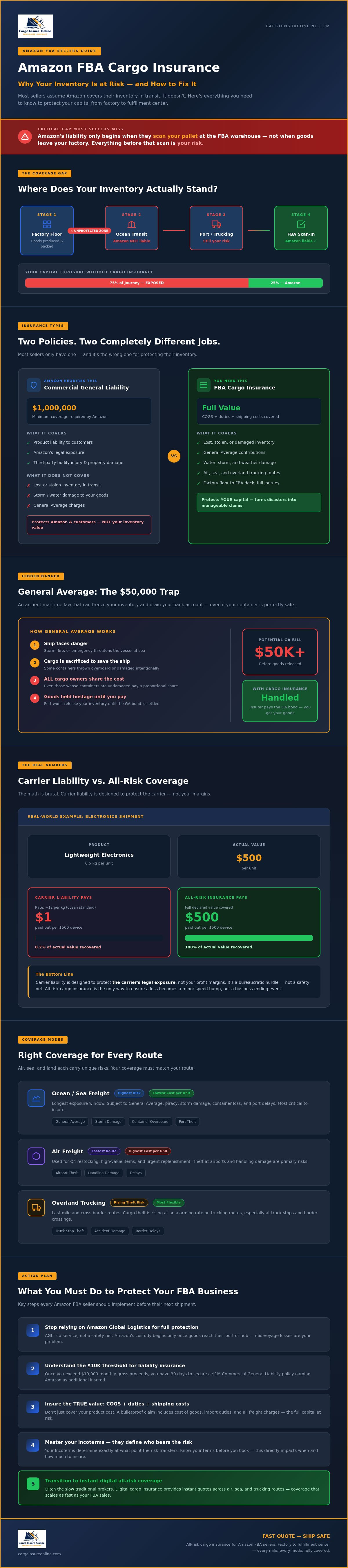
You've spent months sourcing. You've wired the deposit. Your products are finally on a ship. But here's the cold reality: until that stock is checked into an FBA warehouse, you're flying without a net. Most sellers fall for the "Fulfillment Center Myth." They assume Amazon's massive infrastructure provides an invisible shield over their goods from day one. It doesn't. Amazon's liability starts when they scan the pallet, not when it leaves your factory. If your inventory disappears in the middle of the ocean, Amazon isn't writing you a check.
Even if you're booking through Amazon Global Logistics (AGL), you aren't bulletproof. AGL is a service, not a comprehensive safety net. Amazon's custody often begins only once the goods reach their designated port or hub. If a maritime disaster strikes mid-voyage, you'll find that AGL’s claim process is notoriously slow and limited. Relying on AGL for protection is like using a paper umbrella in a hurricane. You need a dedicated strategy to ensure your capital doesn't vanish with a sinking container.
Then there is the ancient maritime law of "General Average." If a ship is in danger and cargo is sacrificed to save the vessel, every cargo owner on that ship pays for the loss. Yes, even if your specific container is fine. Understanding Marine insurance principles is essential here. Without a proper policy, you could be hit with a massive bill just to get your own goods released from the port. Amazon FBA cargo insurance turns this potential business-ending catastrophe into a manageable digital claim.
The In-Transit Black Hole
The window between your factory exit and the FBA dock is a high-risk zone. Containers get lost. Water damage ruins entire batches. Cargo theft is rising at an alarming rate. This is why cargo insurance for online sellers is the only way to close the gap. Your inventory represents more than just cash. It is your growth potential and your Q4 strategy. When a shipment vanishes, you don't just lose the COGS; you lose your market momentum. Don't leave your biggest business expense exposed to the elements.
Carrier Liability vs. All-Risk Protection
Don't confuse carrier liability with real protection. Carriers typically pay "per kilo." If you're shipping lightweight, high-value electronics, they might offer you $20 for a $500 device. That is a trap. Carrier liability is designed to protect the carrier, not your profit margins. It is a bureaucratic hurdle, not a safety net. Switching to all-risk Amazon FBA cargo insurance means you get paid for the full value of the loss. Modern, digital coverage moves at the speed of your sales. It is the difference between a total financial wipeout and a minor speed bump in your scaling journey.
Amazon Seller Insurance vs. Amazon FBA Cargo Insurance: Knowing the Difference
Amazon doesn't care about your profit margins. They care about their legal exposure. Most sellers confuse the insurance Amazon requires with the insurance they actually need. If you've surpassed $10,000 in gross proceeds in any single month, you've likely already dealt with the mandate for Commercial General Liability (CGL). This policy is designed to protect Amazon and your customers if your product causes harm. It's a defensive shield for the platform, not a safety net for your inventory. If your shipment vanishes in a storm, your liability policy will stay silent. It won't pay you a dime for lost stock.
Strategic sellers distinguish between protecting the public and protecting their assets. Amazon FBA cargo insurance is the asset protection layer that actually secures your capital. While the $1 million liability requirement is a cost of doing business, cargo insurance is a choice that determines whether you survive a logistics failure. These two policies work together to create a bulletproof business. One handles the "what-ifs" after the sale; the other handles the "what-ifs" during the high-risk transit phase. You need both to sleep soundly while your goods are in motion.
The Liability Mandate
Amazon's rules are clear. Once you hit that $10,000 monthly revenue threshold, you have 30 days to secure a policy. You must name "Amazon.com Services LLC and its affiliates" as additional insureds. This is non-negotiable. However, don't mistake compliance for coverage. This policy covers bodily injury or property damage caused by your products. It's essential for staying on the platform, but it offers zero relief if a truck is stolen or a container is lost at sea. It protects Amazon's interests, while your own capital remains entirely exposed.
The Asset Protection Layer
True financial security starts with cross-border e-commerce insurance. This isn't about satisfying a terms-of-service agreement; it's about ensuring you have the funds to reorder stock if disaster strikes. This coverage follows your goods from the factory floor to the FBA dock. It includes the crucial land-based segments of the journey, often referred to as inland marine insurance explained by industry experts. This layer fills the gaps that carriers and liability policies leave wide open.
For those scaling with high-value goods, standard protection isn't enough. You need specialized electronics shipping insurance to account for the unique risks of theft and fragile handling common in the tech space. Whether it's a sea voyage or the final-mile trucking, Amazon FBA cargo insurance ensures your investment is never just one accident away from zero. You can secure this peace of mind with an instant digital quote that matches the speed of your modern business.
Choosing the Right Coverage for FBA Shipments (Air, Sea, and Land)
Global logistics is a high-stakes relay race. Your inventory passes through dozens of hands, several vehicles, and multiple jurisdictions before it ever reaches an Amazon dock. A single weak link in this chain can derail your entire quarter. Choosing the right Amazon FBA cargo insurance isn't about checking a box. It's about matching your protection to the specific stresses of each transport mode. Whether you're racing a new launch via air or moving bulk volume across the Pacific, your coverage must be as dynamic as your supply chain.
Don't settle for fragmented policies that leave gaps at the port or the airport. You need a multi-modal solution. This means one single, cohesive policy that stays with your goods from the factory exit to the final FBA check-in. It eliminates the finger-pointing that happens between carriers when damage is discovered. If a pallet is crushed, you don't care if it happened on the plane or the truck. You just want your capital back. All-risk digital protection ensures that your business stays liquid, regardless of how your goods are moving.
Speed vs. Security in Air and Sea
Air freight is the go-to for high-value FBA launches. It's fast, but it's not invincible. Turbulence, rough tarmac handling, and airport theft are real threats. Securing air freight insurance is essential for tech and fashion brands where timing and condition are everything. It protects your high-margin inventory from the unique risks of the runway.
Sea freight involves a much longer risk window. Your goods spend weeks exposed to salt air, humidity, and the threat of container loss. Navigating these complexities requires robust sea freight insurance. You also need to master your Incoterms. If you're buying EXW (Ex Works), you're responsible from the factory door. If it's FOB (Free on Board), your risk starts at the ship's rail. Knowing exactly when your Amazon FBA cargo insurance kicks in is the difference between a successful claim and a total loss.
The Final Mile: Trucking to FBA
The most dangerous part of the journey is often the shortest. Local trucking from the port to the fulfillment center is where the most physical damage occurs. Forklift accidents, sudden braking, and warehouse-to-warehouse transfers are common. Your inland marine coverage must match Amazon’s strict delivery specifications. If a driver drops a pallet at the FBA intake, you need a policy that triggers immediately. Don't let a "last mile" mishap sink your entire investment. Comprehensive trucking protection ensures your goods survive the final, bumpy stretch to the warehouse.
How to Secure FBA Cargo Insurance: A Step-by-Step Implementation Guide
Stop waiting for broker emails. The 2026 supply chain moves at the speed of light. Your insurance should too. Securing Amazon FBA cargo insurance is no longer a manual chore involving stacks of paperwork and endless phone calls. It's a strategic, digital-first process that protects your capital with precision. By following a streamlined implementation plan, you can move from factory exit to FBA check-in with total confidence. It is about removing friction and adding certainty to every shipment.
Before you book your next container, you must audit your strategy. Most sellers make the mistake of only insuring their Cost of Goods Sold (COGS). This is a recipe for a financial gap. If a shipment is lost, you aren't just out of product. You've lost your shipping costs and your prepaid duties too. Always calculate your Total Insurable Value by adding COGS, freight charges, and a 10 percent buffer for incidental expenses. This ensures your business stays liquid even if the worst happens.
Step 1: Know Your Incoterms
You can't protect what you don't technically own yet. Your Incoterms determine exactly when the risk of loss shifts from the supplier to you. If you are buying on EXW (Ex Works) terms, you are responsible the moment the goods leave the factory gate. You need coverage that starts at the origin warehouse. If you use FOB (Free On Board), the supplier handles the risk until the goods cross the ship's rail. Match your Amazon FBA cargo insurance policy to your purchase agreement to avoid paying for double coverage or leaving a dangerous gap in the middle of the ocean.
Step 2: Digital Quote Generation
Ditch the three-day wait for a traditional broker to "get back to you." Modern e-commerce demands instant results. You only need four pieces of data to secure a bulletproof rate: the origin, the destination, the commodity type, and the total value. Digital platforms use automation to analyze these variables and provide a quote in real-time. This allows you to bake your insurance costs into your margins before you even finalize the shipment. It is about intelligence and connectivity over bureaucracy and delays.
Don't settle for "Named Perils" policies that only cover specific disasters like fire or sinking. These are old-school traps. Select All-Risk coverage to ensure you are protected against almost every external cause of loss. You can get an instant cargo insurance quote in under 60 seconds and integrate it directly into your logistics flow. Stop guessing about your coverage and start protecting your momentum.
Scaling Your FBA Business with Cargo Insure Online’s Digital Protection
Growth demands speed. If your logistics are moving at 2026 speeds but your protection is stuck in the 1990s, you're creating a bottleneck. Scaling an FBA brand requires a partner that understands the digital-first reality of global trade. Cargo Insure Online (CIO) isn't a traditional broker. We are a high-energy alternative to the bureaucratic drag of the old-school insurance world. Our Amazon FBA cargo insurance is designed to scale with you, removing the friction that usually slows down global expansion.
Scaling means more containers, more routes, and higher capital exposure. You don't have time to manage individual policies for every shipment manually. You need a platform that integrates with your workflow. CIO provides all-risk, zero-stress protection that covers you from the factory floor to the Amazon dock. It's sophisticated technology made simple, much like the streamlined solutions offered by EZ3PL Ltd for brands looking to master their end-to-end fulfillment. We've mastered the complexities of global trade so you don't have to. You focus on the algorithm; we focus on the assets.
We don't just cover standard dry freight. Our expertise extends to the high-value categories that drive modern e-commerce. Whether you need specialized Electronics & High-Value Devices Insurance, Drones Insurance, or Mobile Phone Insurance, we provide the specific protection those items demand. These aren't just commodities; they're high-margin investments that require more than a "per-kilo" carrier liability payout. We ensure your most valuable stock is bulletproof in transit.
Why CIO is the E-Commerce Choice
Traditional insurance is slow, manual, and opaque. CIO is instant, digital, and transparent. We've replaced the endless email chains with a vibrant, high-speed platform that delivers results in seconds. This isn't just for FBA. Our customized solutions for Shopify seller cargo insurance ensure that no matter where you sell, your goods are protected. We've built a system that moves as fast as your sales. If you have a claim, our digital process is built for efficiency, not delay. It's about empowering you with clarity and speed.
Ready to Ship to FBA?
Your inventory is your business's lifeblood. Don't let a single maritime mishap or trucking accident drain your capital. You've audited your Incoterms and calculated your value. Now, it's time to lock in your protection. Secure your margins and scale with total confidence. Our Amazon FBA cargo insurance provides the frictionless safety net your brand deserves in 2026. Get your instant cargo insurance quote now and experience the relief of bulletproof shipping. One click, total protection, zero stress.
Secure Your 2026 Margins Today
Don't let outdated insurance models slow your momentum. You now know that Amazon's liability mandate protects the platform, not your inventory. You've seen how the "in-transit black hole" can swallow your capital before it ever hits the fulfillment center. Securing Amazon FBA cargo insurance isn't just a safety measure. It's a strategic move for sellers who refuse to let logistics friction dictate their growth. By mastering your Incoterms and choosing all-risk coverage, you ensure that every shipment is a step forward, not a gamble.
Forget the days of waiting for manual quotes from slow brokers. You deserve a partner that moves at the speed of your sales. Our specialized e-commerce experts have built a platform that delivers instant digital quotes and comprehensive protection for your most valuable stock. Whether you're shipping electronics or high-volume fashion, we provide the clarity you need to scale without fear. The future of logistics is digital, transparent, and bulletproof. It's time to Get Your Instant FBA Cargo Insurance Quote Now and protect your business's lifeblood. Keep your supply chain moving and your capital safe.
Frequently Asked Questions
Does Amazon Global Logistics (AGL) include cargo insurance?
No, AGL provides limited carrier liability rather than comprehensive Amazon FBA cargo insurance. While you can open a claim for in-transit losses through Amazon, the payouts are often capped at a low per-kilo rate and the response times can be slow. To protect the full value of your inventory, you need an all-risk policy that covers you from the factory exit to the warehouse dock.
What is the difference between Amazon Seller Insurance and cargo insurance?
Amazon Seller Insurance is a Commercial General Liability policy designed to protect Amazon and your customers if your product causes harm or damage. It is a legal shield. Cargo insurance is an asset protection policy that pays you directly if your inventory is lost, stolen, or destroyed during transit. One protects you from lawsuits; the other protects your bank account from logistics disasters.
Is cargo insurance mandatory for Amazon FBA sellers?
It isn't mandated by Amazon's terms of service, but it's essential for any seller who wants to stay in business. Amazon only requires liability insurance once you exceed $10,000 in monthly gross proceeds. However, cargo insurance is the only way to recover your capital if a ship sinks or a truck is hijacked. It's a strategic choice for professional merchants who value their peace of mind.
How much does Amazon FBA cargo insurance cost?
Rates are typically calculated as a small percentage of your shipment's declared value, often ranging from 0.1 percent to 2 percent depending on the commodity and route. This cost is a minor fraction of your landed expenses and ensures a single accident doesn't wipe out your entire inventory investment. Digital platforms allow you to see these costs instantly before you even book your freight.
Does cargo insurance cover my goods if they are lost in the Amazon warehouse?
No, cargo insurance coverage generally ends once your shipment is checked into the fulfillment center. At that point, Amazon takes physical custody and their internal FBA reimbursement policy kicks in. If your stock is lost or damaged while inside an Amazon facility, you must resolve the issue through Seller Central rather than your transit insurance policy.
What are Incoterms and why do they matter for FBA insurance?
Incoterms are the rules that define exactly when the risk of loss shifts from your supplier to you. If you're buying on EXW (Ex Works) terms, you're responsible for the goods the moment they leave the factory. If you're using FOB (Free on Board), your risk starts when the goods are loaded onto the vessel. Your Amazon FBA cargo insurance must match these terms to ensure you aren't paying for gaps in coverage.
Can I get insurance for high-value electronics being shipped to FBA?
Yes, specialized all-risk coverage is available for high-value items like drones, mobile phones, and sophisticated tech devices. These products are high-risk targets for theft and require more than just basic freight protection. Digital-first providers offer specific electronics coverage that accounts for these unique risks, ensuring your high-margin launches arrive safely or are fully reimbursed.
How do I file a claim if my FBA shipment is damaged in transit?
Report the damage immediately and document the condition of the goods with clear photos before they move further. You'll need to submit your Bill of Lading, commercial invoice, and packing list through your insurance provider's digital portal. A modern claims process bypasses the slow paperwork of traditional brokers, allowing you to upload everything online and get your capital back faster.


