
Why does a quote for high-value electronics fluctuate by thousands of dollars while your shipment sits on the dock? You're likely tired of the opaque pricing structures and the agonizingly slow quoting processes that define traditional insurance. It feels like a bureaucratic hurdle rather than a tool for growth. You deserve better than a "wait and see" approach when your reefer products or drones are on the line.
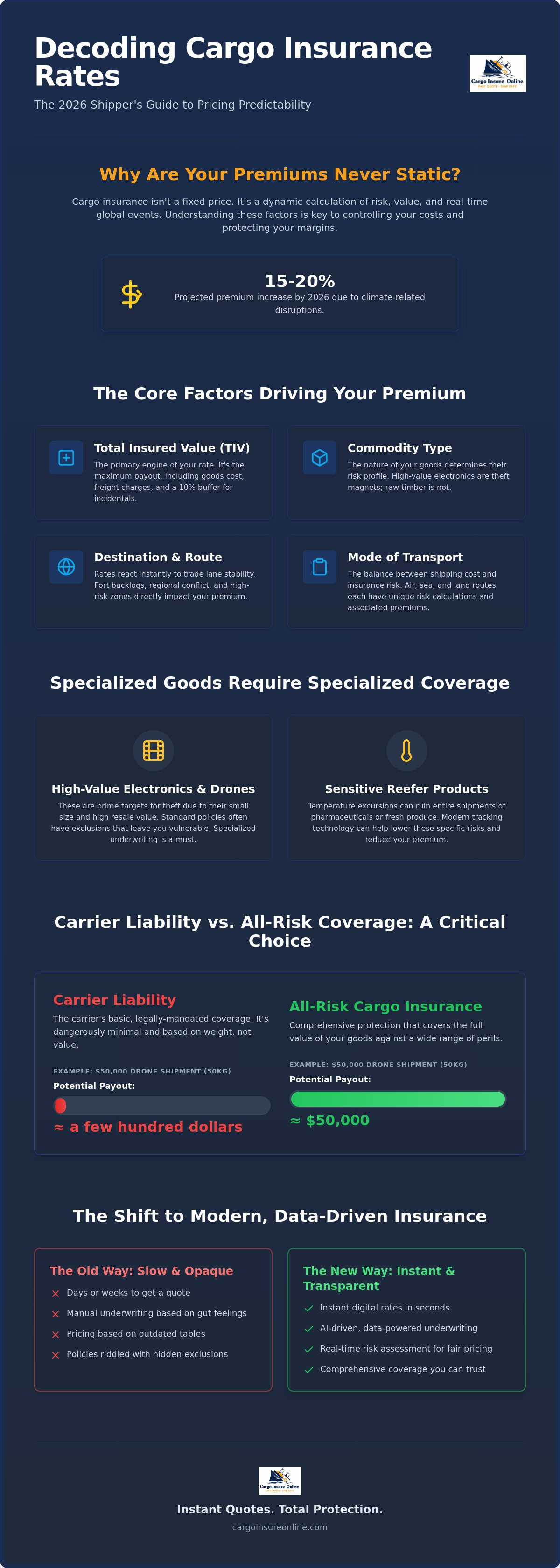
Understanding the factors affecting cargo insurance rates is the first step toward reclaiming control over your margins. With climate-related events driving premiums up by 15-20% in 2026, staying informed isn't just helpful; it's essential for survival. This guide reveals exactly how modern insurers calculate your risk. We'll show you how to slash costs through better data and navigate new 2026 mandates like the USCG cybersecurity regulations. You're about to move from guesswork to total pricing predictability and instant digital protection.
Key Takeaways
- Demystify the pricing engine by identifying the core factors affecting cargo insurance rates, from Total Insured Value to specific 2026 destination risks.
- Learn why specialized goods like drones and high-value electronics require unique risk profiles and how to protect them without overpaying.
- Compare transport modes to find the perfect balance between shipping costs and insurance premiums for air, sea, and land routes.
- Discover strategic ways to slash your overhead using optimized deductibles and choosing the right policy structure for your shipment volume.
- Transition from slow, bureaucratic quoting to instant digital rates powered by AI-driven underwriting that respects your time.
Beyond the Quote: Why Cargo Insurance Rates Are Never Static
Stop thinking of your insurance premium as a static line item on a spreadsheet. It isn't a fixed price tag. It's a heartbeat. In 2026, cargo insurance rates are dynamic calculations of probability, value, and real-time logistics intelligence. If your current broker provides quotes that look the same regardless of the season or the trade lane, you're likely overpaying or, worse, under-insured.
The traditional "negotiation-to-affirmation" reality is a relic of the past. In the old world, you'd wait days for a manual underwriter to "review" your file. They'd use gut feelings and outdated tables. Modern logistics moves too fast for that. Today, sophisticated tech delivers quotes in seconds. This speed is one of the most critical factors affecting cargo insurance rates. When an insurer uses automated, data-driven underwriting, they slash their own administrative overhead. Those savings should be passed directly to you.
Beware the "cheap" insurance trap. A low premium looks heroic on a quarterly report, but it often results in devastatingly expensive claims later. Cheap policies are usually riddled with exclusions. They might skip coverage for "concealed damage" or use restrictive definitions for "theft." You aren't just paying for a piece of paper; you're managing the total cost of risk. A comprehensive policy that pays out instantly is infinitely more valuable than a budget policy that leaves you fighting a legal battle for six months.
The Myth of the Fixed Premium
Rates fluctuate based on global trade lane stability and seasonal demand. If a major port faces a backlog or a specific region sees a spike in "war risk" activity, premiums react instantly. Market capacity also dictates your cost. When more insurers have the appetite for risk, competition drives prices down. In 2026, we've already seen climate-related events push premiums up by 15-20% for certain high-risk routes. Premium volatility is the rate at which your insurance costs shift in response to real-time global disruptions and market capacity changes.
Carrier Liability vs. All-Risk Coverage
Relying on carrier liability is a high-stakes gamble with your company's future. Most carriers operate under international conventions that limit their financial responsibility to a "per-kilo" rule. This is a disaster for high-value tech. If a crate of drones weighing 50kg is crushed, the carrier might only owe you a few hundred dollars, even if the cargo was worth fifty thousand. Marine insurance history is full of stories about businesses that collapsed because they didn't realize how little carriers actually pay. You need all-risk protection to bridge that gap. Don't leave your margins to chance. Learn more about the specific risks in our guide: Carrier Liability vs Cargo Insurance: Don’t Get Burned.
The 'What' and 'Where': Cargo Value, Type, and Destination Dynamics
Your cargo isn't just a box; it's a specific set of risks waiting to be calculated. The Total Insured Value (TIV) acts as the primary engine for your premium. If the value is high, the stakes are higher. But value alone doesn't tell the whole story. The nature of the commodity and its final destination are massive factors affecting cargo insurance rates. Underwriters don't just look at the price tag. They look at how easily that cargo can disappear or break. A shipment of raw timber has a very different risk profile than a container of high-end mobile phones. One is bulky and hard to steal. The other is a liquid asset for criminals. This is why commodity classification is a core pillar of your quote.
Total Insured Value is the primary engine of your insurance rate. It's the maximum amount an insurer will pay out. This number includes the cost of the goods, the freight charges, and usually a 10% buffer for incidental expenses. If your TIV is inaccurate, your coverage is a house of cards. Over-insuring wastes capital; under-insuring leaves you exposed during a total loss. In 2026, climate-related events are no longer "black swan" occurrences. They are predictable variables. Storms now delay 30% of trans-Pacific shipments. This increased risk of damage is baked into modern destination dynamics.
High-Value Tech and Sensitive Reefer Risks
Electronics and drones are theft magnets. They're small, high-value, and easy to flip on the black market. Standard policies often fail here. You need specialized underwriting that understands these vulnerabilities. Reefer products add another layer of math. Temperature excursions can ruin an entire shipment of pharmaceuticals or fresh produce. However, modern reefer tracking tech can actually lower your rates by proving you've maintained cold chain integrity. Check out our Electronics Shipping Insurance Guide to see how to protect your tech assets.
Geopolitical Routes and High-Risk Zones
Where you ship matters as much as what you ship. In 2026, trade route stability is in constant flux. Geopolitical conflicts have forced insurers to re-price "War and Strikes" clauses. Shipping to an established hub in Rotterdam is a different world than navigating emerging markets with poor local infrastructure or high piracy risks. When calculating cargo insurance premiums, underwriters look at port congestion and regional crime statistics. Route-specific surcharges can appear overnight. Don't get blindsided by hidden costs at the border. You can get a transparent rate instantly that accounts for these global shifts.
The 'How': Mode of Transport and Packaging Sophistication
How you move your goods is just as vital as what's inside the box. It is one of the most overlooked factors affecting cargo insurance rates. Traditional logistics views transport mode as a simple choice between speed and cost. Modern insurers see it differently. They see a probability map. Every hour your cargo spends in transit is an hour of exposure to risk. Whether you choose the belly of a cargo plane or the deck of a massive container ship, that choice dictates your premium math from the moment the doors are sealed.
You might assume air freight is expensive to insure because the shipping cost is sky-high. That is a common misconception. Insurers actually love air freight. While the shipping rates are premium, the insurance rates are often significantly lower than sea freight. Why? Shorter exposure. Your cargo spends hours in the air instead of weeks on the ocean. Less time in transit means fewer opportunities for theft, moisture damage, or the dreaded "General Average" claim. In 2026, air freight remains the gold standard for keeping insurance overhead low while maintaining high-speed supply chains.
Air vs. Sea: Calculating the Speed-to-Risk Ratio
Sea freight carries a unique set of hazards. You're dealing with heavy weather, salt-air corrosion, and the risk of containers being lost overboard. As of January 1, 2026, new IMO SOLAS amendments require enhanced fire detection and lifting appliance standards on cargo ships. Following these safety updates can help stabilize your rates, but the inherent risk of the "high seas" remains. If you are moving high volumes via the ocean, you need a policy that understands these specific maritime pressures. Secure your shipments with Sea Freight Insurance: Total Protection.
The Impact of Professional Packaging and IoT
Professional packaging is your first line of defense. It isn't just about bubble wrap; it is about risk mitigation that insurers can see. Modern container standards now focus on preventing "cargo sweat" and moisture damage through advanced desiccant technology and ventilation. If you use certified, high-spec packaging—often validated by International Certification & Compliance (ICC)—you signal to underwriters that you are a low-risk partner.
Smart sensors and IoT tracking are the ultimate game-changers for your premium. When you provide real-time data on tilt, shock, and temperature, you move into "preferred" rate status. Insurers reward transparency. By eliminating the "black box" of the transit journey, you remove the guesswork from the underwriting process. This is especially critical for the "last mile" in trucking. This final leg is often the most expensive to insure because it involves the highest frequency of handling. Use tech to prove your cargo arrived untouched, and watch your long-term costs drop.
Strategic Cost Control: How to Optimize Your Insurance Premiums
You've identified the risks. Now, let's talk about the math. Optimization isn't about cutting corners or sacrificing protection. It's about data-backed decisions that put you in the driver's seat. One of the most powerful factors affecting cargo insurance rates is your own risk appetite. You don't have to be a victim of market fluctuations. By understanding how insurers view your operation, you can drive the narrative and force premiums down.
Traditional brokers often hide behind opaque pricing. They want you to believe rates are set in stone. They aren't. Your premium is a reflection of your perceived reliability. In the 2026 market, insurers are rewarding proactive shippers with significant flexibility. If you can prove your cargo is handled with precision, you unlock access to "preferred" pricing tiers that remain invisible to the average logistics manager.
Deductibles and Claims History
A higher deductible acts as a powerful self-insurance mechanism. It signals to the insurer that you have skin in the game. By taking on more of the initial risk, you slash your monthly premium immediately. This is the "sweet spot" of risk management. But you must watch out for the "frequent flyer" effect. Filing too many low-value claims is a fast track to rate hikes. In 2026, accounts with adverse loss experience are seeing rate increases of 5% to 20%. Manage small losses internally. Protect your premium for the big hits that actually matter. A clean claims history is your most valuable asset during annual negotiations.
Volume Discounts and Annual Policies
Are you still buying insurance shipment-by-shipment? Stop. That is the most expensive way to operate. It is inefficient, slow, and costly. E-commerce sellers and high-volume shippers benefit massively from annual "open" policies. These provide continuous coverage and significant volume discounts that single-trip quotes cannot match. Consolidating your spend gives you negotiation leverage. Programs with a proven, clean loss history are currently seeing rate reductions of 7.5% to 15%. This is the reward for consistency.
Implementing loss-control measures is your secret weapon. Document your security protocols. Show off your IoT tracking data. Prove to underwriters that you are a low-risk outlier. For those moving goods by road, our Trucking Cargo Insurance Guide offers specific land-based strategies to keep your overhead low. Ready to see how your strategy impacts your bottom line? Get your optimized digital quote now and start saving in seconds.
The Cargo Insure Online Advantage: Instant Rates for Modern Logistics
The old way of securing insurance is dead. You shouldn't have to wait days for a human to manually review a manifest while your shipment sits idle. Traditional insurance is a bottleneck. Cargo Insure Online is the solution. We have replaced the red tape with a frictionless, digital-first experience that respects your time. Get your rate in seconds, not days. We provide total transparency with zero hidden fees, zero bureaucratic surprises, and zero "fine print" headaches. It's time to move as fast as the market moves.
We've mastered the complexities of global trade and simplified them into a single, high-speed interface. Whether you're shipping reefer products or high-value mobile phones, our platform delivers. We don't just offer coverage; we offer a modernizing force for your entire supply chain. You get the professional authority of a financial powerhouse combined with the agility of a tech leader. This is how logistics was always meant to feel.
Eliminating Friction with AI-Driven Underwriting
Our proprietary technology analyzes thousands of data points in the blink of an eye. It understands the nuanced factors affecting cargo insurance rates better than any manual underwriter could. We look at real-time global trade lane stability and the specific risk profiles of high-value drones and sensitive tech. Our AI does the heavy lifting so you don't have to. We provide real-time risk assessments for every major route on the planet. This isn't just about speed; it's about accuracy. The result is a 100% digital journey that replaces administrative anxiety with a sense of relief and excitement. You get precise pricing based on live risk data, not generic industry averages that haven't changed in years.
Seamless Integration for Partners
We don't just protect cargo. We empower our partners to grow. Our platform is built for the modern, interconnected logistics ecosystem. Through sophisticated white-label solutions and API integration, freight forwarders and brokers can offer branded insurance directly to their own clients. This is the power of embedded insurance. You can give your customers instant rates at the point of sale. Stop the endless back-and-forth emails. Stop losing deals because a quote took three days to arrive. You can White Label Cargo Insurance: Launch Your Engine and start scaling your revenue immediately. We provide the infrastructure. You provide the brand. It's a seamless, high-speed journey for everyone involved.
Master Your Margins with Data-Driven Protection
Traditional insurance is a drag. It's slow, opaque, and built for a world that doesn't exist anymore. You've seen how cargo value, transport modes, and 2026 geopolitical shifts dictate your costs. But knowledge is only half the battle. You need a partner that moves at the speed of your business. We've replaced the old-school waiting game with instant digital quotes and specialized protection for high-value tech like drones and mobile phones.
Understanding the factors affecting cargo insurance rates gives you the power to optimize your margins. Don't let bureaucratic friction slow your growth. Whether you need a single-trip policy or a global white-label solution, the tools are ready. It's time to trade administrative chores for total peace of mind. Your global supply chain is complex. Your insurance shouldn't be.
Stop guessing and start shipping. Get your instant cargo insurance quote now!
Take control of your risk and keep your momentum high. We're here to ensure your journey is fast, transparent, and completely protected.
Frequently Asked Questions
How are cargo insurance rates calculated for electronics?
Rates for electronics are calculated based on their high liquidity and theft attraction. Underwriters focus on the Total Insured Value and the security of the transit chain. Because devices like mobile phones and drones are easily resold on the black market, they carry a higher risk profile than bulkier commodities. Providing precise data on your security protocols and using GPS tracking can help stabilize these specific factors affecting cargo insurance rates.
Does the shipping route significantly impact my insurance premium?
Your shipping route is a major pricing driver that insurers monitor in real time. Underwriters analyze 2026 geopolitical risk zones and port congestion levels to determine your premium. Routes through high-risk areas or emerging markets often trigger "War and Strikes" surcharges or geographic exclusions. Established trade hubs with modern infrastructure generally enjoy more competitive rates because the probability of delays, damage, or theft is significantly lower.
What is the average cost of air freight insurance compared to sea freight?
Air freight insurance rates are typically lower than sea freight rates because of the drastically reduced transit time. While air shipping itself is more expensive, the cargo is exposed to risk for only a few hours rather than several weeks. This shorter window minimizes the chance of moisture damage, theft, or handling accidents. Sea freight involves longer exposure and higher risks of "General Average" claims, which usually results in a higher insurance premium.
Can I lower my cargo insurance rate by increasing my deductible?
You can lower your premium immediately by increasing your deductible. This shift tells the insurer you are willing to absorb small, manageable losses yourself. It reduces the underwriter's administrative burden and financial liability for minor incidents. It's a strategic way to find the perfect balance between your out-of-pocket costs and comprehensive protection for the catastrophic events that could actually threaten your business's bottom line.
Does professional packaging really reduce insurance costs?
Professional packaging is a direct risk-mitigation tool that underwriters reward with lower premiums. Using certified, high-spec standards prevents common issues like cargo sweat, moisture damage, or impact during handling. When you explore Sale of cargo handling and transport safety products to ensure secure load containment, you signal to the insurer that you are a low-risk partner. This proactive approach is one of the most effective factors affecting cargo insurance rates that you can control through your own logistics operations.
What is the difference between an annual policy and per-shipment insurance?
Annual open policies provide continuous, automatic coverage for high-volume shippers and e-commerce sellers. They offer significant volume discounts and eliminate the friction of requesting individual quotes for every load. Per-shipment insurance is designed for occasional or one-off shipments. While per-shipment offers flexibility for businesses with irregular shipping patterns, it is almost always more expensive on a unit basis than a consolidated annual policy.
How does my claims history affect my future cargo insurance quotes?
Your claims history is a primary indicator that insurers use to predict your future risk. Accounts with a poor loss record can see rate increases between 5% and 20% in the current market. Conversely, well-performing programs with a clean history often secure rate reductions of 7.5% to 15%. Insurers view a lack of claims as a sign of operational excellence and reward that reliability with preferred pricing tiers.
Are there specific surcharges for temperature-sensitive (reefer) cargo?
Reefer cargo often carries specific surcharges because temperature excursions can ruin an entire shipment of pharmaceuticals or produce. These temperature-sensitive goods require specialized equipment and constant power. However, implementing IoT tracking and smart sensors can help mitigate these insurance costs. By providing real-time proof of cold chain integrity, you can often negotiate better terms and avoid the heaviest surcharges for your temperature-sensitive shipments.


