
A stock count can be accurate and still miss the risk attached to inventory on the move. Multi channel e-commerce merchant inventory transit loss protection addresses potential financial loss involving incoming and in-transit stock, while the policy terms determine which shipments and losses are covered. It is a separate question from how inventory is counted or allocated across sales channels.
It makes sense to want a clear view of stock moving between suppliers, warehouses, fulfillment partners, and distribution points. The challenge is knowing where protection applies during those handoffs and how it fits your e-commerce, wholesale, and distribution operations. This article explains how transit loss protection relates to incoming shipments and goods already in transit, which policy details shape coverage, and how freight insurance can fit into a multi-channel supply chain. Use this framework to understand your exposure without confusing inventory availability with insurance protection.
Key Takeaways
- Separate inventory status from transit protection: stock moving between locations can affect availability while creating a distinct exposure to loss or damage.
- Trace incoming shipments, warehouse transfers, and customer deliveries across each sales channel to understand where goods are in transit.
- Wholesale and distribution flows can involve different shipment routes and handoffs, so the movement of goods matters when considering protection.
- Compare cargo insurance and inland marine coverage by the shipments and transit stages their policy terms address.
- Review covered causes of loss, exclusions, and coverage boundaries to understand how protection may apply to e-commerce shipments.
Incoming and in-transit inventory
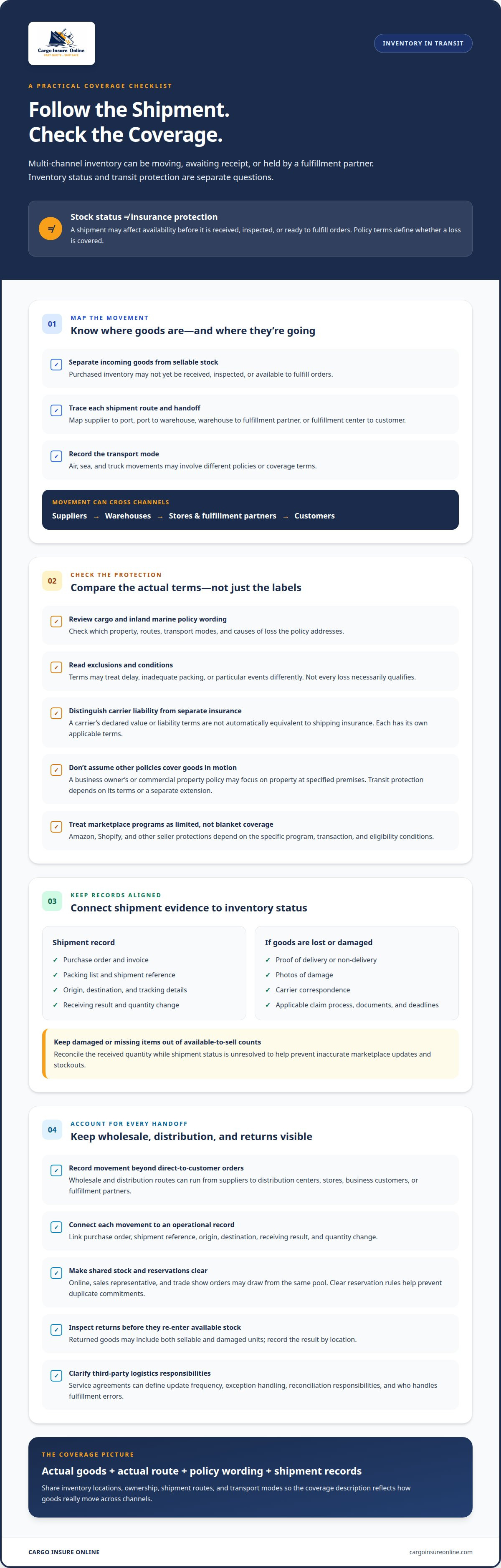
Track incoming goods separately from sellable stock. A shipment may be purchased but not yet received, inspected, or available to fulfill orders.
Transit Insurance Options
Transit insurance can protect a merchant’s financial interest in goods moving between locations, subject to the policy terms. This matters because inventory may be exposed before a warehouse, store, or fulfillment partner records receipt.
Map each shipment’s route: supplier to port, port to warehouse, or fulfillment center to customer. Air, sea, and truck movements may involve different policies or coverage terms. In the EU, the European Commission says the IOSS allows non-EU sellers to collect VAT at checkout on orders under €150. That tax process does not itself protect goods against transit loss.
Keep damaged or missing items out of available-to-sell counts until you reconcile the received quantity. This helps prevent inaccurate marketplace updates and stockouts while a shipment’s status is unresolved.
Carrier Limits and Seller Protections
A carrier’s declared value or liability terms are not automatically equivalent to separate shipping insurance. Carrier responsibility depends on its applicable terms, while an insurance policy defines its own covered interests, causes of loss, limits, and exclusions. Compare those documents with the shipment value and route.
Amazon, Shopify, and other marketplace seller protections are not a blanket substitute for transit insurance. Their scope depends on the specific program, transaction, and eligibility conditions, so do not assume protection follows inventory across every carrier or warehouse.
An insurance provider can explain the applicable claim process, deadlines, and supporting documents, and help organize a submission under its procedures. UPS, FedEx, USPS, and an insurer may each have different processes; the relevant policy and carrier terms determine what applies.
Coverage Scope and Exclusions
Cargo and inland marine policies may cover goods in transit, but the property, route, transport mode, and causes of loss covered depend on the policy wording. Exclusions and conditions matter: terms may treat delay, inadequate packing, or particular events differently. Read the policy rather than assuming every loss qualifies.
A business owner’s policy or commercial property policy does not automatically cover inventory while it is moving. The policy may focus on covered property at specified premises; transit protection depends on its terms or a separate coverage extension.
For a lost or damaged shipment claim, useful records can include the purchase invoice, packing list, tracking details, proof of delivery or non-delivery, damage photos, and carrier correspondence. Keep them with the shipment record. Required documents and filing deadlines depend on the applicable claim process.
Multi-Channel Inventory Coverage
An insurance provider can structure coverage around inventory locations, ownership, shipment routes, and transport modes across sales channels. Share how goods move between suppliers, warehouses, stores, and fulfillment centers so the coverage description reflects the actual logistics flow, not just the central platform’s stock total.
For example, record whether goods are incoming, held by a fulfillment partner, moving between locations, or allocated to orders. Link shipment records to purchase documents and receiving updates. This helps identify the goods involved if a loss occurs, while accurate channel-level records help prevent inventory in transit from appearing ready for sale.
Uses in wholesale and distribution
Wholesale and distribution add shipment paths beyond direct-to-consumer orders. Goods may move from suppliers to distribution centers, then to stores, business customers, or fulfillment partners. Each handoff makes accurate records and clear responsibility important.
A wholesaler can sell through an online portal while also taking orders from sales representatives or trade shows. That shared demand may draw from the same stock pool. For example, a representative may commit inventory while an online order arrives before the allocation appears in the central record. Clear reservation rules help prevent duplicate commitments and customer service problems.
Distribution also relies on timely information from third-party warehouses. Receipts, outbound shipments, adjustments, returns, and location balances all shape the merchant’s view of available stock. When updates arrive late, an ecommerce platform may show inventory that has already shipped, been damaged, or been allocated to a wholesale order.
Useful controls connect each movement to a record: purchase order, shipment reference, origin, destination, receiving result, and quantity change. These details help operations teams distinguish a short receipt from a delayed update or an unrecorded transfer. They also clarify where goods were last confirmed.
Returns need their own status. A wholesale customer’s returned goods should not automatically re-enter available counts before inspection and restocking. For instance, a returned carton may contain both sellable units and damaged products. Recording the result by location keeps counts useful for future orders and reduces confusion across channels.
Third-party logistics service agreements can define update frequency, exception handling, and reconciliation responsibilities. They can also clarify who handles fulfillment errors. A 3PL should take financial responsibility for its fulfillment errors, including re-shipping costs and replacement product. That responsibility is separate from insurance for inventory lost or damaged during transit, so each arrangement should address its own exposure.
For a wholesale shipment, link the buyer’s order to picking, dispatch, delivery, and any shortage report. That record helps teams identify whether the issue arose during fulfillment, transport, or receiving. A manual count may show a mismatch, but it will not necessarily explain where the discrepancy began.
Amazon, Shopify, and other platforms can support sales across channels, but they don’t replace warehouse-level movement records. Aligning platform updates with location balances makes it easier to manage fulfillment priorities and protect the customer experience. For organizations assessing shipment protection alongside these controls, transit protection options can be part of the discussion.
An allocation policy can make that separation explicit by reserving a 10-unit buffer for wholesale in a hypothetical inventory plan. The buffer gives wholesale commitments a defined pool rather than leaving every unit open to whichever channel records a sale first. Teams can apply the same reservation logic when reviewing orders, incoming receipts, and available balances, while keeping uninspected returns or unresolved shipment discrepancies out of usable stock until their status is confirmed. If demand changes, staff can review whether the reserve still fits expected commitments and document any release back to shared inventory.
What insurance covers inventory lost or damaged in transit for e-commerce merchants?
For an e-commerce merchant, cargo insurance is the relevant category to consider for stock moving through a supply chain. The policy wording determines whether a shipment’s loss or physical damage falls within cover. For example, a shipment of products damaged while moving from a supplier to a warehouse may fit the described journey, depending on its terms.
Coverage depends on the insured goods, route, transport mode, and policy-defined transit period. A shipment might travel by air to a port, then by truck to a distribution center. The policy needs to describe the movement and interest being insured. A customer shipment may have different terms from an inbound purchase or warehouse transfer.
Loss scenarios can include goods that go missing during a covered journey or arrive physically damaged. Whether an event qualifies depends on the policy’s covered causes, limits, conditions, and exclusions. A crushed box, for instance, may require evidence of the damage and affected items. Delayed delivery alone is not the same as physical loss or damage.
For sellers using several channels, distinguish stock status from insured movement. A multi channel e-commerce merchant inventory transit loss protection plan should reflect how goods move between locations, not just a platform’s inventory status. Linking purchase orders, dispatch records, receiving counts, and product values helps establish what was shipped and what arrived.
Coverage questions can depend on the commercial arrangements for each stage of a shipment. A supplier, merchant, buyer, or logistics partner may hold responsibility at different points under their commercial arrangements. For example, goods moving from a supplier to a merchant’s warehouse may involve different ownership terms from a transfer between two merchant-controlled locations. The policy schedule and sales or purchase documents help establish the relevant interest.
Keep shipment evidence together. A merchant might retain the invoice, packing list, tracking history, delivery record, receiving report, and photographs of damaged packaging. These records connect the claimed goods to the affected shipment. Filing deadlines and evidence requirements vary by policy and carrier, so a complete, timely record helps move the review forward.
A multi channel e-commerce merchant inventory transit loss protection review can compare actual routes with policy wording. Include supplier deliveries, warehouse transfers, fulfillment-center stock, and customer-bound shipments in the discussion. Then compare each route with the policy terms. This makes gaps easier to spot, especially when inventory moves between locations or transport modes before reaching a buyer.
Does inland marine insurance cover goods shipped to customers or between warehouses?
Inland marine insurance may cover goods moving over land, including customer deliveries or warehouse transfers, when the policy includes those movements. The label alone does not establish coverage. For example, one policy might describe goods moving from a distribution center to a customer, while another addresses transfers between named locations.
The route matters. A shipment leaving a warehouse, traveling by truck, and arriving at a retail store has several identifiable stages. Policy terms may define when transit begins and ends, which locations or destinations qualify, and whose financial interest is insured. Those details help determine whether a loss during a particular leg falls within the policy’s scope.
Consider inventory moving from one fulfillment center to another after demand shifts across channels. The merchant’s platform may show the units as unavailable during the transfer, but the movement still creates a separate exposure. A multi channel e-commerce merchant inventory transit loss protection review should compare these actual routes with the policy’s named locations and covered transit. The wording should also match the goods and transport arrangement.
Customer-bound shipments raise similar questions. A seller may dispatch an order from a store, warehouse, or third-party fulfillment center. The policy may treat these routes differently, particularly when delivery involves another carrier or a handoff. Review how the wording describes shipping to customers, temporary storage during transit, and the point when the covered journey ends.
Exclusions and conditions also shape the answer. A policy may distinguish physical damage from delay, loss of market value, or a shortage discovered after delivery. Packing requirements, unattended vehicles, or specific causes of damage may receive separate treatment. For example, a wet carton could prompt questions about the cause of damage, packaging, and shipment records before coverage is assessed.
Inland marine insurance does not automatically replace cargo coverage for every transport mode or route. A business moving goods by truck between domestic facilities may need different wording from a seller importing inventory by sea before final truck delivery. Compare the named property, covered transit, transport modes, locations, and exclusions across the relevant policy terms.
Clear shipment records make these distinctions easier to apply. Link each transfer or customer order to its dispatch record, origin, destination, carrier information, and receiving confirmation. If a warehouse reports fewer units than expected, those records help isolate the affected leg. The central inventory count alone will not show where a shipment was last documented or when the discrepancy began.
For a multi channel e-commerce merchant inventory transit loss protection plan, assess inland marine coverage against actual movement patterns. Include store-to-customer deliveries, warehouse transfers, and shipments from third-party facilities. The practical test is whether the policy wording matches the goods, route, and transit period, not simply whether the policy bears the inland marine label.
What does cargo insurance cover, and what exclusions apply to e-commerce shipments?
Cargo insurance can protect a merchant’s financial interest in goods during covered transit. The policy defines the insured property, transport route, covered causes of loss, and applicable limits. For example, a shipment of products damaged while moving from a supplier to a warehouse may fit the described journey, depending on the terms.
Coverage does not mean every shipping problem qualifies. Physical loss or damage must fall within the policy wording and conditions. A missing carton, crushed products, or water-damaged packaging each raises different questions about what happened, which goods were affected, and whether the event is covered.
Exclusions vary by policy, so review the wording rather than relying on the label “cargo insurance.” Look for how the policy treats delay, inadequate packing, gradual deterioration, and events outside the insured transit. These are examples of subjects policy terms may address, not exclusions that apply universally. A late parcel without physical damage, for instance, may be treated differently from missing inventory.
Map the whole movement before evaluating coverage. An e-commerce order may travel from a supplier by sea, transfer to a truck, enter a fulfillment center, then ship to a customer. The policy should make clear which goods, transport modes, locations, and transit stages it describes. A warehouse transfer can differ from a customer delivery.
Also consider when the covered journey starts and ends. Terms may address dispatch, temporary storage during transit, delivery, or handoffs between carriers. If a seller uses several fulfillment locations, a policy description based on only one warehouse may not reflect every shipment route. The schedule and wording are central to understanding the scope.
Shipment records help connect a loss to the insured goods. Keep the purchase invoice, packing list, shipment reference, tracking history, receiving record, and photographs of visible damage together. For example, compare a receiving report showing a short quantity with the dispatch record and carrier updates. This creates a clearer account for claim review.
Claims also depend on timing and supporting evidence. Policy and carrier procedures may set different notice deadlines or documentation requirements. Record when the issue was discovered, preserve packaging where practical, and retain relevant correspondence. Late reporting or missing shipment details can complicate review, even when the inventory discrepancy is clear.
Before selecting coverage, compare the policy’s covered property, route, transit period, limits, and exclusions with actual e-commerce movements. Explore e-commerce cargo coverage as part of assessing protection for shipments across your supply chain.
Inventory reconciliation helps clarify what was available and where. Multi-channel sellers should update available stock to account for sales, returns, received shipments, bundle adjustments, and transfers. They should also obtain timely receipts, shipment records, adjustments, returns, and location balances from every third-party warehouse. Review sales, late shipments, stockouts, return reasons, and net margin by channel every week.
For cross-border shipments, U.S. Customs and Border Protection describes Section 321 as a de minimis rule for duty-free shipments under $800; Type 86 is a US customs entry type for low-value Section 321 shipments requiring PGA review.
Cargo Insure Online: E-Commerce Cargo Insurance
Cargo Insure Online offers E-Commerce Cargo Insurance for merchants assessing transit risks across their supply chains. It is a natural next step when inventory moves between suppliers, fulfillment centers, and customers and you want to consider protection alongside shipment records and policy terms.
Shipment mode matters, too. Cargo Insure Online also offers Air Freight Insurance, Sea Freight Insurance, and Trucking Insurance. These products address different legs of a shipment and can help merchants consider the transport modes used for incoming and in-transit inventory. The applicable protection depends on the policy terms and the goods’ movement.
To discuss transit protection for your e-commerce shipments, contact Cargo Insure Online.
Make your next shipment decision with clarity
A useful protection plan starts with how your inventory actually moves, not just where it appears in a sales platform. Map the routes, handoffs, and ownership changes across your supply chain. Then align that picture with the policy terms so decisions reflect real operations rather than assumptions.
That is the practical value of multi channel e-commerce merchant inventory transit loss protection: it connects shipment exposure with how you sell, store, and fulfill goods. As your routes or fulfillment arrangements change, revisit whether the coverage still matches those movements. Clear shipment records and a well-defined scope make each review more focused.
Ready to discuss how transit coverage could fit your e-commerce shipments? Contact Cargo Insure Online and take the next step with confidence.


