Would you bet your entire profit margin on a payout of just $0.50 per pound? That is the reality of standard carrier liability for most LTL shipments. It is not insurance; it is a legal minimum that leaves you exposed. If your high-value electronics or reefer products vanish, relying on carrier defaults is a fast track to a massive financial loss. You need freight insurance coverage that acts as a digital shield, not a bureaucratic hurdle.
We know the drill. You are exhausted by slow claims, hidden exclusions, and the "per-kilo" rules that turn a total loss into a tiny check. It is time to stop settling for "good enough" protection. This guide shows you how to master 2026 shipping complexities with total certainty and zero friction. We will preview the shift toward embedded, digital-first policies that offer full reimbursement. You will discover how to secure your global shipments in seconds and finally get the peace of mind you deserve.
Key Takeaways
- Ditch the "pennies on the pound" gamble. Learn why modern freight insurance coverage provides first-dollar protection for the full invoice value of your global shipments.
- Stop relying on limited carrier liability. Discover why legal minimums like $0.50 per pound are a recipe for financial disaster and how all-risk policies bridge the gap.
- Protect sensitive cargo with precision. Identify the specific clauses needed to safeguard high-value electronics, drones, and reefer products against spoilage and theft.
- Experience the 60-second setup. See how digital-first platforms eliminate paperwork by integrating cargo protection directly into your existing TMS or ERP via API.
- Fast-track your recovery. Transition from slow, manual claims to an automated system designed for speed, transparency, and total financial certainty.
What is Freight Insurance Coverage? (The 2026 Definition)
In 2026, freight insurance coverage isn't just a line item on a spreadsheet. It is a high-speed, digital-first contract that shields your business from financial ruin when things go wrong in transit. While traditional logistics models focus on moving boxes, modern coverage focuses on moving value. It is the definitive agreement that protects shippers against financial loss from physical damage or theft during the journey. Whether your goods are in a plane, on a ship, or in the back of a truck, this coverage ensures you aren't left holding an empty bill.
The old way of insuring cargo was slow and reactive. You'd wait weeks for a quote and months for a payout. The 2026 standard is different. It moves beyond "standard" protection to provide first-dollar coverage for the full invoice value of your goods. This means no deductible hurdles and no complex legal battles over who was at fault. If the cargo is damaged, you get paid. It is a level of Cargo Insurance sophistication that matches the speed of global trade. Modern policies now include digital-first triggers and automated claims processes that settle in hours, not weeks.
Why 'Standard' Protection Isn't Enough
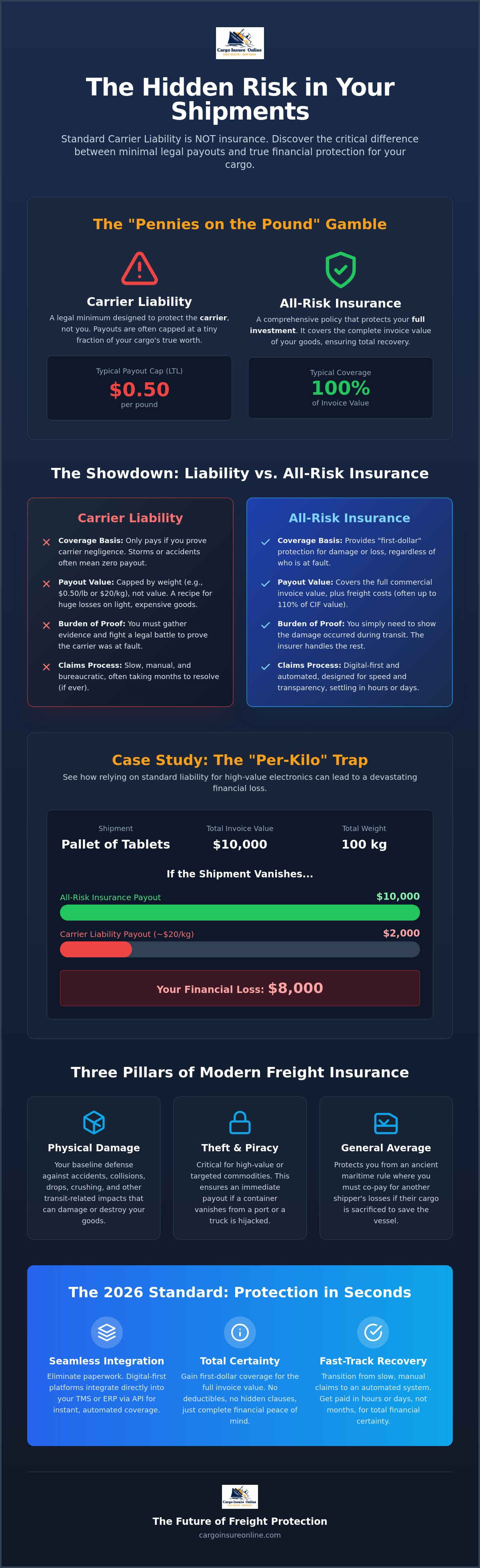
Carrier liability is not insurance. It is a relic of 20th-century bureaucracy designed to protect carriers, not you. Most shippers don't realize they are only covered for a tiny fraction of their cargo's actual value. If a storm hits at sea or a truck swerves to avoid an accident, the carrier often isn't legally "negligent." In those cases, you get zero. Even when they are liable, payouts are often capped at $0.50 per pound or $20 per kilogram. Freight insurance is the only way to guarantee 100% value recovery for your shipments.
The Three Pillars of Modern Coverage
- Physical Damage: This is your baseline defense. It covers accidents, drops, collisions, and crushing. In high-speed automated warehouses, one mechanical glitch can ruin a shipment of high-value electronics.
- Theft and Piracy: Critical for global sea routes and "target" commodities like mobile phones or drones. If a container vanishes from a port or a truck is hijacked, you need a policy that triggers an immediate payout.
- General Average: An ancient maritime rule that is still very real in 2026. If a ship's captain sacrifices cargo to save the vessel, every shipper on that boat shares the financial loss. Without freight insurance coverage, you could be forced to pay for someone else's lost containers just to get your own released.
Logistics is unpredictable. Your insurance shouldn't be. By securing a digital-first policy, you turn a complex legal headache into a seamless, automated safety net.
Carrier Liability vs. All-Risk Freight Insurance
Stop settling for pennies on the pound. Many shippers mistake carrier liability for a safety net. It isn't. Liability is a limited legal responsibility, not a financial guarantee. It is designed to protect the carrier, not your bottom line. If a container falls overboard or a truck flips, the carrier only pays if you can prove they were negligent. Even then, the payout is often a fraction of your actual loss. Don't gamble with your margins. All-risk freight insurance coverage flips the script. It provides first-dollar protection regardless of who is at fault. It covers the full commercial value of your goods plus shipping costs, typically reaching 110% of the Cost, Insurance, and Freight (CIF) value.
The difference between these two models is the difference between a total loss and a total recovery. While liability relies on outdated 20th-century rules, all-risk insurance is built for the high-speed demands of 2026. It removes the burden of proof from your shoulders. It replaces legal battles with automated settlements. You don't need to prove the driver was speeding or the ship was unseaworthy. You just need to show the damage happened. That is the power of a modern policy. It turns a logistical nightmare into a manageable, digital event.
The 'Per-Kilo' Trap Explained
Imagine you're shipping a $10,000 pallet of high-end tablets. The pallet weighs 100kg. If that pallet vanishes, you'd expect $10,000 back, right? Under standard air freight liability rules (The Montreal Convention), the carrier is only liable for roughly $20 per kilogram. Your payout? A measly $2,000. You're left with an $8,000 hole in your budget. This "per-kilo" trap is why generic protection fails tech shippers every single day. For high-value goods, you need specialized electronics shipping insurance that covers the actual invoice value, not just the weight of the box.
Acts of God and Exclusions
Carriers have a "get out of jail free" card for major disasters. They aren't liable for "Acts of God." If a hurricane sinks a vessel or an earthquake destroys a warehouse, the carrier pays nothing. They'll cite force majeure and walk away. You're left holding the bill for destroyed inventory. All-risk freight insurance coverage doesn't have these loopholes. It covers natural disasters, ensuring your capital stays safe even when the weather turns. You can see how sea freight insurance handles these maritime disasters, providing a shield where carrier liability leaves you exposed. Don't leave your recovery to chance when securing an instant quote can lock in total certainty in seconds.
Specialized Coverage for High-Value and Sensitive Cargo
Generic policies are the enemy of high-value logistics. In 2026, shipping a pallet of gravel is not the same as shipping a container of high-end drones. Yet, many traditional providers use the same broad-brush approach for both. This leaves you dangerously exposed. Standard freight insurance coverage often excludes 'target' commodities like mobile phones or specialized medical equipment. If your cargo is "attractive" to thieves, you need more than a basic policy. You need a digital shield designed for the specific risks of high-value assets. Don't let a hidden exclusion in the fine print turn a successful launch into a financial disaster.
E-commerce has rewritten the rules of the shipping game. High-volume sales require high-velocity protection. You don't have time to wait for manual quotes or faxed certificates for every single parcel. Modern solutions offer frictionless, per-parcel coverage that integrates directly into your workflow. This is where customized GAP insurance becomes a game-changer. It fills the legal holes found in traditional logistics contracts, ensuring that no matter how complex the route or how many carriers touch the box, your financial recovery is guaranteed. It is about removing the "maybe" from your insurance strategy.
Electronics and High-Value Devices
Theft is the primary risk for mobile phones and laptops in transit. Professional thieves target these goods because they are easy to move and hard to track. But physical loss isn't the only threat you face. Concealed damage discovered only after delivery can ruin your margins if your policy doesn't specifically account for it. Cargo Insure Online provides specialized protection for drones and high-tech assets. We cover everything from tarmac theft to internal component failure caused by rough handling. We ensure that your tech arrives ready for the end-user, not the scrap heap.
Cold Chain and Reefer Protection
Temperature is the lifeblood of the cold chain. Spoilage can happen in minutes if a reefer unit fails or a driver misses a setting. A standard policy might cover a truck crash, but it won't necessarily cover a two-degree deviation that ruins a shipment of pharmaceuticals. Your freight insurance coverage must include specific refrigeration breakdown clauses. This protects you against equipment failure and human error alike. Read our reefer cargo insurance guide for a deep dive into modern cold chain safety and total temperature control.
How to Secure Coverage in Under 60 Seconds
The 20th-century model of cargo protection was a bottleneck. You'd call a broker, wait for a callback, and fax over a manifest. That era is dead. In 2026, freight insurance coverage is issued instantly. It is no longer a separate, manual chore; it is an integrated part of the booking process. Modern logistics demands speed. If your insurance process takes longer than your booking process, you are losing money. Digital-first issuance means you get your certificate the moment you click "bind." No waiting. No paperwork. Just total certainty.
Integration is the secret to this speed. You can now access coverage directly inside your existing Transportation Management System (TMS) or ERP. By connecting via API, the insurance engine pulls data directly from your shipment records. This eliminates the need for double entry and slashes the risk of human error. It is a seamless flow that turns insurance from an administrative hurdle into a competitive advantage. While your competitors are still waiting for an underwriter to review a PDF, you've already secured your load and your profit margin.
The Power of Cargo Insurance APIs
Logistics providers are no longer just moving freight. They are becoming tech-driven service hubs. By using advanced APIs, forwarders and brokers can now offer branded cargo insurance directly to their clients. This automation ensures that no load ever leaves the dock uninsured. It creates a frictionless experience for the end shipper and provides the logistics partner with a sophisticated, digital-first value add. Speed is the ultimate currency in global trade, and API-driven insurance is how you spend it wisely.
What You Need for an Instant Quote
You don't need a stack of documents to get a price. The digital underwriting process is remarkably simple. To get a quote in seconds, you only need three core pieces of information:
- Origin and Destination: Accurate data on global routes to assess transit risk.
- Commodity Type and Value: Knowing exactly what is being shipped and its full commercial value.
- Mode of Transport: Selecting between air, sea, or Trucking cargo insurance.
Once you enter these details, the system generates a transparent quote. You select your value, review the terms, and bind the policy. The entire cycle happens in under a minute. This efficiency even carries over into the claims process. In the digital age, claims are handled with photo evidence and automated payouts. You upload a picture of the damage from the warehouse floor, and the settlement process begins immediately. Ready to experience the future of logistics? Get an instant quote now and see how easy freight insurance coverage can be.
Cargo Insure Online: The Future of Freight Protection
Cargo Insure Online (CIO) isn't just another insurance provider. We are a tech-driven force disrupting a stagnant industry. For decades, shippers were forced to navigate a maze of brokers and paper-heavy contracts. Those days are over. We've built a platform where freight insurance coverage is as fast as your digital supply chain. We prioritize speed, clarity, and total financial certainty. You shouldn't have to choose between protection and efficiency. With CIO, you get both. It is a modern solution for a modern world.
We focus on what matters most in the 2026 economy. High-value electronics, sensitive reefer products, and high-velocity e-commerce are our specialties. We don't just cover the easy stuff. We cover the complex, the high-risk, and the global. Our reach is worldwide, but our expertise is surgical. We understand the specific risks of every mile, from the loading dock to the final mile delivery. Stop worrying about the fine print. Start shipping with the confidence that only modern technology can provide. We've removed the friction so you can focus on growth.
Why Shippers Choose CIO
Transparency is our baseline. We've eliminated the "black box" of traditional underwriting. Our users enjoy zero paperwork and 100% digital visibility into their policies. But speed doesn't mean a lack of security. Every policy is backed by A.M. Best 'A' rated carriers. This ensures you have the financial muscle of an industry giant with the agility of a digital-first partner. We also offer tailored solutions for cross-border e-commerce, helping you scale into new markets without the traditional insurance hurdles. We provide the safety net, you provide the vision.
Ready to Shield Your Cargo?
Don't wait for a catastrophic loss to realize your freight insurance coverage is inadequate. A single lost container or damaged reefer unit can wipe out months of profit. The risk is real, but the solution is simple. The era of reactive insurance is finished. Proactive, instant protection is the new standard. Get an instant quote today and see exactly how frictionless modern cargo protection feels. It's time to empower your business with speed and certainty. Protect your next shipment with Cargo Insure Online and experience the future of global trade. Your cargo deserves total certainty. Your business deserves CIO.
Master Your Logistics Shield in 2026
Shipping is no longer about crossing your fingers and hoping for the best. You've seen the "per-kilo" trap of carrier liability and the undeniable power of all-risk protection. By choosing a digital-first approach, you turn a complex administrative chore into a seamless competitive advantage. The era of manual paperwork and slow settlements is over. The era of total certainty has arrived.
Your freight insurance coverage should be as fast and agile as your supply chain. With Cargo Insure Online, you get instant digital certificates and specialized high-value tech coverage backed by A.M. Best 'A' rated carriers. We've removed the friction so you can focus on scaling your global footprint. No more guessing. No more gambling with your profit margins. Just pure, tech-driven reliability.
It's time to embrace the frictionless future of global trade. Stop waiting for traditional brokers and start securing your shipments in seconds. Stop gambling with your cargo. Get an instant freight insurance quote now! Your business is moving fast. Your insurance should keep up.
Logistics Protection: Your Questions Answered
What is the difference between freight insurance and carrier liability?
Carrier liability is a limited legal obligation, not a financial guarantee. It often pays as little as $0.50 per pound and requires you to prove the carrier was negligent. Freight insurance is a private contract that pays the full invoice value of your goods regardless of who was at fault. It replaces legal battles with guaranteed recovery.
Does freight insurance cover 'Acts of God' like natural disasters?
Yes. All-risk policies cover hurricanes, earthquakes, and lightning strikes. Carriers are legally exempt from liability during "Acts of God" under force majeure clauses. Without your own freight insurance coverage, you'd be forced to absorb the total loss of your inventory during a natural disaster.
What is All-Risk cargo insurance coverage?
All-Risk is the gold standard for 2026 shipping. It covers all causes of physical loss or damage from any external cause. Unlike named-peril policies that only cover specific events, All-Risk covers everything unless it is explicitly excluded in the fine print. It is the most comprehensive way to protect your margins.
How much does freight insurance coverage typically cost?
Industry rates for per-load coverage typically range from 0.1% to 2% of the declared cargo value. The exact premium depends on your commodity type, the shipping route, and the mode of transport. It is a small investment that prevents a catastrophic hit to your company's balance sheet.
Is freight insurance required for international shipping?
Governments don't legally require it, but your bank or buyer might. Most Letters of Credit and commercial contracts mandate insurance to secure the transaction. Beyond the paperwork, it is a business necessity. International routes involve multiple handoffs, increasing the risk of theft or damage at every port.
What is 'General Average' in sea freight insurance?
General Average is a maritime rule where all parties share the cost if cargo is sacrificed to save a ship. If a captain throws containers overboard to prevent a sinking, you must pay a portion of that loss. All-risk insurance covers these unexpected contributions so your goods aren't held hostage at the port.
How do I file a claim for damaged freight?
Go digital. Document the damage with high-resolution photos immediately upon delivery and note it on the Proof of Delivery (POD). Submit your commercial invoice and packing list through your insurance platform. Modern systems use automated workflows to settle claims in hours or days rather than months.
For logistics professionals seeking to deepen their expertise in handling these complex processes, check out Certified Claims Professional Accreditation Council, Inc. (CCPAC) to learn about industry-standard certification and professional development.
Can I get insurance for high-value electronics and mobile phones?
Yes, but you need specialized protection. Standard policies often exclude "target" commodities like drones and smartphones due to high theft risk. Digital-first providers like Cargo Insure Online offer dedicated electronics coverage that accounts for both theft and concealed damage discovered after the box is opened.


