In 2026, your trucking cargo insurance is either a bottleneck or a jet engine for your business growth. Most carriers still struggle with agonizingly slow quote turnarounds and confusing exclusions that leave high-value electronics dangerously exposed. It's frustrating to watch a profitable load sit idle while you wait for a legacy broker to shuffle paperwork. We know that in a digital-first economy, insurance must move at the same high speed as your fleet.
This guide helps you master the complexities of modern freight protection and secure your cargo with high-speed, frictionless coverage. You'll learn how to turn liability into a competitive advantage by leveraging all-risk protection that covers the full value of every load. With the FMCSA proposing liability increases to $2 million, staying ahead isn't just about compliance; it's about survival. We'll preview the Motus system transition and show you how to integrate digital-first protection directly into your existing logistics workflow for an immediate operational edge.
Key Takeaways
- Ditch the paperwork. Learn how to turn trucking cargo insurance from a bureaucratic headache into a high-speed financial firewall.
- Stop gambling with "Named Perils." Understand why All-Risk protection is the essential gold standard for securing the full value of your freight in 2026.
- Protect what matters most. Get the blueprint for securing high-value electronics and reefer cargo with specialized coverage that standard policies often miss.
- Demand instant results. Master a two-step framework for choosing a digital insurance partner that offers API integration and real-time quotes.
- Build a competitive edge. Discover how frictionless, digital-first protection eliminates operational delays and keeps your trucks moving.
Rethinking Trucking Cargo Insurance: Beyond the Bureaucracy
Stop treating cargo insurance as a box to check. In 2026, trucking cargo insurance is your financial firewall. It's the difference between a minor delay and a total business collapse. Traditional brokers move at a crawl. They thrive on paperwork. They love delays. But your trucks don't wait. Modern logistics requires instant, digital-first protection. This isn't just for "for-hire" carriers. If you're moving value, you're holding risk. Stop viewing insurance as a sunk cost. Start seeing it as instant liquidity that keeps your operations agile and your shippers confident.
The Carrier Liability Trap: Why $2.00 Per Kilo Isn’t Enough
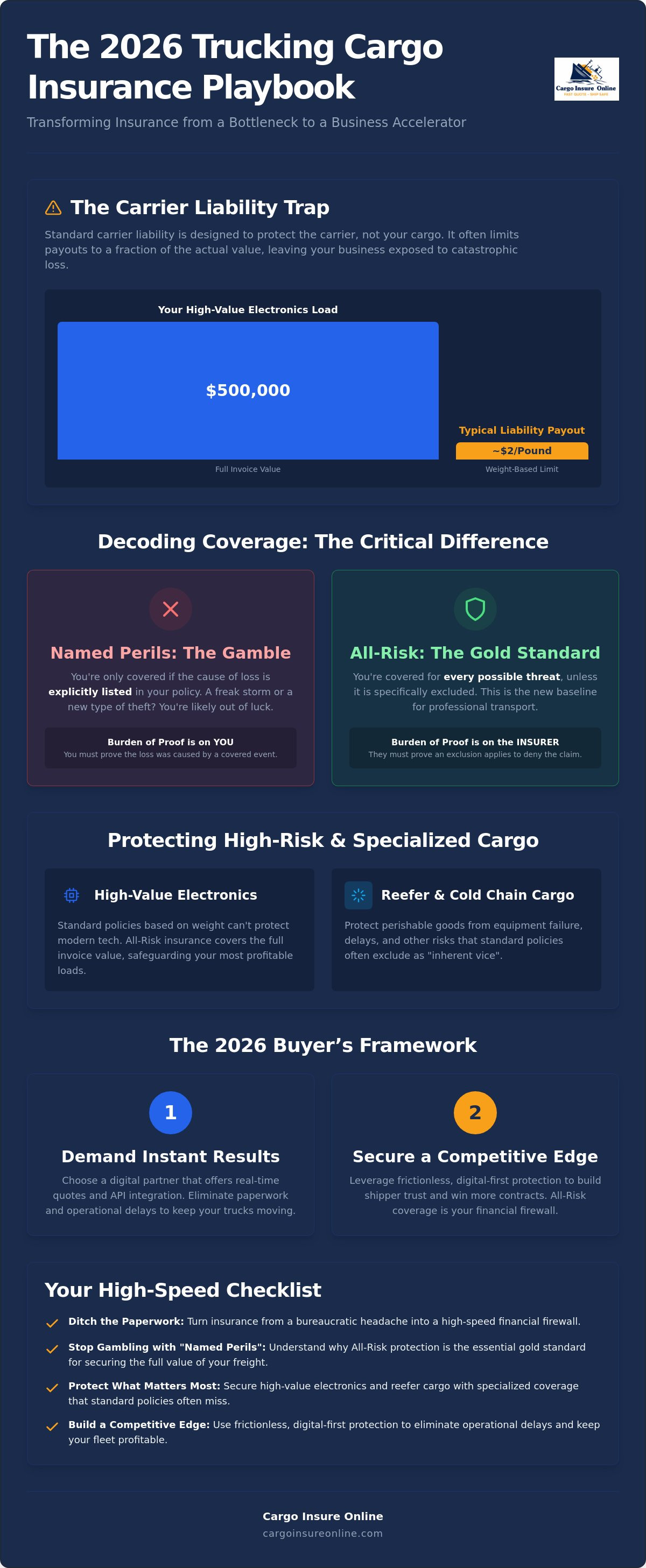
Most shippers assume the carrier covers everything. They don't. Standard carrier liability is a trap designed to protect the carrier, not the cargo owner. It often limits payouts to a measly $2.00 per pound or kilo. If you're hauling $500,000 in high-value electronics, that weight-based limit won't even cover the cost of the packaging. A single highway incident can bankrupt an uninsured carrier overnight. Don't rely on the "automatic" coverage myth. It's often non-existent or riddled with exclusions. True protection means covering the full invoice value of the load, not just a fraction of its weight.
- Weight-based limits: Payouts are tied to mass, not market value.
- Proof of negligence: Shippers must prove the carrier was at fault, which can take months of legal battles.
- Limited perils: Standard liability often ignores "Acts of God" or unpredictable road hazards.
The 2026 Logistics Reality: Speed, Tech, and Trust
Shippers in 2026 demand more than just a truck. They demand certainty. Digital-first insurance builds that trust instantly. When you can provide a certificate of insurance in seconds, you win the contract. This is where inland marine cargo insurance becomes your secret weapon. It provides a modern shield for land-based logistics that traditional, paper-heavy policies simply can't match. The open road is unpredictable. It's full of hazards, from sophisticated theft rings to environmental damage. You need closed-loop financial protection that moves at the speed of your data. Real-time coverage isn't a luxury; it's the new baseline for professional transport.
Decoding Coverage: All-Risk vs. Named Perils
Named Perils coverage is a dangerous gamble. You only get paid if your specific disaster appears on a pre-written list. If a freak storm, a weird road accident, or a specific type of theft isn't explicitly named, you're out of luck. That is a legacy mindset. In 2026, trucking cargo insurance needs to be broader and more resilient. All-Risk is the gold standard because it flips the script. It covers every possible threat unless the policy specifically excludes it in the fine print. It's the difference between hoping you're covered and knowing you are.
Even the best policies have boundaries. You'll still see exclusions for war, nuclear risks, and "inherent vice," which refers to natural deterioration like fruit rotting or metal rusting. But the real value lies in "loading and unloading" coverage. Most cargo damage doesn't happen at 60 mph on the highway. It happens on the dock. If your policy doesn't explicitly protect the transition from warehouse to trailer, you have a massive hole in your financial firewall. You can explore all-risk options that close these gaps instantly and keep your freight moving without hesitation.
Why All-Risk is the Only Logical Choice for 2026
All-Risk isn't just a marketing term; it's a legal shift in power. With Named Perils, the burden of proof is on you. You have to prove the loss was caused by a covered event. With All-Risk, that burden shifts to the insurer. They must prove an exclusion applies to deny the claim. This shift provides massive peace of mind for freight brokers and carriers who manage high volumes. While federal cargo insurance regulations set the baseline for public liability, they don't guarantee full value recovery for your cargo. All-Risk does the heavy lifting that regulations leave behind.
Hidden Perils: Theft, Strikes, and Civil Commotion
Theft is evolving. It isn't just about broken padlocks anymore. Organized hijacking and strategic identity theft are rising. Your trucking cargo insurance must include specific protection that accounts for these modern tactics. Watch out for the "unattended vehicle" clause. This is the most dangerous fine print in the industry. It can void your coverage if a driver leaves the rig for a quick break and the cargo vanishes. You also need protection for debris removal and pollution cleanup. An overturned trailer can lead to environmental fines that dwarf the cost of the cargo itself. Don't let a simple accident turn into a multi-million dollar environmental disaster.
Specialized Protection: High-Value Tech and the Cold Chain
Standard trucking cargo insurance often treats every pallet the same. That's a dangerous assumption. A pallet of high-value electronics requires a completely different risk profile than a load of lumber. If your policy doesn't account for the specific vulnerabilities of tech or the precision of the cold chain, you're flying blind. You need specialized protection that understands the difference between a fender bender and a total loss of temperature integrity. In 2026, general coverage is no longer enough to protect high-margin freight. It's time to demand insurance that is as sophisticated as the cargo you carry.
Finding an agency that understands these nuances is critical for long-term success; you can learn more about AMCO.NET LLC to see how their professional team handles complex coverage needs.
Safeguarding the Tech Pipeline: Electronics and Drones
Shipments of mobile phones and drones are high-stakes targets. Standard theft clauses won't cut it. You need electronics shipping insurance that includes "mysterious disappearance" coverage. This protects you when the inventory doesn't match the manifest, even without signs of forced entry. Digital-first valuation models are essential here. They ensure you aren't stuck with a 2024 payout for a 2026 device. Traditional policies ignore the reality of "concealed damage." If the exterior box looks fine but the internal circuitry is fried from road vibration, you need a policy that recognizes the loss immediately. Don't let a technicality drain your margins.
The Cold Chain: Preventing Spoilage and Loss
Reefer loads are a race against time. Most carriers think a basic accident policy is enough. It isn't. You need reefer cargo insurance that specifically covers mechanical breakdown. If the cooling unit fails while the truck is parked, a standard trucking cargo insurance policy might leave you frozen out of a claim. Modern sensors change everything. They provide real-time temperature log data that serves as indisputable evidence during the claims process. When your data proves the temperature stayed within the margin until the moment of failure, payouts move at digital speed. It turns a week-long investigation into a near-instant resolution. This is how you turn a potential spoilage disaster into a minor operational hiccup.
The 2026 Buyer’s Framework: Choosing a Digital Insurance Partner
Choosing a partner for your trucking cargo insurance shouldn't feel like a trip to the DMV. In 2026, the gap between legacy brokers and digital-first allies has become a canyon. If your insurance provider still relies on spreadsheets and callback promises, they are a liability to your logistics chain. You need a partner that operates at the speed of your fleet. Follow this five-step framework to ensure your coverage is an asset, not an anchor.
- Demand instant quotes: If you have to wait 24 hours for a price, they are too slow. Your shippers won't wait. Neither should you.
- Check for API readiness: Your insurance should live where your logistics live. It should integrate directly into your TMS or shipping platform.
- Verify global reach: Even local haulers often carry international goods. Ensure your protection doesn't stop at the border or the port.
- Look for specialized expertise: As we discussed with high-value tech, generalists miss the critical fine print that leads to denied claims.
- Prioritize digital claims: Paper-based systems are slow and prone to error. Demand a portal where photos, sensor data, and documents move instantly.
The Death of Paperwork: Speed of Issuance
In 2026, insurance is a click, not a call. The old-school broker model is dying because it thrives on friction. They want you to wait. They want to "shop the market" while your truck sits idle. Dismiss that. Modern trucking cargo insurance provides instant certificates of insurance (COIs) the moment you bind. These instant COIs are your ticket to winning high-value contracts. When a shipper asks for proof of coverage, you don't send an "it's coming" email. You send the document. This builds immediate trust and keeps your wheels turning. You can get an instant quote today and experience the speed for yourself.
Integration and Scalability: API and White Label
Freight brokers and large fleets need more than just a policy; they need an engine. This is why forward-thinking companies are moving toward branded cargo insurance platforms. Your insurance should be embedded in your workflow. When you book a load, the coverage should trigger automatically via API. This eliminates the risk of human error and ensures every mile is protected. Whether you are managing a single owner-operator or a global fleet of thousands, your insurance must scale with you. Don't buy a static policy. Invest in a scalable digital infrastructure that grows as fast as your ambition.
Cargo Insure Online: Frictionless Trucking Protection
Stop settling for "good enough" insurance. Traditional insurers love the status quo. They thrive on the friction that slows your business down. Cargo Insure Online isn't just another intermediary. We're your digital logistics ally. We provide the high-speed trucking cargo insurance traditional brokers simply can't touch. While they are busy shuffling paper, we are busy shielding your entire supply chain. From the first mile to the last, we turn protection into a competitive advantage. Zero friction. Zero stress. Total protection for the road ahead.
Instant Quotes for Modern Truckers
The old way of getting insured was built for a world that didn't move this fast. It relied on phone tags, manual entries, and 48-hour waiting periods. We've replaced that broken model with pure, automated efficiency. Get your trucking cargo insurance quote in seconds, not days. We've designed our platform for the 2026 standard of digital logistics. Whether you are hauling high-value electronics or managing a delicate reefer load, our coverage is customizable and immediate. You don't have to wait for a broker to wake up to secure your freight. You just need a partner that values your uptime as much as you do.
- Electronics & High-Value Devices: Specialized protection for the tech pipeline.
- Reefer Product: Precision coverage for temperature-sensitive goods.
- Digital First: Instant COIs that let you bind and move in the same minute.
Global Protection, Local Expertise
The road is unpredictable. In 2026, the transition to the Motus system and shifting FMCSA liability requirements mean you need an expert that stays ahead of the curve. We provide worldwide coverage that respects the unique risks of every route you drive. But coverage is only half the story. When a claim happens, you need a portal that respects your time. Our 24/7 digital claims support ensures that an incident doesn't become a permanent roadblock. We've eliminated the bureaucratic hurdles to keep your trucks moving and your shippers happy. Experience the future of freight protection today. Get your instant trucking cargo insurance quote now!
Drive into the Future of Freight Protection
Logistics in 2026 demands absolute speed. Traditional insurance is a roadblock; digital-first protection is a jet engine. We've moved beyond the era of waiting days for a quote. You now have the power to secure All-Risk coverage for high-value electronics and reefer goods in seconds. It's about turning a mandatory cost into a strategic asset that wins more shippers and builds immediate trust.
Your business doesn't stop at the state line. Neither should your protection. With instant digital certificates and specialized high-value tech protection, you're ready for any route across air, sea, or land. Don't let legacy brokers slow your momentum with outdated paperwork and confusing exclusions. Secure your fleet with modern trucking cargo insurance that actually moves as fast as you do.
Ready to experience the standard of 2026? Get Your Instant Trucking Cargo Insurance Quote Today and keep your trucks moving with total confidence. The road is open. Your freight is protected. Let's get to work.
Frequently Asked Questions
Is trucking cargo insurance legally required for all carriers?
Strictly speaking, the FMCSA mandates public liability insurance, but it doesn't require trucking cargo insurance for every interstate carrier. Don't let that fool you into skipping it. Almost every reputable broker and shipper mandates a minimum of $100,000 in cargo coverage before they'll even let you see a load board. It's a commercial necessity for anyone who wants to stay in business.
What is the difference between motor truck cargo insurance and freight insurance?
Motor truck cargo insurance protects the carrier’s liability for the property of others while in transit. Freight insurance is a broader term often used by shippers to protect their own investment. In practice, they're often used interchangeably in the digital space. Our approach focuses on the value of the load itself, ensuring your financial protection is absolute and immediate regardless of the label.
Does trucking cargo insurance cover the truck itself during an accident?
No, it doesn't. Trucking cargo insurance is designed exclusively to protect the goods you're hauling. If you want protection for your rig, trailer, or equipment after a collision, you need physical damage insurance. Think of cargo insurance as the shield for what's inside the trailer, while other policies handle the steel and rubber on the road; for your physical business premises and depots, you might consider the options at wsinsurance.co.uk.
How much trucking cargo insurance coverage do I actually need?
The industry standard for most general freight is $100,000 per load, but that's just the baseline. If you're moving high-value electronics or pharmaceuticals, your needs could easily jump to $500,000 or more. Don't guess on your limits. Check your shipper contracts. Modern digital platforms allow you to scale your coverage up or down instantly based on the specific value of today's freight.
What happens if my reefer unit breaks down and the cargo spoils?
If you have a standard policy, you're likely in trouble. Most basic plans exclude spoilage due to mechanical failure. You need a specific reefer breakdown endorsement to cover these losses. In the digital age, this protection uses sensor data to prove the failure happened during transit. This turns a complex spoilage claim into a clear, data-backed payout that keeps your business moving.
Can I get cargo insurance for high-value electronics and mobile phones?
Yes, you can, but you need more than a generic policy. High-value electronics are high-risk targets that require specialized tech protection. This includes "mysterious disappearance" and "concealed damage" clauses. These policies account for the unique valuation and theft risks inherent in the tech pipeline. They ensure you aren't left with a massive bill for a stolen or damaged pallet of smartphones.
How does the claims process work for digital cargo insurance?
It's fast, transparent, and entirely paperless. You don't wait for a mail-in form or a legacy adjuster to call you back. You upload photos of the damage, the bill of lading, and any sensor data directly into a digital portal. Automation and AI-driven underwriting then review the facts, often leading to claim resolutions in a fraction of the time it takes traditional brokers.
Does cargo insurance cover theft from an unattended vehicle?
It depends entirely on your policy's fine print. Many legacy insurers use "unattended vehicle" clauses to deny theft claims if the driver isn't in the cab. Digital-first policies are more flexible but often require proof of security, like GPS tracking or locked gates. Always verify this clause. It's the difference between a covered loss and a total financial disaster while your driver takes a break.


