Your carrier’s standard liability policy isn’t a safety net; it’s a trap door. Most logistics providers value your high-tech UAVs by weight, offering pennies on the dollar if your gear disappears or arrives in pieces. You’ve invested heavily in specialized sensors and lithium-ion powerhouses, yet traditional shipping insurance for drones often treats your $15,000 asset like a crate of scrap metal. It’s a gap that leaves your business grounded and your capital at risk.
We understand that modern drone logistics move faster than old-school insurance can track. You need protection that follows your tech globally without the slow, bureaucratic claims processes that stall your operations. This 2026 checklist promises to help you master the complexities of UAV transit and secure your high-value assets with confidence. We’ll preview the latest IATA Red Sea communication mandates, reveal how to navigate complex battery exclusions, and show you how to get instant digital quotes that provide full-value, all-risk coverage for every flight path.
Key Takeaways
- Ditch the "per-kilo" trap of standard carrier liability that leaves your high-value UAVs dangerously underinsured.
- Master the anatomy of specialized coverage to protect both the airframe and expensive sensors like LiDAR or thermal cameras.
- Audit your current shipping insurance for drones using our 2026 checklist to ensure full replacement value and international compliance.
- Secure your logistics chain by mastering 2026 IATA lithium-ion battery regulations and advanced packaging standards.
- Transition to a digital-first insurance partner to access instant quotes and frictionless, all-risk protection for your entire fleet.
Why Standard Cargo Insurance Leaves Drones Grounded
Drone shipping insurance isn't your standard liability coverage. It's a specialized shield. It protects UAVs while they're in boxes, on trucks, or in cargo holds. Many operators confuse this with flight insurance. Don't fall for that mistake. This is about protecting your asset during transit. It's the difference between a total loss and a seamless replacement. When your tech is in the hands of a third-party carrier, you need a policy that understands the specific risks of high-value hardware.
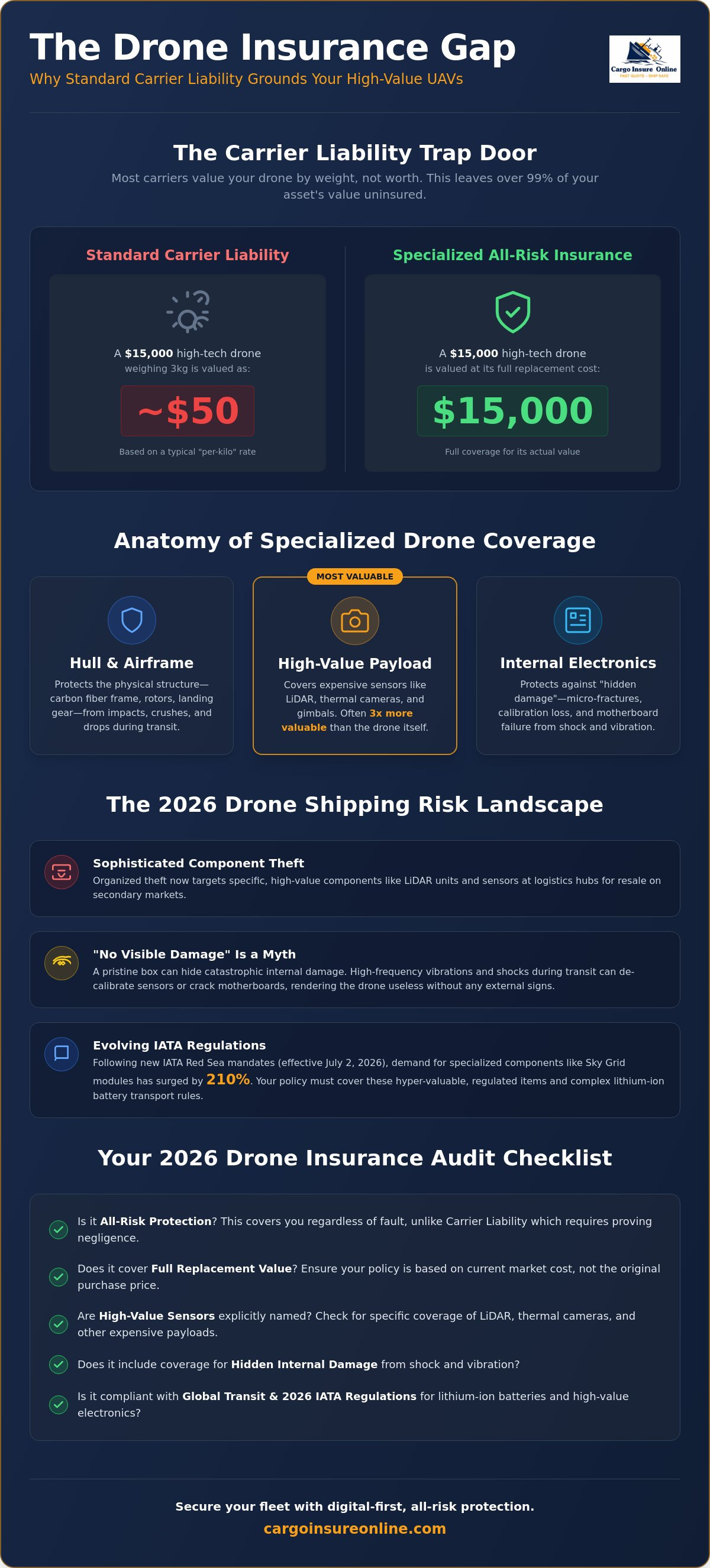
Standard shipping insurance often treats a drone like a pallet of bricks. We call this the "Per-Kilo" trap. Carriers limit their liability based on weight. If your $10,000 carbon-fiber drone weighs three kilograms, a standard carrier might offer you an insulting check for fifty bucks. It's a financial nightmare. Modern logistics classifies drones as "High-Value Electronics." They're dense with value. They're incredibly fragile. They require a policy that respects their price tag, not their weight. Without a dedicated policy, you're essentially self-insuring 99% of your drone's value.
Traditional policies are bureaucratic nightmares. They're slow. They're vague. Specialized shipping insurance for drones is different. It's precise. It's digital. It's built for the speed of the tech industry. We’ve removed the friction so you can focus on the mission.
Carrier Liability vs. All-Risk Insurance
Relying on a freight forwarder’s basic coverage is a gamble. There’s a massive gap between Carrier Liability vs Cargo Insurance. Liability only pays out if you prove the carrier was negligent. That's a high bar to clear. All-risk protection covers you regardless of fault. Drones are uniquely vulnerable to "hidden damage." A box might look pristine. However, a hard jolt in a cargo hold can knock a gimbal out of alignment. It can crack a sensitive motherboard. Without specialized protection, you’re stuck with the repair bill for damage you can’t see.
The 2026 Drone Risk Landscape
The threats are shifting. Theft of high-tech components is a surging trend in global logistics hubs. Thieves target specific sensors and LiDAR units. These are easy to flip on secondary markets. Even if the drone arrives safely, sensitive sensor calibration remains a concern. "No visible damage" is a myth in the UAV world. A single vibration event can render a thermal camera useless. Following the IATA Red Sea rule effective July 2, 2026, the demand for specialized equipment like Sky Grid modules has surged by 210%, significantly increasing the total value of shipments in transit. Dedicated shipping insurance for drones is the only way to protect these hyper-valuable, regulated components from the moment they leave the warehouse.
The Anatomy of Specialized Drone Shipping Coverage
Specialized shipping insurance for drones isn't a one-size-fits-all blanket. It's a precision-engineered stack. Think of it like the UAV itself; you have the frame, the motors, and the high-value payload. Hull protection covers the physical impact. It handles the crushed carbon fiber or snapped rotors that happen when a pallet shifts in a cargo hold. But the real risk lies in the gaps of warehouse storage and rough loading. You need a policy that treats your tech as more than just "cargo."
This is where electronics shipping insurance integrates into a broader logistics strategy. It accounts for the extreme sensitivity of internal components. Standard policies might cover a broken wing, but they often ignore the internal micro-fractures caused by high-frequency vibrations during transit. Effective shipping insurance for drones must account for the reality that the "brain" is often more valuable than the wings.
Insuring the Payload: The Real Value
Forget the frame. It's about the glass. Often, the camera or sensor rig costs three times more than the drone carrying it. A high-end LiDAR unit or a thermal sensor isn't just hardware; it's a massive capital investment. When valuing these for a policy, you must focus on current replacement costs rather than original purchase price. Be careful with exclusions. Most policies cover physical impact but might balk at internal electronic failure. You need a policy that bridges that gap, ensuring your sensors are protected from the moment they're packed until they reach the field. For specialists who rely on this tech for detailed site analysis, such as the team at Lin Inspects, a single transit mishap can compromise an entire project's data integrity.
Global Transit: Air, Sea, and Land
Risk profiles change with the mode of transport. Trucking involves constant vibration and potential theft at rest stops. Air freight is faster but involves high-pressure altitude changes and rapid temperature shifts. If you're moving gear across borders, you must follow FAA drone shipping regulations to ensure your lithium-ion batteries don't ground the whole shipment. Non-compliance doesn't just mean fines; it can void your entire claim.
For urgent international moves, air freight insurance is non-negotiable. It provides the speed and high-limit protection required for 2026's complex supply chains. Always opt for "door-to-door" coverage. Port-to-port leaves your asset vulnerable during the most dangerous legs of the journey: the first and last mile. Secure your fleet with a digital-first quote that matches your operational speed and protects your high-tech investments globally.
Drone Shipping Insurance Checklist: Evaluating Your Policy
Stop guessing about your coverage. Start auditing. A high-performing logistics strategy requires a policy that pays out at Full Replacement Value (RRP). Most legacy providers offer "Actual Cash Value," which accounts for depreciation. If your two-year-old UAV is lost, they'll pay you for a used model. That doesn't get you back in the air. Specialized shipping insurance for drones ensures you receive the funds for a brand-new unit, keeping your operations seamless and your fleet modern.
Global transit adds layers of complexity that standard policies ignore. You must verify that your protection meets drone cargo insurance standards in every country on your route. Different jurisdictions have different liability caps and regulatory hurdles. Citing commercial drone insurance coverage guidelines helps distinguish between simple liability and the robust asset protection needed for high-value logistics. If your policy doesn't follow the drone across borders, it isn't a solution; it's a liability.
Cyber risks are the new frontier of transit loss. If a drone is stolen in transit, the hardware loss is just the beginning. Is your proprietary flight data protected? Ensure your policy doesn't have a "Data Exclusion" clause that leaves you vulnerable to intellectual property theft. You also need to look at claims speed. If you can't file a claim via an app in five minutes, your insurer is living in the 1990s. We've replaced bureaucratic delays with digital-first efficiency.
The 5-Point Policy Audit
Step 1: Check the "High-Value Goods" sub-limit. Many policies cap electronics at a fraction of the total shipment value. Step 2: Verify lithium battery coverage. Following the 2026 IATA updates, non-compliant battery packing can void your entire claim. Step 3: Confirm "All-Risk" status. Don't settle for "Named Perils," which only covers specific events like fire or theft. You want a policy that covers everything unless it's explicitly excluded. Step 4: Validate global scope. Step 5: Test the claims portal. If it's slow now, it'll be a nightmare during a crisis.
Deductibles and Premiums
Low premiums are a siren song. They usually hide massive deductibles that exceed the cost of minor repairs. If your deductible is $2,000 but a gimbal repair is $1,500, you're effectively uninsured for common mishaps. Balance your deductible against your shipment frequency to find the sweet spot of risk. Cheap insurance is a gamble; specialized protection is an investment. Investing in a specialized premium transforms a recurring expense into a strategic shield against total capital loss.
Mitigating Risk: Best Practices for High-Value UAV Transit
Packaging excellence isn't a suggestion. It's a requirement for a successful claim. If your shipping insurance for drones provider sees sub-par packing, they'll deny you in a heartbeat. Don't rely on the factory box. Upgrade to double-walled corrugated containers with custom-cut anti-static foam. These aren't just "best practices"; they're your first line of defense against transit damage. Protecting sensitive gimbals and LiDAR sensors requires a level of cushioning that standard shipping materials simply can't provide.
IoT sensors are the 2026 standard for high-value logistics. They track G-force spikes, temperature shifts, and humidity levels in real-time. If a forklift driver drops your pallet in a warehouse, you’ll have the telemetry to prove it before the box even reaches your door. Combine this tech with a strict "Unboxing Protocol." Document every angle with high-resolution photos the moment the seal is broken. If there's a problem, speed is your ally. Immediate documentation removes the "hidden damage" ambiguity that often stalls claims.
Battery Safety and Insurance
Incorrect labeling is the fastest way to void your protection. IATA and DOT regulations for 2026 classify lithium-ion batteries as Class 9 Dangerous Goods. You must ensure the State of Charge (SoC) is below 30% for all air transit legs. If a thermal event occurs and your records show a higher SoC, your shipping insurance for drones won't cover the loss. Negation: Standard boxes aren't enough for bulk moves. Affirmation: Use fire-suppression packaging to stay compliant and keep your insurance valid. It's about precision; it's about data.
Documentation and Evidence
Digital manifests are your secret weapon. They streamline the intake process and help you secure air cargo insurance quotes faster than ever. When you can prove your packing meets professional certifications, insurers see you as a lower risk. High-resolution photos aren't just for records; they're forensic evidence. Capture the condition of the outer box, the internal padding, and the serial numbers of every sensor. This digital trail removes all friction from the claims process. Don't leave your assets to chance. Get a specialized drone insurance quote today and ship with total confidence.
Cargo Insure Online: Frictionless Protection for the Drone Industry
Traditional insurance is a bottleneck. We are the bypass. Most brokers force you into a world of fax machines, "call for a quote" delays, and manual paperwork. We’ve deleted that friction. Tech-forward logistics require speed, and our platform delivers instant digital results. You shouldn't wait days to secure a shipment that's leaving in hours. With Cargo Insure Online, you get shipping insurance for drones that moves at the same velocity as your supply chain.
We provide comprehensive All-Risk coverage designed specifically for the unique vulnerabilities of high-value tech. From the manufacturing hubs in Shenzhen to the tech corridors of San Francisco, our global reach follows your asset through every handoff. We don't just cover the box; we protect the innovation inside. Negation: No endless paperwork; Affirmation: Just pure, automated protection that scales with your business. Whether you're moving a single prototype or a thousand units, our system handles the complexity so you don't have to.
Digital-First Claims Process
A policy is only as good as its claims process. When a high-value sensor arrives out of alignment, you need a resolution, not a bureaucratic runaround. Our platform handles shipping insurance for drones claims with high-speed efficiency. Every step is transparent. Every update is digital. For distributors looking to add value to their own clients, our white label cargo insurance solution allows you to launch your own branded insurance engine. It’s about empowering your brand with our sophisticated technology.
Your Partner in UAV Logistics
Tech-forward companies choose us because we speak their language. We understand that a startup moving its first fleet has different needs than an enterprise giant managing global logistics. Our policies are fully customizable. We offer the precision of a specialist with the power of a global leader. You’ve spent years perfecting your UAV technology; don't leave its safety to a legacy broker who doesn't know the difference between a gimbal and a gearbox. Take control of your risk profile. Protect your high-value drones today with a partner that values your time and your peace of mind.
Future-Proof Your UAV Logistics Today
The days of crossing your fingers and hoping for the best are over. Your UAVs are sophisticated assets. They deserve sophisticated protection. We’ve dismissed the "per-kilo" trap of carrier liability. You now have the tools to audit your policy for full replacement value and international compliance. By mastering 2026 battery standards and implementing real-time tracking, you’ve already hardened your supply chain.
Securing specialized shipping insurance for drones is the final step in bulletproofing your logistics. Don't let a slow, bureaucratic claims process or a vague exclusion ground your operations. You need a partner that offers specialized All-Risk tech coverage with the speed of a digital-first platform. From Shenzhen to San Francisco, your tech is shielded. It's time to ship with total confidence and zero friction.
Get an Instant Drone Shipping Insurance Quote and keep your innovation in the air. Your next mission starts with a secure delivery.
Frequently Asked Questions
Is shipping insurance for drones different from flight liability insurance?
Yes, they're entirely different products. Flight liability protects you against third-party property damage or injury while the rotors are spinning. Shipping insurance for drones specifically covers the UAV as cargo while it's in a box, on a truck, or in a cargo hold. Don't assume your hull policy follows the drone into the shipping container; most legacy policies stop the moment the drone is packed for transit.
Does standard UPS or FedEx insurance cover high-value commercial drones?
Standard carrier insurance is actually just "declared value" with massive limitations. They often pay pennies on the dollar based on weight rather than the replacement cost of your high-tech sensors. If you're shipping a $20,000 LiDAR rig, a carrier's basic liability is a financial disaster waiting to happen. You need specialized asset protection that respects the actual market value of your hardware, not its physical weight.
What happens if my drone is damaged but shows no outward signs on the box?
This is "concealed damage," and it's a major risk for sensitive gimbals and motherboards. A box can look pristine while the internal electronics are shattered from vibration or drops. Our All-Risk policies cover these internal failures. To speed up the claim, document the unboxing with high-resolution photos and use IoT impact sensors to prove a G-force event occurred during transit. Documentation is your best defense against "hidden" claims denials.
Are lithium-ion batteries covered under drone shipping insurance?
Yes, but compliance is non-negotiable. Your policy covers lithium-ion batteries provided you follow 2026 IATA and DOT "Dangerous Goods" regulations, including maintaining a State of Charge (SoC) below 30% for air freight. Negation: Don't ignore the labels. Affirmation: Follow the rules, and your batteries are fully protected against fire, theft, or transit loss. It’s about precision and following the safety data sheets for every shipment.
How do I determine the insured value of a custom-built drone?
Base the value on the total replacement cost of all components plus specialized assembly labor. For custom builds, keep a detailed manifest of every sensor, motor, and frame element. We recommend insuring for the current Retail Replacement Price (RRP) rather than the original build cost. This ensures you can actually replace the unit in today's market if it's lost, rather than receiving a depreciated payout that leaves you short.
Does drone shipping insurance cover international transit to Asia or Europe?
Absolutely. Our global logistics protection follows your tech from the manufacturing floor in Shenzhen to the deployment site in Europe. We cover the entire multi-modal journey, whether it's crossing oceans by air or crossing borders by truck. You get a single, seamless policy that removes the friction of dealing with local carrier limits in different jurisdictions. It's one policy for a truly global supply chain.
How long does it take to get a drone shipping insurance quote in 2026?
We’ve deleted the waiting game. You can get a specialized shipping insurance for drones quote in minutes through our digital-first platform. Negation: No waiting days for a broker to call you back. Affirmation: Just enter your shipment details and get an instant, actionable price. It’s insurance designed for the speed of the modern tech industry. We value your time as much as your gear.
Can I insure a drone that is being shipped for repair?
Yes, and you definitely should. Drones being shipped for repair are often at their most vulnerable because they might already have weakened structures or loose internal components. We provide full-value protection for "return to base" (RTB) shipments. This ensures that a minor repair doesn't turn into a total financial loss if the carrier mishandles the unit during transit. Don't let a shipping mishap double your repair bill.


