

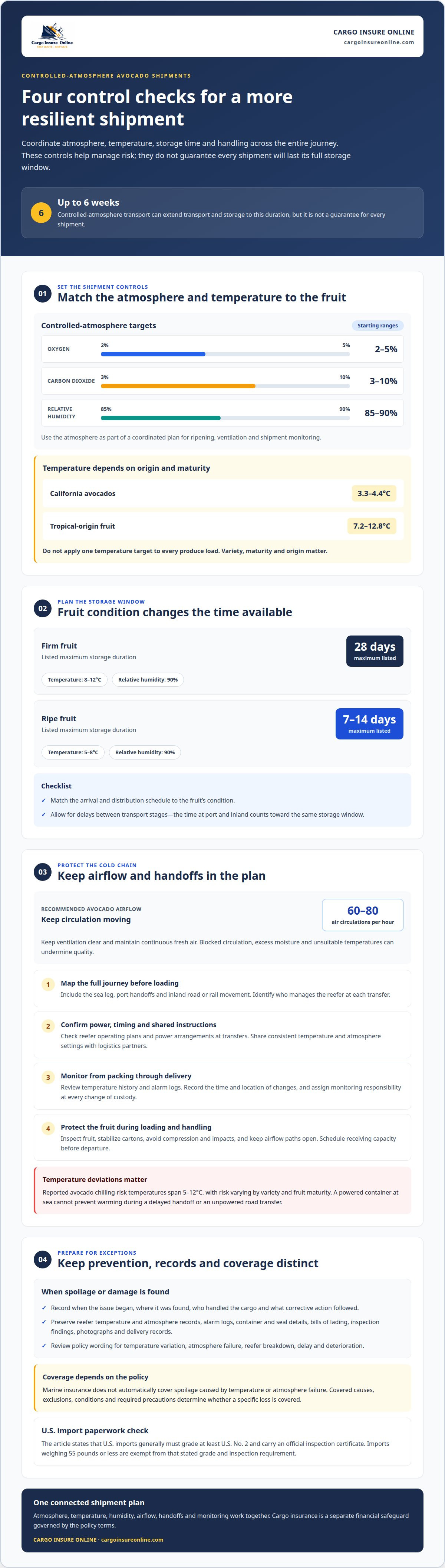
Controlled-atmosphere avocado shipments can extend transport and storage to 6 weeks when temperature, humidity and gas levels are managed for the fruit. A useful starting point is 2-5% oxygen, 3-10% carbon dioxide and 85-90% relative humidity, with temperature adjusted for origin and maturity. Planning for spoilage insurance in controlled-atmosphere container avocado shipments belongs alongside these controls, not in place of them.
Even a well-set reefer can’t undo damage caused by poor handling or a break in the cold chain. Clear controls and shipment monitoring can help reduce preventable risks. This guide explains how to manage temperature, humidity, oxygen and carbon dioxide, set realistic storage expectations, protect airflow and respond when conditions change. You’ll find practical steps for planning a more resilient avocado shipment and learn where cargo insurance fits if a loss occurs.
Key Takeaways
- Match temperature targets to avocado variety, maturity and origin to reduce chilling injury and premature ripening.
- Plan storage duration around fruit condition and the full journey, including delays between transport stages.
- Protect airflow during loading and handling, and watch for impacts or cold-chain disruptions that can accelerate spoilage.
- Use controlled-atmosphere reefer settings as part of a coordinated plan for ripening, ventilation and shipment monitoring.
- Consider cargo insurance alongside prevention measures to address financial exposure if cargo is damaged during transit.
Controlled-atmosphere transport and storage duration
For U.S. imports, avocados generally must grade at least U.S. No. 2 and carry an official inspection certificate, according to the U.S. Department of Agriculture, Agricultural Marketing Service. Imports weighing 55 pounds or less are exempt from that stated grade and inspection requirement, according to the U.S. Department of Agriculture, Agricultural Marketing Service.
- Set the atmosphere for the fruit and route. Controlled-atmosphere transport commonly uses 2-5% oxygen and 3-10% carbon dioxide to slow ripening. Pair those targets with a shipment plan for the origin, cultivar and maturity. For example, California avocados have a stated transport range of 3.3-4.4°C, while tropical-origin fruit has a range of 7.2-12.8°C. Don’t apply one temperature target to every produce load.
- Build a realistic storage window. Controlled-atmosphere transport can extend avocado transport and storage duration to 6 weeks, but that is not a guarantee for every shipment. Firm fruit has a listed maximum storage duration of 28 days at 8-12°C and 90% relative humidity. Ripe fruit has a listed maximum of 7-14 days at 5-8°C and 90% relative humidity. Match the planned arrival and distribution schedule to fruit condition.
- Plan the full international journey. Map the sea leg, port handoffs and inland movement before loading. A door-to-door plan should identify who manages the reefer at each transfer, including road or rail connections. For Mexican produce moving north, coordinate the inland leg with the port schedule and receiving facility. Time lost at a port or during inland transport uses the same storage window as time at sea.
- Check reefer and port handoffs. Confirm the container’s operating plan, power arrangements and transfer timing across the route. Port infrastructure matters because refrigerated containers still need appropriate handling during pauses between vessel and inland transport. Share the target temperature and atmosphere settings with each logistics partner, and keep instructions consistent across sea, road and rail documents.
- Protect quality through arrival. Use 85-90% relative humidity as the stated controlled-atmosphere transport range, and keep packaging airflow in mind. Excess moisture or blocked circulation can undermine temperature management inside a loaded container. Schedule receiving capacity before departure, so fruit can move promptly from the port to storage or distribution. Treat reefer cargo transport as one connected chain, not separate bookings.
Avocado spoilage and cold-chain disruption
Reduce ocean-transit losses by controlling temperature, airflow and handling at every handoff. If damage occurs, review its likely cause, the policy wording and shipment records before considering insurance as a way to recover the loss.
-
Maintain the Cold Chain
Track the reefer’s temperature history from packing through port transfer and delivery. Set alarms or review logs for unexplained changes, and record the time and location of each interruption. Avocado chilling damage varies by variety, with reported risk temperatures spanning 5-12°C; fruit maturity also affects vulnerability. Keep ventilation clear, since recommended avocado airflow is 60-80 air circulations per hour with continuous fresh air. Train each carrier and handling team to preserve these settings.
Include the inland leg in the same cold-chain plan. A powered container at sea cannot prevent warming during a delayed terminal handoff or an unpowered road transfer. Assign responsibility for reefer monitoring at each change of custody, and make escalation steps clear to staff across the global supply chain.
-
Identify and Prevent Spoilage Causes
Inspect avocado condition before loading and at planned transit points. Impact damage can accelerate deterioration, while unsuitable temperatures can cause chilling damage or premature ripening. Check that cartons are stable, airflow paths remain open and fruit isn’t compressed during handling. Where practical, remove affected fruit to limit decay spreading to nearby produce.
Ocean-transit spoilage can also result from poor atmosphere control, excess moisture, blocked ventilation or prolonged delays. Keep temperature and reefer records with the load, and report deviations promptly to the carrier and receiver. Consistent handling instructions help teams in different countries protect the same shipment and preserve its remaining shelf life.
-
Check Spoilage Coverage and Temperature Failures
Read the marine cargo policy wording for its treatment of temperature variation, atmosphere failure, reefer breakdown, delay and deterioration. Marine insurance does not automatically cover spoilage caused by a temperature or atmosphere failure. The policy’s covered causes, exclusions, conditions and required precautions determine whether a specific loss is covered.
Before shipment, align the declared cargo and route details with the protection being arranged. For a sea leg, review sea freight cargo insurance as part of the shipment’s risk plan. Keep prevention measures and insurance separate: careful reefer management reduces exposure, while policy terms define the financial response to an insured loss.
-
Gather Evidence for a Spoilage Claim
Build a clear timeline as soon as you discover damage. Preserve reefer temperature and atmosphere records, alarm logs, container and seal details, bills of lading, inspection findings, photographs and delivery records. Note when the issue began, who handled the cargo and what corrective action followed. These records help relate the avocados’ condition to events during transit.
Where possible, keep affected cargo available for inspection and document its quantity and condition before disposal or sorting. Collect purchase and shipment documents that establish what the goods are and how they moved. Notify the relevant parties promptly under the policy’s claim process, then submit the records together. A complete file supports assessment of the cause and loss without relying on memory alone.
Controlled-atmosphere reefer containers for avocado shipments
Unlike a standard reefer, a controlled-atmosphere container manages oxygen and carbon dioxide alongside refrigeration, helping slow ripening during long-distance transport. Insurance is a separate consideration: temperature or atmosphere failure, delays and handling damage must be assessed against the policy wording.
- Choose the container for the ripening timeline. Avocados produce ethylene at a stated rate of 10-100 µl/kg*h, so ripening continues during transit. Controlled-atmosphere equipment regulates oxygen and carbon dioxide to slow that process and preserve freshness. A standard reefer provides refrigeration but doesn’t provide the same active gas control. Select the setup according to fruit maturity, route length and intended condition at destination, not simply the container name.
Use a documented operating plan for the shipment. Set the target atmosphere to suit the variety and maturity, and manage temperature to protect the fruit from chilling or excessive ripening. Align the plan with the receiving schedule, since a delayed release can reduce the useful shelf life after arrival.
- Coordinate pre-cooling and any pre-conditioning. Avocados respond well to immediate post-harvest treatment with 20% to 25% carbon dioxide. The cited pre-conditioning treatment lasts 48 to 72 hours at 5.5°C. Treat this as a specific preparation method, not as the atmosphere setting for the entire sea journey. Coordinate the treatment with packhouse handling and loading so the fruit enters transit in the intended condition.
Before loading, confirm the fruit’s condition and the reefer’s temperature-control plan. Pre-cooling should reflect the variety’s tolerance and maturity. Record when preparation ends and loading begins so later condition assessments can be compared with the shipment timeline.
- Protect airflow through packaging and loading. Keep carton vents aligned with the container’s air path, and avoid stacking that blocks circulation. Avocado packaging can use perforated, breathable bags or boxes to support ventilation and help maintain humidity. Improving produce packing airflow during loading can reduce losses by roughly 10%. Treat that figure as a potential benefit, not a guaranteed result for every load.
Inspect pallet placement before closing the doors. Check that return-air paths remain open and the load is secure against movement. Temperature control can’t work evenly if airflow is obstructed around produce, even when the reefer system is running.
- Review insurance terms against shipment risks. Assess temperature excursions, atmosphere-control failure, delays and physical handling damage. Marine cargo insurance doesn’t automatically cover every cause of spoilage; covered events, exclusions, duties and claim evidence depend on the policy wording. Review how the policy treats reefer breakdown, deterioration and failure to maintain specified conditions. Match records of settings, alarms and cargo condition with the shipment documents.
Keep prevention and insurance cover distinct. A controlled-atmosphere container helps manage ripening but can’t eliminate every transit risk. Clear operating records make it easier to explain what happened if the cargo arrives in poor condition.
Controlled-atmosphere refrigerated containers
- Set a container plan before harvest. Confirm the avocado variety, maturity and intended destination with the packhouse and logistics team. These details shape the temperature and atmosphere plan; one setting won’t suit every load. Controlled-atmosphere refrigerated containers combine cooling with oxygen and carbon dioxide regulation, so share the operating targets with everyone handling the shipment. Include the planned sea journey and inland transfer. This gives reefer operators and the receiving team one consistent reference from loading onward.
- Keep the atmosphere within the fruit’s tolerance. Controlled-atmosphere storage is recommended to use carbon dioxide up to 10%. The aim is to slow ripening without treating a container setting as a substitute for suitable fruit preparation. Confirm the selected settings against the avocado’s condition and the shipment plan. Record them at loading, then compare them with the container’s operating history after arrival. A clear record helps identify whether a deviation occurred during transport or before loading.
- Make airflow part of the load design. Arrange cartons so air can move through the produce, rather than creating a solid wall around pallets. Keep ventilation paths clear and avoid packaging that blocks circulation. Avocado shipments need a continuous fresh-air supply, with recommended ventilation of 60-80 air circulations per hour. Check the load plan before closing the reefer doors. Even a properly functioning cooling system can’t distribute air through blocked spaces.
- Coordinate cooling with the handoff schedule. Confirm the refrigerated container can maintain appropriate conditions during each transfer. Map the port handoff, vessel movement and inland delivery, including who is responsible for reefer monitoring at every stage. Atmosphere settings help only while the system operates as intended. Keep the receiving team informed about the planned arrival and inspection process so the cargo doesn’t wait unnecessarily after discharge.
- Use inspection and records to manage exceptions. Inspect the fruit before loading and again at its destination. Note visible damage, uneven ripening or signs of deterioration, and keep the findings with the shipment record. Real-time shipment tracking can help teams spot problems sooner and coordinate a response. If the container’s atmosphere or temperature history shows a deviation, compare its timing with the inspection results. That sequence helps distinguish handling damage from a change in condition during transit.
How does a controlled atmosphere container preserve avocados during shipment?
- Slow ripening by managing the gas balance. Avocados continue producing ethylene after harvest, which drives ripening. A controlled-atmosphere container regulates oxygen and carbon dioxide to slow that process while refrigeration manages temperature. For transport, stated atmosphere ranges are 2-5% oxygen and 3-10% carbon dioxide. These settings work as a coordinated system, not as a substitute for suitable fruit condition, handling or airflow.
Use the destination and expected arrival condition to plan the desired ripening rate. A long sea journey and a short distribution leg call for different timing decisions.
- Match the settings to variety and maturity. Avocado temperature tolerance differs by origin and fruit condition, so don’t treat one reefer setting as universal. California avocados have a stated controlled-atmosphere transport range of 3.3-4.4°C, while tropical-origin avocados have a range of 7.2-12.8°C. The selected temperature must work alongside the gas plan and the fruit’s maturity.
Before loading, align the operating plan with harvest and packing information. Keep the instructions with the shipment so reefer operators can follow the same targets through each handoff.
- Maintain humidity and circulation together. Controlled-atmosphere avocado transport has a stated relative humidity range of 85-90%. Humidity helps limit moisture loss, while airflow moves refrigerated air through the load. If cartons or pallets obstruct the air path, conditions can vary within the container even when the reefer is operating.
Choose packaging that preserves ventilation, then keep the container’s circulation paths clear. Check airflow during loading rather than relying on a temperature display alone. Both moisture management and air movement affect fruit condition.
- Plan for a realistic transit window. Controlled-atmosphere transport can extend avocado transport and storage duration to 6 weeks. Use that as a planning possibility, not a promise that every load will retain the same quality for that long. Harvest maturity, temperature history, atmosphere control and time spent at ports all shape the usable shelf life after arrival.
Coordinate the vessel schedule, port release and inland delivery before dispatch. The receiving team should be ready to inspect and handle the cargo promptly, especially after a long voyage.
- Keep operating records through delivery. Preserve records of reefer settings, temperature and atmosphere readings, alarms, handoffs and arrival condition. Compare the operating history with inspection findings if fruit shows uneven ripening or deterioration. A timeline helps identify when a deviation occurred and supports clear communication between the shipper, carrier and receiver.
For the financial side of a temperature-sensitive shipment, explore reefer cargo protection alongside the container plan. Insurance doesn’t control ripening, but it can form part of a broader approach to managing cargo exposure.
Cargo Insure Online
Cargo Insure Online helps businesses consider cargo insurance alongside practical spoilage controls. The route matters for avocado shipments: sea transport, air freight and inland trucking can each shape financial exposure. Cargo Insure Online offers Sea Freight Insurance, Air Freight Insurance and Trucking Insurance, as well as GAP Insurance. The right fit depends on the cargo journey and applicable policy terms. Insurance doesn’t replace temperature management, careful handling or shipment records, and spoilage isn’t automatically covered under every policy.
Consider your route, cargo details and main transit concerns when reviewing your insurance needs. Contact Cargo Insure Online to explore cargo protection for your shipment.
Make your next shipment plan more resilient
Turn your handling plan into a repeatable process for every avocado shipment. Record the cargo condition, route, handoffs and reefer history together. This gives your team a clearer starting point when reviewing risk or planning the next load. For a controlled-atmosphere container avocado shipment, consider spoilage insurance alongside operational controls, with cover determined by the applicable policy terms.
Cargo Insure Online offers Air Freight Insurance, Sea Freight Insurance and Trucking Insurance for cargo moving through different transport stages. Review spoilage insurance for a controlled atmosphere container avocado shipment as part of your upcoming shipment planning. Contact Cargo Insure Online to discuss your cargo insurance needs and take the next step with greater clarity.
Frequently Asked Questions
How do you prevent spoilage when shipping fresh produce?
Prevent spoilage by matching cargo settings to the produce, protecting airflow and acting quickly when handling or equipment problems arise. For avocados, keep the reefer’s fresh-air supply clear, avoid impacts during loading and inspect fruit at transit handoffs. If you find damaged fruit, separate it where practical to limit deterioration nearby. Keep the shipment’s condition and reefer history together so changes can be traced to a specific stage.
Why Are Avocados So Hard to Ship?
Avocados are sensitive to both physical injury and changing storage conditions. They keep producing ethylene after harvest, which drives ripening, while unsuitable temperatures can cause chilling damage. The reported chilling-damage range varies by variety from 5-12°C, and unripe fruit may be affected at 8-12°C. A load with mixed maturity can therefore need careful handling and a plan suited to its fruit condition, not one assumption for every carton.
What temperature, humidity, oxygen, and carbon dioxide levels are recommended for shipping avocados?
For controlled-atmosphere transit, the stated ranges are 2-5% oxygen, 3-10% carbon dioxide and 85-90% relative humidity. Temperature depends on origin and fruit condition: California avocados are listed at 3.3-4.4°C, while tropical-origin avocados are listed at 7.2-12.8°C. Treat these as planning ranges, not universal settings; variety and maturity affect the appropriate temperature. Keep the gas and temperature plan aligned.
How long can avocados be shipped in a controlled atmosphere container without spoilage?
Controlled-atmosphere transport can extend avocado transport and storage duration to 6 weeks. That duration is a planning limit, not a promise that fruit will arrive without spoilage. Harvest maturity, temperature history, handling and delays all affect condition and remaining shelf life. Plan the vessel, port release and inland delivery together, then align arrival with receiving capacity. Inspect the fruit promptly, especially after a long voyage or disrupted handoff.
What are the main risks and exclusions in avocado shipment insurance policies?
Policies may address temperature or atmosphere failure, reefer breakdown, delay, deterioration and handling damage, but these losses are not automatically covered. The policy’s covered causes, exclusions, conditions and required precautions determine whether a loss qualifies.


