
Your carrier’s liability limit isn't a safety net; it's a trap door. For high-value pharma and perishables, relying on standard carrier payouts is a gamble you’ll likely lose. You know the drill. A mechanical failure happens, the temperature spikes, and you’re left buried in paperwork while your margins evaporate. It’s frustrating to watch a modern cold chain get throttled by slow, bureaucratic insurance brokers who don't understand the urgency of a 2026 logistics schedule.
It’s time to stop settling for coverage that excludes the very risks you face daily. This article shows you how to secure comprehensive temperature-sensitive cargo insurance that actually keeps pace with your business. You’ll discover how to eliminate spoilage risks using our specialized Reefer Product and digital-first solutions that offer instant, all-risk protection. We’re breaking down the latest IATA and FSMA requirements for 2026; giving you the roadmap to seamless digital claims and total peace of mind for every shipment. Forget the friction and the long waits. Let's modernize your protection.
Key Takeaways
- Ditch the "trap door" of carrier liability. Learn how to replace weak payouts with comprehensive, all-risk financial certainty.
- Identify the critical components of temperature-sensitive cargo insurance required to navigate 2026’s stricter IATA and FSMA regulations.
- Uncover the "spoilage clause" secrets that ensure your high-value pharma and food shipments are covered even during mechanical failures.
- Streamline your logistics with specialized Reefer Product solutions designed to eliminate the friction of traditional brokers through instant, digital-first quoting.
What is Temperature-Sensitive Cargo Insurance?
Temperature-sensitive cargo insurance isn't just another line item on a shipping manifest. It’s a specialized financial shield for goods that require precise thermal environments to remain viable. In the high-stakes world of 2026 logistics, a single degree of variance can turn a multi-million dollar shipment of biologics into hazardous waste. This isn't just about "coverage." It’s about securing the integrity of your entire supply chain. Understanding What is a Cold Chain? is the first step in realizing that traditional, generic insurance simply doesn't cut it for refrigerated or frozen freight.
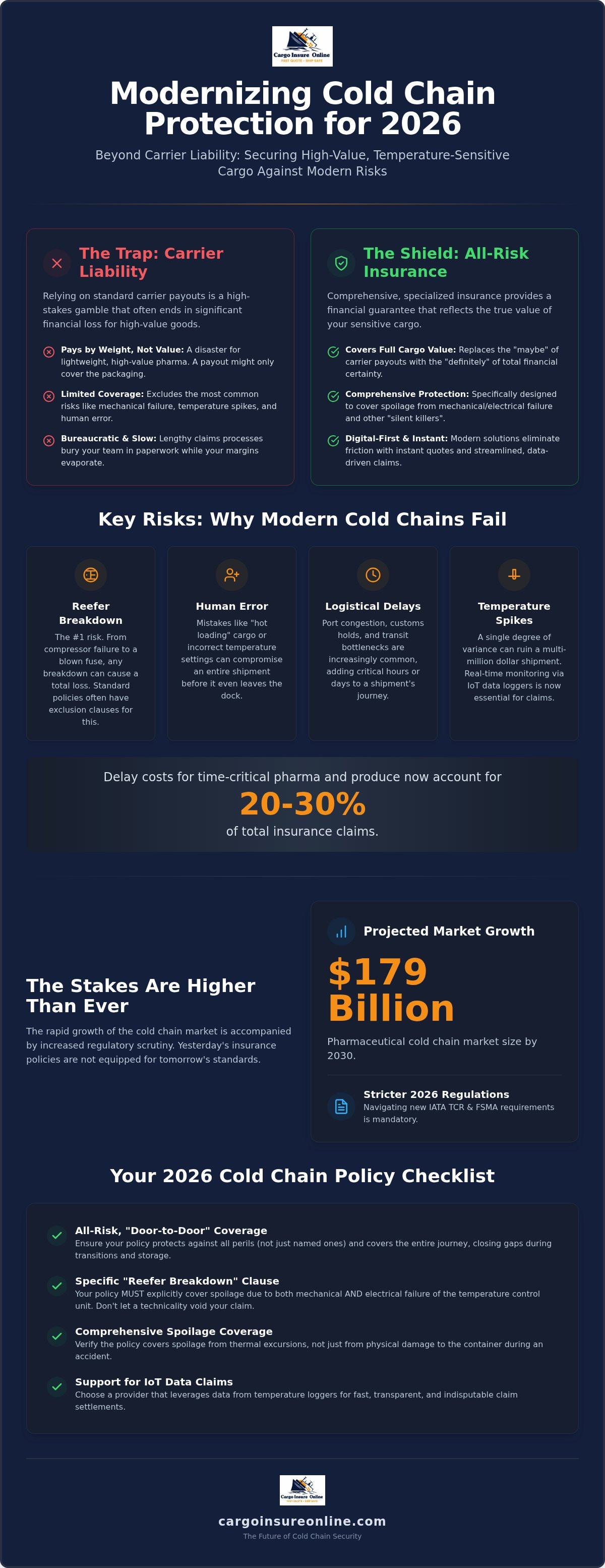
The stakes have never been higher. By 2030, the pharmaceutical cold chain market is projected to reach $179 billion. This growth brings increased scrutiny from regulators and tighter standards from the IATA Temperature Control Regulations (TCR) 14th Edition. If you’re still relying on a "spoilage gap" policy that only covers physical impact, you’re exposed. Modern temperature-sensitive cargo insurance closes that gap, protecting you against the "silent killers" of the cold chain: humidity spikes, sensor failures, and power loss.
The Anatomy of a Temperature-Controlled Shipment
Not all cold chain cargo is created equal. You must distinguish between standard perishables like produce and high-value temperature-sensitive goods like mRNA vaccines or specialty chemicals. Each carries a different risk profile. Active cooling systems utilize powered mechanical units, while passive systems rely on advanced insulation and phase-change materials. Both are vulnerable to human error and transit delays. We believe "door-to-door" coverage is the only acceptable standard. If your protection stops at the warehouse dock or the airport terminal, you’re leaving your most vulnerable assets at risk during the most dangerous parts of the journey.
Standard Liability vs. Specialized Cargo Insurance
Carrier liability is a trap. Most shippers don't realize that carriers typically pay out based on the weight of the cargo, not its actual value. This "per-kilo" rule is a disaster for lightweight, high-value pharmaceuticals. If a shipment spoils, a carrier’s check might cover the cost of the cardboard box it came in, but it won't replace your lost revenue or protect your reputation.
Traditional carrier liability is a bureaucratic gamble. Cargo Insure Online is a digital-first guarantee. We’ve eliminated the friction of slow-moving brokers to provide instant protection that reflects the true value of your goods. For a deeper look at how this fits into your broader strategy, check out our guide on What is Cargo Insurance? to see why specialized protection is the only way to move at the speed of 2026 trade. Our Reefer Product is engineered to replace the "maybe" of carrier payouts with the "definitely" of all-risk coverage.
Key Risks: Why Cold Chains Fail in 2026
The clock starts the moment a reefer unit stops. In 2026, delay costs for time-critical shipments like biologics and fresh produce now account for 20-30% of total insurance claims. This is a sharp increase from previous years. Mechanical failure is the obvious culprit, but it's rarely the only one. Human error remains a persistent threat. "Hot loading" cargo that hasn't reached the correct core temperature is a rookie mistake that costs millions in spoiled inventory. You aren't just fighting the weather; you're fighting the limitations of your own team and equipment.
Technology is finally catching up to these risks. IoT data loggers are no longer optional accessories; they're the judge and jury of modern claims. These devices provide the forensic evidence needed for all-risk insurance filings. They track temperature, humidity, and shock in real-time. If a carrier claims the unit was running, but your data shows a four-hour spike, the argument is over. This transparency is transforming temperature-sensitive cargo insurance from a reactive expense into a proactive risk management tool.
Reefer Breakdown: The Invisible Peril
Reefer Breakdown isn't just a term; it's a specific policy endorsement you can't afford to overlook. Traditional policies often distinguish between mechanical failure and electrical failure. If your compressor dies, you're covered, but what if a simple blown fuse kills the cooling? You need a policy that covers both. In 2026, Reefer Breakdown coverage is the critical safeguard that protects high-value pharmaceutical shipments from thermal excursion caused by any mechanical or electrical failure of the cooling unit. Don't let a technicality be the reason your claim gets rejected. It's better to secure a specialized Reefer Product that treats these risks as a priority, not an afterthought.
Logistical Bottlenecks and External Factors
Port congestion and customs bottlenecks act as spoilage catalysts. When a container sits in the sun past its passive cooling duration, disaster is inevitable. Customs inspections add another layer of danger. Officers frequently break seals for inspections, exposing sensitive goods to ambient air. Once that seal is broken, the thermal integrity is compromised. A Stock Throughput advantage is vital here. It covers your cargo from the factory, through the port, and even during long-term storage. This "cradle-to-grave" protection ensures that temperature-sensitive cargo insurance remains active even when your goods are stationary. Weather disturbances are also becoming more volatile, making it essential to have coverage that accounts for extended transit times and unexpected rerouting.
Reefer Breakdown vs. All-Risk Coverage
Most shippers believe they're protected because they have a policy. It’s a dangerous assumption. Many standard policies only offer "Total Loss" coverage. This means you only get paid if the entire ship sinks or the truck is obliterated in a crash. For cold chain logistics, this is practically useless. If your reefer unit fails and your cargo spoils, but the truck remains intact, a "Total Loss" policy won't pay a cent. You need temperature-sensitive cargo insurance that prioritizes the condition of the goods, not just the vehicle carrying them.
All-Risk Cargo Insurance is the gold standard for a reason. It flips the script on traditional coverage. Instead of listing specific "named perils" that are covered, it covers everything except what is explicitly excluded. This is where the "Spoilage Clause" becomes your best friend. This clause ensures your policy covers a "change in temperature" regardless of whether the reefer unit physically broke or simply malfunctioned. For more complex environmental risks, such as extreme heat or freezing during transit, seeking Optional Temperature Coverage can provide the extra layer of security needed for sensitive commodities like wine or specialized chemicals.
Decoding All-Risk Spoilage Protection
All-Risk doesn't just mean "more coverage." It means smarter coverage. In the cold chain, "Consequential Damage" is the real threat. If a pharmaceutical shipment experiences a thermal excursion, it might look fine, but its chemical integrity is destroyed. All-Risk protection accounts for this loss of utility. When you're moving high volumes across the ocean, the risks multiply. Our Sea Freight Insurance guide explains how to handle reefer-specific perils on the high seas, where help is often days away. Don't settle for "maybe." Choose a policy that treats a one-degree deviation as the serious event it is.
Exclusions You Can't Afford to Ignore
Even the best insurance has boundaries. "Inherent Vice" is a standard exclusion you must understand. If your produce was already suffering from pre-existing rot or a latent defect before it was loaded, insurance won't cover the loss. Insurance is for accidents, not inevitable decay.
The "Pre-Cooling" requirement is another common trap. Most insurers require proof that the container was pre-cooled to the correct temperature before loading. If you skip this step, you’re essentially self-insuring. Maintenance records are your trail of evidence. If a carrier can't produce a maintenance log for the reefer unit, your claim could be dead on arrival. Improper packaging is the final hurdle. If your insulation fails because it was poorly designed, the insurer will likely point the finger back at the shipper. Our Reefer Product is designed to help you navigate these nuances, turning complex legalities into a streamlined, digital-first experience that actually pays out when disaster strikes.
Checklist: Choosing the Right Policy for 2026
Choosing temperature-sensitive cargo insurance shouldn't feel like a trip back to the 1990s. If you're still waiting 48 hours for a quote from a local broker, you're already behind the curve. Modern logistics demands a digital-first approach that matches the velocity of global trade. Don't settle for a policy that slows you down. Use this checklist to ensure your coverage is a high-speed asset, not a bureaucratic bottleneck.
- Verify Multi-Modal Coverage: Does the policy protect the goods across the entire journey? Your protection must be seamless. Ensure your provider offers integrated Trucking Insurance, air freight, and sea freight protection under one digital roof.
- Scrutinize the '24-Hour Rule': Many legacy policies won't pay for a reefer breakdown unless the unit is down for a full day. In 2026, a 24-hour gap for biologics is a total loss. Demand a policy with zero-hour response triggers.
- Demand Instant Quoting: You shouldn't have to beg for a price. A sophisticated platform provides instant, all-risk quotes in minutes.
- Check the Underwriter’s Rating: Massive pharma losses require deep pockets. Ensure the underwriter has the financial strength to handle high-value claims without flinching.
Evaluating Digital Capabilities
Traditional insurance is a black box. Modern insurance is a transparent dashboard. You need real-time visibility into every certificate and every active shipment. If you're a freight forwarder, look for White Label Solutions. This allows you to embed protection directly into your own booking platform via API. It’s about removing friction for your customers while securing their most sensitive assets. Don't just buy a policy; buy a tech stack that empowers your operation.
The Speed of Recovery
Paper claims are dead. In 2026, successful shippers use digital filing to upload IoT data logger evidence directly to the insurer. This cuts the settlement time from months to days. When you have digital proof of a thermal excursion, you shouldn't have to waste weeks arguing about it. In the cold chain, speed isn't just a convenience; it's the only way to recover capital before a cargo loss turns into a supply chain collapse. Stop mailing envelopes and start securing your Reefer Product online today for a faster, smarter recovery journey.
Cargo Insure Online: The Future of Cold Chain Security
Logistics in 2026 doesn't wait for anyone. Why should your insurance? Traditional brokers are anchored in the past. They rely on manual entry and slow-moving underwriters. Cargo Insure Online (CIO) is different. We’ve built our Reefer Product specifically for the high-velocity reality of modern trade. We aren't just a service provider; we’re a sophisticated ally for your most sensitive shipments. Our technology removes the friction, replacing anxiety with the confident optimism you need to scale your operations.
Our platform delivers high-speed digital quotes that eliminate the "wait and see" approach. You need temperature-sensitive cargo insurance that activates the moment you book your freight. Whether you’re moving vaccines across Europe or perishables through the Americas, our global reach ensures your cargo is protected on every continent. We’ve ditched the bureaucratic hurdles to provide a tech-savvy experience that mirrors the speed of the digital services you use every day. It’s about empowerment through clarity and speed.
Why CIO Sphere Inc. is Disrupting the Industry
We’ve traded manual paperwork for instant logistics solutions. CIO Sphere Inc. understands that high-value tech and specialized reefer goods require more than just a generic policy. Our expertise isn't limited to the cold chain, either. From biologics to high-end hardware, we provide a broad spectrum of protection designed for the modern world. Explore our guide on Electronics Shipping Insurance to see how we safeguard the world’s most advanced technology. We prioritize relief and excitement over administrative chores, ensuring every claim is handled with the urgency your perishables deserve.
Get Covered in Seconds
Traditional brokers take days to "get back to you." CIO takes seconds. Our digital-first platform allows you to secure temperature-sensitive cargo insurance with a few clicks. It’s transparent. It’s efficient. It’s built for the way you work now. For partners looking to scale, we offer white-label API solutions. You can embed our world-class insurance directly into your existing booking platform, adding immediate value to your clients without the overhead.
The old way of insuring cargo was a friction-filled obstacle. Cargo Insure Online is a high-speed accelerator. Don't let a slow broker be the weak link in your supply chain. It’s time to secure your cold chain with a Cargo Insure Online quote today and experience the relief of instant, all-risk protection.
Future-Proof Your Cold Chain Integrity
The 2026 cold chain doesn't forgive mistakes. Relying on outdated carrier liability or slow-moving brokers is a recipe for spoilage and lost revenue. You've seen how all-risk protection and real-time IoT data transform risk into certainty. It’s no longer about just moving goods; it’s about moving them with total financial confidence across every continent. Forget the paperwork and the long waits. Your logistics operation deserves a partner that moves as fast as you do.
Cargo Insure Online replaces bureaucratic friction with high-speed logistics tools. Our specialized Reefer Product protection is engineered for the specific thermal demands of high-value pharma and food. We offer global multi-modal coverage that follows your shipment from the truck to the plane to the ship without gaps. Secure your temperature-sensitive cargo insurance through an instant digital quoting engine that respects your time. It's time to trade uncertainty for a digital-first guarantee.
Stop waiting and start shipping; get your instant reefer cargo insurance quote now
Frequently Asked Questions
Does standard cargo insurance cover reefer breakdown?
Standard policies often exclude it. You need a specific endorsement or a specialized Reefer Product. Generic insurance covers physical damage like fire or theft but ignores silent thermal failures. Our Reefer Product ensures that mechanical or electrical failures of the cooling unit are fully covered. Don't assume you're protected. Verify that your policy explicitly includes breakdown protection to avoid paying for spoiled inventory out of pocket.
What is the 24-hour rule in temperature-sensitive insurance?
It's a legacy clause requiring the cooling unit to be non-functional for 24 continuous hours before a claim is valid. For modern biologics, this rule is a disaster because goods can spoil in minutes. Digital-first temperature-sensitive cargo insurance removes this hurdle. We provide zero-hour triggers. The moment the temperature deviates from your specified range, the coverage is active. It’s about protecting the cargo, not the clock.
Can I get insurance for pharmaceutical cold chain shipments?
Yes, pharmaceutical cold chains are a primary focus for specialized all-risk policies. With global regulations shifting toward competency-based training (CBTA) in 2026, compliance is more complex than ever. Our platform provides the all-risk coverage needed for these sensitive shipments across air, sea, and land. We understand the 14th Edition IATA TCR requirements and offer protection that accounts for the high financial stakes of thermal excursion in modern medicine.
How do I prove a claim for spoilage without physical damage?
Use IoT data logger evidence. In 2026, data is your most powerful witness. These devices record every temperature fluctuation during transit. If your shipment arrives spoiled but looks fine externally, your data logger provides the forensic proof of thermal deviation. We prioritize this digital evidence to speed up payouts. You don't need a crushed box to file a claim. You just need the data showing the cooling failed.
Is air freight safer than sea freight for temperature-sensitive goods?
Air freight is faster, which reduces the window for failure, but it’s not inherently safer. Air shipments face risks during tarmac transfers and warehouse handling. Sea freight involves longer durations but offers stable thermal environments in advanced reefer containers. Both modes require specialized temperature-sensitive cargo insurance. We provide global multi-modal coverage to ensure your goods stay protected whether they’re at 30,000 feet or crossing the Atlantic.
What documents are needed for a reefer cargo insurance claim?
You’ll need digital essentials to fast-track your recovery. Start with these items:
- Bill of Lading and commercial invoice.
- Temperature logs from your IoT data loggers.
- Carrier’s reefer maintenance records.
Our digital filing system allows you to upload these documents instantly, cutting through the bureaucratic red tape that slows down traditional claims.
Does temperature-sensitive insurance cover delays at customs?
Most standard policies exclude delay as a cause of loss. However, specialized all-risk coverage can include endorsements for spoilage resulting from certain logistical bottlenecks. Customs inspections are high-risk events where seals are broken and thermal integrity is compromised. We recommend a Stock Throughput approach to ensure your cargo remains protected even when it’s stationary at a port. Always check your policy for specific exclusions regarding port congestion.
What is the difference between reefer breakdown and spoilage coverage?
Reefer breakdown covers the mechanical or electrical failure of the cooling equipment itself. Spoilage coverage is broader. It protects the actual goods if they perish due to a change in temperature, regardless of why that change happened. You need both to be fully secure. Our Reefer Product combines these elements. We ensure you’re protected if the unit dies or if a human error leads to a temperature spike that ruins your cargo.


