

Your carrier just called. The trailer is sagging, the axles are over the 80,000-pound limit, and your high-value electronics are now a heap of scrap at a weigh station. You think you're covered because they signed the Bill of Lading. You're likely wrong. Carriers often cut corners to save time, but when things go sideways, they hide behind "Act of the Shipper" defenses to kill your overloaded cargo claim. It's a gut-punch that leaves you facing massive financial loss while drowning in legal jargon. You deserve better than a carrier's excuses.
We know the anxiety of a denied claim is real. It's frustrating to watch your bottom line take a hit because of someone else's negligence. This article gives you the roadmap to navigate these complexities and ensure you get paid even when carriers fail. We'll break down the "Denial Trap," explain why carrier liability isn't actual insurance, and show you how frictionless digital coverage settles claims in days, not months. Let's move past the bureaucracy and get your business back on track with speed and clarity.
Key Takeaways
- Uncover why carriers cut corners and how exceeding weight limits triggers a complex overloaded cargo claim process.
- Master the "Denial Trap" by learning how illegal overloading can void standard liability policies instantly.
- Identify the fine line between carrier negligence and your insurance coverage to keep your high-value goods protected.
- Follow our 5-step recovery roadmap to document damage and secure your payout without the usual administrative friction.
- Switch to digital-first "All-Risk" coverage to bypass bureaucratic legal battles and get paid in days, not months.
What is an Overloaded Cargo Claim? The Shipper’s Perspective
An overloaded cargo claim is more than a legal headache. It's a financial emergency. At its core, this claim arises when your goods are damaged because a carrier exceeded a vehicle's weight capacity. Carriers often push these limits to maximize profit per trip. They want more freight in fewer trucks. But when they cut corners, your inventory suffers. Structural damage, crushed pallets, and total losses from accidents become the reality. This isn't just a traffic ticket for the driver; it's a direct threat to your business value.
Common Signs Your Cargo Was Overloaded
Detecting overloading doesn't always require a scale. You see the evidence when the trailer doors open. Look for these red flags:
- Crushed packaging: Boxes at the bottom of a stack that are flattened or split are a classic sign of excessive vertical pressure.
- Evidence of load shift: If cargo has migrated significantly from its original position, the weight distribution was likely unstable or excessive for the securement methods.
- Missing documentation: Be wary if a carrier refuses to provide weigh station receipts or scale tickets. Transparency is the standard; silence is a warning.
The Difference Between Legal Weight and Safe Weight
Regulations are clear. The Federal Highway Administration sets the gross vehicle weight limit at 80,000 pounds for interstate travel. However, legal weight isn't always safe weight. Every trailer and commodity has specific limits. If you're shipping high-value electronics or reefer goods, "just a few pounds over" can destabilize the vehicle's center of gravity. This makes the truck prone to tipping or suspension failure during sudden maneuvers.
When an incident occurs, adjusters scrutinize the bill of lading documentation to compare declared weights against actual scale data. If the numbers don't align, carriers quickly pivot to "Act of the Shipper" defenses. They'll claim you misdeclared the weight to avoid liability. This is why accuracy matters. A small discrepancy in weight distribution can trigger a total overloaded cargo claim denial. Don't let a carrier's desire for a "full load" compromise your recovery rights. You need a partner that understands these nuances and moves as fast as your supply chain.
The Denial Trap: Why Overloading Voids Standard Carrier Liability
Insurance companies don't look for reasons to pay you. They look for reasons to say no. When a carrier ignores weight limits, they hand the insurer a perfect exit strategy: the "Illegal Act" clause. Most standard policies explicitly state they won't cover losses resulting from illegal activities. Overloading a vehicle is a violation of federal safety standards. When that truck tips or the suspension snaps, the insurance company walks away from the overloaded cargo claim because the carrier broke the law. You're left holding the bill for damaged inventory while the carrier hides behind their policy's fine print.
There's a thin, dangerous line between simple negligence and gross negligence. A driver forgetting to secure a strap is negligence. A carrier willfully ignoring weight ratings to squeeze more profit into a trailer is gross negligence. Payouts often vanish when gross negligence is proven. Don't wait for the carrier's insurance to save you. It's designed to protect their assets, not your cargo. You need a solution that prioritizes your recovery, not the carrier's legal defense.
Decoding the Fine Print on Weight Restrictions
Every vehicle has a Gross Vehicle Weight Rating (GVWR) that dictates its maximum safe operating weight. When carriers exceed this, they aren't just risking a fine. They're voiding their safety certifications. Adjusters use the Bill of Lading to cross-reference your cargo's weight against FHWA federal bridge formula weight limits. If the data shows the truck was over capacity, your claim is dead on arrival. This is why electronics shipping insurance is vital. High-value tech is heavy and fragile. One bad decision by a carrier shouldn't bankrupt your shipment.
Carrier Liability vs. All-Risk Insurance
The "Per-Kilo" trap is a disaster for modern shippers. If you rely on standard carrier liability, you might get paid cents on the dollar based on weight rather than actual value. Imagine receiving fifty dollars for a crushed pallet of high-end drones. It's an insult to your bottom line. All-risk coverage bypasses the "carrier negligence" debate entirely. It pays based on the invoice value of your goods, regardless of whether the truck was over the limit. You can learn more about these risks in our guide: Carrier Liability vs Cargo Insurance: Don't Get Burned. If you want to avoid these bureaucratic nightmares, it's time to switch to modern cargo insurance that puts speed and transparency first.
Cargo Insurance vs. Carrier Negligence: Navigating Gray Areas
Determining fault in an overloaded cargo claim shouldn't feel like a high-stakes courtroom drama. Usually, the blame shifts between the shipper, the broker, and the carrier in a frustrating circle. The "Duty of Care" standard is the baseline expectation in modern logistics. It requires carriers to handle your goods with reasonable safety and within legal limits. But reality is often messy. Carriers want speed. Brokers want volume. Shippers want the lowest possible rates. This friction creates the perfect environment for weight limits to be ignored.
By 2026, the evidence game has evolved. We don't rely on fuzzy memories or handwritten notes anymore. Digital logs and telematics provide real-time data on axle weight, braking patterns, and suspension stress. This data acts as the ultimate truth-teller. It proves exactly when a vehicle was pushed beyond its capacity. If a truck's sensors show a dangerous center of gravity, the carrier can't hide behind a clean Bill of Lading. Technology removes the guesswork from the equation and puts the facts front and center.
Traditional insurance makes you wait for a verdict. They wait for the carrier to admit fault. They wait for the broker to check their files. We don't play that game. Modern insurance pays your claim first. We settle the invoice value and then handle the subrogation process in the background. You keep your cash flow moving while we fight the legal battles. It's about empowering your business, not protecting the carrier's bottom line. Speed is the new standard of reliability.
When the Shipper is at Fault
Fault isn't always on the driver. If you declare 10,000 pounds on the manifest but actually load 15,000, you've created the hazard. Incorrect weight declarations are immediate claim-killers. Similarly, if you load a container with poor weight distribution, you're responsible for the resulting shift. This is especially critical for brands utilizing e-commerce cargo insurance. Accurate data is the foundation of a successful claim. Without it, even the best policy can't bridge the gap created by bad information.
When the Carrier is at Fault
Carriers cross the line when they intentionally "top off" a trailer with extra freight to maximize a single trip's revenue. They ignore weigh station warnings and bypass safety protocols to shave hours off a delivery. Under the Carmack Amendment liability provisions, carriers are generally liable for the full value of the goods they carry. But they're experts at using legal loopholes to limit that liability to pennies. Don't waste years in a lawsuit. You need a partner that understands carrier negligence but pays you regardless of their excuses.
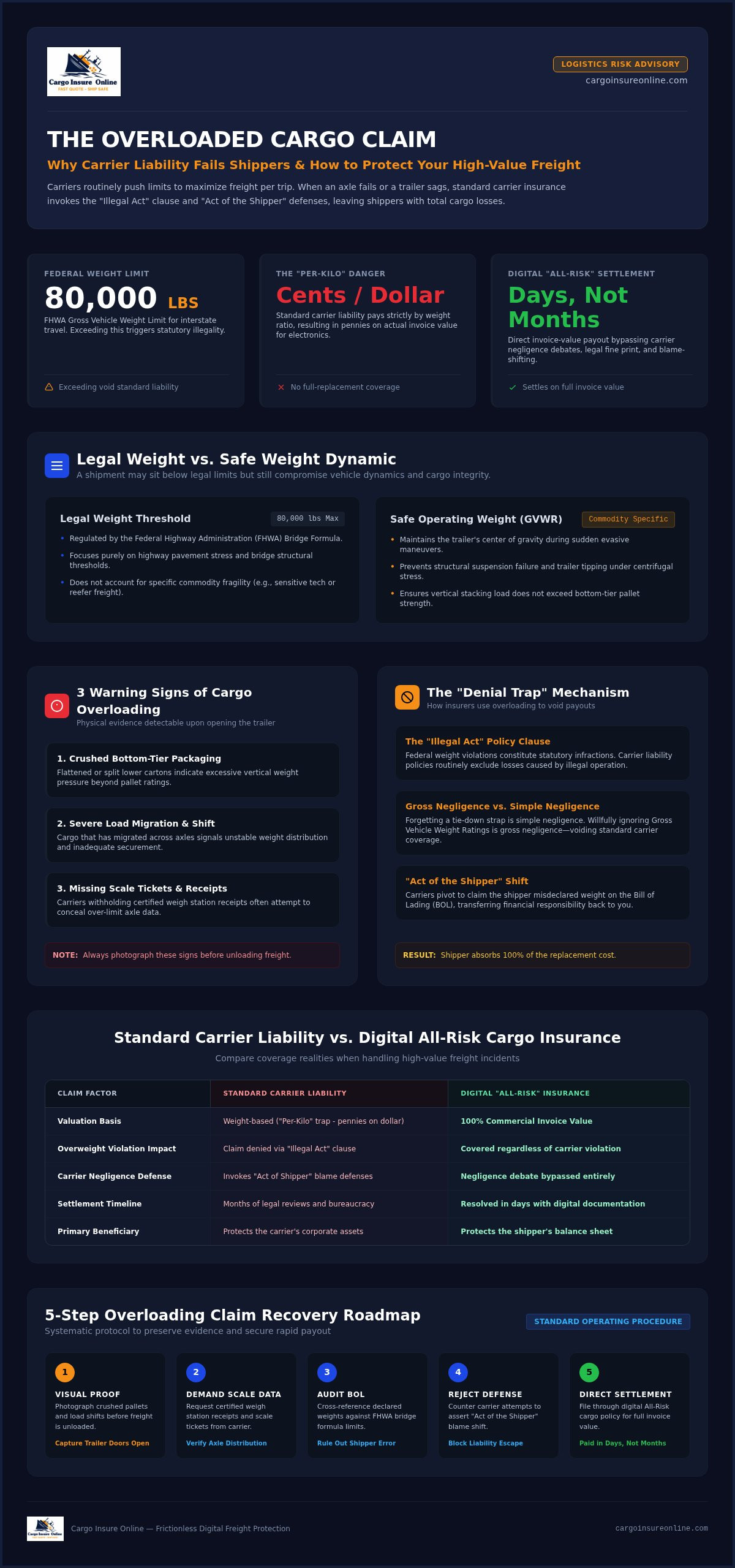
5 Steps to Securing Your Payout After an Overloading Incident
Carrier negligence shouldn't be your financial burden. When you discover your goods are damaged, your reaction speed determines your recovery. Don't wait for the driver to offer an explanation. Start moving. Documentation is your strongest weapon against a denied overloaded cargo claim. Traditional insurance thrives on delays. We thrive on momentum. Follow these five steps to lock in your payout and keep your business moving.
- Step 1: Immediate Documentation. Take high-resolution, timestamped photos before a single pallet is moved. Capture the sagging trailer floor, the crushed bottom boxes, and the interior load height.
- Step 2: Preserve the Evidence. Keep every scrap of damaged packaging. Do not discard impact sensors or tilt indicators. These devices provide the physical proof of carrier failure.
- Step 3: Check the Telematics. Demand the ELD and GPS data. Modern trucks utilize weight sensors that record axle stress in real-time. This data is the ultimate truth-teller when weight limits are breached.
- Step 4: File the Notice of Intent. Speed is your best ally. Send a formal written notice to the carrier immediately. This stops the clock and forces them to acknowledge the incident.
- Step 5: Leverage Digital Claims. Stop chasing paper trails. CIO Sphere Inc. tech utilizes API integrations to process evidence instantly. We replace weeks of back-and-forth with a streamlined digital journey.
Essential Documentation Checklist
Precision beats guesswork every time. You need the Bill of Lading (BOL) to show the declared weight and the Packing List to verify the contents. Collect every scale ticket and weight certificate from the transit route. If you are dealing with temperature-sensitive goods, ensure you have the full logs for your reefer cargo insurance claim. Gaps in data lead to gaps in payouts. Keep your records airtight.
Communicating with the Adjuster
Stick to the facts. Don't offer assumptions about why the truck was heavy. Provide hard evidence of the vehicle's weight and clear proof of value for high-value electronics or drones. Use the CIO digital portal to track your claim status in real-time. Transparency removes the "scary" from insurance bureaucracy. You deserve a partner that acts as a sophisticated ally, not an administrative obstacle. Ready to experience frictionless protection? Get your digital quote now and protect your next shipment in seconds.
CIO Sphere: Digital-First Coverage That Doesn't Blink
Traditionally, insurance is where momentum goes to die. It's a black hole of dusty files, legal stalling, and the dreaded "no." We've built the antidote. At CIO Sphere, our mission is simple: remove the "scary" from international shipping. We've replaced the dry, bureaucratic friction of legacy providers with a vibrant, high-energy platform. We don't just sell policies. We empower shippers with intelligence and connectivity. You get instant quotes, zero paperwork, and total transparency. It's insurance for the digital age.
When you're hit with an overloaded cargo claim, you don't have months to wait for a carrier's insurer to investigate. You have a business to run. Our platform is built for 2026 logistics leaders who value their time. We offer API-driven underwriting that generates quotes in under 60 seconds. We've moved past the administrative chore and turned insurance into a seamless, positive experience. It's about confident optimism and removing the roadblocks that slow you down. No more waiting. Just speed.
High-Speed Claims for a High-Speed World
Legacy claims processes are broken. They rely on physical surveyors and manual reports that take weeks to process. We've automated the entire journey. Our API allows you to file claims instantly from your own TMS or ERP system. This is especially vital for electronics shipping insurance, where high-value tech needs rapid replacement to maintain your supply chain. Small claims are typically resolved within 7 business days. You get dedicated support that speaks your language. We understand logistics, not just "insurance-ese."
Future-Proof Your Supply Chain
Scaling a global business requires protection that keeps up with your growth. We offer all-risk coverage that spans air, sea, and land, ensuring your inventory is safe from door to door. For freight brokers and forwarders, our white-label solutions provide a sophisticated integration that builds trust with your clients. You shouldn't have to choose between speed and security. We provide both. Our technology handles the complexity so you can focus on the next shipment. The future of shipping is frictionless and high-speed. Stop waiting for legacy insurers. Get an instant quote now.
Upgrade Your Protection for a Frictionless Future
Carriers will always look for ways to maximize their load. You can't control their shortcuts, but you can control your recovery. An overloaded cargo claim doesn't have to end in a denial or a per-pound payout that barely covers the shipping cost. By moving from legacy carrier liability to modern All-Risk insurance, you bypass bureaucratic legal battles. You get paid based on your cargo's true value, not its weight.
Success in 2026 global logistics requires speed and transparency. Whether you're moving high-value tech or sensitive reefer goods, our platform provides the specialized protection and instant quotes you need to stay ahead. Leverage our white-label solutions to empower your partners and simplify every shipment. It's time to replace administrative chores with confident optimism. Secure your cargo with instant, digital-first insurance today.
You've built a high-performing business. It's time your insurance partner operated at the same speed. Protect your growth with confidence and leave the friction behind.
Frequently Asked Questions
Can an insurance claim be denied if the truck was only slightly overloaded?
Yes, even a minor weight violation can kill your claim. Insurance companies view weight limits as absolute safety thresholds. If a truck exceeds its legal Gross Vehicle Weight Rating by any margin, it's a violation of federal safety standards. Adjusters use this breach to trigger "Illegal Act" or "Negligence" clauses. This allows them to walk away from the payout entirely. Precision is your only defense against these bureaucratic traps.
Who pays for the damage if the carrier was negligent but has no insurance?
You'll likely absorb the loss yourself if you rely solely on carrier liability. Suing an uninsured carrier is a slow, expensive dead end. Most carriers lack the liquid assets to cover a total loss for high-value electronics or reefer goods. This is why first-party All-Risk insurance is essential. It pays you directly and leaves the recovery battle to the experts. You get cash flow now instead of a worthless judgment later.
Does all-risk cargo insurance cover overloading incidents?
Yes, All-Risk cargo insurance is designed to protect you when carriers fail. While a carrier's insurer might deny an overloaded cargo claim based on the driver's specific negligence, All-Risk coverage focuses on the damage to the goods themselves. It bypasses the "who is at fault" debate to deliver a fast payout. You get comprehensive protection for drones and mobile phones without the friction of legacy carrier disputes.
What is the time limit for filing an overloaded cargo claim?
You have a statutory minimum of nine months to file a written notice under the Carmack Amendment. However, waiting is a mistake. We recommend notifying your insurer within three business days of discovery. Speed preserves evidence and accelerates the digital claims process. The longer you wait, the harder it is to link the damage to the overloading incident. Move fast to secure your business's financial health and maintain transparency.
How do I prove a truck was overloaded after the cargo has been delivered?
You prove it through digital footprints and physical evidence. Request the carrier's ELD telematics and GPS weight sensor data immediately. These logs record axle stress in real-time. Combine this with photos of "crushed bottom" packaging and any weigh station citations issued during transit. This data creates an undeniable narrative of negligence. Technology makes it impossible for carriers to hide their corner-cutting behind a signed delivery receipt.
Will my premium go up if I file a claim for carrier overloading?
Not typically if the fault lies entirely with the carrier. All-Risk insurance is about protecting your interest, and insurers usually pursue the negligent carrier through subrogation to recover costs. Filing an overloaded cargo claim for a carrier's mistake shouldn't penalize your business. Our digital-first platform focuses on transparent underwriting. We prioritize keeping your global logistics moving efficiently without the "scary" surprises found in traditional insurance policies.
What is the difference between gross negligence and simple overloading?
The difference is intent and severity. Simple overloading might result from a minor weighing error or manifest discrepancy. Gross negligence is a willful, reckless disregard for safety limits to maximize profit. When a carrier intentionally "tops off" a trailer beyond its legal capacity, they've crossed into gross negligence. This distinction is critical. It often determines whether a carrier's standard liability policy will pay out or walk away entirely.
Can I file a claim for 'hidden damage' found days after the delivery?
Yes, you can file for concealed damage, but you must act instantly. Once you discover internal structural failure or broken electronics, document it with photos and video immediately. Most policies have a strict window for reporting hidden issues. Don't wait. The faster you report the discovery through our digital portal, the easier it is to prove the damage occurred during the carrier's overloaded transit. Speed is your best ally.


