
Your high-value electronics arrive at the warehouse crushed. The ocean carrier blames the rail operator. The rail operator points at the trucker. The trucker claims the damage happened at the port. In 2026, this "blame game" remains the most expensive trap in global logistics. With the average cargo theft loss now reaching $273,990 per incident, you can't afford to be stuck in a liability vacuum. Traditional carrier limits are fragmented and often cap your recovery at a tiny fraction of the cargo's worth. You need a better way. You need multimodal cargo insurance.
We understand the headache of navigating complex claims across different transport modes. It’s a friction-filled process that drains your time and your profits. We’re here to fix it. This guide shows you how a single, integrated policy protects your goods across sea, air, and land without the administrative nightmare. We'll preview the latest 2026 liability traps and explain how to secure instant, door-to-door protection with a single point of contact. Say goodbye to the paperwork and hello to total freight confidence.
Key Takeaways
- End the carrier blame game by closing the liability gaps between sea, air, and road conventions.
- Master the critical difference between multimodal and intermodal contracts to streamline your entire claims workflow.
- Secure "All-Risk" protection that covers concealed damage. Ensure your high-value cargo is safe even during complex transshipments.
- Leverage multimodal cargo insurance to gain frictionless, door-to-door coverage through a single point of contact.
- Transform your logistics speed with instant digital quotes and automated certificate issuance that keep your supply chain moving.
The Multimodal Liability Trap: Why Single-Mode Insurance Fails
You open the container at your final warehouse. The goods inside are destroyed. You call the shipping line, but they point at the rail operator. The rail operator blames the trucker. The trucker claims the damage happened at the port. Welcome to the "Blame Game." It's the default setting for global logistics. Carriers aren't in the business of paying claims; they're in the business of limiting their own financial exposure. Single-mode coverage is a relic of the past, but multimodal cargo insurance is the modern standard for global trade.
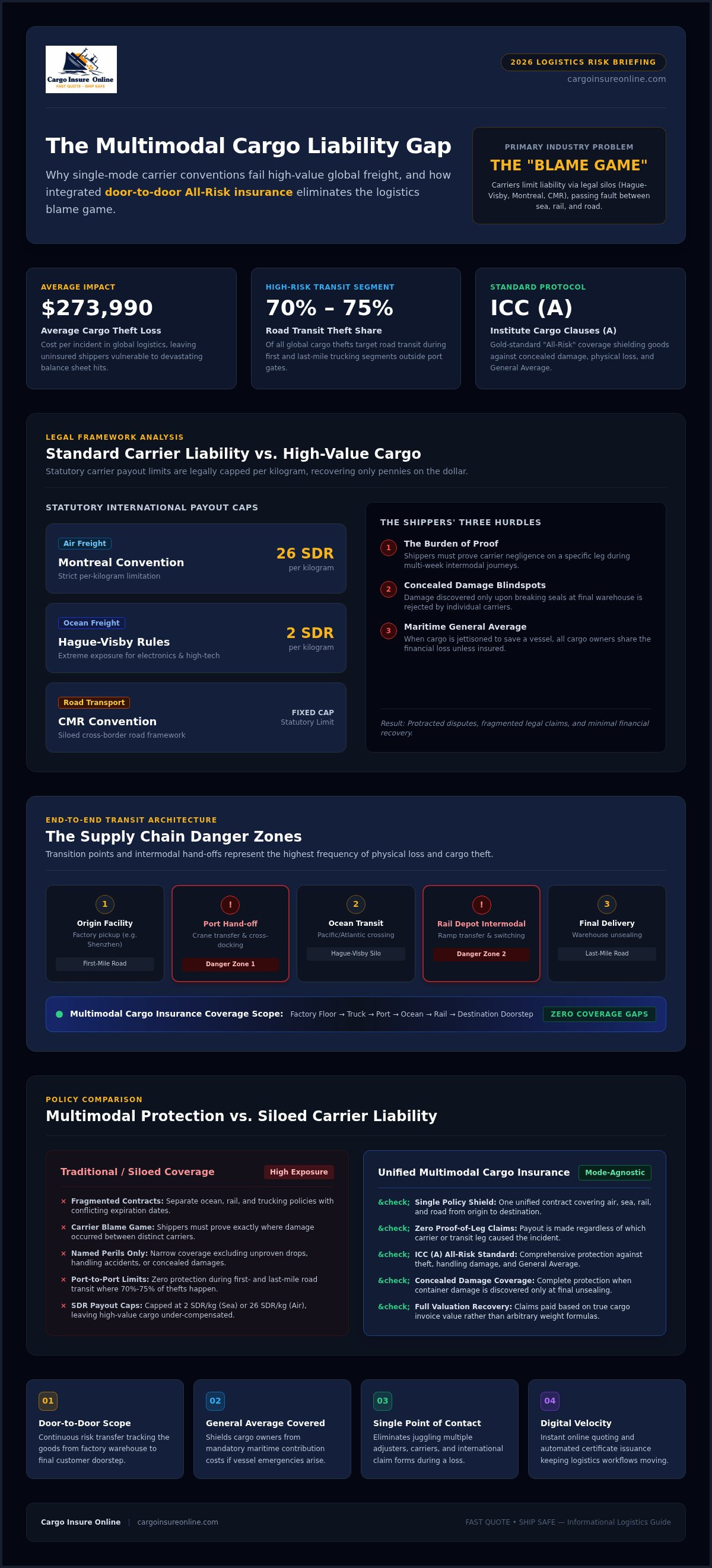
Carriers hide behind a patchwork of laws. Sea freight uses Hague-Visby. Road freight follows the CMR Convention. These legal frameworks are silos that don't talk to each other. If you rely on "Port-to-Port" policies, you're effectively uninsured during the most dangerous segments of the journey: the first and last mile. The Liability Gap is the primary risk for modern importers; it is the financial chasm between your cargo’s real-world value and the pocket-change payouts mandated by international carrier laws.
The Problem with Carrier Liability
Standard carrier liability is a trap for anyone shipping high-value goods. Under the Montreal Convention for air freight, liability is capped at 26 SDR per kilogram. For sea freight, it drops to a measly 2 SDR per kilogram. If you're shipping compact, high-value electronics or drones, these "per-kilo" limits are a financial disaster. You'll recover pennies on the dollar after months of paperwork.
Then there's the burden of proof. To get paid, you usually have to prove the carrier was negligent. How do you prove exactly when a sealed container was dropped during a three-week journey? You can't. Stop relying on carrier good faith. It doesn't exist. Start securing your bottom line with multimodal cargo insurance that pays regardless of who's at fault.
Transitions are the Danger Zones
Transshipment points are the Bermuda Triangle of logistics. Every time your cargo moves from a ship to a train or a truck, the risk of damage or theft spikes. In 2026, 70% to 75% of global cargo thefts target road transit. If your coverage ends at the port, you're walking into a trap during the final mile. More hand-offs mean more opportunities for "concealed damage" that only shows up when the seal is finally broken at your warehouse. You need a policy that bridges these gaps and follows the goods, not the mode. For a deeper look at the risks on the road, explore our insights on Trucking Cargo Insurance.
What is Multimodal Cargo Insurance? One Policy, Total Protection
One policy. Every mode. Zero gaps. That's the core of multimodal cargo insurance. It’s a comprehensive "All-Risk" solution that follows your goods from the factory floor to the customer's doorstep. You don't need to juggle a sea policy, an air policy, and a trucking policy. You need one shield that works everywhere. It’s the ultimate antidote to the logistical friction we discussed in the previous section.
In the fragmented landscape of 2026 global trade, multimodal cargo insurance has emerged as the definitive standard for end-to-end risk mitigation, replacing siloed carrier liability with a unified, mode-agnostic safety net. It’s the "Door-to-Door" promise in action. If your cargo moves from a truck in Shenzhen to a ship across the Pacific and finally onto a railcar in Los Angeles, your protection never blinks. This eliminates the administrative nightmare of managing multiple certificates and varying expiration dates.
How It Works Across Modes
Traditional insurance often stops at the port gate, leaving your goods vulnerable during the most dangerous hand-offs. Our approach ensures continuous coverage during high-risk moments like port handling, crane transfers, and cross-docking. When your goods move from ship to rail or road, the protection is seamless. There’s no need to prove where damage happened because the same policy covers every leg of the journey. For shipments that spend significant time on the water, you can dive deeper into our specialized Sea Freight Insurance options to see how we handle maritime-specific risks.
The All-Risk Advantage
We don't settle for "named perils" coverage that only pays out in narrow, specific disasters. We use Institute Cargo Clauses (A), or ICC (A), as our gold standard for 2026. This is the broadest form of protection available. It covers everything from theft and physical damage to the terrifying "General Average" at sea. If a ship captain jettisons cargo to save the vessel, you aren't left holding the bill for everyone else's losses. It's about total financial peace of mind.
We specialize in the cargo that matters most to modern businesses. Whether it's high-value electronics prone to theft or temperature-sensitive reefer products, our policies are built for precision. We use digital-first tools to make this complex protection accessible to everyone. You can even get an instant quote to see how easy it is to secure your entire supply chain in under a minute. By consolidating your protection, you simplify your claims. You have one point of contact. One digital dashboard. One team that actually wants to help you recover your losses. It's insurance rebuilt for the speed of modern trade.
Multimodal vs. Intermodal: Decoding the Logistics Jargon
Stop using these terms interchangeably. They aren't the same thing. In intermodal transport, you sign a separate contract for every leg of the journey. One for the trucker, one for the rail line, one for the ocean carrier. It’s a logistical jigsaw puzzle. If something breaks, you’re chasing three different companies across three different legal jurisdictions. Multimodal is different. You sign one contract with one Multimodal Transport Operator (MTO). They take the heat for the entire trip, from your factory to the final warehouse.
For 2026 e-commerce giants and Amazon FBA sellers, multimodal is the only choice that makes sense. You need your goods to move from a factory in Vietnam to a fulfillment center in Ohio without stopping for paperwork. Using multimodal cargo insurance alongside an MTO setup drastically reduces your administrative overhead. Instead of filing multiple claims and managing different sets of terms, you have one digital dashboard. One point of contact. Total clarity. It’s about moving at the speed of the internet, not the speed of a bureaucrat's pen.
The Multimodal Bill of Lading (MBL)
The Multimodal Bill of Lading (MBL) is your legal safety net. It’s a single document that covers the goods from origin to destination regardless of how many times they change hands. When you have an MBL, your multimodal cargo insurance claim becomes significantly easier to process. You don't have to play detective to find out which carrier dropped the ball. The MTO is legally responsible for the entire journey.
Many shippers think, "My freight forwarder handles this." Don't bet your business on that assumption. A forwarder often acts only as an agent, not a carrier. Unless they issue a specific MBL and assume primary liability, you're still exposed. You need your own first-party protection to ensure you get paid full replacement value, not just the carrier's legal minimums which often cover only a fraction of your loss.
Choosing the Right Contract Type
If you’re running high-speed air-to-truck routes for electronics or drones, multimodal contracts are essential. They keep the momentum high and the friction low. You can learn more about securing these fast-moving legs in our guide to Air Freight Insurance. Segmented coverage is a false economy. You might save a few dollars on individual premiums, but you’ll lose thousands in man-hours when a claim arises. A unified policy provides a cost-benefit ratio that segmented insurance simply can't match. It’s about buying back your time and ensuring your supply chain remains unbreakable in a volatile global market.
5 Critical Features of a Modern Multimodal Policy
Not all policies are created equal. In 2026, you can't rely on legacy insurers who move at the speed of a fax machine. You need a modern multimodal cargo insurance policy that anticipates the specific risks of high-speed global trade. A generic policy leaves you exposed; a specialized one keeps you profitable. Look for these five non-negotiable features:
- All-Risk Coverage: Don't settle for "named perils" that only cover fires or sinking ships. You need protection against all external causes of loss, including theft and rough handling.
- Concealed Damage Protection: Containers stay sealed from origin to destination. Damage often hides until the final warehouse. This feature ensures you're covered even if you can't prove exactly when the damage occurred.
- High-Value Specialization: Standard carrier liability is a joke for tech. You need tailored limits that reflect the actual replacement cost of your goods.
- Reefer and Cold Chain Clauses: Temperature fluctuations during transshipment can ruin an entire shipment. Modern policies include specific protections for power failures and sensor-verified temperature abuse.
- Digital Claim Management: Paperwork is a relic. You need a paperless, API-driven process that lets you file claims and upload evidence in seconds, not weeks.
Specialized Protection for Tech and Reefer
High-value electronics are prime targets for organized crime. With average losses per incident jumping to $273,990 in 2025, a "cents-per-kilo" payout is a death sentence for your margins. We provide the robust limits required for Electronics Shipping Insurance, ensuring your smartphones and drones are fully protected. For those moving perishables, our Reefer Cargo Insurance bridges the gap between different transport modes to keep the cold chain unbroken.
E-Commerce and FBA Requirements
Selling globally means meeting strict platform standards. Amazon FBA has specific insurance mandates that can stall your business if not handled correctly. Our multimodal cargo insurance is designed to meet these requirements while providing frictionless protection from the factory floor to the customer's doorstep. Whether you're navigating customs or last-mile delivery, our Cross-Border E-Commerce Insurance ensures your growth isn't sidelined by a single lost container. Stop worrying about the "what-ifs" and start scaling your global footprint.
Protect your high-value tech and secure your supply chain today.
Cargo Insure Online: The High-Speed Multimodal Solution
Global trade doesn't wait for brokers to finish their lunch. Why should you? Cargo Insure Online (CIO) is the digital-first response to a fragmented industry. We provide the certainty you need across every major trade corridor, specifically focusing on the high-volume Asia-US and Asia-EU routes. This isn't just about protection; it's about speed. In an era where a single delay can cascade into a supply chain disaster, our multimodal cargo insurance platform keeps you moving. We’ve mastered the complexities of global trade so you don’t have to.
Legacy insurers treat multimodal shipments like a burden. They see the hand-offs and the transshipment points as excuses to raise premiums or delay quotes. We see them as opportunities for intelligent automation. By leveraging A-rated global marine insurers and a sophisticated tech stack, we offer a modern alternative that replaces bureaucratic dread with confident optimism. It’s time to ditch the slow-moving giants for a partner that operates at the same high speed as your business.
White Label and API Integration
We don't just sell insurance; we build engines. For logistics providers, freight forwarders, and TMS platforms, our REST API integration is a game-changer. You can embed our automated quoting and binding system directly into your existing workflow. This allows you to offer branded, high-speed protection to your clients without ever leaving your dashboard. It’s about scaling your business with an automated insurance engine that works as hard as you do. Explore how to launch your own branded solution with our White Label Cargo Insurance guide. We take the technical complexity and turn it into a seamless revenue stream for your logistics operation.
Get Your Quote in Seconds
Forget the old way of doing things. No more endless email chains. No more confusing spreadsheets. No more waiting forty-eight hours for a premium that might not even cover your high-value tech. Just instant, all-risk coverage that protects your bottom line. We’ve stripped away the bureaucratic friction to give you a high-speed user journey. You enter your route, select your cargo type-whether it's reefer goods or high-end electronics-and bind your policy in under sixty seconds. It’s professional authority meets playful efficiency. You get the relief of knowing your goods are safe from the moment they leave the factory until they hit the customer's doorstep. Ready to eliminate the risk? Get an Instant Multimodal Quote Now and experience the future of multimodal cargo insurance today.
Take Control of Your Global Supply Chain Protection
Global trade moves fast. You can't let fragmented liability and carrier blame-shifting slow you down. The 2026 logistics landscape demands a safety net that follows your goods, not just the vehicle carrying them. By choosing multimodal cargo insurance, you eliminate the dangerous liability gaps that leave high-value electronics and reefer goods exposed. You move from a world of finger-pointing to a world of digital certainty.
We are redefining cargo insurance for 2026. No more waiting days for quotes. No more complex claims across multiple modes. You get instant digital quotes and specialized protection tailored for the most sensitive tech and cold-chain products. It's about empowering your business through speed and clarity. Stop settling for "good enough" coverage that fails at the port gate. It’s time to embrace a frictionless, door-to-door solution that respects your time and your bottom line. Get Your Instant Multimodal Cargo Insurance Quote today and feel the relief of total protection.
Frequently Asked Questions
What is the difference between multimodal and intermodal cargo insurance?
Multimodal transport operates under a single contract and one Combined Transport Bill of Lading. This makes the Multimodal Transport Operator legally liable for the entire trip. Intermodal transport involves separate contracts for every leg of the journey. You'd have to deal with the trucker, the airline, and the shipping line individually. Multimodal simplifies your life by providing one point of contact for the whole journey; intermodal leaves you managing the mess.
Does multimodal insurance cover the entire journey from factory to customer?
Yes, it provides true door-to-door protection. Your coverage starts the moment the goods leave the factory floor and stays active until they reach the final customer. It bridges the gaps between sea, air, and land segments. You don't need to worry about the first or last mile being left out. This seamless transition ensures your high-value tech stays protected during every transshipment and hand-off. It's total protection without the gaps.
How much does multimodal cargo insurance cost in 2026?
Rates in 2026 depend on your cargo's risk profile. General dry freight usually ranges between 0.1% and 0.6% of the declared value. If you're shipping high-risk items like electronics or temperature-sensitive reefer goods, industry rates typically run from 1.0% to over 2.0%. Most policies have a minimum premium threshold between $25 and $100. We use a digital-first approach to give you instant, competitive quotes in seconds, not days.
Why is carrier liability insufficient for multimodal shipments?
Carrier liability is designed to protect the carrier, not you. Limits are often capped at 2 SDR per kilogram for sea freight and 26 SDR for air freight. If your compact electronics are damaged, you'll recover only a fraction of their value. You also have to prove the carrier was negligent. Multimodal cargo insurance pays full replacement value regardless of carrier fault or statutory caps. It’s the only way to ensure financial recovery.
Can I insure high-value electronics on a multimodal route?
Absolutely. We specialize in high-value tech like mobile phones, drones, and specialized electronics. Standard policies often exclude these or offer insufficient limits. Our digital platform allows you to specify these high-risk commodities during the quoting process. You get tailored protection that accounts for the $273,990 average loss per incident seen in 2025. Don't risk your margins on generic coverage that leaves tech exposed. We protect the items that carriers won't.
What happens if cargo is damaged but I don’t know which carrier caused it?
This is where multimodal policies shine. In containerized shipping, damage is often "concealed" and only discovered at the final destination. Carriers will point fingers at each other to avoid paying. An All-Risk multimodal policy covers the loss regardless of which leg caused the damage. You file one claim with us, and we handle the rest. You get paid while we deal with the carriers. No blame game; just results.
Is reefer cargo covered under standard multimodal insurance?
Yes, but you need a policy with specific reefer clauses. Standard insurance might not cover temperature abuse or power failures during transshipment. Our specialized reefer product protects temperature-sensitive goods moving between modes. It covers moisture damage, power outages, and equipment failure. This is essential for pharmaceuticals and perishables that face 10 to 14 days of extra exposure due to modern global rerouting. We keep your cold chain unbroken from start to finish.
How do I file a claim for a multimodal shipment?
We’ve killed the paperwork. You file your claim through our digital dashboard. You don't need to contact multiple carriers or mail physical documents. Just upload your evidence, including photos and the Bill of Lading, directly to our platform. Our API-driven system processes the data instantly. You have one point of contact for the entire process. Multimodal cargo insurance makes recovery fast, transparent, and built for the 2026 shipping environment.


